
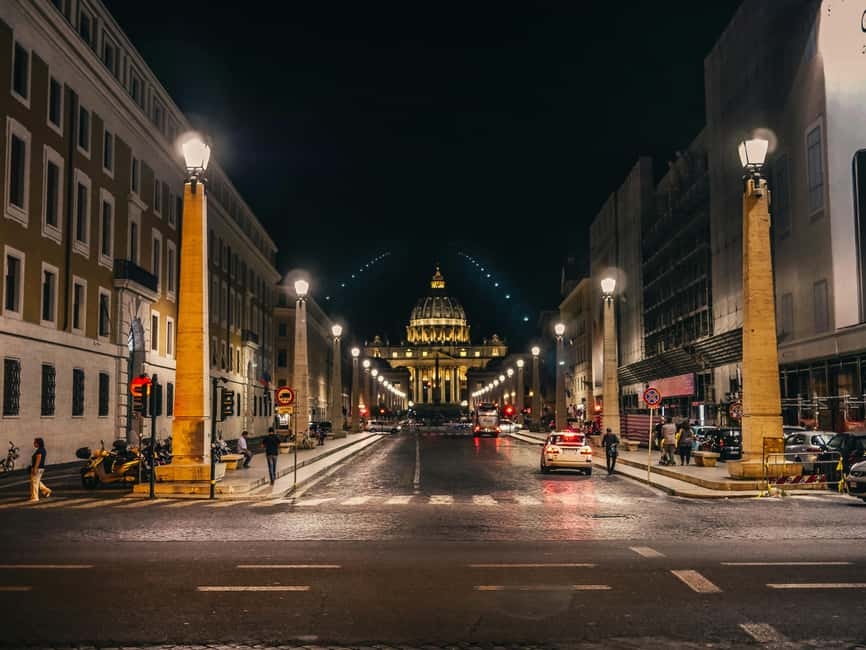
Reviewed · ROME
Rome: City walking tour. the beauty.
Rome packs centuries of history into a walkable center, and this four-hour route gives you a fast, useful orientation. You begin beside St. Peter’s Square, pass through Rome’s grand squares and fountains, and finish at the Colosseum. Guide Felice is especially praised for clear history, patience, local advice, and a good sense of where to stop for photos.
I like the small groups of up to 10 people, which should make it easier to hear and ask questions. I also like the route’s range: Bernini, ancient Roman engineering, Baroque fountains, national monuments, and Vatican City all appear in one outing. The trade-off is distance. This is a long city walk with several timed stops, not a slow stroll, and the tour offers exterior visits and guided stops rather than guaranteed entry to every major monument.
Key points to know
- Starts at St. Peter’s Square: Meet at Piazza Papa Pio XII, 1, at the beginning of St. Peter’s Square.
- Ends at the Colosseum: The route crosses central Rome from west to east, so plan your next activity near the Colosseum.
- Seven major stops: You visit Vatican City, Piazza Navona, the Fountain of the Four Rivers, the Pantheon, Spanish Steps, Trevi Fountain, and the Colosseum.
- Small-group format: The group is limited to 10 participants, with guides speaking English, Italian, Arabic, or French.
- Felice is a noted guide: He is praised for his timing, patience, local suggestions, and explanations of Roman history.
- Vatican Museums are optional: St. Peter’s Square is part of the route, while the Vatican Museums and Sistine Chapel can be added if available.
Starting beside St. Peter’s Square
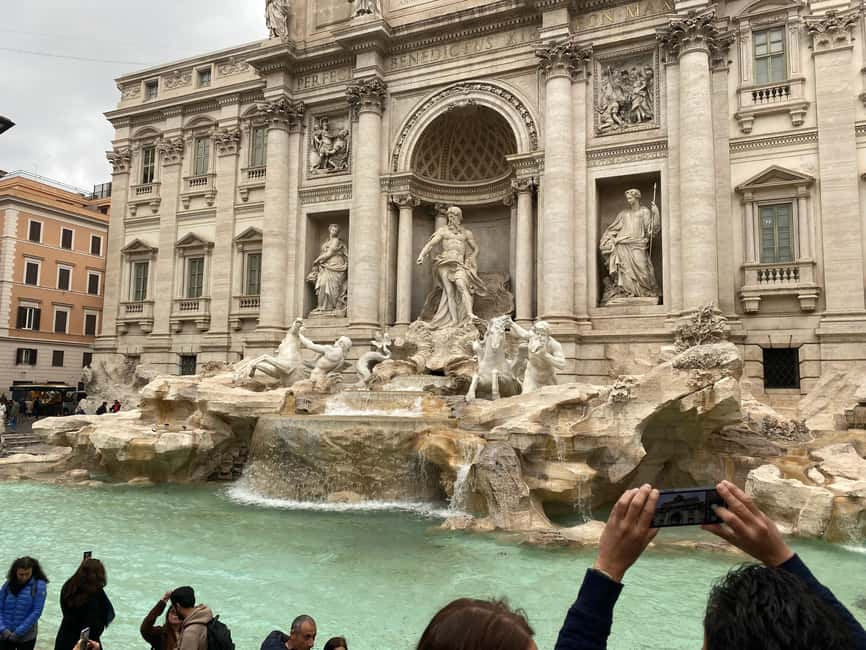
The meeting point is Piazza Papa Pio XII, 1, at the beginning of St. Peter’s Square. The listed coordinates are 41.90250015258789, 12.458390235900879. This is an important detail because St. Peter’s Square has several entrances and can feel confusing when crowded.
The tour begins with about 30 minutes in Vatican City. You can expect a guided look at St. Peter’s Square and the setting around St. Peter’s Basilica, with time for photos and an introduction to the Vatican’s place in Rome.
This opening gives you a strong sense of Rome’s scale. The square is formal and grand, while the rest of the route moves through narrower streets, open piazzas, and busy public spaces. If you want a full interior visit to the Vatican Museums and Sistine Chapel, treat that as an optional addition rather than assuming it is part of the basic walking route.
The meeting point also means you should arrive ready to walk. You will not be starting at the Colosseum despite the tour’s broad description. The actual route begins at the Vatican and ends at the Colosseum, crossing a large section of central Rome.
More walking tours in Rome:
- Rome: Trastevere & Campo de Fiori Street Food Walking Tour
★ 4.9 · 2,768 reviews - Rome: Paranormal Night Walking Tour & Secret Backstreets
★ 4.9 · 1,921 reviews - Rome by Night Walking Tour – Legends & Criminal Stories
★ 4.5 · 1,003 reviews
Piazza Navona and Bernini’s great fountain
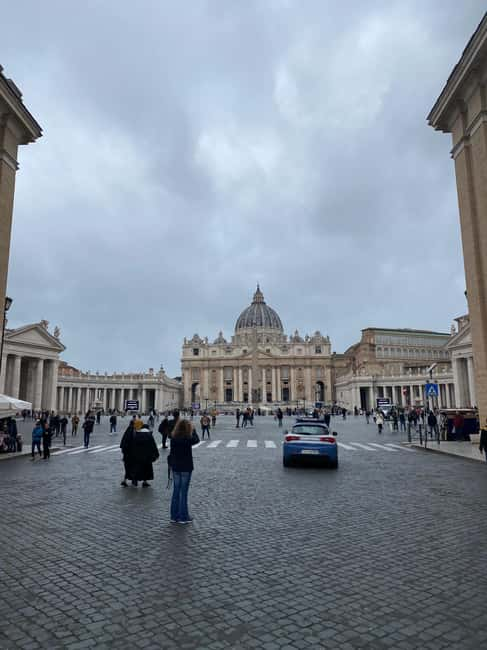
From Vatican City, the group continues to Piazza Navona for about 20 minutes. This long, elegant square is one of Rome’s best places to understand how the city reused its ancient foundations for later public life.
The main focus here is the Fountain of the Four Rivers, which receives another 15-minute stop. The fountain was designed by Gian Lorenzo Bernini and uses dramatic figures, flowing water, and a tall central obelisk to represent four great rivers.
I like the way this part of the route links art with city life. You are not viewing a sculpture in a quiet gallery. You are seeing it in the middle of a public square, surrounded by cafés, artists, street performers, and people crossing Rome on foot.
The two listed stops at Piazza Navona and the Fountain of the Four Rivers overlap in location, so the guide can explain the square first and then focus on Bernini’s work. Fifteen minutes is enough for an introduction and photos, but not for a long art-history lecture. If you care deeply about Baroque art, you may want to return later and study the fountain at your own pace.
The Pantheon’s remarkable dome
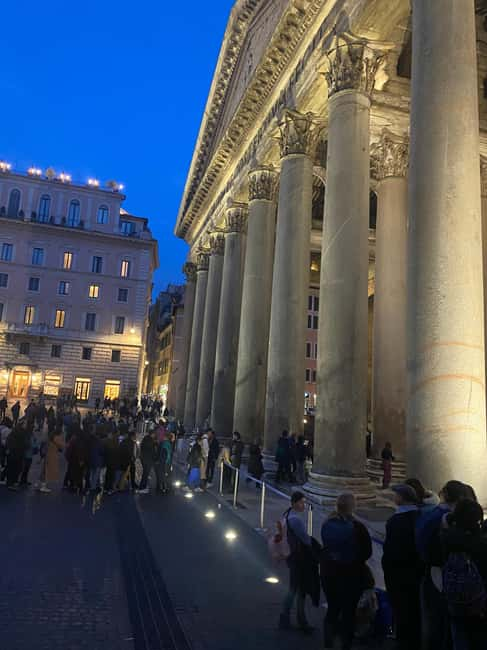
The Pantheon follows, with about 15 minutes for a guided visit and photos. This is one of the most rewarding short stops on the route because the building makes ancient Roman engineering easy to appreciate at a glance.
The dome is the star. Its central opening, known as the oculus, brings daylight into the interior and gives the space a simple but unforgettable effect. The building began as a Roman temple and remains one of the clearest reminders that ancient Rome was not only about military power and emperors. It was also about ambitious design, mathematics, and construction.
A 15-minute stop gives you a useful introduction, but it is brief. Entry conditions can vary, and the supplied tour details do not promise a particular interior access arrangement. You should therefore see this portion as a guided stop at the Pantheon, with the possibility of visiting inside depending on the tour plan and local conditions.
The Pantheon is also a good place to notice how Rome mixes time periods. Ancient stone, Christian use, modern restaurants, and daily traffic all sit close together. That mixture is one of the pleasures of walking Rome instead of viewing its monuments one at a time from a vehicle.
Spanish Steps and the art of lingering
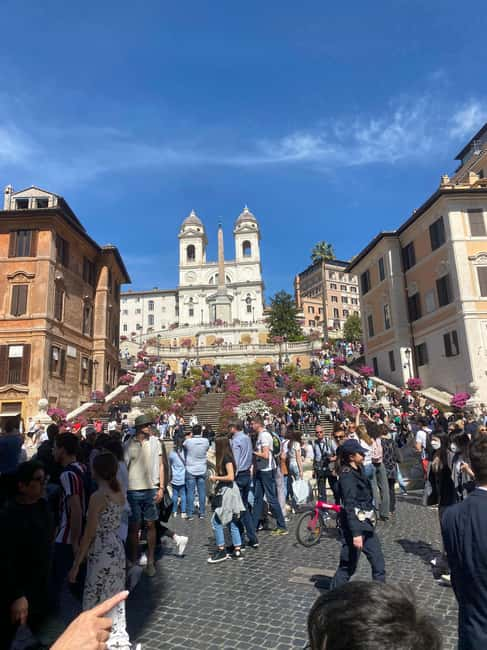
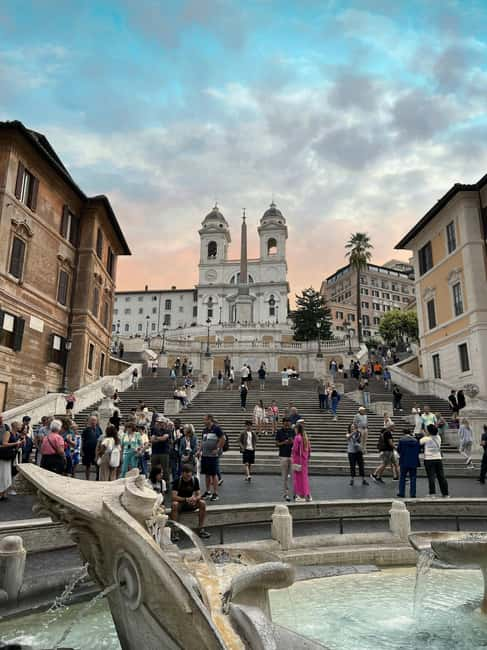
The group then walks to the Spanish Steps for about 20 minutes. The steps are a famous meeting place and offer a fine view back toward the city. They also show Rome at its most social, with people gathering, taking photos, and moving between the surrounding streets.
The stop is more about atmosphere and setting than a long historical explanation. You can admire the staircase, look over the area below, and take in the elegant streets around it.
Rome’s rules about sitting on the Spanish Steps can change or be enforced closely, so follow the guide’s instructions. The tour details do not promise a long pause here, and 20 minutes will pass quickly if the area is crowded.
This is one reason the tour works best as an introduction. You get the location, the story, and a chance to see the major feature. You can later return to the Spanish Steps if you want quieter photos or more time in the nearby streets.
More city highlights tours in Rome:
- Rome: City Sightseeing Hop-on Hop-off Bus with Audioguide
★ 4.0 · 16,045 reviews - City Sightseeing Rome Hop-On Hop-Off Bus Tour
★ 3.5 · 5,446 reviews - Rome: Fettuccine Pasta Cooking Class in Rome’s City Center
★ 4.8 · 2,414 reviews - Vatican City: Vatican Museums & Sistine Chapel Entry Ticket
★ 4.3 · 2,185 reviews
Trevi Fountain and the coin tradition
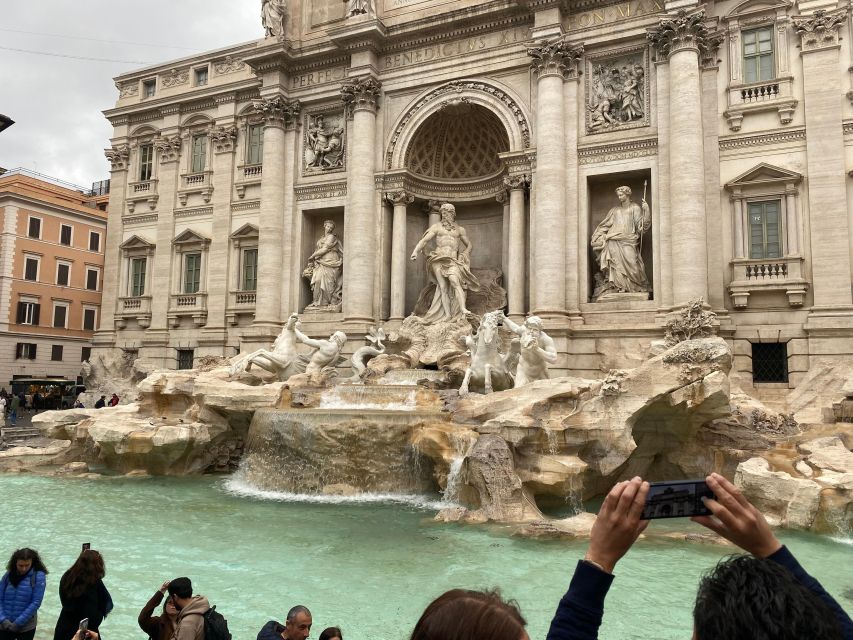
The Trevi Fountain receives another 20-minute stop. This is Rome’s largest Baroque fountain and one of the city’s most popular photo locations.
The traditional coin toss is part of the appeal. You toss a coin into the water with the hope of returning to Rome. It is a small ritual, but it gives the visit a personal touch, especially if this is your first time in the city.
Expect crowds. The fountain is famous for good reason, but that fame means the space can feel tight and noisy. A guide can help you find a sensible place to view the monument and explain the main details without wasting the entire stop searching for a clear photo.
I would keep your expectations practical here. This is not a quiet, private encounter with a fountain. It is a quick meeting with one of Rome’s most famous public sights. Keep your belongings secure, stay aware of the group, and do not expect to linger at the front for long.
Finishing at the Colosseum
The final stop is the Colosseum, with about 30 minutes for a guided visit and photos. Ending here gives the tour a strong finish, since the amphitheater is one of the clearest symbols of ancient Rome.
The outside alone tells part of the story. You can see the enormous scale, the repeated arches, and the way the structure has survived centuries of change. A guide can help you picture how the building functioned and place it within Rome’s wider story.
The important limitation is access. The tour information describes a photo stop and guided visit, but it does not state that entry to the Colosseum, Roman Forum, or Palatine Hill is included. If you want to explore those sites inside, book a separate Colosseum and Forum ticket or guided visit. Several similar experiences focus specifically on those archaeological areas.
Finishing at the Colosseum is useful for planning. You can continue with another visit nearby, find lunch in the area, or use public transportation from there. It also means the tour does not return you to the Vatican, so think about your day’s route before booking.
What four hours really means
Four hours sounds generous, but this route covers a lot of Rome. The listed guided stops total about two and a half hours, leaving the rest for walking between them, gathering the group, crossing roads, and making short pauses.
You should wear comfortable shoes and bring water. The tour is wheelchair accessible, but Rome’s historic streets and crowds can still make movement slower at times. The route’s accessibility is a useful feature, though the pace and crowded public spaces are still worth considering for anyone who needs frequent rests.
The group limit of 10 is one of the tour’s strongest practical features. A small group usually makes it easier to hear explanations in open squares and easier for the guide to respond to individual questions. It also helps at photo stops, where a large group can feel unwieldy.
The guide languages are English, Italian, Arabic, and French. Felice is the guide most often praised in the supplied comments. His strengths include being on time, explaining history clearly, answering requests patiently, and offering local suggestions for restaurants and wineries beyond the most tourist-heavy areas.
That local advice can add real value. A route like this covers famous sights, but a good guide can help you turn the rest of your stay into something more personal. Ask for practical food suggestions if that matters to you, since Felice is specifically noted for giving meal recommendations.
The value of a highlights tour
The price is not provided here, so I cannot judge whether this is a bargain in exact euro terms. The value depends on what is included in your booking and how much you would otherwise spend on separate guides or audio tours.
For a first visit, the tour can be good value if you want a single orientation walk rather than several separate bookings. You see the city’s main squares, fountains, and monuments in one continuous route, while a guide gives the places a basic historical connection.
The value is weaker if your main goal is interior access. A four-hour walking route cannot give the Colosseum, Roman Forum, Vatican Museums, Sistine Chapel, and Pantheon the time they each deserve. You may still need separate entry tickets and guided visits for the monuments you want to explore in depth.
The optional Vatican Museums and Sistine Chapel visit is worth treating carefully. The details say you can choose that addition, but they do not state the price, duration, ticket arrangement, or whether it replaces part of the walking route. Confirm those points before booking if Vatican art is a top priority.
Cancellation is flexible up to 24 hours before the activity for a full refund, and you can reserve now and pay later. Those terms help if your Rome schedule is still taking shape. The tour is available at different starting times, subject to availability.
Who will enjoy this Rome walking tour
I would recommend it most strongly to first-time visitors who want to see the main sights quickly and learn how the center fits together. It also suits couples, families with older children, and solo visitors who prefer a small group instead of navigating Rome’s complicated history alone.
The route is especially useful at the start of a Rome stay. After four hours, you will know where the major squares and fountains are, and you can return later to the places that deserve more time.
It is less suitable if you want a relaxed pace, long museum visits, or detailed archaeological study. The route includes many sights, but the stops are short. You are sampling Rome’s essentials, not completing a full visit to its major monuments.
I would also avoid scheduling this immediately before another fixed appointment. Rome’s streets, crowds, and walking distances can slow the group, and the tour’s finish at the Colosseum is far from its starting point at St. Peter’s Square.
Should you book it?
Book this tour if you want a broad, efficient introduction to Rome with a small group and a guide who can add local food advice to the usual history. The route covers an impressive number of landmarks, and the five-star feedback supplied for the experience consistently praises Felice for patience, warmth, timing, and strong explanations.
Do not book it expecting full entry tours of the Vatican Museums and Colosseum. Think of it as a guided city walk with major photo and explanation stops. Add separate museum or archaeological tours if you want time inside the monuments.
For many first-time visitors, that is a sensible plan. Use this walk to get your bearings, mark the places you want to revisit, and let a local guide connect Rome’s ancient, Baroque, religious, and modern sides in one long day on foot.
FAQ
Where does the Rome walking tour begin?
It begins at Piazza Papa Pio XII, 1, at the beginning of St. Peter’s Square in Vatican City.
Where does the tour finish?
The tour finishes at the Colosseum.
How long is the walking tour?
The tour lasts four hours.
Which sights are included on the route?
The route includes Vatican City, Piazza Navona, the Fountain of the Four Rivers, the Pantheon, the Spanish Steps, the Trevi Fountain, and the Colosseum.
Is entry to the Vatican Museums and Sistine Chapel included?
The Vatican Museums and Sistine Chapel are described as an optional visit. The available details do not state the ticket price or exact entry arrangement.
What languages are available?
The live guide can conduct the tour in English, Italian, Arabic, or French.
Newest Rome tours we have reviewed
- Private TikTok Video Making in Rome★ 5.0 · 7 reviews
- Assisi, Orvieto and Civita di Bagnoregio Full Day Tour from Rome★ 4.5 · 45 reviews
- Assisi & Saint Francis Path Tour from Rome★ 5.0 · 45 reviews
- Art Class in the center of Rome!★ 4.0 · 4 reviews
- Art & Craft: Beer Tour with Street Art in Rome★ 4.5 · 6 reviews
- Assisi and Cascia Private Day Tour from Rome with Lunch★ 5.0 · 10 reviews
- Arrival in Rome: Airport Transfer & Exclusive City Introduction★ 5.0 · 3 reviews
- From Rome: Private Day-Tour of Tuscany★ 5.0 · 16 reviews