
Reviewed · ROME
Rome: Cycling through Eternity
Rome’s best surprises often sit beyond the usual monument circuit. This 4.5-hour ride takes you from the Colosseum and Circus Maximus to the ancient Appian Way, the catacombs, long Roman aqueducts, and broad green parks on the city’s southern edge.
I like the mix of major Roman landmarks and quiet countryside. I also like the small group, capped at 10 people, and the chance to hear Rome’s story from Dimitri, a guide praised for his clear historical explanations and careful riding style. The main drawback is physical: this is not a gentle sightseeing spin, and parts of the old road are bumpy. The heat, sun, city traffic, and nearly five hours on a bike deserve serious thought.
Key points to know before you book
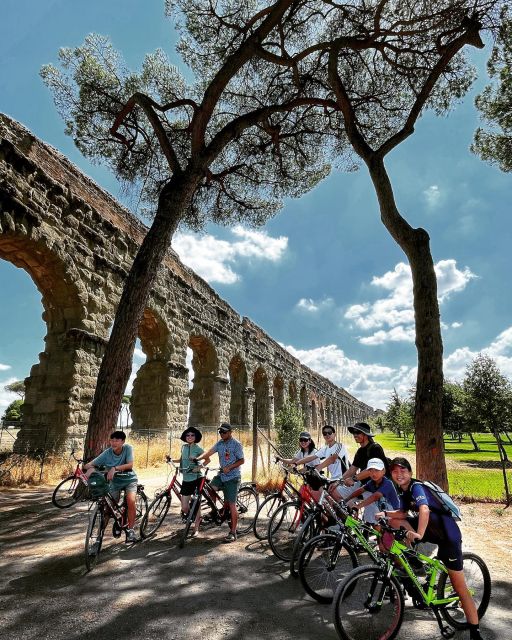
- The Appian Way is the star of the ride: You cycle along one of Rome’s oldest and most famous roads, with catacombs and archaeological sites along the route.
- Aqueducts replace crowded piazzas: Parco degli Acquedotti gives you long views of ancient engineering in open countryside.
- Dimitri leads the experience: He is praised for his Roman history, storytelling, friendly manner, and habit of checking that the group is together.
- It is an active half-day: Expect roughly 4.5 hours of cycling, with some uneven surfaces and city streets near the start and finish.
- You see Rome’s edges, not just its icons: Caffarella Park, Torre Fiscale, Egeria, and the Aurelian Walls add a quieter side of the city.
- The $100 price includes the bike and helmet: That is fair value if you want a guided route through places that can be difficult to connect on your own.
Why this bike tour shows you a different Rome
Most first-time visits to Rome revolve around the Colosseum, Roman Forum, Pantheon, Trevi Fountain, and Vatican. Those places deserve their crowds, but they can make the city feel like one long queue between monuments.
This ride gives you a different rhythm. You begin in the historic center, then pedal toward the southern edge of Rome. Ancient walls give way to archaeological fields, stone roads, green parks, and aqueduct arches. You still get the big Roman story, but you hear it while moving through the places that once supported the city.
That change matters. The route links Rome’s imperial past with its later defenses, burial grounds, water systems, roads, and open land. You are not simply checking off sights. You are seeing how the city spread beyond the central monuments.
The group limit of 10 is useful here. A large bike group would be awkward on narrow paths and uneven roads. A smaller group also gives Dimitri more room to explain what you are seeing and keep an eye on the riders.
More e-bike tours in Rome:
- Rome EBike Tour: Appian Way, Catacombs & Roman Aqueducts
★ 5.0 · 1,766 reviews - Rome: Top Highlights & Hidden Gems Tour by Cannondale E-Bike
★ 4.9 · 1,760 reviews - Rome: Appian Way, Catacombs, & Roman Aqueducts E-bike Tour
★ 4.9 · 1,421 reviews
Starting beside the Colosseum and Circus Maximus
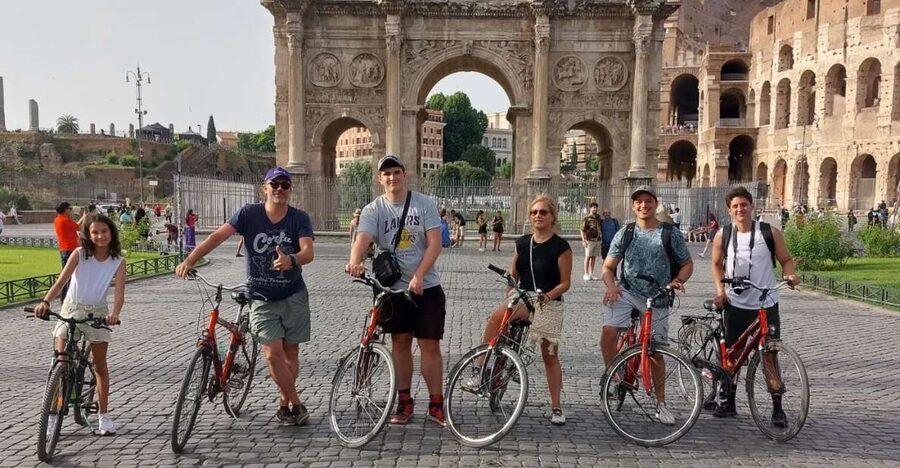
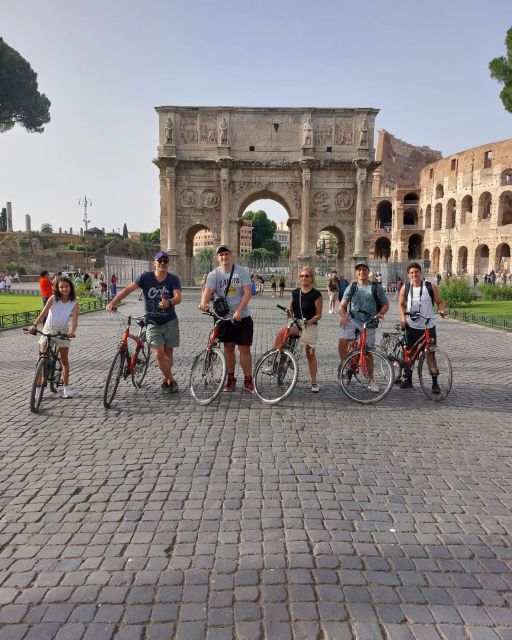
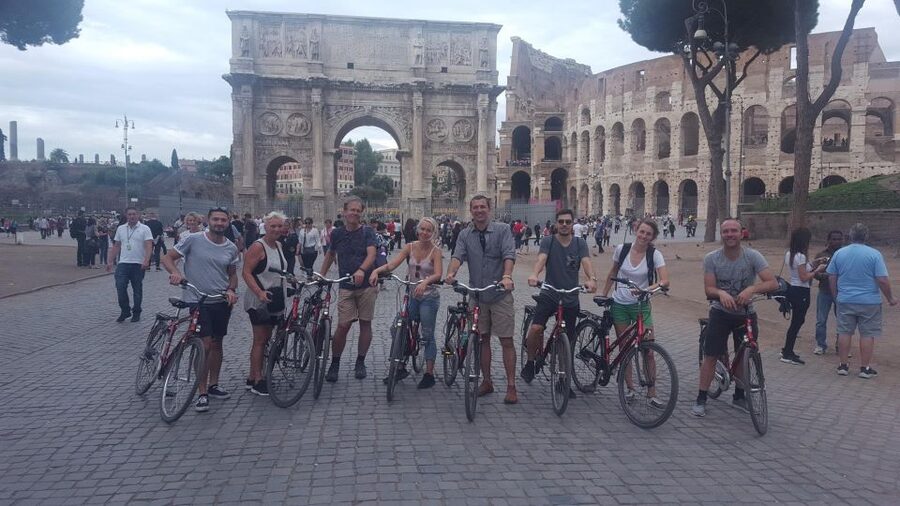
The meeting point is at Via dei Serpenti, 89, in the Monti area. The ride then heads toward the Colosseum, where you stop near the Arch of Constantine for a view of the amphitheater and a short explanation of the surrounding monuments.
This is a good opening because you get your bearings with Rome’s most recognizable sight in view. The stop is for sightseeing and interpretation, not a Colosseum interior visit, so do not book this tour expecting arena access or Roman Forum entry.
From here, the route continues to Circus Maximus. The enormous valley is easy to underestimate from street level. It once held one of the ancient world’s largest public venues, built for chariot races and mass entertainment. A bike gives you a useful sense of its scale because you move along the long open space rather than seeing it only from one fixed viewpoint.
You then pass the Baths of Caracalla, one of the grand public bathing complexes of ancient Rome. The stop helps explain how Roman public life extended beyond temples and political buildings. These baths were social spaces as well as places for washing, exercise, and relaxation.
The first part of the tour stays fairly close to central Rome. That means traffic and city streets are part of the experience. The upside is that you move efficiently between major sites. The downside is that riders who want an entirely car-free outing may find this section less peaceful.
The Aurelian Walls and Rome’s changing borders
The route includes the Museo delle Mura, located within the Aurelian Walls. These walls mark the edge of what is usually thought of as Rome’s historic center and offer a clear way to understand how the city defended itself.
The walls were not just a backdrop for photographs. They tell the story of a city that had grown so large that older defenses were no longer enough. The museum adds context to the fortifications and Rome’s changing boundaries.
You should check how much time the group spends inside the museum on your particular departure. The supplied schedule lists a bike segment and a stop, but it does not promise a full museum visit or admission. Still, even a brief look at the walls helps prepare you for the next section of the ride, where the city begins to feel much more open.
Riding the Appian Way toward the catacombs
The route becomes most distinctive as you reach the Via Appia Antica, often called the Queen of Roman roads. This is the part that makes the tour more than a standard city bike ride.
The Appian Way carried people, goods, soldiers, and messages away from Rome. You cycle along an ancient route rather than simply viewing it from a bus window. The surface can be uneven for a short section, so keep your hands relaxed and expect a slower pace. This is not a smooth cycle lane.
The ride passes the Catacombs of Saint Callixtus and other catacomb areas. The experience is described as a panoramic ride through Rome’s large catacomb district, not as a guaranteed underground visit. If entering the catacombs is important to you, confirm that point before booking.
Even without an interior visit, this section has a strong sense of place. The old road, stone remains, burial sites, and open surroundings show a side of Rome that you cannot get from the central plazas. Dimitri’s role matters here because the sites are spread out and easy to misunderstand without background.
This is also where the tour feels least like ordinary sightseeing. You are not moving from one ticketed attraction to another. You are following an ancient route through the wider Roman story.
Same city, a completely different half-day:
- Vatican Museums & Sistine Chapel Tour with Optional Basilica
★ 4.3 · 67,413 reviews - Vatican Museums, Sistine Chapel & St Peter’s Basilica Guided Tour
★ 4.5 · 39,149 reviews - Rome: Colosseum, Palatine Hill and Roman Forum Guided Tour
★ 4.8 · 32,814 reviews - Rome: Guided Tour of Colosseum, Roman Forum & Palatine Hill
★ 4.7 · 27,897 reviews
Parco degli Acquedotti and the scale of Roman engineering
Parco degli Acquedotti is one of the tour’s best stops. The park sits outside the central tourist zone and is known for its surviving aqueduct structures and wide open views.
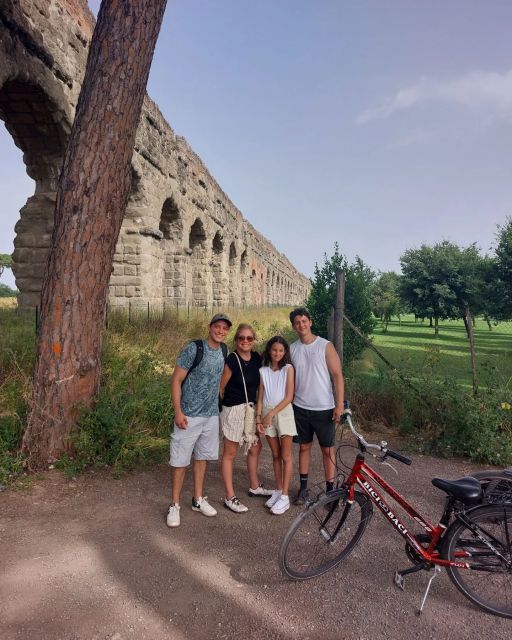
The aqueducts are impressive because they are both practical and dramatic. Roman engineers carried water over long distances, and the raised arches remain a clear reminder of the system that supplied public fountains, baths, and homes. Seeing them in an open park gives you a better sense of their length than a short stop beside a city street.
This is a good place to pause and take photographs. It is also a welcome break from buildings and traffic. You may find the park exposed to the sun, so sunscreen and water are not optional extras on a warm day.
Several riders specifically praised the contrast between Rome’s crowded center and this quieter countryside setting. That contrast is the point. You are still close to the city, yet the aqueducts and open land make Rome feel far larger than the compact center suggests.
Torre Fiscale, Egeria, and Caffarella Park
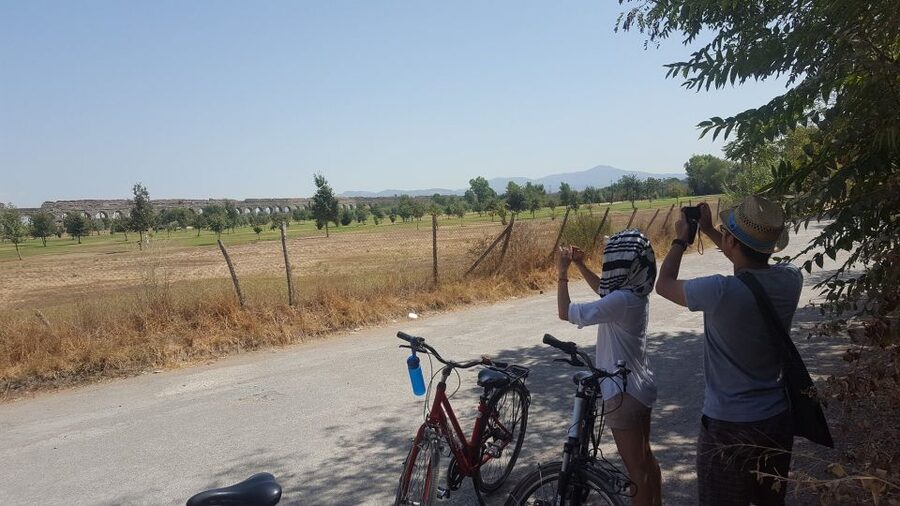
Next comes Parco di Torre Fiscale, where the route adds another layer to Rome’s past. The tower and surrounding park reflect the long use of this area as a crossing point and defensive setting. The stop is shorter than the main Appian Way and aqueduct sections, but it helps connect the separate pieces of the route.
The ride then reaches Egeria, known as L’Acqua Santa di Roma. The itinerary includes a bike segment here, giving you another look at the natural side of Rome and the city’s long relationship with water.
Caffarella Park is one of the longest sections of the tour. This is where the ride really shifts from archaeological sightseeing to open green space. The park is a meeting point of city and countryside, with paths that let you continue through Rome without the constant noise of central streets.
The 45-minute ride through Caffarella gives the route breathing room. You can appreciate the setting instead of rushing through it for a quick photograph. At the same time, a longer park section means more pedaling, so this is where tired legs may begin to make themselves known.
I would especially recommend this part to anyone who has already spent a few days in central Rome. After crowded museums and busy streets, the open parks feel like a needed change of pace.
The return along Via Cristoforo Colombo
The final section follows Via Cristoforo Colombo, the major road linking Rome’s historic center with Ostia and the Tyrrhenian Sea. It brings you back toward the starting point at Via dei Serpenti, 89.
This is the least romantic-sounding part of the route, but it has practical value. You see another side of modern Rome, one shaped by long road connections rather than ancient ruins. It also means the tour is not entirely on secluded paths. You should be comfortable cycling near urban traffic and following a guide’s directions.
Riders have praised Dimitri for repeatedly checking behind him and keeping the group together. That matters most on the city sections. You should still pay attention, ride at a sensible pace, and follow the guide closely.
Bikes, effort, weather, and group size
Bike hire and helmets are included in the $100 price. The information does not clearly specify whether every departure uses standard bikes or electric bikes. One rider had brand-new e-bikes, while another found that the e-bike controls needed maintenance and more uniform design. If an electric bike is important to you, ask the operator what is available on your date.
The route is suitable for people who are comfortable cycling for several hours. You do not need to be a serious cyclist, but you should expect a real ride rather than a short city rental. The old Appian road can be bumpy, and the combination of heat, sun, and distance adds to the effort.
Wear comfortable clothes and shoes. Bring water and sunscreen. The tour runs in rain unless conditions become extreme, and the start may be moved slightly earlier during hot weather.
The activity is not suitable for people with mobility impairments, pregnant women, or children under 10. Those restrictions make sense given the uneven road, the duration, and the need to manage a bicycle around city streets.
Is $100 a fair price?
At $100 per person, this is more expensive than renting a bike for a few hours. But the comparison is not quite fair. You are paying for the route planning, a live English-speaking guide, bike hire, a helmet, and access to a connected half-day itinerary that would be difficult to arrange efficiently by yourself.
The value is strongest if you want the Appian Way, catacombs area, aqueducts, and parks in one outing. A self-guided ride could cover some of the same ground, but you would need to plan the route, find the safest connections, understand what you are seeing, and manage the return journey.
The value is weaker if your main goal is a relaxed ride through the center or a quick look at the Colosseum. You are not paying for extended interior visits at the major monuments. You are paying for movement between historic areas and for Dimitri’s explanations along the way.
Free cancellation up to 24 hours before departure and the option to reserve now and pay later make the booking less risky. Those policies are useful in Rome, where weather and packed schedules can change quickly.
Who should book this Rome cycling tour?
I would choose this tour if you:
- Want a break from the central crowds
- Enjoy Roman history but prefer outdoor sightseeing
- Can cycle for several hours
- Are curious about the Appian Way and aqueducts
- Prefer a small group to a large guided procession
- Have already seen the main center and want a less familiar side of Rome
I would skip it if you want a slow, fully paved ride, cannot manage uneven surfaces, or dislike cycling near traffic. It is also a poor match if you expect entry into the Colosseum, Baths of Caracalla, or catacombs to be the main focus.
Dimitri is a major part of the experience. His strong points are his Roman history, friendly manner, storytelling, and attention to the group. Several riders described learning more than on other Rome tours, while one raised a fair concern about e-bike maintenance and controls. That balance is worth keeping in mind when you book.
Should you book Cycling Through Eternity?
Book it if you want to see Rome as a connected ancient city rather than a set of isolated monuments. The Appian Way, aqueducts, Aurelian Walls, catacomb district, Torre Fiscale, and Caffarella Park give you a fuller sense of Rome beyond the center.
The tour earns its price through its route and guide, not through long stays inside famous attractions. Bring water, sunscreen, and patience for rough pavement. If you are fit enough for the distance and happy to trade polished streets for old roads and open parks, this is one of the more distinctive ways to spend half a day in Rome.
FAQ
How long does the Rome cycling tour last?
The tour lasts 4.5 hours. The route begins and ends at Via dei Serpenti, 89.
What is included in the price?
Bike hire and a helmet are included. The tour has a live English-speaking guide.
Who leads the tour?
The guide is Dimitri. He provides explanations about Roman history and the sites along the route.
Does the tour enter the Colosseum or catacombs?
The route includes a view and explanation near the Colosseum, plus a ride through the catacomb area. The provided information does not state that interior entry to the Colosseum or catacombs is included.
What should I bring?
Bring comfortable shoes, comfortable clothing, water, and sunscreen. The tour takes place in most weather unless there is extreme rain.
Is the tour suitable for children?
Children under 10 are not permitted. The tour is also not suitable for pregnant women or people with mobility impairments.
Newest Rome tours we have reviewed
- Private TikTok Video Making in Rome★ 5.0 · 7 reviews
- Assisi, Orvieto and Civita di Bagnoregio Full Day Tour from Rome★ 4.5 · 45 reviews
- Assisi & Saint Francis Path Tour from Rome★ 5.0 · 45 reviews
- Assisi and Cascia Private Day Tour from Rome with Lunch★ 5.0 · 10 reviews
- Art Class in the center of Rome!★ 4.0 · 4 reviews
- Art & Craft: Beer Tour with Street Art in Rome★ 4.5 · 6 reviews
- Arrival in Rome: Airport Transfer & Exclusive City Introduction★ 5.0 · 3 reviews
- From Rome: Private Day-Tour of Tuscany★ 5.0 · 16 reviews