
Reviewed · ROME
Rome: Private Leonardo da Vinci Exhibition Guided Tour
Leonardo da Vinci’s genius feels surprisingly hands-on here. Instead of only viewing paintings behind glass, you can touch many of the machines, test how they work, and build a version of his bridge. I especially like the nine 3D holograms and the chance to see more than 65 full-scale machines based on his designs.
I also like the setting. The exhibition occupies Rome’s Palazzo della Cancelleria, a Vatican-owned palace with a Roman tomb from 43 B.C. beneath it. The main consideration is that this is an exhibition of reproductions and models, not a collection of original Leonardo paintings. The guided explanations matter, especially for children, since some sections can feel technical without them.
Key points to know before booking
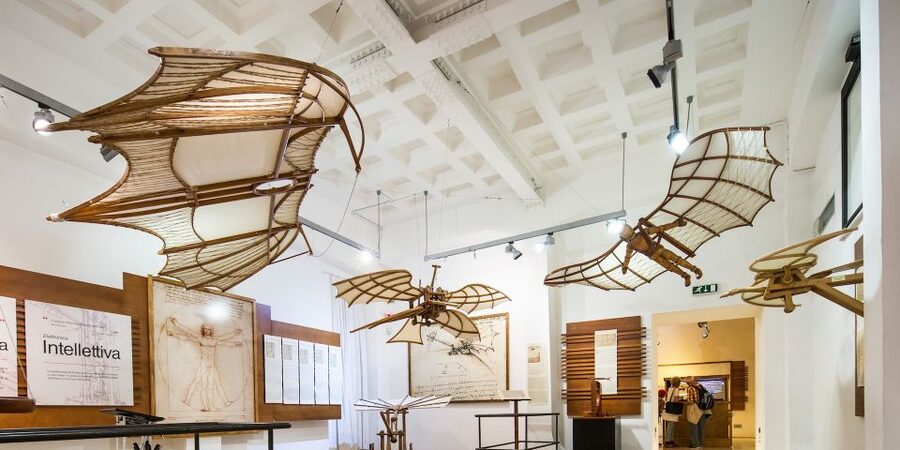
- Nine holograms bring Leonardo’s art and inventions into 3D, giving you a quick visual sense of his ideas.
- More than 65 full-scale machines cover engineering, flight, water, military design, and science.
- Hands-on displays let you touch and test many models, including a bridge based on one of Leonardo’s designs.
- Four sections examine Water, Air, Fire, and Earth, offering a simple framework for his wide-ranging studies.
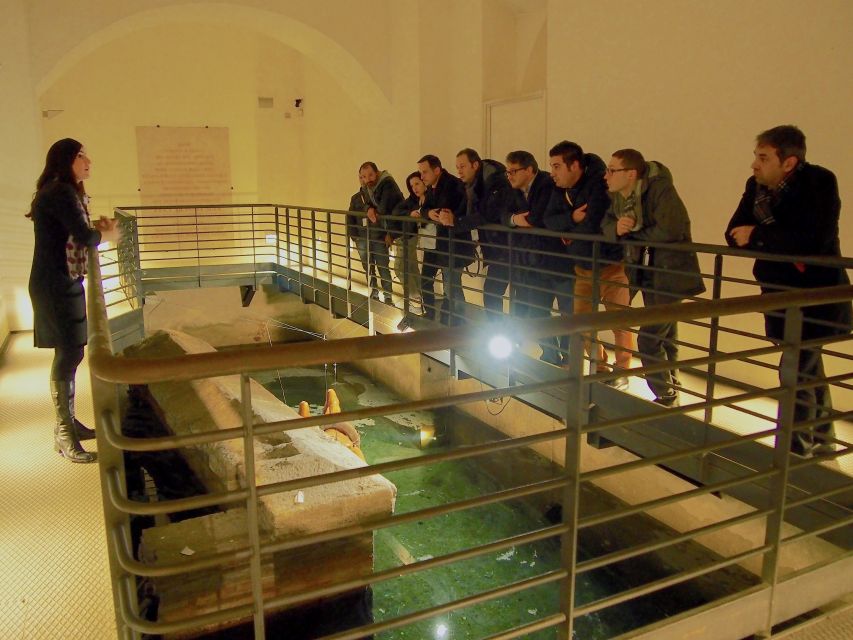
- An ancient tomb lies beneath the exhibition, dating to 43 B.C. and set within an underground natural pond.
- Private guides can explain the displays in six languages, with child-friendly explanations and access to additional workshops.
Entering Palazzo della Cancelleria in central Rome
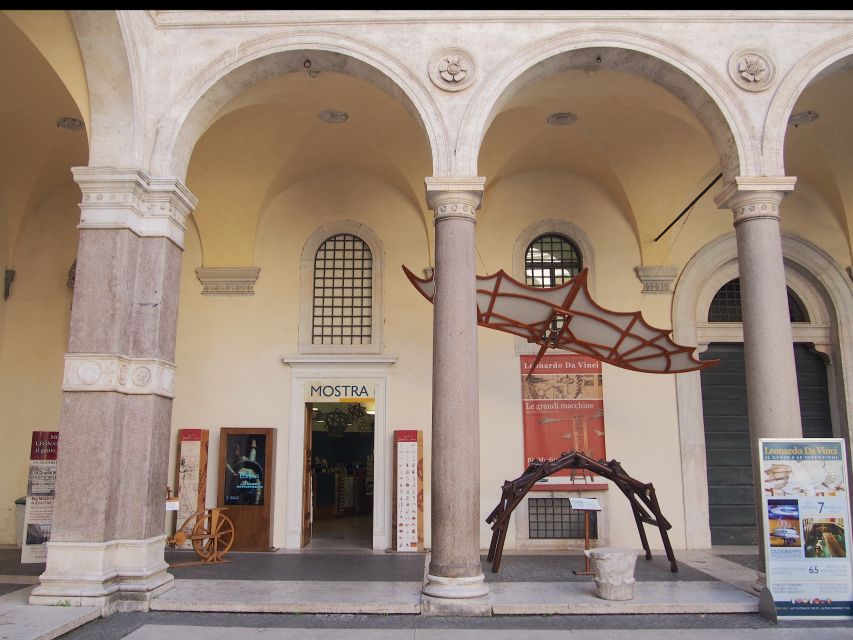
The tour takes place inside Palazzo della Cancelleria, a substantial palace owned by the Vatican. The building itself adds weight to the visit. You are not entering a modern science center detached from Rome’s past. You are walking into a historic palace that also houses the Sacra Rota on its upper floor, the church court connected with marriage annulments.
The exhibition focuses on Leonardo as an engineer and inventor. That distinction helps set expectations. You will not find a room filled with original Renaissance masterpieces. Instead, you will see working-scale interpretations of his plans, multimedia displays, and machines built from his drawings.
I find this approach useful because Leonardo’s notebooks can look like a jumble of reversed writing, gears, wings, canals, and human anatomy. A model gives those sketches physical form. You can see the way a lever might move, how a bridge might support weight, or how an idea for flight was shaped by close observation of nature.
Arrive 15 minutes before the scheduled departure. That small buffer matters in central Rome, where finding a large palace entrance can take longer than expected. The ticket includes exhibition admission and the guided tour, and the activity includes skip-the-ticket-line access.
More museums and galleries in Rome:
- Vatican Museums & Sistine Chapel Tour with Optional Basilica
★ 4.3 · 67,413 reviews - Vatican Museums, Sistine Chapel & St Peter’s Basilica Guided Tour
★ 4.5 · 39,149 reviews - Rome: Vatican Museums, Sistine Chapel & Basilica Tour
★ 4.3 · 13,872 reviews
Four sections built around Water, Air, Fire, and Earth
The exhibition is arranged in four broad sections: Water, Air, Fire, and Earth. This structure gives your guide a useful way to connect Leonardo’s interests instead of presenting one unrelated machine after another.
In the Water section, you can expect designs linked to movement, flow, and hydraulic engineering. Leonardo studied water both as a natural force and as a practical tool. The displays help show how his observations could lead toward bridges, channels, pumps, and other forms of engineering.
Air shifts the focus to flight and movement through space. Leonardo’s flying-machine studies are among his most familiar ideas, but seeing the full-size reproductions makes the question more practical. You can look at the shape, frame, and mechanical logic of the designs rather than treating them as fanciful sketches.
Fire connects with force, energy, and military technology. The exhibition also includes inventions related to warfare. This part may appeal most to older children and adults who enjoy understanding how Renaissance engineers approached weapons and machines.
Earth brings the discussion back to materials, construction, and the physical world. Across all four sections, the point is not that every design was ready for use. Leonardo’s value lies in the questions he asked and the links he made between art, science, mechanics, and observation.
A guide makes a real difference here. The tour is available in English, Italian, French, Spanish, German, and Portuguese. On a German-language tour, guide Julia was singled out for answering questions and making the visit memorable. You should still check the language and starting time when booking, since the available guide language can affect how much you get from the technical material.
Touching machines instead of only looking at them
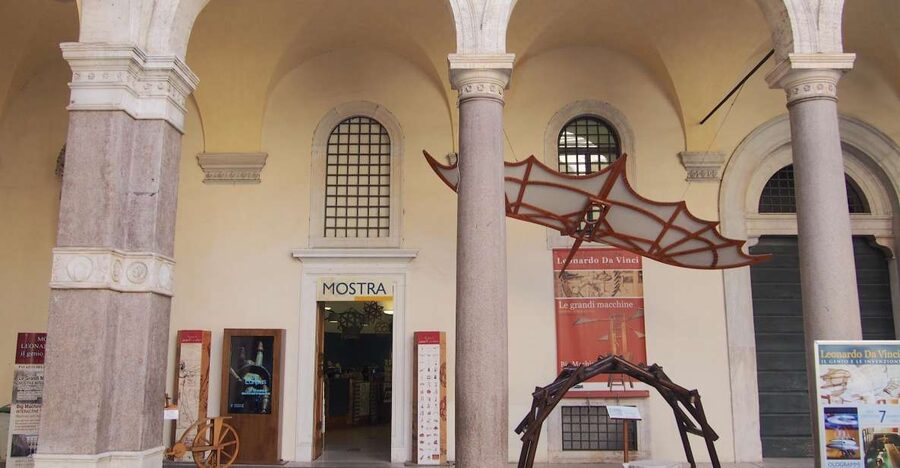
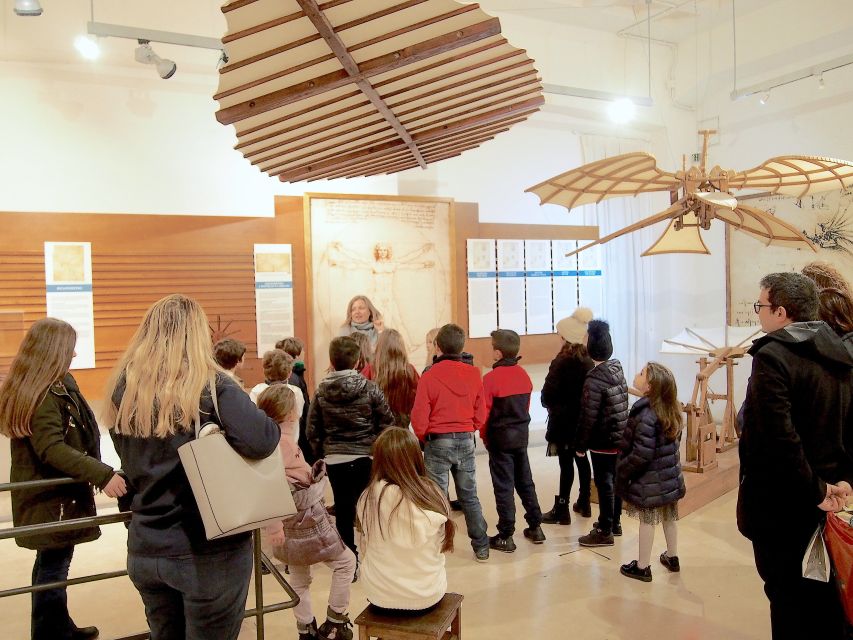
The most distinctive part of this exhibition is the permission to interact with many of the displays. You can touch and play with almost all of the machines, and you may be able to construct your own version of one of Leonardo’s bridges.
That hands-on format changes the pace. You are not simply walking past a row of cases while trying to remember dates. You can test the relationship between parts and see why a design might work, or where a model reveals the limits of an idea.
This is particularly useful for families. Children who might drift away during a long explanation about Renaissance engineering have something physical to examine. The guide can turn a machine into a question: What happens if this part moves? Why is the support shaped this way? What problem was Leonardo trying to solve?
The activity is not presented as a full workshop schedule with a separate craft lesson for every age group, so you should not expect a long series of organized games. The value comes from the interactive machines and the guide’s explanations. One practical improvement for a family visit would be to ask for child-friendly demonstrations and make good use of the models rather than trying to hurry through every display.
The private format should also help if someone in your group wants to stop and ask questions. A guide can adjust the explanation instead of following a fixed lecture for a large crowd. Additional workshops may be available through the private tour, giving you access to more of the exhibition’s interactive side.
Nine holograms and Leonardo’s paintings in three dimensions
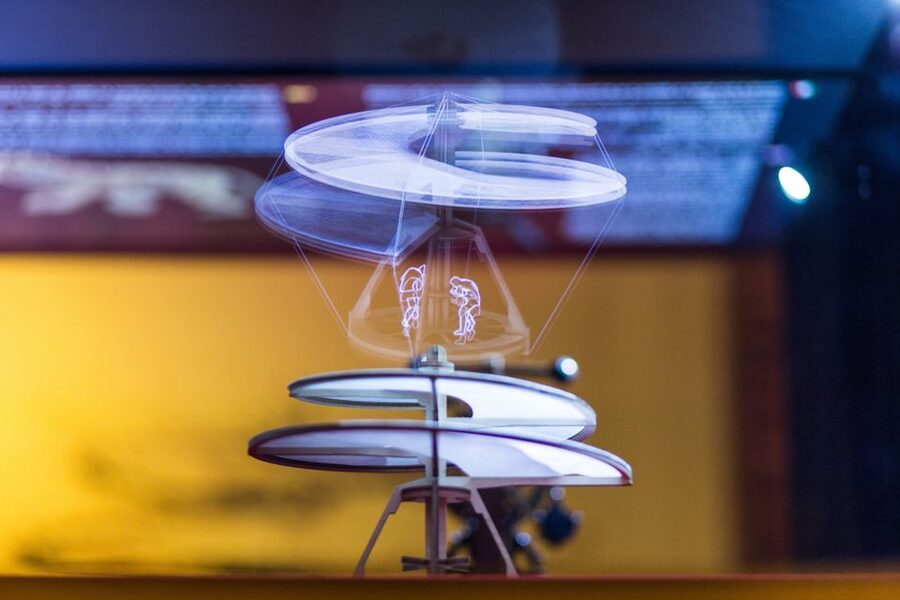
The exhibition includes nine holograms showing Leonardo’s paintings and inventions in 3D. These displays provide a change of pace from the physical machines and help place the engineering work beside his artistic work.
A hologram is not an original artwork, so it should not be confused with seeing a Leonardo painting in a major museum. Its strength is visual explanation. You get a layered presentation of ideas that can be difficult to understand from a flat image or a short written caption.
The holograms also fit the exhibition’s main aim: showing Leonardo as a Renaissance man whose interests crossed several fields. He was not neatly divided into painter, engineer, scientist, and anatomist. His studies often connected one subject to another.
You will also see a video about his inventions and his work in anatomy. This gives the guide another tool for explaining how close observation shaped Leonardo’s thinking. The video may be especially useful if you are visiting with children or with someone who prefers a short visual introduction before looking at technical models.
More private tours in Rome:
- Rome by Golf Cart Private Tour: Beyond the Landmarks
★ 5.0 · 4,361 reviews - Early Morning Vatican, Sistine, St. Peter’s Semi or Private Tour
★ 5.0 · 3,779 reviews - Rome on a Golf Cart Semi-Private Tour Max 6 with Private Option
★ 5.0 · 2,502 reviews - Rome Private Arrival Transfer: Fiumicino Airport to Hotel in Rome
★ 4.5 · 2,492 reviews
Leonardo’s anatomy studies and scientific habits
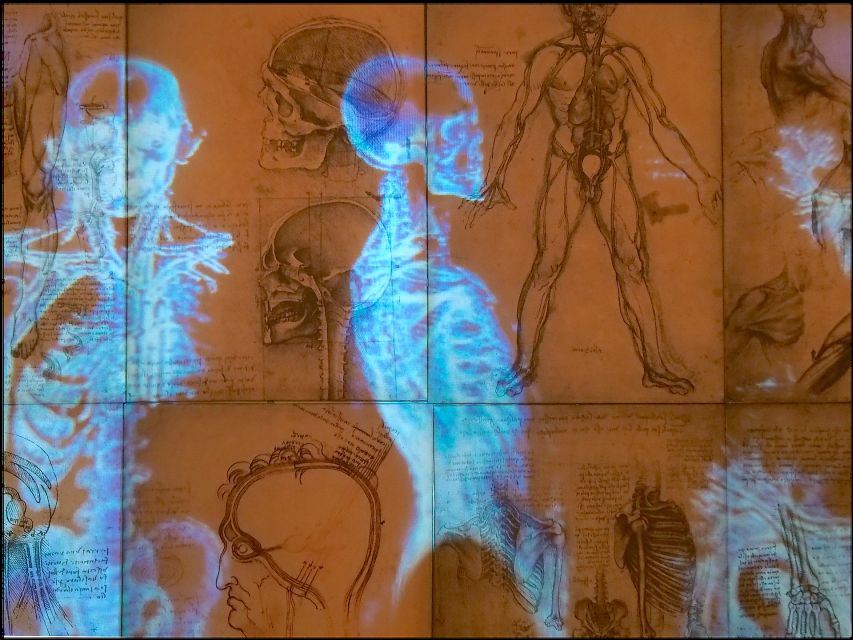
Leonardo’s anatomy work reveals the less mechanical side of the exhibition. He studied the human body in detail, trying to understand structure rather than relying only on traditional artistic formulas.
The anatomy material helps explain why his paintings and machines share a similar quality of close observation. He wanted to know how things were put together. That habit applied to muscles, bones, wings, gears, water, and buildings.
For you, the value of this section depends on the guide. A short label cannot always explain why anatomy mattered to both art and science. A good guide can connect the drawings to Leonardo’s broader method of testing ideas through observation.
The experience is suitable for a mixed-age group, but not every part will appeal equally to everyone. Younger children may prefer the machines and bridge-building. Older children and adults may spend more time with the anatomy and engineering sections. The guide can offer explanations suited to children, and the language options make it easier to keep everyone involved.
The 43 B.C. tomb beneath the exhibition
One of the most unusual details comes below the exhibition. You can see the tomb of the architect Auro Irzio, dating from 43 B.C. It is set within an underground natural pond, giving the museum visit an archaeological turn.
This is not simply another Leonardo display. The tomb reminds you that the palace sits in a city where ancient Roman remains often appear beneath later buildings. It also makes the visit feel more tied to Rome itself rather than being a stand-alone exhibition that could exist anywhere.
The information provided does not promise a long archaeological tour or a separate guided excavation visit. Think of the tomb as a striking feature within the exhibition route. Ask your guide to point it out and explain what you are seeing, since it could be easy to miss if your attention is fixed on the machines above.
How the private tour works for families and small groups
The price is listed as $93 per group up to one person, so check the final group pricing carefully before confirming. Since this is a private guided experience, the value is not based only on the length of the visit. You are paying for a guide who can adapt the pace, explain difficult ideas, and provide access to additional workshops.
For one person, the price may feel high compared with a simple museum ticket. For a small group, the calculation can look better, particularly if several people would otherwise need separate admissions and you want a guide in your preferred language.
The tour lasts about 1.5 to 2 hours. That is long enough to cover the four sections without turning the visit into an all-day commitment. It also fits neatly beside other central Rome sights. You can see the exhibition in the morning or afternoon and still have time for nearby churches, piazzas, and Roman ruins.
The private format suits families, couples, and small groups with different interests. If one person loves military inventions and another prefers anatomy or art, the guide can spend more time where your group is most engaged. A large school-style group might benefit from the interactive displays, but this booking is designed around a private party of up to the stated capacity.
Wheelchair access is available. You should still arrive early and confirm any specific access needs when arranging the visit, since historic palaces can have layouts that are less straightforward than newer museums.
The guides are the main reason to book
The exhibition has plenty to look at, but the guide determines how clearly it all comes together. The strongest praise has focused on guides who explain with energy, answer questions, and remain patient with children.
That matters because Leonardo’s designs can become confusing quickly. One model may represent a bridge, another a flying device, and another a military machine. Without context, you may remember the shapes but miss the reason behind them.
A good guide can also keep the visit from becoming a lecture. The best approach is to ask questions, test the machines, and request connections between the different sections. If you are visiting with children, tell the guide at the start that you want short explanations and hands-on demonstrations.
Language choice is another practical point. Tours are available in English, Italian, French, Spanish, German, and Portuguese. A German-language visit with Julia included careful answers to questions, while French-language tours have been praised for their warmth and appeal to children. Confirm the language before booking rather than assuming every departure offers all six options.
What the tour does well, and where it falls short
The exhibition’s biggest strength is its combination of physical models and clear themes. The machines give Leonardo’s ideas weight, while the holograms and video keep the presentation varied. Touching the displays makes this more active than a standard portrait-and-painting museum visit.
The ancient tomb is another strong point. It adds a layer of Roman archaeology that you might not expect from a Leonardo exhibition and gives the palace a stronger connection to the city.
The main limitation is that the exhibition centers on reproductions. If your priority is seeing original Leonardo paintings or original notebook pages, this is not a substitute for Rome’s major art museums or collections elsewhere in Italy.
The visit may also feel short if you want to read every label and study every machine. With 65 or more full-scale models, you cannot give each one equal attention in 1.5 to 2 hours. Let the guide set priorities, then return to the machines that interest you most.
Families should also know that hands-on does not mean every moment is a game. Some explanations remain technical, and the experience would benefit from more built-in drawing, construction, or group activities for children. The private guide can help bridge that gap.
Who should book the Leonardo exhibition tour
I would choose this tour if you want to understand Leonardo’s inventions without spending hours deciphering sketches on your own. It is a good match for families, curious adults, engineering fans, and anyone who likes museums with something to do.
It also works well if you have already seen Rome’s famous paintings and want a different side of Renaissance culture. The exhibition links art, anatomy, mechanics, aviation, military design, and natural forces in one compact visit.
I would think twice if you are looking specifically for original masterpieces, a large archaeological collection, or a long scholarly museum program. The appeal here is interpretation, scale, and interaction.
The booking includes free cancellation up to 24 hours before the tour for a full refund, and you can reserve now and pay later. That flexibility is useful when your Rome schedule is still changing. Bring your confirmation details, arrive 15 minutes early, and verify the meeting point and language before setting out.
Should you book it?
Book this private tour if you want Leonardo explained through working models rather than only paintings and labels. The hands-on machines, nine holograms, child-friendly guidance, and ancient tomb make it more varied than a basic art visit.
Skip it if you want original Leonardo works above all else. For most families and small groups, though, the private format gives the exhibition its best chance to work: you can ask questions, slow down at the machines, and see how Leonardo’s ideas connect across art, science, and engineering.
FAQ
Where does the Leonardo da Vinci tour take place?
The tour takes place at Palazzo della Cancelleria in Rome’s Lazio region. The palace is owned by the Vatican.
How long does the tour last?
The experience lasts about 1.5 to 2 hours.
What does the ticket include?
The booking includes exhibition admission, the guided tour, and a gadget.
How many machines are on display?
The exhibition contains more than 65 full-scale machines based on Leonardo da Vinci’s designs.
Can I touch the machines?
You can touch and play with almost all of the machines on display. You may also build your own version of one of Leonardo’s bridges.
How many holograms are included?
The exhibition includes nine holograms presenting Leonardo’s paintings and inventions in 3D.
What languages are available?
Guided tours are available in Italian, French, Spanish, English, German, and Portuguese.
Is the tour suitable for children?
Yes. The private tour can include child-friendly explanations, and the interactive machines give children something practical to explore.
Is the exhibition wheelchair accessible?
Yes, the activity is listed as wheelchair accessible.
How early should I arrive?
You should be at the meeting point 15 minutes before the tour departure.
Is cancellation allowed?
You can cancel up to 24 hours in advance for a full refund.
Can I reserve now and pay later?
Yes. The activity allows you to reserve your place and pay later.
Newest Rome tours we have reviewed
- Private TikTok Video Making in Rome★ 5.0 · 7 reviews
- Assisi, Orvieto and Civita di Bagnoregio Full Day Tour from Rome★ 4.5 · 45 reviews
- Assisi & Saint Francis Path Tour from Rome★ 5.0 · 45 reviews
- Assisi and Cascia Private Day Tour from Rome with Lunch★ 5.0 · 10 reviews
- Art Class in the center of Rome!★ 4.0 · 4 reviews
- Art & Craft: Beer Tour with Street Art in Rome★ 4.5 · 6 reviews
- Arrival in Rome: Airport Transfer & Exclusive City Introduction★ 5.0 · 3 reviews
- From Rome: Private Day-Tour of Tuscany★ 5.0 · 16 reviews