
Reviewed · ROME
Rome: St Paul’s Basilica, Sarcophagus, & Major Basilica Tour
St Paul Outside the Walls holds the sarcophagus of St Paul, along with the chain said to have bound him during his captivity in Rome. That alone gives this one-hour visit unusual weight, but the basilica’s gold mosaics, Holy Door, cloister, and layers of rebuilding make it far more than a quick stop for religious pilgrims.
I like the small groups of up to 10 and the clear focus. You are not being marched through a long list of Roman sights. I also like the guides’ personal command of the subject. Tom, Wen, Dan, and Daniel are singled out for warm, careful explanations, with Wen praised for speaking slowly and clearly.
The main drawback is the short running time. One hour is enough for a focused introduction, not a full study of every chapel, artwork, and archaeological detail. The meeting point beside Bar Tabacchi Pappagone also requires care, especially if your map app is having a bad day.
Key points to know before you book
- St Paul’s relics are the heart of the visit: You see the sarcophagus beneath the altar area and learn why Paul was buried here.
- The tour explains Catholic meaning, not just architecture: Expect interpretation of symbols, saints, mosaics, the Holy Door, and church tradition.
- Guides make a strong impression: Tom, Wen, Dan, and Daniel are praised for clear delivery, patience, and warmth.
- It is outside central Rome: The basilica is a short Metro ride from the center, in the San Paolo neighborhood.
- One hour moves quickly: This suits you if you want a concentrated visit, but you may want extra time afterward to look around.
- Dress for a church: Shorts and short skirts are not allowed, and clerics can attend free by contacting the provider.
Why St Paul Outside the Walls is worth the trip
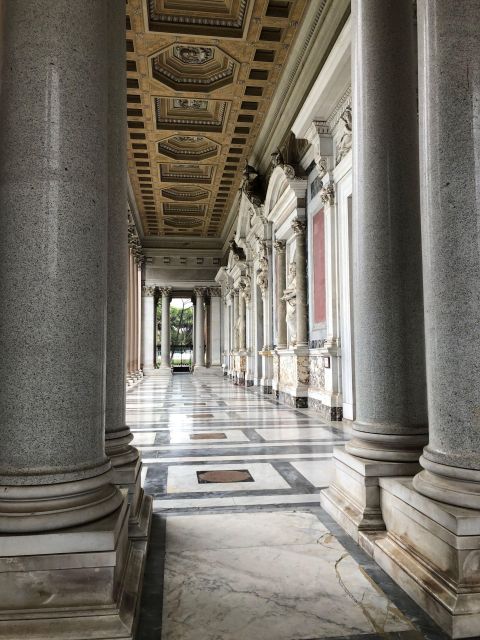
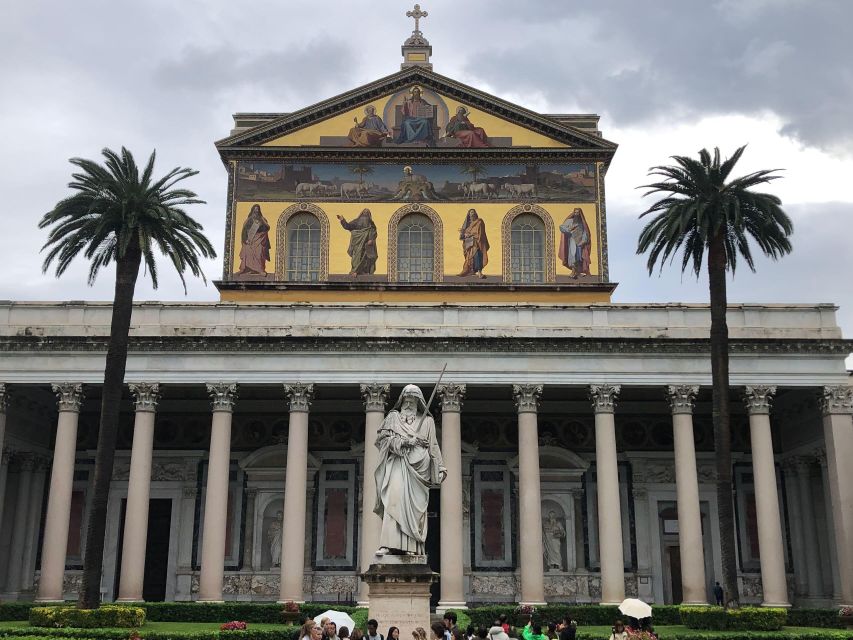
Rome’s most famous churches cluster around the historic center, so St Paul Outside the Walls can lose out to the Colosseum, Pantheon, and Vatican. I think that is part of its appeal. You make a short trip beyond the usual sightseeing circuit and reach one of the city’s four Major Papal Basilicas, one of its Seven Pilgrim Churches, and a UNESCO World Heritage site.
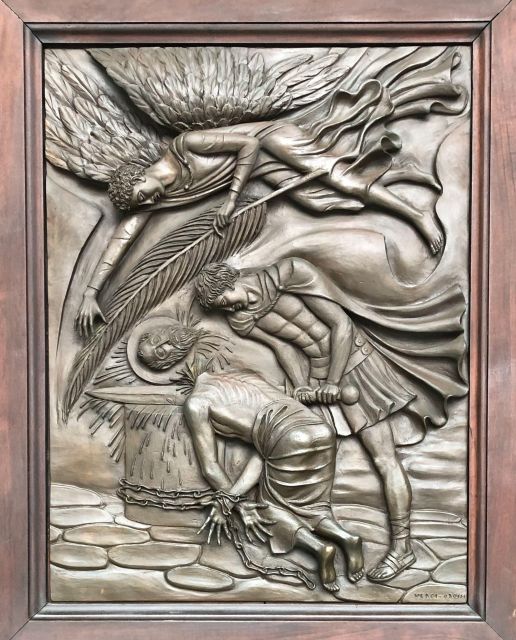
The basilica was first built in the fourth century over the place associated with St Paul’s burial. Paul was a Roman citizen, so Roman law spared him crucifixion. Instead, he was beheaded after being condemned for his Christian faith. The church’s purpose has always been tied to that burial site, not simply to a later dedication.
The building you see today carries almost 1,700 years of change. It was expanded and repaired over many centuries, then badly damaged by fire in 1823. Much of what you admire inside comes from restoration and rebuilding, but the site itself remains linked to the earliest Christian memory of Paul in Rome.
That distinction matters. You are not only looking at a grand church built by later patrons. You are visiting a place shaped by burial, pilgrimage, worship, fire, repair, and the continuing life of the Church.
Other Rome tours people pair with this one:
- Vatican Museums & Sistine Chapel Tour with Optional Basilica
★ 4.3 · 67,413 reviews - Vatican Museums, Sistine Chapel & St Peter’s Basilica Guided Tour
★ 4.5 · 39,149 reviews - Rome: Colosseum, Palatine Hill and Roman Forum Guided Tour
★ 4.8 · 32,814 reviews
Meeting at Via Ostiense
The tour begins outside Bar Tabacchi Pappagone di Francesconi Monica on Via Ostiense. Use the supplied map pin carefully rather than relying only on a broad search for the basilica. The precise meeting point matters because a café or tobacco shop is easier to miss than the enormous church itself.
The provider asks you to download WhatsApp so the guide can reach you in real time if something goes wrong. That is sensible here. One visitor had trouble with Google Maps, though the tour company called and sent the guide to help. I would still arrive early, check the pin before leaving your hotel, and keep your phone charged.
The basilica is a few Metro stops from central Rome, but transport to the meeting point is not included. You also arrange your own return trip after the tour. Since the visit lasts only an hour, it can fit neatly into a morning or afternoon plan without taking over your day.
Entering one of Rome’s four Major Basilicas
Once inside, the guide gives the church a clear religious and historical frame. This is not a standard architecture walk with a few saints added at the end. The tour is designed for Catholic pilgrims and for anyone who wants to understand how the building’s visual language connects to Christian belief.
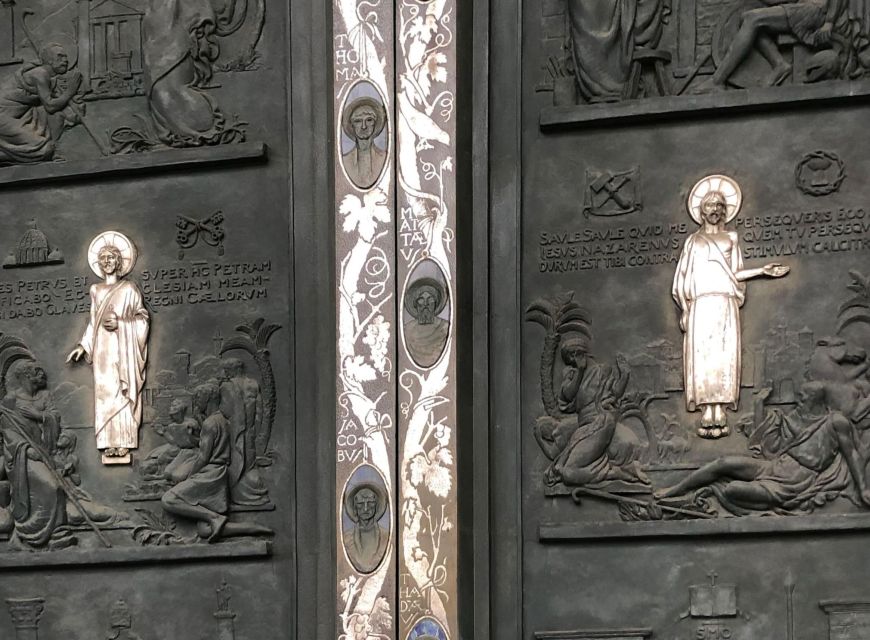
You will hear about the basilica’s role as one of Rome’s four Major Papal Basilicas. You will also learn about the Holy Door, one of four in Rome that open during Jubilee Years. The door is not treated as a decorative entrance. Its meaning belongs to the tradition of pilgrimage, repentance, and passage into a sacred space.
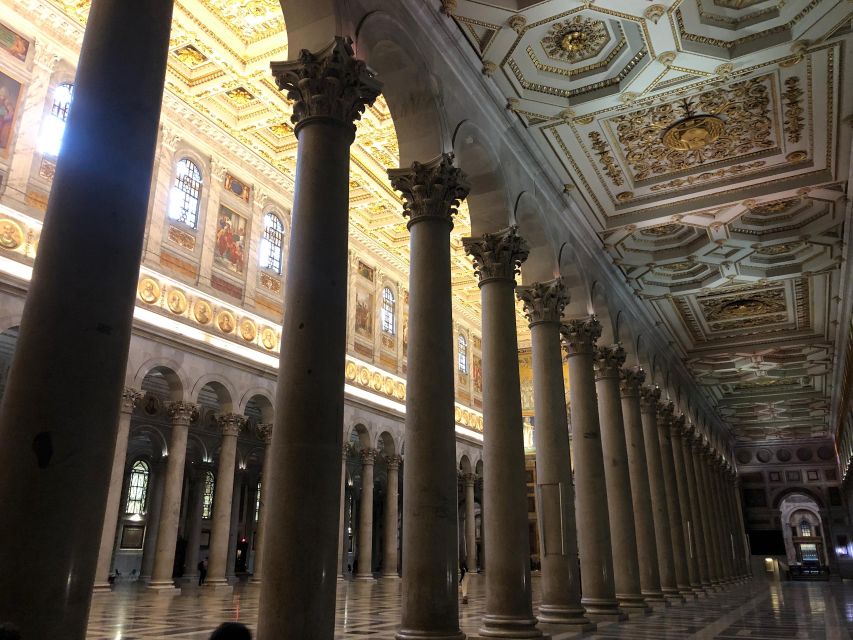
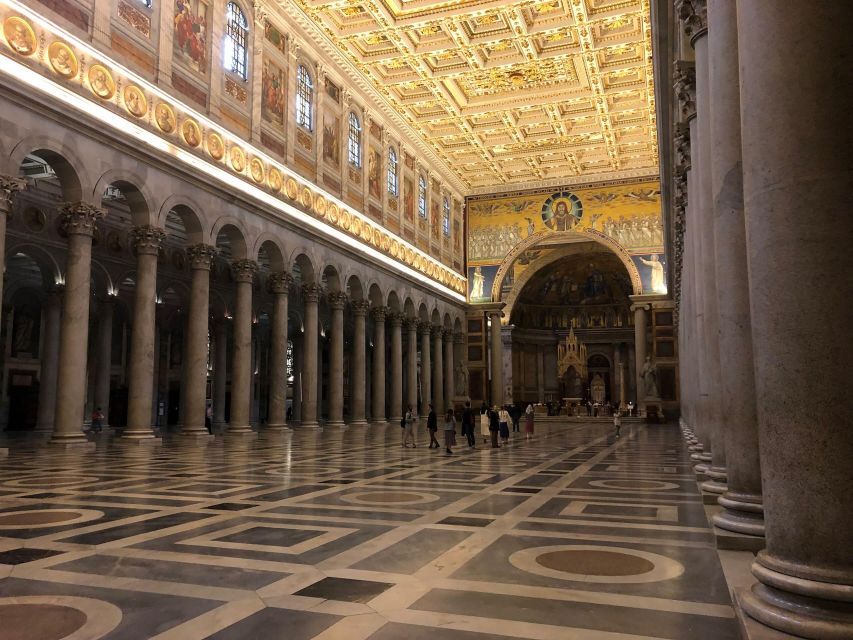
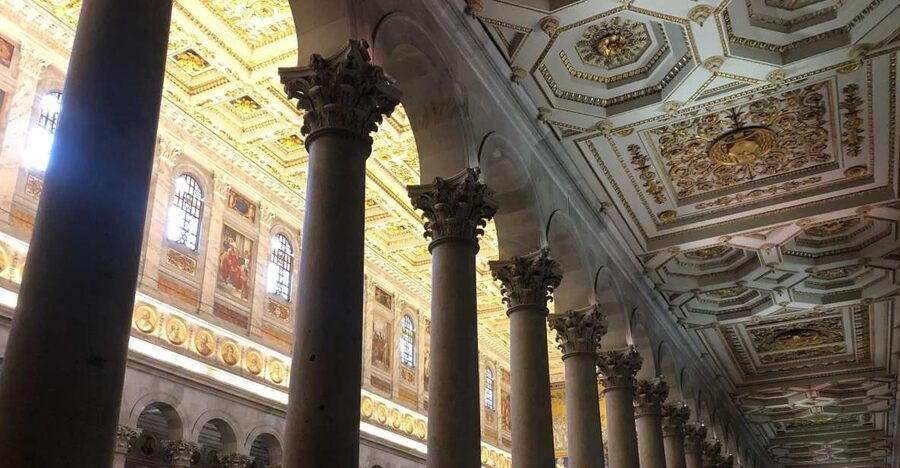
The large scale can be surprising. Even if you have already visited major Roman churches, St Paul’s gives you a different impression from the tighter, busier churches in the center. The interior’s long perspective, repeated columns, mosaics, and rows of saint portraits make the building feel ordered and ceremonial.
Your guide helps prevent that scale from becoming visual noise. Instead of simply pointing out gold, marble, and painted details, the explanation connects them to the basilica’s purpose. This is where the tour’s Catholic approach makes a real difference.
St Paul’s sarcophagus and the chain relic
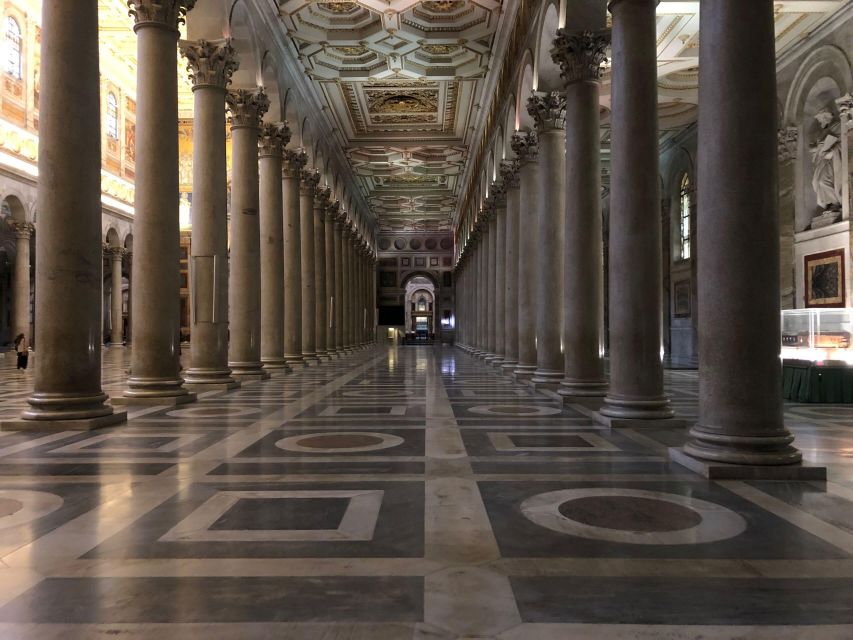
The key stop is the sarcophagus associated with St Paul. The tour presents it as the place where the Apostle’s relics are preserved, giving you time to understand why this location matters to Christian pilgrims.
Paul is known as the Apostle to the Gentiles and is regarded as one of the Pillars of the Church alongside St Peter. His letters helped shape Christian teaching, and his journeys carried the faith far beyond its earliest community. Seeing the burial site puts that familiar name into a physical place.
You also see the relic of the chain believed to have bound Paul during his captivity in Rome. It is a small object compared with the scale of the basilica, but its meaning is direct and powerful. The chain links the church to Paul’s imprisonment and to the cost of his public preaching.
This is the point where the visit feels most different from a conventional Roman church tour. You are not simply admiring an artifact behind glass. The guide places it within Paul’s life, martyrdom, writing, and continuing importance to the Church.
Same city, a completely different half-day:
- Rome: Guided Tour of Colosseum, Roman Forum & Palatine Hill
★ 4.7 · 27,897 reviews - Rome: Colosseum & Forum with Audio Guide App -Optional Arena
★ 4.2 · 24,770 reviews - Rome: Colosseum, Roman Forum and Palatine Hill Guided Tour
★ 4.5 · 23,903 reviews - Rome: City Sightseeing Hop-on Hop-off Bus with Audioguide
★ 4.0 · 16,045 reviews
Mosaics, saints, and symbols overhead
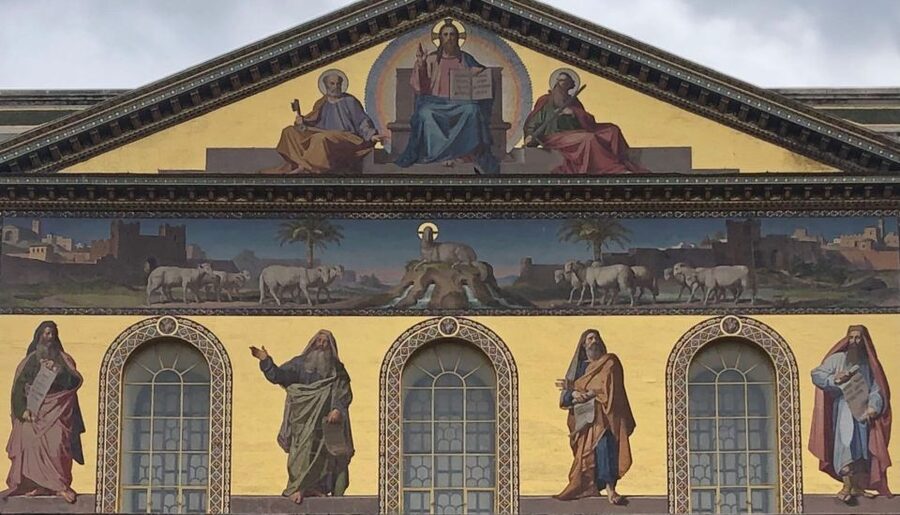
The golden mosaic facade is one of the basilica’s most memorable visual features. It contains layers of religious meaning that are easy to miss if you walk in, take a few photos, and leave. The guide explains how the imagery and design communicate Christian beliefs.
Inside, a long series of portraits presents the popes. The effect is both artistic and historical, showing the continuity of the Roman Church through successive generations. You can look at these images as works of art, but the guide also explains why their arrangement matters within the basilica.
The tour covers depictions of saints and the symbolism built into the architecture. Olivia, who had hearing difficulties, found Wen particularly effective because she spoke slowly, clearly, and answered questions carefully. That detail is useful if you worry about following a live guide in a large echoing church.
One honest caution: the basilica can be difficult acoustically when pilgrims are singing or other services are taking place. One visitor felt a radio device would have helped. Headsets are included for groups of seven or more, but smaller groups may rely on the guide’s voice. Stay close, ask the guide to repeat anything you miss, and consider a quieter time if your schedule allows.
The miraculous cross and St Bridget of Sweden
One of the lesser-known objects included in the visit is a cross connected with St Bridget of Sweden. According to the tour’s tradition, this miraculous cross inspired Bridget to found the Order of the Bridgettines.
This is exactly the sort of detail that rewards a guided visit. You might notice a cross in a side area on your own, but you would not necessarily know its connection to Bridget, her religious foundation, or the wider network of Christian figures who shaped medieval Europe.
The story also adds a human layer to the basilica. St Paul’s is not only about imperial scale and papal history. It contains objects tied to personal devotion, religious movements, and the choices of individual saints.
The cloister and the space behind the altar
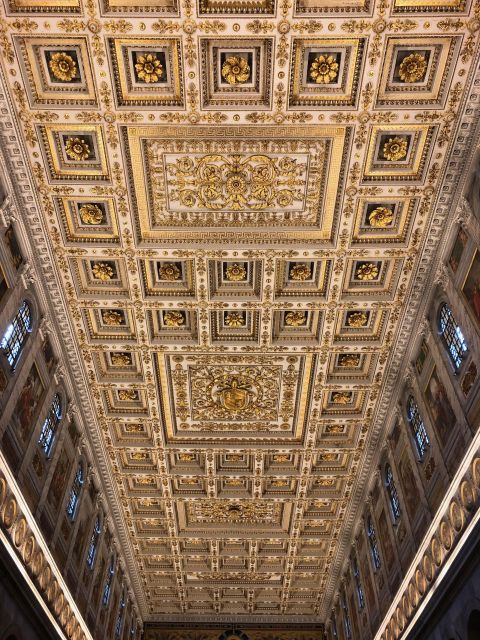
The cloister is another important part of the visit. Its design helps explain how the basilica functioned as a religious community, not just as a grand public church. The guide draws attention to the meaning in the cloister’s form, adding context that a quick self-guided visit may not provide.
The area behind the main altar is also part of the explanation. The tour refers to the conclave behind the altar, and the guide connects this feature to the Church’s ongoing life. In a building filled with large visual statements, these more contained spaces can be easy to overlook.
Because the tour is only an hour, the guide has to make choices. You should expect a well-shaped overview rather than time in every corner. If you become especially interested in the cloister, mosaics, or relics, plan to remain after the official tour and look more closely at anything permitted during your visit.
What the guides add to the visit
The strongest pattern in the guide feedback is the quality of explanation. Tom is repeatedly praised for his depth of information, strong opening, punctuality, and ability to keep children interested. Wen is praised for clear speech, patience, and careful answers. Dan is described as engaging, while Daniel is noted for combining church history with archaeology and Roman context.
That range matters because this is a subject that can easily become either dry or overly devotional. The guides appear to handle both sides. They explain architecture and history while also presenting the basilica as a place of living faith.
The Catholic tone is clear. If you want a strictly secular art-history tour, this may not be your best choice. If you are Catholic, Christian, or simply curious about how the Church understands its own buildings and relics, the catechesis is the main reason to choose this experience over a basic audio guide.
Families may also find the format useful. Tom’s explanations kept children engaged, and the small-group size makes it easier to ask questions than on a large coach tour. Still, the subject is serious and the pace is focused, so very young children may not enjoy every part equally.
Is $65 good value for one hour?
At $65 per person, this is not a cheap church visit. You can enter many Roman churches without paying for a guide, and St Paul’s setting outside the center means you also spend time and money reaching it.
The value depends on what you want from the visit. You are paying for a live guide, a small group limited to 10, religious interpretation, and a structured explanation of the sarcophagus, chain, Holy Door, mosaics, cloister, and related works. For a pilgrim or a visitor who wants the meaning behind the objects, that can be worthwhile.
I would be less likely to recommend the price to someone who only wants a quick look at the interior. The basilica itself is the attraction, and you can spend time viewing it without this particular tour. You are paying for the connections between the objects, the Christian story, and the building’s role in Rome.
The one-hour length also makes the price easier to fit into a busy itinerary, though not necessarily cheaper in hourly terms. Think of it as a focused introduction, then give yourself extra time to explore on your own if the basilica is open and your schedule permits.
Timing, clothing, and access
The published duration is one hour, with some wording describing the visit as lasting 60 to 90 minutes. I would plan for one hour and allow a little extra time around the meeting and finish.
The tour is wheelchair accessible. English and Chinese guiding are available, and the group is limited to 10 participants. Groups of seven or more receive radio headsets. That can help, but the church’s acoustics and any singing or services may still affect how clearly you hear.
Dress like you are visiting a major Catholic church. Shorts and short skirts are not allowed. Clerics can attend free by contacting the provider in advance.
Free cancellation is available up to 24 hours before the tour, and you can reserve now and pay later. Those terms are useful if you are building a Rome schedule around changing museum and church hours, though you should still confirm the available start time before booking.
Explore San Paolo after the tour
The visit finishes outside the basilica in the San Paolo neighborhood. This is a useful chance to see a less tourist-heavy part of Rome instead of rushing straight back to the historic center.
The area is described as a fashionable suburb and a good place to get away from the city’s main tourist routes. The tour itself does not provide a neighborhood program, so treat this as an optional extension rather than a guided second act.
I like the idea of pairing the basilica with a slower meal or walk nearby, but keep your expectations practical. The main reason to come here is St Paul’s. The neighborhood is an added benefit, not a replacement for the major attractions in central Rome.
Who should book this St Paul’s tour?
I would choose this tour if you are Catholic, interested in Christian history, traveling as a pilgrim, or tired of tours that describe only dates and decoration. The guide’s religious interpretation gives the basilica a clear purpose, and the small group makes the hour feel personal.
It is also a good match if you have already seen the Colosseum and Vatican and want a major Roman site with fewer crowds. The visit offers a different side of Rome, one shaped by worship and pilgrimage rather than imperial spectacle.
I would skip it if your schedule is extremely tight, you do not want a religious presentation, or you are happy to explore churches without a guide. The $65 cost is hard to justify for a quick visual visit alone.
FAQ
How long does the St Paul Outside the Walls tour last?
The activity is listed as one hour, with the tour description also referring to a 60 to 90 minute pilgrim visit. Plan on one focused hour, with some flexibility.
Where does the tour meet?
Meet outside Bar Tabacchi Pappagone di Francesconi Monica on Via Ostiense. Use the precise map location supplied when booking, since the meeting point is outside the basilica rather than simply at the main church entrance.
What can I see during the tour?
You can see the sarcophagus containing the relics of St Paul, the chain relic associated with his captivity, one of Rome’s Holy Doors, mosaics, artwork, the cloister, and the area behind the main altar.
Is the tour suitable for wheelchair users?
Yes. The activity is listed as wheelchair accessible.
What languages are available?
Live guiding is available in English and Chinese.
Can I wear shorts or a short skirt?
No. Shorts and short skirts are not allowed, so wear suitable church clothing.
Can clerics join for free?
Yes. Clerics can attend free, but they should contact the provider in advance.
Should you book it?
Book this tour if you want St Paul Outside the Walls explained as a place of faith, relics, and Christian memory, not just as a beautiful building. Tom, Wen, Dan, and Daniel are associated with especially strong guiding, and the small group gives you a better chance to ask questions.
Give yourself time to find the Via Ostiense meeting point, dress for the basilica, and accept that one hour is only an introduction. For the right visitor, the sarcophagus, chain, Holy Door, and Catholic interpretation make the trip beyond central Rome well worth considering.
Newest Rome tours we have reviewed
- Private TikTok Video Making in Rome★ 5.0 · 7 reviews
- Assisi, Orvieto and Civita di Bagnoregio Full Day Tour from Rome★ 4.5 · 45 reviews
- Assisi & Saint Francis Path Tour from Rome★ 5.0 · 45 reviews
- Art & Craft: Beer Tour with Street Art in Rome★ 4.5 · 6 reviews
- Assisi and Cascia Private Day Tour from Rome with Lunch★ 5.0 · 10 reviews
- Art Class in the center of Rome!★ 4.0 · 4 reviews
- Arrival in Rome: Airport Transfer & Exclusive City Introduction★ 5.0 · 3 reviews
- From Rome: Private Day-Tour of Tuscany★ 5.0 · 16 reviews