
Reviewed · ANCIENT ROME TOURS
Ancient Rome’s Ultimate Night Walk
Rome is at its most atmospheric after sunset, when the ruins along Via dei Fori Imperiali are lit and the city’s grand squares feel less hurried. This 2.5-hour walk links ancient Rome with the modern Italian state, taking you from the monument at Piazza Venezia to the seat of the prime minister at Piazza Colonna.
I like the small maximum of 15 people, which should make it easier to hear the guide, and I like the way the route mixes major sights with political stories. Guide Nick is specifically praised for bringing Roman history to life. The main drawback is price: at $84.33 per person, this is costly for an outdoor walking tour with no listed admission tickets.
Key points at a glance
- Rome after dark: See major monuments and ruins in evening light, when the city takes on a different mood.
- Michelangelo’s Campidoglio: Visit one of Rome’s finest designed squares, now home to the city government.
- Ancient and modern Rome together: Connect the Roman Forum and Temple of Hadrian with the Quirinale and Italian prime minister’s office.
- Small group size: The tour is capped at 15 people.
- English-language outing: The experience is offered in English and uses a mobile ticket.
- A nightcap at the end: The walk finishes in central Rome with a complimentary drink or other nightcap, though the specific offering is not stated.
Why a night walk gives Rome a different feel
This is not a tour of the Colosseum interior or the Vatican Museums. It is an outdoor stroll through central Rome, built around views, city squares, ruins, and stories. That distinction matters when you compare it with a standard sightseeing ticket.
At 7 p.m., the route begins on Via dei Serpenti, 89, in the Monti area. From there, you move through some of the city’s most important public spaces. The walk is less about checking off isolated monuments and more about seeing how Rome’s layers sit side by side.
I like that approach. Rome can feel confusing at first because an imperial ruin may sit beside a Renaissance building, a Baroque church, or a modern government office. A guide who explains those changes gives you a useful framework for the rest of your stay.
The evening timing also helps with the heat and glare that can make daytime sightseeing tiring, particularly in warmer months. You should still expect to walk outdoors for roughly two and a half hours. Wear comfortable shoes and bring something suitable for changing weather.
More ancient Rome tours:
- Colosseum: Underground and Ancient Rome Tour
★ 4.7 · 12,691 reviews - Colosseum & Ancient Rome with Arena Floor Option I Max 6 People
★ 5.0 · 3,306 reviews - Rome: Colosseum, Ancient Rome Tour or Self AudioGuided Tour
★ 4.4 · 2,866 reviews
Piazza Venezia and the story of Italian unity
The first stop is Piazza Venezia, where you get about 15 minutes to hear the story of Italian unification and see the huge monument built to honor it. The square is one of Rome’s key traffic and ceremonial hubs, so it can feel grand rather than peaceful.
The monument is an important symbol of modern Italy. Its scale can be overwhelming, but that is part of the point. This stop gives the tour a useful opening: Rome is not only an ancient capital. It is also the capital of a much younger nation, shaped by the process of Italian unification.
Because admission is free and the visit is outdoors, you are seeing the monument from public space rather than entering a museum or paid site. Fifteen minutes is enough for an introduction and orientation, but not for a detailed examination of every feature.
The Quirinale, from papal residence to presidential palace
Next comes Piazza del Quirinale, also scheduled for about 15 minutes. The Quirinale is the current seat of the Italian president. Before that, it served as a main papal residence and later as a home for Italy’s royal family.
That succession tells you a great deal about Rome. A single place has been adapted by the papacy, the monarchy, and the republic. The tour uses this square to show how power changed hands over the centuries, rather than treating Roman history as a single ancient chapter.
This is a strong stop for anyone who enjoys political history. You are not simply looking at a pretty piazza. You are hearing how the city’s leading institutions changed as Italy moved from papal rule through monarchy and into its present government.
The stop is outdoors and free. If you want to enter official buildings, this experience will not do that. Its value comes from the explanation and the setting.
Michelangelo’s Campidoglio and Rome’s civic heart
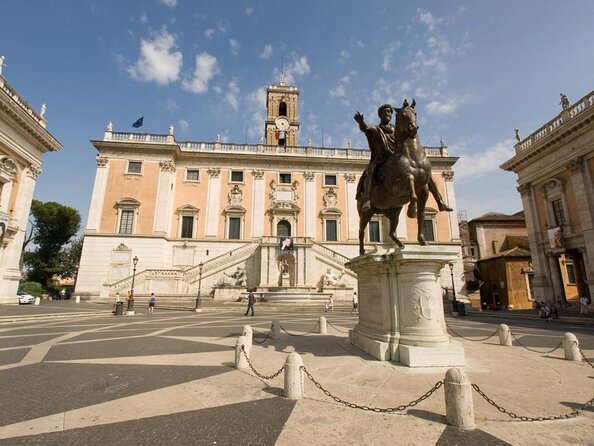
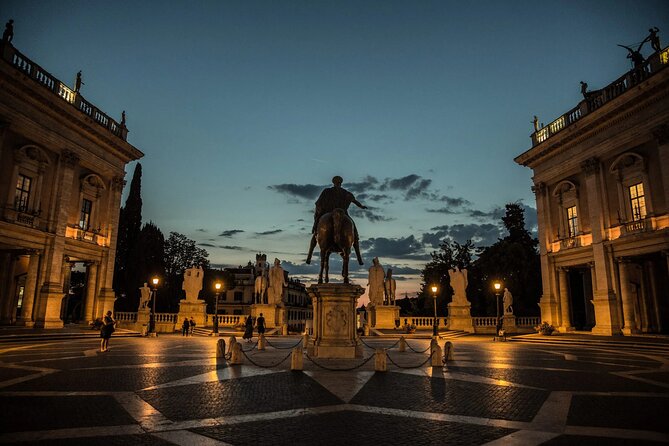
Piazza del Campidoglio is likely the artistic high point of the walk. Michelangelo designed the square, which is also associated with the seat of Rome’s mayor. The layout, paving, and surrounding buildings give the space a carefully controlled sense of order.
I like having this stop between the Quirinale and the ancient ruins. It shows that Rome did not simply preserve its past. Later architects and civic leaders reshaped it, often placing new ideas directly on top of old ones.
The tour allows around 15 minutes here. That is enough to take in the design and hear why Michelangelo’s work matters, though it is not a long art lecture. If you are especially interested in Renaissance architecture, you may wish to return during the day for a slower look.
The square also helps you understand Rome as a living city. The mayor’s seat is not an archaeological shell. It is part of the machinery of local government, surrounded by a design that reaches back to the Renaissance.
More evening tours in Rome:
- Rome: City Highlights Open-Top Bus Night Tour
★ 4.1 · 2,038 reviews - Vespa Sidecar Tour By Night with Pickup
★ 5.0 · 1,803 reviews - Rome by Night – Ebike Small Group Tour – Food and Wine (Option)
★ 5.0 · 1,275 reviews - Colosseum Sunset Tour with Entry
★ 4.5 · 1,230 reviews
Via dei Fori Imperiali and the Roman Forum
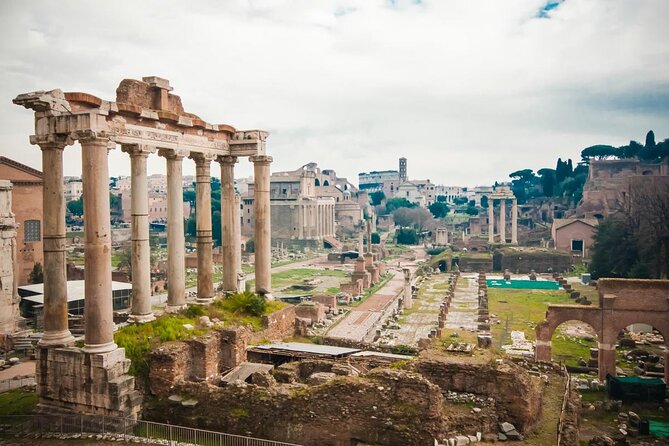
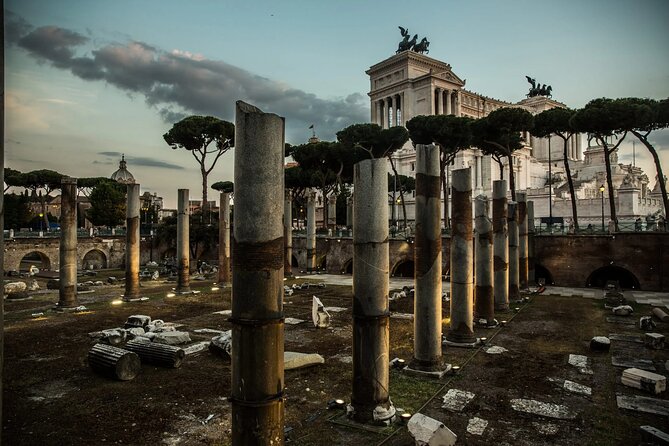
The route then intersects Via dei Fori Imperiali and offers a view of the Roman Forum, once the center of the Western world. This is the point where the scale of ancient Rome becomes easiest to grasp.
You are not entering the archaeological area on this walk, and no admission ticket is listed. Instead, the guide uses the road and viewpoints to explain the ruins. That can be a good introduction if you have not yet visited the Forum, but it is not a substitute for an interior archaeological visit.
At night, the ruins can look especially dramatic under artificial lighting. You may find it easier to imagine the Forum as a civic center when its broken columns and fragments are presented against the dark sky. A good explanation is important here because the remains can otherwise look like a confusing field of stones.
The 15-minute allocation is fairly brief for such a major site. Still, it gives you a foundation for a later daytime visit, or a way to appreciate the Forum if you have limited time and do not want to buy another ticket.
Piazza di Pietra and the surviving Temple of Hadrian
Piazza di Pietra is a smaller stop, lasting about five minutes. Its main feature is the facade of the local Chamber of Commerce, which incorporates the original columns of the Temple of Hadrian.
This is exactly the sort of detail that makes a Rome walk worthwhile. You might pass the square on your own and see a handsome row of ancient columns without realizing what they are or how they became part of a later building.
The short stop reflects the size of the site. You will not spend long here, but the contrast is memorable: an ancient temple survives as part of a modern working building. It is a neat example of Rome’s habit of building around, over, and into its past.
Piazza Colonna and the modern Italian government
The final listed square is Piazza Colonna, where the tour discusses the Roman families that once helped run the Catholic Church and points out the seat of the Italian prime minister. The visit lasts about 15 minutes.
This brings the route back to modern political power. After seeing papal and royal connections at the Quirinale, you get another look at the families and institutions that shaped Rome’s government and church life.
Piazza Colonna is also the end point, so the route finishes in a central location rather than leaving you far from the main sights. The official end point is listed as P.za Colonna, beside the prime minister’s office.
The combination of Roman ruins, Renaissance design, church history, and present-day government is the tour’s strongest feature. It gives you a connected story instead of a string of unrelated photo stops.
What the guide adds to the experience
The quality of a history walk depends heavily on the guide. One guide named in the feedback is Nick, who is praised for using a strong narrative and for being friendly and gracious. That suggests the best version of this tour is lively and story-led rather than a dry list of dates.
You should think of the guide as the main reason to book. The monuments are free to see, and many of them can be reached independently. You are paying for the route, interpretation, group organization, and the chance to connect the pieces.
The small group limit helps. With no more than 15 people, you are less likely to be buried in a large crowd, and it should be easier to ask a question or stay close to the guide. The tour is offered in English, so you should be comfortable listening to historical explanation in that language.
The overall rating is 4.8 from 25 ratings, with 96 percent recommending it. That is a strong approval figure, but the sample is not large, so I would treat it as useful guidance rather than a guarantee.
Is $84.33 a fair price?
At $84.33 per person, this is not a cheap Rome walk. The listed stops are free, and there are no included museum or archaeological admission tickets. You should judge the price mainly by the guide’s storytelling, the small group, the evening timing, and the included nightcap.
For a first evening in Rome, the route can provide a helpful mental map. You see where several central landmarks sit in relation to one another, and you get background that may improve later visits. That has real value if you prefer a guided introduction instead of finding your own way through the city.
Still, budget-minded visitors should pause. You can walk through many of these squares independently, and the experience does not include entry to the Roman Forum. If your priority is going inside ancient sites, spend the money on an archaeological ticket and use this walk only if you also want interpretation and company.
The complimentary nightcap adds a pleasant finish, but the details are not specified. Do not book solely for the drink. Consider it a small extra after the main walk.
Timing, weather, and practical planning
The tour starts at 7 p.m. and lasts about two hours and 30 minutes. The listed sightseeing stops add up to roughly 80 minutes, leaving time for walking between locations, explanations, pauses, and the final nightcap.
You will need to arrive at Via dei Serpenti, 89, in time for the start. The meeting point is near public transportation, which makes the beginning fairly practical, but the tour does not provide private transport. Plan on reaching the area under your own arrangements.
Weather deserves attention. This experience requires good weather, and rain can make the walk uncomfortable. One unhappy booking involved heavy rain, a delayed flight, and a missed meeting, so I would avoid scheduling this for the same evening as an important arrival or tight connection.
Free cancellation is available up to 24 hours before the start time. Changes or cancellations inside that window are not refunded or accepted. If poor weather cancels the tour, you are offered another date or a full refund. The same applies if the minimum number of participants is not reached.
The tour is limited to 15 people. Most people can participate, and service animals are allowed. The supplied information does not give a detailed mobility assessment, so if you have specific walking needs, confirm them before booking.
Who will get the most from this Rome walk?
I would recommend it most to a first-time visitor who wants a clear introduction to Rome’s major eras without spending the evening inside a museum. It also suits anyone who enjoys politics, civic history, architecture, and stories about how a city changes over time.
It is a good fit for couples and small groups who like evening sightseeing and want a hosted route through central Rome. The night setting can also be appealing if you have spent the day visiting indoor sights and want an outdoor change of pace.
I would be more cautious if you are looking for an intensive ancient Rome tour. You will see the Roman Forum from outside, not explore its paths and ruins in detail. Likewise, art specialists may find 15 minutes at Campidoglio too short.
The tour is less suitable for anyone who dislikes walking in uncertain weather or who needs a very slow pace. At two and a half hours, it is not an extreme outing, but it is still a substantial evening on foot.
Should you book Ancient Rome’s Ultimate Night Walk?
Book it if you want a polished evening overview of Rome, with a small group, English narration, Michelangelo’s Campidoglio, illuminated ancient ruins, and a route that connects old power with modern government. The strongest reason to choose it is the guide’s storytelling, particularly if you are fortunate enough to have a guide like Nick.
Skip it if $84.33 feels high for a walk through free public spaces, or if your main goal is to enter the Roman Forum and other archaeological sites. In that case, spend your budget on admission tickets and explore independently.
For the right person, this is a useful first-night orientation with a thoughtful route and a pleasant finish. Just arrive on time, watch the forecast, and remember that you are paying for the guide and the story, not for entry into the ruins.
FAQ
How long does Ancient Rome’s Ultimate Night Walk last?
The tour lasts approximately two hours and 30 minutes.
What time does the tour begin?
The start time is 7 p.m.
Where does the tour begin?
The meeting point is Via dei Serpenti, 89, 00184 Rome, Italy.
Where does the tour end?
The tour ends at Piazza Colonna, beside the seat of the Italian prime minister.
Is the tour offered in English?
Yes. The tour is offered in English.
What is the maximum group size?
The tour has a maximum of 15 participants.
Can I cancel for a full refund?
Yes, if you cancel at least 24 hours before the experience start time. Cancellations or changes made less than 24 hours before the start are not refunded.
More walking tours in Rome
- Rome: Trastevere & Campo de Fiori Street Food Walking Tour
★ 4.9 · 2,768 reviews - Rome: Paranormal Night Walking Tour & Secret Backstreets
★ 4.9 · 1,921 reviews - Rome by Night Walking Tour – Legends & Criminal Stories
★ 4.5 · 1,003 reviews - Rome: Guided City Center Evening Sightseeing Walking Tour
★ 4.4 · 953 reviews
Newest Rome tours we have reviewed
- Private TikTok Video Making in Rome★ 5.0 · 7 reviews
- Assisi, Orvieto and Civita di Bagnoregio Full Day Tour from Rome★ 4.5 · 45 reviews
- Assisi & Saint Francis Path Tour from Rome★ 5.0 · 45 reviews
- Assisi and Cascia Private Day Tour from Rome with Lunch★ 5.0 · 10 reviews
- Art Class in the center of Rome!★ 4.0 · 4 reviews
- Art & Craft: Beer Tour with Street Art in Rome★ 4.5 · 6 reviews
- Arrival in Rome: Airport Transfer & Exclusive City Introduction★ 5.0 · 3 reviews
- From Rome: Private Day-Tour of Tuscany★ 5.0 · 16 reviews
Ancient Rome Tours, compared.
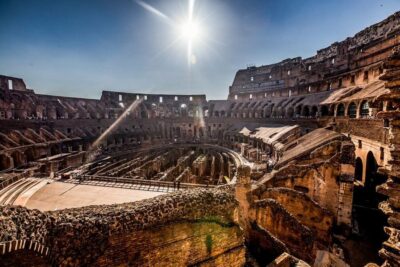
Colosseum: Underground and Ancient Rome Tour
Read our review →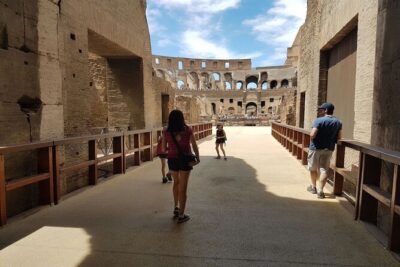
Colosseum & Ancient Rome with Arena Floor Option I Max 6 People
Read our review →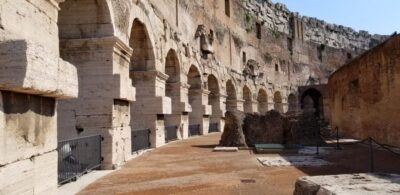
Colosseum, Ancient Rome Tour or Self AudioGuided Tour
Read our review →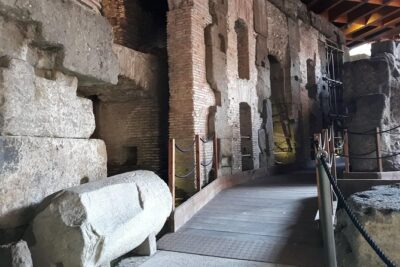
Colosseum Underground & Ancient Rome Guided Tour
Read our review →
Ancient Rome: Colosseum Underground Group Tour
Read our review →
Colosseum Express Guided Tour and Ancient Rome Admission Included
Read our review →
Colosseum Arena Access and Ancient Rome Guided Tour
Read our review →
Ancient Rome Discovery: Colosseum, Forum, Palatine Guided Tour
Read our review →Browse the lists this tour appears in