
Reviewed · TRASTEVERE TOURS
Jewish Quarter and Trastevere District Private Walking Tour
Rome’s Jewish Ghetto and Trastevere are two of Rome’s most rewarding neighborhoods for a walk, and this tour links them with ancient theaters, bridges, churches, and the only island in the Tiber. You move from the quiet lanes around the Portico of Octavia to the lively streets of Trastevere, with a guide to connect the scattered pieces.
I like the private format, especially if your group has children, students, or mixed interests. I also like the route’s variety: you get Roman ruins, Jewish history, medieval streets, river views, and important churches in one outing. The main caution is that the tour is a walking overview, not an in-depth visit to every monument, and the synagogue is listed as an exterior stop.
Key points at a glance
- A private group walk for up to 10: You have the guide to yourself, so questions and pacing can be adjusted.
- Jewish Ghetto context: The route includes the Portico of Octavia, the former ghetto area, Piazza Mattei, and the synagogue exterior.
- Ancient bridges and Tiber Island: Ponte Rotto, Ponte Fabricio, and Isola Tiberina give the walk a strong Roman setting.
- Two very different neighborhoods: Trastevere shifts the mood from historic Jewish Rome to narrow lanes, small squares, and old churches.
- Strong guide potential: Yevgen, also referred to as Yev, is praised for keeping a tired student group engaged and adapting the route.
- Good group value: At $437.68 for as many as 10 people, the price works best when shared by a full group.
Why this route works so well in Rome
This is not a tour built around one blockbuster sight. Its appeal comes from the way the stops fit together.
You begin near the Theatre of Marcellus, a Roman theater built during the transition from republic to empire. From there, the route enters the former Jewish Ghetto, crosses the Tiber by old bridges, pauses on Tiber Island, and continues into Trastevere. The result is a compact lesson in how Rome changed over time without losing its older layers.
That makes this a useful choice if you have already seen the Colosseum and Vatican Museums and want a slower, street-level side of Rome. You are not spending the afternoon in a large museum line. Instead, you are moving through neighborhoods where the past appears in fragments: a fountain, a broken bridge, an ancient portico, a small church, or a worn stone lane.
The private setup matters here. A large group would make it harder to hear a guide in narrow streets or stop for questions. With only your own party, you can ask about Jewish Roman life, bridge construction, church art, or the best place to continue after the tour.
More Jewish Ghetto tours:
- Rome: Trastevere or Jewish Quarter Street Food Tour
★ 4.8 · 3,839 reviews - Jewish Ghetto and Trastevere Tour Rome
★ 4.5 · 1,729 reviews - Jewish Ghetto and Synagogues with Jewish Roman Guide 3 Hours
★ 5.0 · 907 reviews
From the Theatre of Marcellus to Piazza Mattei
The meeting point is Antico Caffè del Teatro di Marcello, at Via del Teatro di Marcello 42. The first stop is the Theatre of Marcellus, viewed from outside.
Julius Caesar cleared the site, but he was killed before construction began. Augustus completed the theater in 13 BC and named it for his nephew Marcus Claudius Marcellus, who had died years earlier. Performances of drama and song once took place here, and the surviving structure still shows how Roman buildings were reused across the centuries.
You receive about 15 minutes at this stop. That is enough for an explanation and photographs, but not for a long archaeological visit. The strength of the stop is the setting. The theater is not isolated behind a gate or presented as a single museum object. It sits within the modern city, allowing you to see ancient Rome as part of the present street scene.
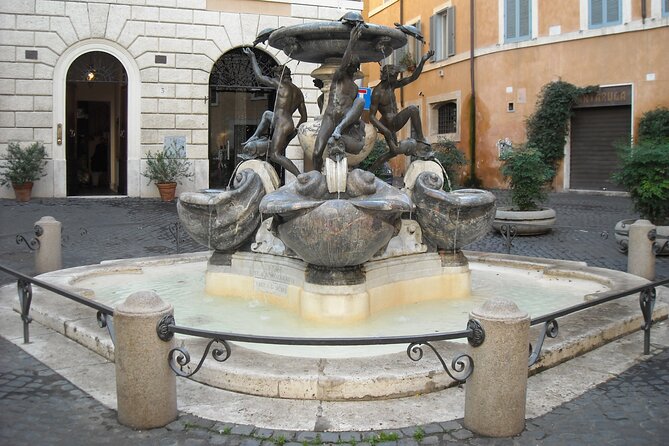
The route then reaches Piazza Mattei, a small square centered on the Fountain of Turtles. The fountain was designed by Giacomo Della Porta, with bronze figures by Taddeo Landini. Turtles were added later, probably by Gian Lorenzo Bernini, and the originals were repeatedly stolen. The turtles now visible are copies, while surviving originals are kept in the Capitoline Museums.
This is an easy stop to overlook if you are walking alone, which is exactly why a guide helps. The fountain is small, attractive, and full of details that reward a close look. Do not expect a major piazza with room to spread out. Expect a brief pause in a compact urban corner.
The Jewish Ghetto and the Portico of Octavia
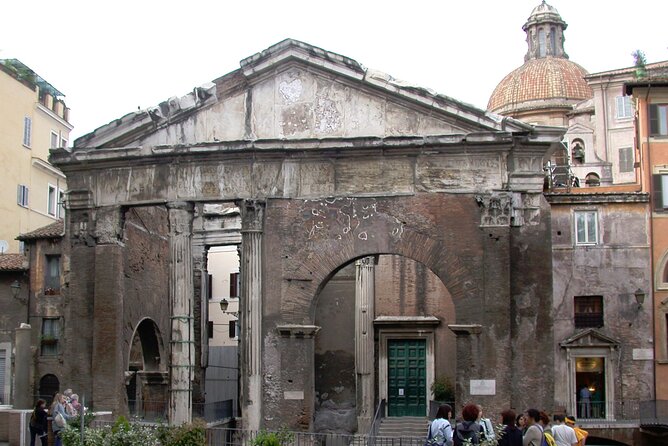
The walk continues through the former Jewish Ghetto, one of the most meaningful parts of the route. The itinerary includes the Portico of Octavia, a Roman structure that once enclosed temples dedicated to Jupiter Stator and Juno Regina, along with a library.
In the medieval period, the portico became a fish market. That shift from imperial religious complex to market tells you something important about Rome: buildings rarely have only one life. The remains are not just ancient stones. They also point to the daily work, trade, and changing communities that shaped this neighborhood.
The ghetto itself deserves careful treatment. A good guide can place the streets and monuments in their Jewish Roman context rather than presenting them as a quick stop between famous churches. This is where guide quality matters most. Yevgen, also identified as Yev, is specifically praised for answering questions, allowing time for photographs, and adjusting the route to suit the group’s previous experience.
The synagogue is viewed from outside according to the stated itinerary. It was built between 1901 and 1904 on the Tiber, overlooking the former ghetto. Its design combines Assyrian-Babylonian, Egyptian, and Greco-Roman elements, while the interior uses Art Nouveau decoration.
You should be clear about the visit before booking: the synagogue is not presented as an included interior admission. One account describes a guide saying that it could not be visited, followed by the group entering and finding that it was the highlight of the area. That suggests access can vary, but it does not guarantee entry. If seeing the interior is essential to you, confirm the arrangement in advance and do not assume the exterior stop includes it.
Crossing Rome’s old bridges
After the Jewish Ghetto, the route shifts toward the Tiber. Ponte Rotto, or Broken Bridge, is the surviving arch of the ancient Pons Aemilius. The bridge began as a wooden crossing in the second century BC and was later rebuilt in stone.
Only part of it remains, rising from the river near Tiber Island. It is a brief stop, but it gives the walk a strong visual change. Instead of looking at a monument from a square, you are looking across water at a broken piece of Roman infrastructure.
Next comes Ponte Fabricio, also called Ponte dei Quattro Capi. Built in 62 BC, it is the oldest Roman bridge in Rome that still survives in its original state. It links the Campus Martius side of the river with Tiber Island.
The name Four Heads refers to the marble pillars bearing two-faced Janus herms on the parapet. These details are easy to miss when you are simply crossing the bridge, so your guide can point them out. The bridge is functional as well as historic, which makes the stop feel connected to everyday Rome rather than sealed off as an archaeological exhibit.
The itinerary allows roughly 15 minutes at each bridge. That is enough for a short explanation and photographs. It is not enough for a full discussion of Roman bridge engineering or the whole history of the Tiber, so visitors with a strong specialist interest should keep their expectations in check.
More Trastevere tours:
- Winner 2025 Rome Twilight Trastevere Food Tour by Eating Europe
★ 5.0 · 5,157 reviews - Rome: Trastevere Food tour with Free-Flowing Fine Wine
★ 5.0 · 2,853 reviews - Rome: Trastevere & Campo de Fiori Street Food Walking Tour
★ 4.9 · 2,768 reviews - Rome: Award Winning Trastevere Group Food Tour with Wine
★ 5.0 · 2,273 reviews
Tiber Island and its medical past
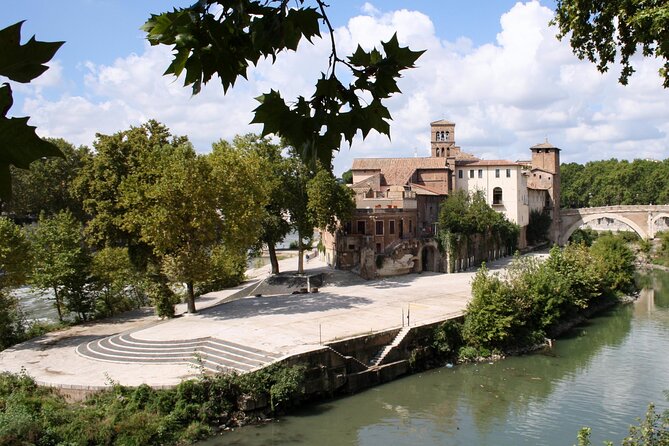
Isola Tiberina is the only river island in the section of the Tiber that runs through Rome. It is boat-shaped, about 270 meters long and 67 meters wide, and has been connected to both riverbanks by bridges since antiquity.
The island has long been linked with medicine and healing. An ancient temple to Asclepius once stood here, and the island remains associated with hospitals. The Fatebenefratelli Hospital dates from the 16th century, while San Bartolomeo all’Isola dates from the 10th century.
This stop gives the tour a useful pause between the two neighborhoods. You are no longer in the tight streets of the ghetto, but you have not yet reached the main squares of Trastevere. The river also helps you understand Rome’s geography. The districts on opposite banks are close, but their street patterns and atmosphere can feel quite different.
Again, the visit is a walk-through stop rather than a formal admission. You will have time to look around, listen, and take pictures, but the tour does not include private transportation or bottled water. Bring your own water, especially in hot weather.
Entering Trastevere through small streets
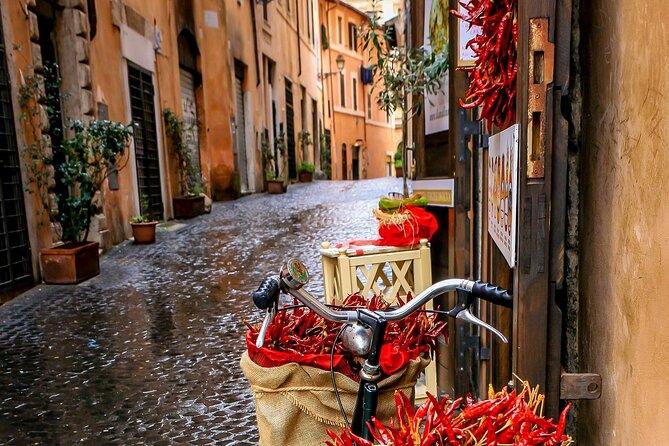
Trastevere means beyond the Tiber, and the route now enters the district through its older streets. This part is less about one grand monument and more about the rhythm of the neighborhood: cobblestones, uneven lanes, small squares, and layers of medieval construction.
That does not mean every street is quiet. Trastevere is a popular part of Rome, and its appeal comes partly from the mix of residential corners, restaurants, churches, and public spaces. The route gives you an introduction rather than a complete survey.
At Piazza in Piscinula, medieval structures known as the Case Mattei frame the square. The tiny Church of San Benedetto in Piscinula adds another point of interest. The square is also described as a calm area that can function as a parking spot, so do not expect a grand ceremonial piazza. Its value is its scale and modesty.
This is the sort of place where a private guide can make the difference. You can stop for a detail, ask about the unusual name, or move on if your group is more interested in churches or street scenes. A fixed large-group schedule would have less room for those choices.
Santa Cecilia and Santa Maria in Trastevere
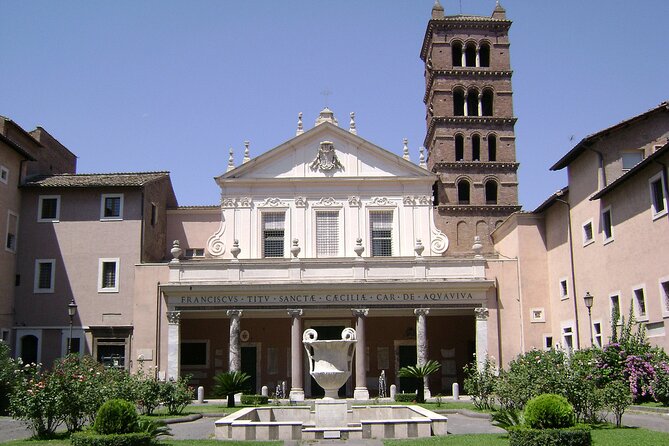
The next church is Santa Cecilia in Trastevere, dedicated to Saint Cecilia, a Roman martyr associated with the early third century. The first church on the site was probably founded in the third century by Pope Urban I, and the present church dates in part to the fifth century.
The tour allows about 15 minutes here. That makes the church a concise architectural and historical stop, not a long art-focused visit. If you are especially interested in sacred art, ask your guide what can be seen during the tour and how much time is available inside.
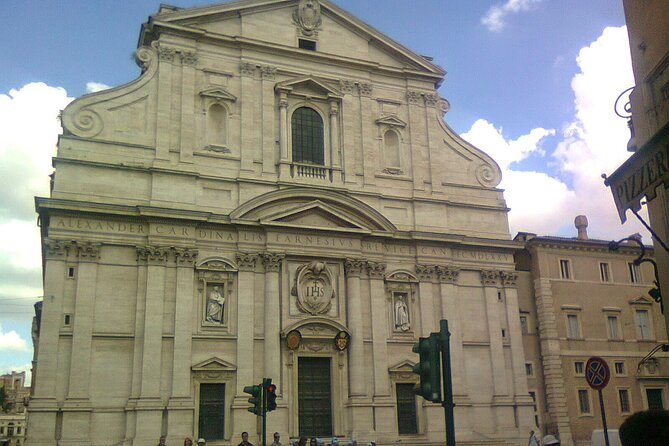
The final major stop is the Basilica of Santa Maria in Trastevere, one of Rome’s oldest churches. Its floor plan and wall structure date to the 340s, while much of the present building comes from the 12th century. The basilica is also known for important late 13th-century mosaics by Pietro Cavallini.
This church gives the walk a fitting finish. After ancient Roman ruins, Jewish Roman landmarks, bridges, and narrow lanes, you arrive at a large historic church with a long Christian past. The itinerary lists 15 minutes here, so you will get an introduction and time to look, but not an extended art lecture.
The activity ends back at the original meeting point. That is practical if you need to retrieve something nearby or continue with dinner plans, though returning to the start means the route does not function as a one-way transfer to another part of Rome.
How the private price works
The listed cost is $437.68 per group of up to 10 people. For a full group, that works out to about $43.77 per person. For two people, the effective cost is about $218.84 each, which is a much bigger commitment.
I see the strongest value for families, school groups, or friends who can fill most of the 10-person limit. You are paying for a licensed local guide for about three and a half hours, not for admission to a series of paid attractions. The value comes from the explanation, route planning, and ability to ask questions.
For a small party, compare the cost with a shared walking tour before booking. The private experience can still be worthwhile if you care about flexible pacing or have a particular interest in Jewish Rome, but it is not the budget choice for a couple.
The tour is offered in English, uses a mobile ticket, and operates near public transportation. Most people can participate, and service animals are allowed. Comfortable shoes are a sensible choice because the route includes cobbled streets and several bridge crossings.
Guide quality and the importance of fit
The strongest praise is directed at guide Yevgen, also called Yev. He kept a jetlagged student group interested, adapted the route to experience they already had, answered questions, and allowed time for photographs. Those are useful signs for anyone booking a private walk, because a guide who adjusts the pace can make the difference between a pleasant outing and a tiring list of facts.
The experience has also had a poor match with another guide. One account describes a guide who was nervous, difficult to understand, and gave information the visitor felt was inaccurate. The provider responded that Karin is one of its experienced Rome guides with a specialty in Jewish history, while also acknowledging that guide and group fit can affect the day.
That contrast is worth taking seriously. A private tour does not automatically guarantee a perfect guide match. If the Jewish Ghetto is your main reason for booking, ask about the guide assigned to your date and explain your interests clearly. The company may be able to match the tour more closely to your needs.
Who should book this walk?
I would choose this tour if you want a neighborhood-focused introduction to Rome rather than another major-ticket attraction. It suits first-time visitors who want context, repeat visitors who have already covered the central sights, and groups that enjoy asking questions as they walk.
It is also a good fit for students. The route connects ancient Rome, Jewish history, Christian sites, and modern city life without requiring a full day. A private guide can keep the pace moving and respond when attention starts to fade.
You may want something else if you need extensive interior visits, wheelchair-specific planning, or a specialist-level lecture at every stop. The tour is mainly an outdoor walking route, the synagogue is listed as exterior only, and each stop is fairly brief.
Cancellation is free if you cancel at least 24 hours before the start time. Changes or cancellations made later are not refunded, and the cutoff uses local Rome time.
Should you book it?
Book this walk if your group values personal attention and wants to connect the Jewish Ghetto, Tiber Island, and Trastevere in one well-shaped route. The ancient bridges and smaller squares give you a side of Rome that can be missed when you stick to the headline monuments.
I would be more cautious if you are traveling as only two people and are focused on keeping costs low. I would also confirm the synagogue arrangements and guide assignment before paying. With those points settled, the tour offers a useful three-and-a-half-hour introduction to Rome’s Jewish quarter and the streets beyond the Tiber.
FAQ
How long does the Jewish Quarter and Trastevere tour last?
The tour lasts approximately 3 hours and 30 minutes.
How many people can join the private tour?
The private tour is available for a group of up to 10 people. Only your group participates.
What language is the tour offered in?
The tour is offered in English.
Where does the tour start?
It starts at Antico Caffè del Teatro di Marcello, Via del Teatro di Marcello 42, Rome.
Where does the tour end?
The activity ends back at the original meeting point.
Is entry to the synagogue included?
The planned synagogue stop is outside the building. Interior entry is not listed as an included part of the tour, so confirm access before booking if it is important to you.
Is transportation included?
Private transportation is not included. The experience is a walking tour, and it operates near public transportation.
What is the cancellation policy?
You can cancel for a full refund up to 24 hours before the experience start time. Cancellations or changes made less than 24 hours before the start are not refunded.
More walking tours in Rome
- Rome: Paranormal Night Walking Tour & Secret Backstreets
★ 4.9 · 1,921 reviews - Rome by Night Walking Tour – Legends & Criminal Stories
★ 4.5 · 1,003 reviews - Rome: Guided City Center Evening Sightseeing Walking Tour
★ 4.4 · 953 reviews - Best of Rome Walking Tour including Trevi Fountain
★ 4.5 · 923 reviews
Newest Rome tours we have reviewed
- Private TikTok Video Making in Rome★ 5.0 · 7 reviews
- Assisi, Orvieto and Civita di Bagnoregio Full Day Tour from Rome★ 4.5 · 45 reviews
- Assisi & Saint Francis Path Tour from Rome★ 5.0 · 45 reviews
- Assisi and Cascia Private Day Tour from Rome with Lunch★ 5.0 · 10 reviews
- Art Class in the center of Rome!★ 4.0 · 4 reviews
- Art & Craft: Beer Tour with Street Art in Rome★ 4.5 · 6 reviews
- Arrival in Rome: Airport Transfer & Exclusive City Introduction★ 5.0 · 3 reviews
- From Rome: Private Day-Tour of Tuscany★ 5.0 · 16 reviews
Trastevere Tours, compared.

Winner 2025 Rome Twilight Trastevere Food Tour by Eating Europe
Read our review →
Trastevere or Jewish Quarter Street Food Tour
Read our review →
Trastevere Food tour with Free-Flowing Fine Wine
Read our review →
Trastevere & Campo de Fiori Street Food Walking Tour
Read our review →
Award Winning Trastevere Group Food Tour with Wine
Read our review →

Rome Food Tour: Hidden Gems of Trastevere with Dinner & Wine
Read our review →Browse the lists this tour appears in