
Reviewed · ROME
Roma: Barocco, segreti e arte della città eterna
Rome’s Baroque center is best understood on foot, and this tour links several of Rome’s biggest sights in one compact walk. You’ll begin at Piazza Barberini and finish near the Spanish Steps, passing fountains, churches, old streets, and grand squares along the way.
I like the small group limit of 10, which gives the guide room to answer questions and adjust the pace. I also like the route’s mix of famous places and lesser-known detail, especially Sant’Ignazio’s unusual church interior and the story behind Trevi Fountain. The main drawback is time: 2.5 hours goes quickly, and each listed stop is planned for about 15 minutes.
Key points at a glance
- Trevi Fountain’s design: You learn more than the usual coin-toss tradition, including the idea behind its mythological figures and grand theatrical setting.
- A compact Baroque route: The walk connects Barberini, Trevi, the Pantheon, Sant’Ignazio, Piazza Navona, and the Spanish Steps without requiring transport between stops.
- Bernini’s Four Rivers Fountain: Piazza Navona provides the tour’s best lesson in art, symbolism, and Rome’s former stadium site.
- A group of up to 10: The smaller format makes questions and short pauses easier than on a large city walk.
- English or Italian guiding: You can choose between the two listed tour languages.
- Pantheon admission costs extra: The stop is included, but the entry ticket is not.
Why this Rome walk works well
Rome can feel like a city of separate sights. One moment you are looking at a fountain, then you turn a corner and find an ancient temple, a painted church, or a square that once served a very different purpose. This walk helps connect those pieces.
The route focuses on central Rome, where the distances between major sights are manageable on foot. You will not spend time loading onto a bus or finding your way through unfamiliar streets. Instead, the guide can explain what you are seeing as the city changes around you.
The price is $94 per person. That is not a bargain-priced orientation walk, so the value depends on how much you want from the guide. For someone who wants a short introduction to central Rome, a small group, and help making sense of art and architecture, the cost can be reasonable. If you only want quick photographs at the main sights, you could cover much of this route yourself for less.
The strongest reason to book is the guide. The limited group size gives the guide more room to answer questions and spend a little extra time where your interest is strongest. One participant was helped when a late train caused a delayed arrival, which suggests some flexibility is possible, though you should not assume the start can always be held.
Other Rome tours people pair with this one:
- Vatican Museums & Sistine Chapel Tour with Optional Basilica
★ 4.3 · 67,413 reviews - Vatican Museums, Sistine Chapel & St Peter’s Basilica Guided Tour
★ 4.5 · 39,149 reviews - Rome: Colosseum, Palatine Hill and Roman Forum Guided Tour
★ 4.8 · 32,814 reviews
Starting beside the fountain in Piazza Barberini
Your meeting point is next to the fountain in Piazza Barberini. This is a useful starting place because it puts you in central Rome before the walk heads toward Trevi Fountain and the city’s famous shopping streets.
Piazza Barberini is also a proper Roman square, not just a pickup point. It gives you an early taste of the city’s Baroque character and prepares you for the fountains and theatrical public spaces ahead.
Look for the guide beside the fountain rather than simply arriving somewhere in the general square. Give yourself enough time to locate the correct person, especially if you are unfamiliar with Rome or arriving by public transport.
The walk is offered in English or Italian. No guide name is provided in the tour details, so you should not expect to request a particular guide in advance. The guide is the main source of context throughout the experience, and past comments place strong emphasis on friendly service, preparation, and helpful answers.
Trevi Fountain: more than a coin toss
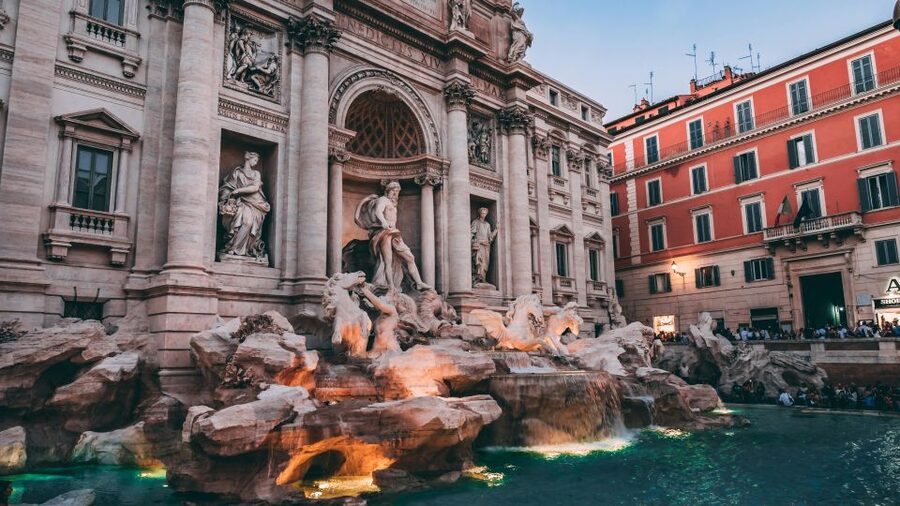
Trevi Fountain is the first major stop. It is one of Rome’s most famous sights, and the tour asks you to look beyond the standard photograph.
The fountain’s design is filled with mythological figures and moving water. Its broad central sculpture gives the scene a grand, almost stage-like quality. Your guide explains the concept behind the fountain, helping you see how the figures, water, and setting work together.
You will have time for a photo stop and a guided visit, with the planned stop lasting about 15 minutes. That is enough for an introduction and photographs, but not a slow study of every detail. The area can be crowded, so listen carefully for the meeting point before you spread out for pictures.
The famous coin tradition is part of the experience. Tossing a coin into the water is meant to ensure your return to Rome. It is a small ritual, but it suits Trevi’s theatrical mood. Bring a coin if you want to take part, though the tour does not require it.
Trevi is one of the places where a guide adds real value. Without context, you may simply see a beautiful fountain. With an explanation of the concept, the mythological subjects and dramatic composition become easier to read.
The Pantheon and the question of admission
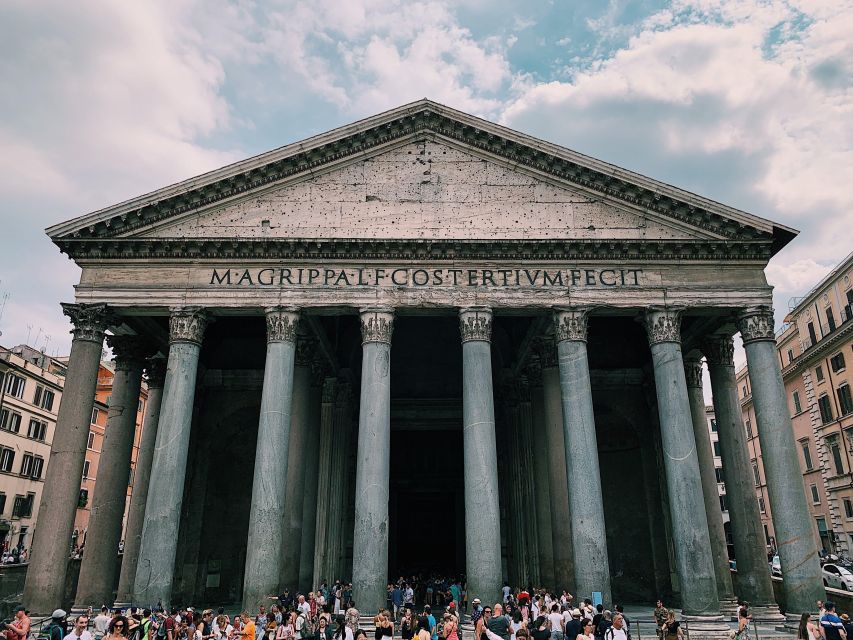
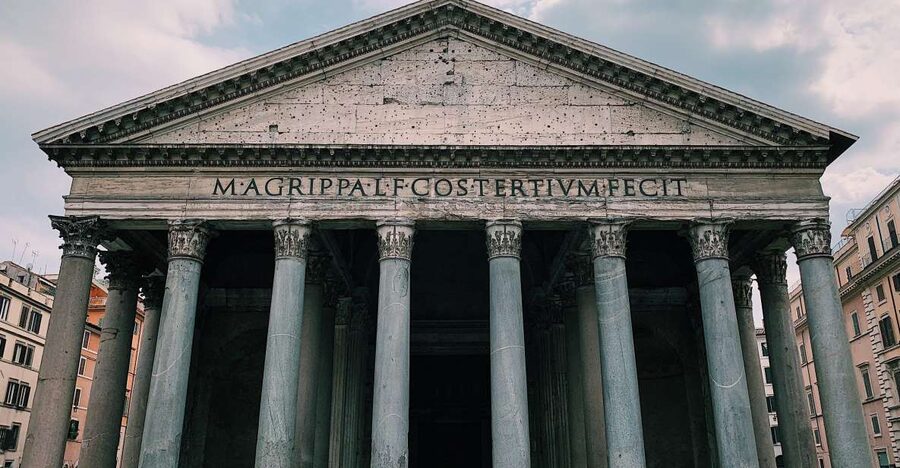
The walk continues to the Pantheon, one of Rome’s great ancient buildings. The tour includes a guided stop, but the entry ticket is not included in the price.
That distinction matters. The schedule lists about 15 minutes here, so the guide may focus on the building’s outside, history, engineering, and key interior features depending on access and timing. If you want to go inside, budget separately for admission and check the current entry conditions before booking.
The Pantheon is famous for its huge rotunda and central oculus, an opening in the roof that brings daylight into the interior. The building’s scale is easier to appreciate when someone points out how the dome and round interior work together. Its bronze doors and marble surfaces also make the entrance memorable.
Raphael is buried inside, along with other important figures. The guide can give this stop more meaning than a quick look at the facade, but the short scheduled time means you should treat it as an introduction rather than a full Pantheon visit.
If entering the building is a priority, ask the guide how the stop will work on your chosen date. The supplied details clearly state that admission is extra, so do not assume the $94 covers it.
Same city, a completely different half-day:
- Rome: Guided Tour of Colosseum, Roman Forum & Palatine Hill
★ 4.7 · 27,897 reviews - Rome: Colosseum & Forum with Audio Guide App -Optional Arena
★ 4.2 · 24,770 reviews - Rome: Colosseum, Roman Forum and Palatine Hill Guided Tour
★ 4.5 · 23,903 reviews - Rome: City Sightseeing Hop-on Hop-off Bus with Audioguide
★ 4.0 · 16,045 reviews
Sant’Ignazio: a quieter art stop
The Church of Sant’Ignazio di Loyola is a welcome change from the headline sights. It is included as a guided stop and gives the route a more local, less predictable rhythm.
The church is known for its painted interior and dramatic visual effects. Since the experience description specifically includes Sant’Ignazio, this is one of the places where the guide can show you something you might otherwise pass without understanding.
The scheduled visit is about 15 minutes. That is enough for a focused explanation and a look around, but not a long church tour. Keep your expectations in line with the format: this is one stop within a larger walking route, not a dedicated art-history visit.
I like this addition because it prevents the walk from becoming a simple checklist of Rome’s most photographed locations. You get a chance to see how Roman art works inside a church as well as in open squares and fountains.
Piazza Navona and Bernini’s Four Rivers Fountain
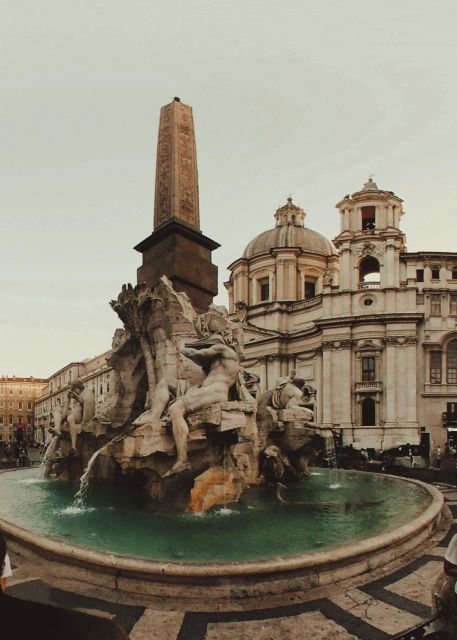
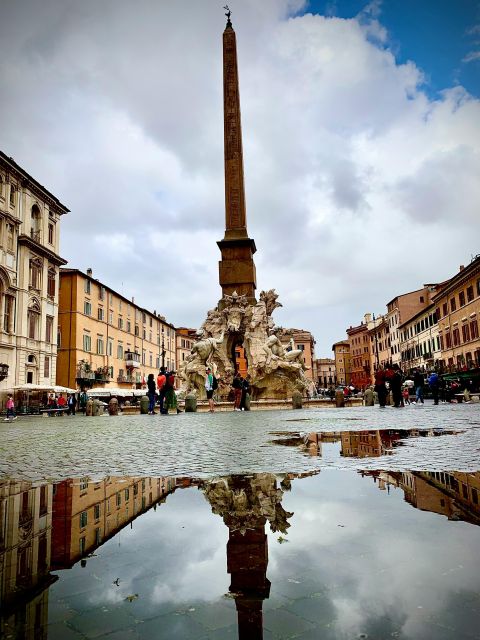
Piazza Navona is the route’s grand public square. Its long shape reflects its earlier use as a stadium, a detail that helps explain why the piazza feels so different from a regular town square.
The guide covers the old stadium and the buildings around the piazza, then turns attention to its fountains. Piazza Navona has three fountains, with Bernini’s Fountain of the Four Rivers receiving the most attention.
The Four Rivers Fountain uses sculpted figures and a tall central obelisk to represent major rivers and continents known to the designers. It is not just decoration. The work combines sculpture, water, symbolism, and political display in one crowded composition.
A 15-minute stop is enough to identify the main figures and explain the fountain’s purpose. It is not enough to inspect every carving, so stay close if the square is busy. Street artists and musicians may add to the atmosphere, but they are not a promised part of the tour.
This is probably the strongest stop for visitors who want art explained in plain terms. The guide can help you understand why the fountain looks so theatrical and how it fits the square around it.
The Spanish Steps and Via Condotti
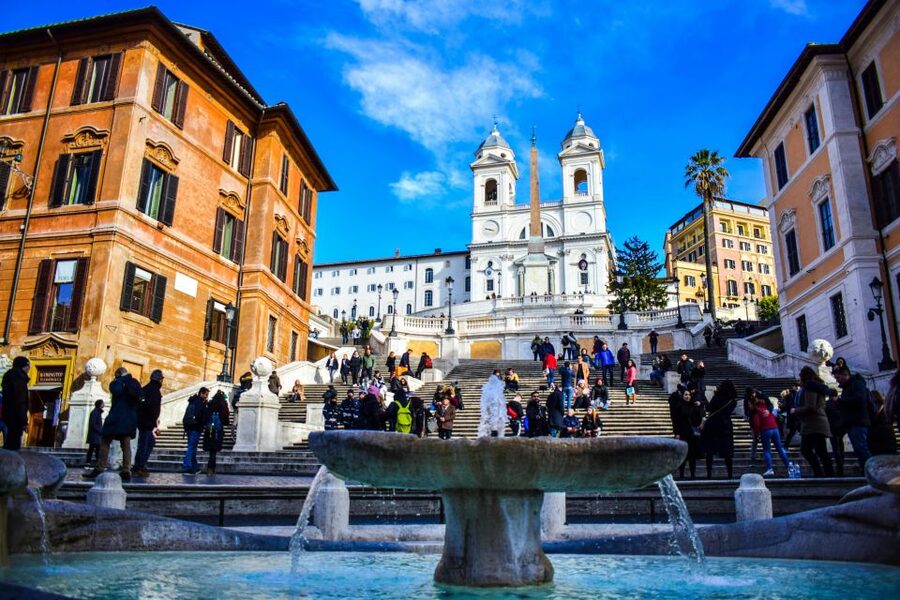
The final major area is Piazza di Spagna, home to the Spanish Steps. The staircase has been a meeting place since the 18th century and remains one of Rome’s most recognizable public spaces.
You will have a photo stop and guided visit, with time to look at the steps and the square below. The climb offers a view back over Piazza di Spagna, though the tour details do not promise a long pause at the top.
The nearby Via Condotti is one of Rome’s best-known shopping streets. It adds a different side of the city after the ancient Pantheon and Baroque fountains. Here, Rome’s old streets meet modern luxury shopping and cafe life.
The Spanish Steps can be crowded, and the stop is short. If you want extended shopping time or a relaxed coffee, plan to return after the tour. The route introduces the area but does not leave much room for browsing.
Ending here makes practical sense. You finish in a lively central part of Rome with easy access to more walking, shopping, cafes, and nearby sights. The tour does not include transportation back to Piazza Barberini.
What the small group changes
The tour is limited to 10 people. That is a useful middle ground. You still have company, but the group should be easier to keep together than a large city walk.
A small group also gives you a better chance to ask questions. One particularly positive account described a guide who answered questions about Rome’s past and present, offered help throughout the walk, and allowed extra time at certain places. The same guide also worked with a late-arriving participant whose train had been delayed.
That kind of flexibility is valuable in Rome, where trains, crowds, and narrow streets can disrupt a tight schedule. Still, arrive on time. Extra help may be possible, but it is not a guaranteed late-arrival policy.
The tour is listed as wheelchair accessible. The route includes cobblestone streets, public squares, fountains, and historic sites, so you may want to confirm the practical route details before booking if you have specific mobility needs.
Timing, pace, and what to bring
The total duration is 2.5 hours. The listed stops are each planned for around 15 minutes, with the remaining time used for walking and explanations between locations.
Expect a steady city walk rather than a long stop at each landmark. Wear comfortable shoes and bring water. The route moves through central Rome, where pavement, crowds, and uneven streets can affect your pace.
The tour is available at several possible starting times, depending on the date. Check the available departure before booking, especially if you are fitting the walk around a train, museum reservation, or meal.
Because the tour finishes at Piazza di Spagna, think of it as a one-way introduction to central Rome. It does not return you to the starting point, and that is actually useful if you want to continue exploring near the Spanish Steps afterward.
Is $94 a fair price?
At $94 per person, this is best viewed as a guided orientation rather than a cheap sightseeing walk. The price includes the live guide, the small group format, and explanations at several major landmarks. It does not include the Pantheon entry ticket.
The value improves if you want art and history explained instead of simply being led from one photograph to the next. It also improves if you are new to Rome and want a clear first look at central sights without planning the route yourself.
The value is weaker if you already know Rome well, prefer to explore alone, or plan to spend a long time inside the Pantheon. In that case, you may want a focused museum or church tour instead.
The available ratings are very strong, with a perfect 5 out of 5 from five bookings. The most consistent praise concerns the guide’s friendly manner, preparation, helpfulness, and ability to answer questions. That is the feature I would weigh most heavily when deciding.
Who should book this walk?
I would recommend it to first-time Rome visitors who want a compact introduction to central landmarks. It also suits couples, families, and small groups who prefer conversation with a guide rather than a large crowd.
It is a good fit if you want to see Trevi Fountain, the Pantheon, Sant’Ignazio, Piazza Navona, the Four Rivers Fountain, and the Spanish Steps in one outing. The route gives you enough background to return later with a better sense of what deserves more time.
I would hesitate if your main goal is extended interior visits. The short stop times and extra Pantheon admission make this less suitable for a detailed art or archaeology day. It is also not ideal if you want a slow cafe break or a long shopping stop along Via Condotti.
Should you book it?
Book this tour if you want a small-group introduction to Rome’s Baroque center and value a guide who can explain the ideas behind the monuments. The strongest parts are the connected route, the Four Rivers Fountain, Sant’Ignazio, and the chance to ask questions.
Skip it if you prefer setting your own pace or want to spend serious time inside the Pantheon. If you do book, arrive at the fountain in Piazza Barberini on time, wear good walking shoes, and plan for the Pantheon ticket as an extra cost.
FAQ
Where does the tour begin?
The meeting point is next to the fountain in Piazza Barberini.
Where does the tour finish?
The route finishes at Piazza di Spagna, near the Spanish Steps.
How long does the tour last?
The tour lasts 2.5 hours.
What language is the tour offered in?
The live guide conducts the tour in English or Italian.
How large is the group?
The tour is limited to 10 participants.
Is the Pantheon entry ticket included?
No. The Pantheon entry ticket is not included in the tour price.
Which landmarks are included?
The route includes Trevi Fountain, the Pantheon, the Church of Sant’Ignazio di Loyola, Piazza Navona, the Fountain of the Four Rivers, and Piazza di Spagna.
Is the tour wheelchair accessible?
Yes, the activity is listed as wheelchair accessible.
What does the tour price include?
The $94 price includes the tour guide. Pantheon admission is not included.
Can I cancel for a full refund?
Yes. You can cancel up to 24 hours in advance for a full refund.
Newest Rome tours we have reviewed
- Private TikTok Video Making in Rome★ 5.0 · 7 reviews
- Assisi, Orvieto and Civita di Bagnoregio Full Day Tour from Rome★ 4.5 · 45 reviews
- Assisi & Saint Francis Path Tour from Rome★ 5.0 · 45 reviews
- Assisi and Cascia Private Day Tour from Rome with Lunch★ 5.0 · 10 reviews
- Art Class in the center of Rome!★ 4.0 · 4 reviews
- Art & Craft: Beer Tour with Street Art in Rome★ 4.5 · 6 reviews
- Arrival in Rome: Airport Transfer & Exclusive City Introduction★ 5.0 · 3 reviews
- From Rome: Private Day-Tour of Tuscany★ 5.0 · 16 reviews