
Reviewed · ROMAN FORUM AND PALATINE HILL TOURS
Roman Forum Myths and Legends Private Guided Tour
The most gripping part of this tour is how it turns scattered stones into stories. At the Lapis Niger, you hear the legend of Romulus’s burial. At the Temple of Vesta, the fate of the Vestal Virgins brings ancient Roman religion sharply into view. Myth gives the ruins a human voice.
I like the private format, since your guide can focus on the questions and interests of your own group. I also like the use of images and artists’ renderings, which helped guide Paolo explain what the vanished buildings may have looked like. The main drawback is price: at $286.60 per person, this is a serious splurge for a two-hour walk, especially since Colosseum entry is not included.
Key points to know before you book
- Romulus and Rome’s sacred center: The route links the Forum to stories about Rome’s founding, the Mundus, and the city’s earliest religious beliefs.
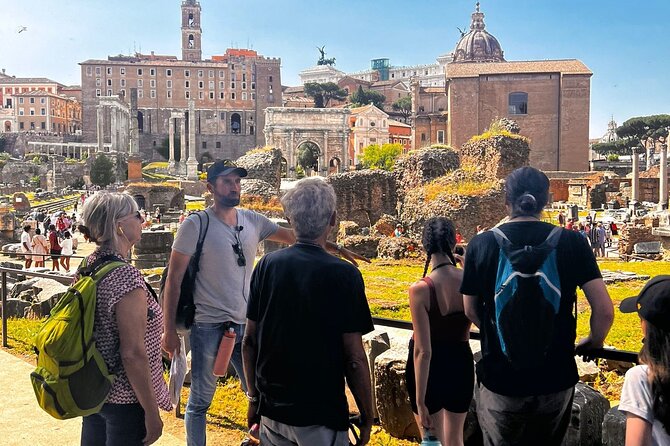
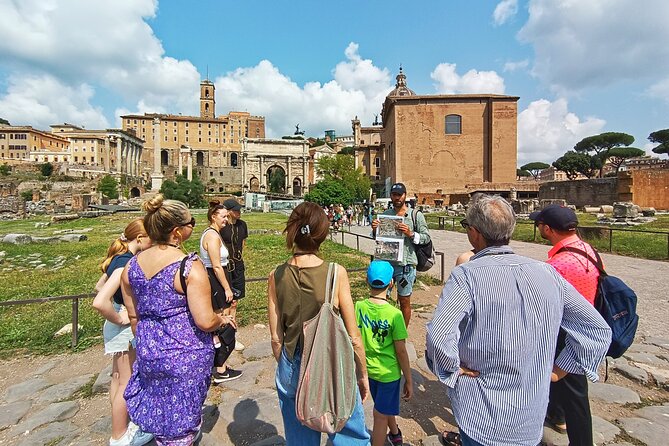
- Paolo’s visual storytelling: Paolo has used artists’ renderings to help make the broken temples and basilicas easier to picture.
- A private two-hour visit: Your group receives a more personal pace and direct access to the guide.
- Strong focus on myths and religion: Expect stories about Juturna, Saturn, Castor and Pollux, Vesta, and the Vestal Virgins.
- Useful ticket coverage: Admission includes the Roman Forum, Palatine Hill, and Imperial Forums, but not the Colosseum.
- Bring your passport or ID: Full names and valid identification are required for guaranteed entry.
Why myths help make sense of the Roman Forum
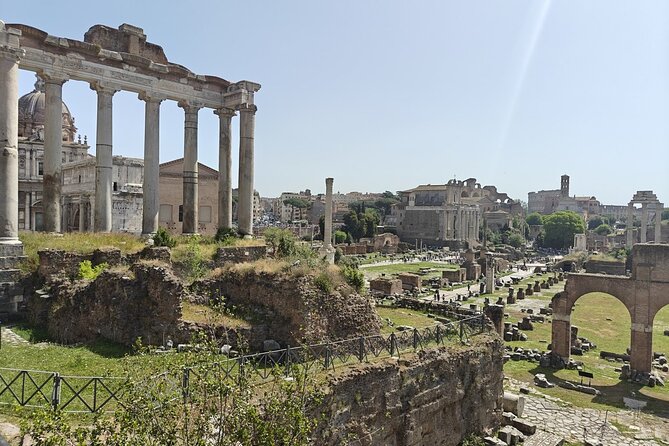
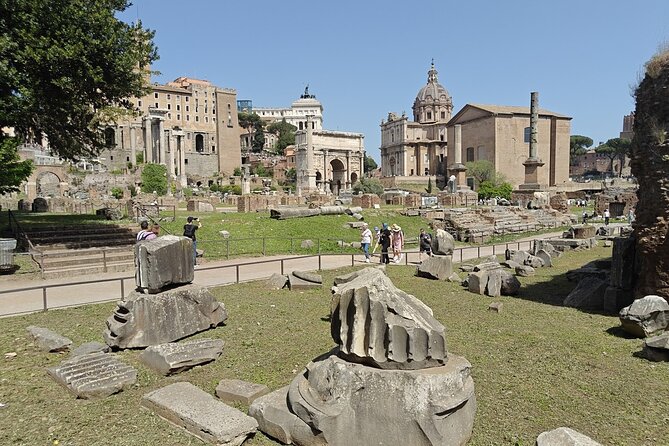
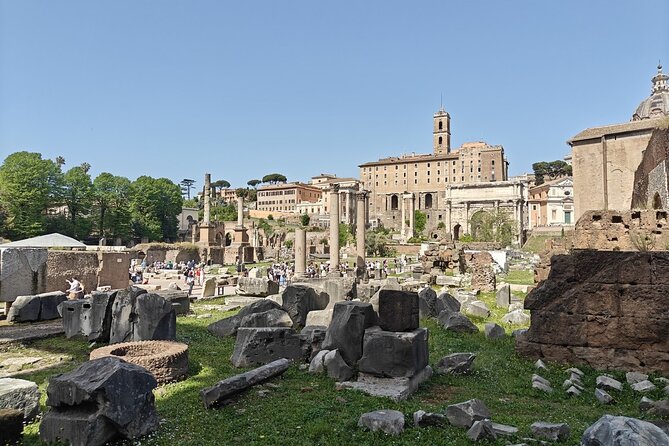
The Roman Forum can be hard to read on your own. You see columns, low walls, paving stones, and fragments spread across a broad archaeological site. Without a guide, it is easy to admire the view and miss what each place meant to Roman life.
This tour takes a different path. Instead of treating the Forum as a list of ruins, it follows stories about kings, gods, soldiers, political leaders, and sacred rituals. That approach is especially useful if you enjoy the way legends reveal what a society feared, admired, and considered holy.
You will hear about Romulus and Remus, the traditional founders of Rome, then move through places tied to public law, religious duty, military success, and imperial power. The stories are not all historical fact, and a good guide needs to separate legend from archaeology. That tension is part of the fun. Ancient Romans themselves often used myth to explain why a place mattered.
The route lasts about two hours. That is enough time to build a clear picture of the Forum without making you spend half a day among the ruins. It is also short enough to fit beside other major sights in central Rome.
More Roman Forum and Palatine Hill tours:
- Rome: Colosseum, Palatine Hill and Roman Forum Guided Tour
★ 4.8 · 32,814 reviews - Rome: Guided Tour of Colosseum, Roman Forum & Palatine Hill
★ 4.7 · 27,897 reviews - Rome: Colosseum, Roman Forum and Palatine Hill Guided Tour
★ 4.5 · 23,903 reviews
Starting at the Lapis Niger and the story of Romulus
The walk begins at the Lapis Niger, or Black Stone, an ancient shrine dating from the sixth century BCE. It was found by chance during excavations in 1899 beneath a medieval pavement. The discovery surprised archaeologists, since the site was linked by legend to Romulus, Rome’s first king.
According to the story, Romulus was murdered by his own people and buried here. The archaeology does not prove that tale, but the setting shows how closely Rome connected its political beginnings with sacred places.
This is a good opening stop because it sets up the tour’s main question: how did Rome use stories to explain its origins? You will also see why the Forum can be confusing. Some sites are linked to several periods, and the remains you see today often represent only a small part of an earlier building.
The stop is brief, about five minutes, so do not expect a long examination of the shrine. Its value comes from the story and from placing the Forum at the center of Rome’s legendary birth.
Basilica Emilia and the public business of Rome
Next comes Basilica Emilia, one of the Forum’s major public buildings. A Roman basilica was not originally a church. It was a place for meetings, legal business, and commercial activity.
Basilica Emilia was first built in the second century BCE and rebuilt several times after fires. Its ruins help explain how much daily business took place in the Forum. Rome was not only a setting for temples and triumphal arches. It was also a work center where senators, lawyers, merchants, and ordinary citizens dealt with public affairs.
The remains are fragmentary, so the guide’s explanation matters. You will need help picturing the building as a busy civic hall rather than a low set of stones. This is one place where the visual material used by Paolo can be useful. Artists’ renderings give the ruins a clearer shape and help you understand the scale of ancient construction.
Temples, rulers, and the changing use of sacred space
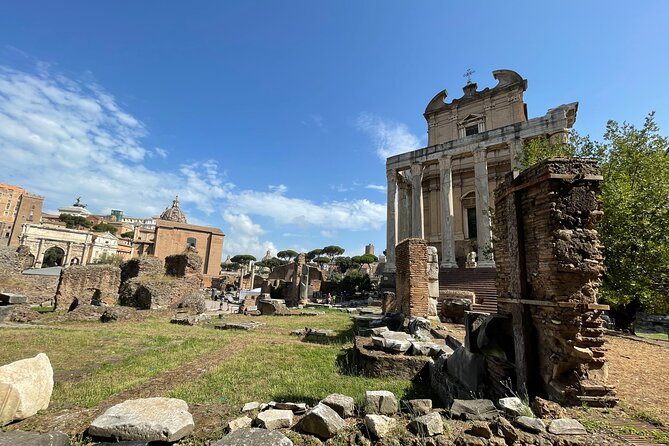
The Temple of Antoninus Pius and Faustina introduces the connection between imperial power and religion. It was dedicated to the deified emperor Antoninus Pius and his wife, Faustina the Elder.
The temple was built to honor the couple after their deaths. Its story also reflects how Roman religion changed over time. An emperor could become a divine figure after death, and a building in the Forum could honor both political authority and religious belief.
The temple later fell into disrepair and was used for other purposes. That later history is worth remembering as you walk through Rome. Ancient buildings did not simply remain untouched monuments. People reused their stone, altered their spaces, and gave them new roles.
The Regia nearby was associated first with Rome’s kings and later with the pontifex maximus, the chief priest of Roman religion. Legend connects it with Numa Pompilius and the goddess Egeria, who was said to advise him on government and religious matters.
Only a small amount of the Regia remains, but its importance was enormous. It was tied to ceremonies, religious rules, and political power. This stop helps explain why Roman leadership was never fully separate from religion. A ruler or high priest could influence both the state and the sacred calendar.
More ghost and legend tours in Rome:
- Rome by Night Walking Tour – Legends & Criminal Stories
★ 4.5 · 1,003 reviews - Haunted Rome Ghost Tour – The Original
★ 4.5 · 668 reviews - Haunted Rome Ghost Night Walking Tour
★ 5.0 · 495 reviews - Rome: Small Group Rome’s Dark Side – Ghosts & Legends Tour
★ 4.9 · 343 reviews
The Temple of Vesta and the Vestal Virgins
The Temple of Vesta is one of the most memorable places on the route. Here, the Vestal Virgins tended the sacred flame that symbolized the continuing life of Rome.
The Vestal Virgins were selected as young girls, usually between six and ten years old, and served for thirty years. They were expected to remain celibate and keep the flame burning. Their position brought unusual privileges, including the right to own property and the power to grant clemency to condemned prisoners.
The punishment for breaking the vow of chastity was severe. A guilty Vestal Virgin was buried alive. That detail can feel shocking, but it shows how seriously Romans treated the sacred fire and the women responsible for it.
The nearby House of the Vestal Virgins, called the Casa delle Vestali, was a large complex with living quarters, ritual spaces, and administrative areas. The ruins give you a better sense of the institution behind the famous priestesses. They were not simply caretakers living beside a small temple. They held a special place in Roman public life.
This part of the walk is especially good for anyone interested in women’s roles in ancient societies. The Vestals had more legal freedom and social status than most Roman women, but those privileges came with strict rules and heavy penalties.
Juturna’s spring and the healing power of water
The Fonte di Giuturna, or Juturna Spring, brings the tour back to a more personal myth. Juturna was associated with fountains, wells, and springs.
According to the legend, the god Jupiter desired Juturna. She escaped and became a spring. The water was believed to have healing powers, so people came to bathe in it.
This small site shows how mythology could be attached to ordinary needs. Water was essential in Rome, and a spring could be seen as both a practical resource and a sacred place. The stop lasts only about five minutes, but it adds variety to the tour after the larger temples and religious buildings.
Nearby, the Temple of Castor and Pollux recalls another legend. The twin gods, also called the Dioscuri, were said to have appeared on horseback in the Forum after Rome won the Battle of Lake Regillus. The Romans credited them with announcing the victory and protecting the state.
Only part of the temple remains, including its famous columns. The story connects military success with divine help, a theme that appears again and again in Roman public monuments.
Lacus Curtius and the Roman ideal of sacrifice
The Lacus Curtius is tied to one of Rome’s clearest stories of self-sacrifice. A deep chasm supposedly opened in the Forum, and the Sibylline Books declared that Rome could be saved only if its most valuable possession was thrown into the opening.
Marcus Curtius, a young soldier, rode into the chasm in full armor. The gap closed, and Rome was saved. The story later became a symbol of devotion to the city.
This is one of the route’s strongest legends because it presents a simple Roman ideal: the good citizen gives everything for the state. You can also use it to think about how ancient governments shaped public memory. A story like this taught courage, duty, and loyalty without needing a written law.
The stop takes about ten minutes. It is not a grand monument, so the guide’s narration is essential. You will get more from the meaning of the place than from the physical remains alone.
Saturn, the city center, and the Umbilicus Urbis
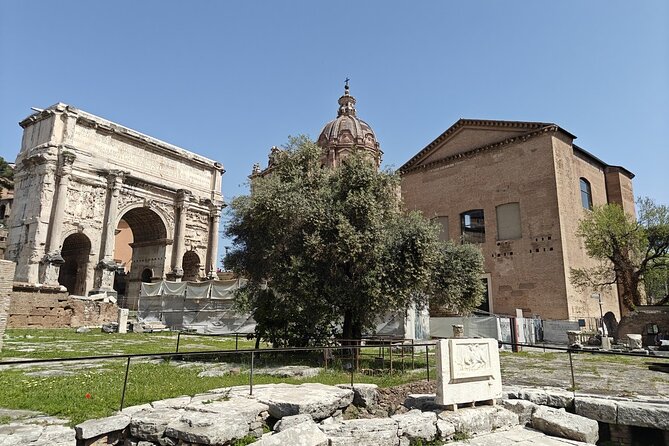
The Temple of Saturn was linked to Saturn, the agricultural god who was believed to have brought civilization and farming to Italy. It also housed the state treasury, which made it one of the most important buildings in Roman public life.
During Saturnalia, the festival held from December 17 to December 23, the treasury was opened and gifts were exchanged. Saturnalia is often remembered as a period of celebration and social role reversal, but the temple also shows the practical side of Roman religion. Sacred buildings could hold money, records, and state resources.
The Umbilicus Urbis, or Navel of the City, takes you back to the foundation of Rome. It marks the symbolic center of the city and is connected to the story of the Mundus.
According to Plutarch’s account, Romulus dug a circular pit and placed offerings in it, along with soil brought by his followers from their homelands. The pit marked the spiritual center of Rome. It was opened only three days each year so the living and the dead could communicate.
The idea is strange by modern standards, but it tells you how Romans understood the city. Rome was not only a collection of streets and buildings. It was a sacred boundary with a center, rituals, and links to the underworld.
Arches, roads, law, and the machinery of power
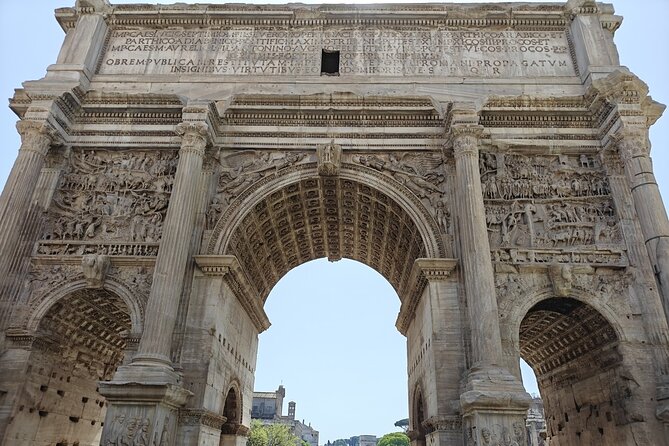
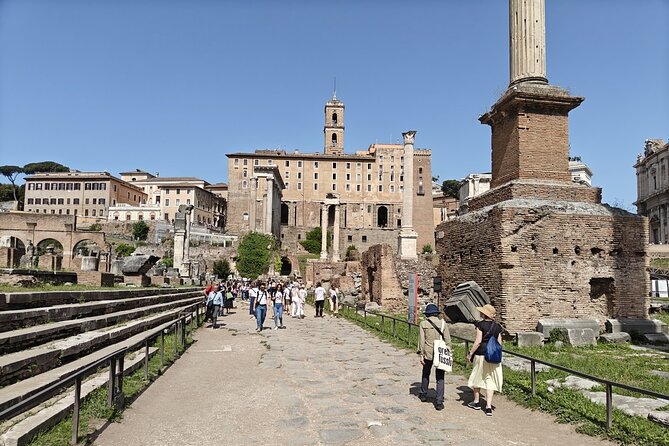
The Arch of Septimius Severus is one of the Forum’s most complete monuments. Its reliefs show scenes from the emperor’s military campaigns, and the arch celebrates victory and imperial force.
It also has a long afterlife. The arch survived earthquakes and floods and was used as a medieval fortress in the fourteenth century. Seeing it as both an ancient victory monument and a later defensive structure makes the site easier to understand. Rome’s ruins were repeatedly reused, not frozen in one historical period.
The Miliarium Aureum, or Golden Milestone, was erected by Augustus as a central point for measuring distances across the empire. It helps explain the phrase all roads lead to Rome. The empire’s roads connected distant cities to the capital, and this monument represented Rome’s place at the center of that system.
The Basilica Julia brings you back to law. It served as a courthouse, a location for trials, and a place for government work. Judges sat on a raised platform while lawyers, witnesses, and other participants used the surrounding space.
The Curia Julia was the Senate house built by Julius Caesar in 44 BCE. The Senate met there to debate public affairs, treaties, laws, and foreign policy. Together, the Basilica Julia and Curia Julia show how the Forum worked as a political machine, not just a religious district.
Julius Caesar’s temple and the end of the walk
The final major stop is the Temple of Divus Julius, built by Augustus after Julius Caesar’s death. It was the first temple in Rome dedicated to an individual who had not originally been a god or goddess.
Caesar’s assassination triggered grief and unrest. The people of Rome mourned him, and his funeral drew an enormous crowd. The temple helped turn Caesar into a sacred figure and gave Augustus a way to connect his own rule with Caesar’s memory.
This is a fitting end because it brings together myth, politics, and public emotion. The Forum’s stories are not only about distant gods or legendary kings. They also concern real people who used memory and religion to shape power.
You finish back at the meeting point. The tour does not include Colosseum access, so plan that separately if you want to see the arena’s interior. Your ticket does include entry to the Roman Forum, Palatine Hill, and Imperial Forums, which gives you useful flexibility before or after the guided portion.
Is $286.60 per person a fair price?
The price is high for two hours. If you are comparing this with a large group tour, the difference can be substantial. You are paying for a private experience, a dedicated guide, included Forum admission, and the chance to ask questions without competing with a crowd.
The value improves if you are traveling with family or friends who want one shared tour. It also makes more sense if you care about mythology, Roman religion, and the story behind smaller sites that are easy to miss.
The price is harder to justify if you mainly want a quick orientation or if your budget is tight. The included ticket covers several archaeological areas, but Colosseum entry is separate, and the most detailed route description centers on the Roman Forum.
The tour is booked an average of 16 days ahead, so it is wise to arrange it early if your Rome dates are fixed. Free cancellation is available until 24 hours before the start time.
Practical details that affect the experience
The meeting point is Largo della Salara Vecchia, and the tour returns there. Transportation, food, drinks, and hotel pickup are not included, so you need to make your own way to the Forum.
An official guide leads the visit. A headset is provided when more than six people are present, which should help you follow the explanation around the open archaeological site.
You must provide every participant’s full name as written on their passport or ID. Bring that identification with you. Without it, entry to the Roman Forum is not guaranteed.
Service animals are allowed, the meeting point is near public transportation, and most people can participate. The information does not specify the exact walking distance or surface conditions, so anyone concerned about mobility should confirm those details before booking.
Who should book this Forum tour?
I would choose this tour for a first visit to Rome if you want the Forum to feel like a story rather than a field of ruins. It suits families, couples, and small groups who enjoy asking questions and prefer a private guide.
It is especially well matched to anyone interested in ancient religion, Roman legends, political power, or the lives of the Vestal Virgins. The myths give younger participants something memorable to follow, while the basilicas, Senate house, and legal sites add useful historical structure.
I would skip it if your main goal is the Colosseum, since that entrance is not included. I would also think twice if $286.60 per person feels too steep for a short visit.
Should you book it?
Book this tour if you want help making sense of the Forum’s scattered ruins and you value a private guide who can use stories and visual reconstructions. Paolo’s approach, especially his use of artists’ renderings, is well suited to a site where much of the original architecture has disappeared.
The strongest reason to go is not simply the list of temples. It is the way the route connects Romulus, the Vestal Virgins, Marcus Curtius, Julius Caesar, and the Roman gods to the political and religious life of the city.
For a short, focused introduction to Rome’s ancient center, this is a good choice. Just budget separately for the Colosseum and decide if the private-tour price matches your priorities.
FAQ
How long does the Roman Forum Myths and Legends Private Guided Tour last?
The tour lasts approximately two hours.
What areas are included with the admission ticket?
The ticket includes the Roman Forum, Palatine Hill, and the Imperial Forums.
Is Colosseum entry included?
No. Colosseum access is not included in this experience.
Where does the tour begin?
The tour begins at Largo della Salara Vecchia in Rome.
Where does the tour end?
The activity ends back at the meeting point.
Do I need to bring a passport or ID?
Yes. Full names must be provided as written on each participant’s passport or ID, and valid identification is required for guaranteed entry.
Is this a private tour?
Yes. Only your group participates in the activity.
Can I cancel for a full refund?
Yes, if you cancel at least 24 hours before the experience start time. Cancellations made less than 24 hours before the start time are not refunded.
Newest Rome tours we have reviewed
- Private TikTok Video Making in Rome★ 5.0 · 7 reviews
- Assisi, Orvieto and Civita di Bagnoregio Full Day Tour from Rome★ 4.5 · 45 reviews
- Assisi & Saint Francis Path Tour from Rome★ 5.0 · 45 reviews
- Assisi and Cascia Private Day Tour from Rome with Lunch★ 5.0 · 10 reviews
- Art Class in the center of Rome!★ 4.0 · 4 reviews
- Art & Craft: Beer Tour with Street Art in Rome★ 4.5 · 6 reviews
- Arrival in Rome: Airport Transfer & Exclusive City Introduction★ 5.0 · 3 reviews
- From Rome: Private Day-Tour of Tuscany★ 5.0 · 16 reviews
Roman Forum and Palatine Hill Tours, compared.
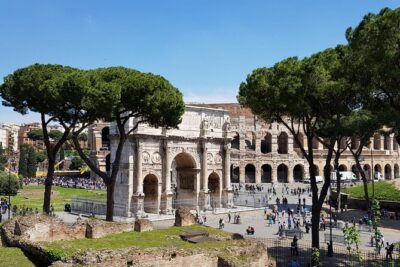
Colosseum, Palatine Hill and Roman Forum Guided Tour
Read our review →
Guided Tour of Colosseum, Roman Forum & Palatine Hill
Read our review →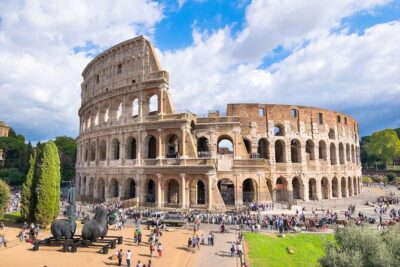
Colosseum, Roman Forum and Palatine Hill Guided Tour
Read our review →
Colosseum, Forum & Palatine Hill Tour & Optional Arena
Read our review →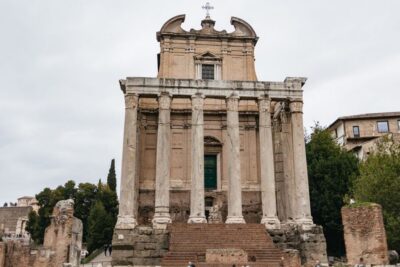
Colosseum, Palatine Hill & Roman Forum Guided Tour
Read our review →
Colosseum Arena, Palatine Hill & Forum Guided Tour
Read our review →
Colosseum, Roman Forum & Palatine Hill Guided Tour
Read our review →Colosseum, Roman Forum And Palatine Hill Guided Tour
Read our review →Browse the lists this tour appears in