
Reviewed · ROME
Roman Gladiator School: Learn How to Become a Gladiator
At Rome’s Gladiator School, you do more than look at ancient weapons. You put on a tunic, belt, leather gloves, and a wooden training sword called a rudis, then learn basic fighting moves before facing other would-be gladiators in an arena. It is history with a little theatrical chaos.
I like the hands-on museum visit, where you can see Roman gear and learn how it was used, and the way the instructors turn the lesson into a family game without dropping the historical thread. The small groups, capped at 15 people, also allow for more attention than a large city tour.
The catch is location. The school sits outside the central sights on the Appian Way, and the final approach can be hard to find. Allow extra time, bring mosquito repellent, and wear comfortable clothes and shoes.
Key points to know before booking
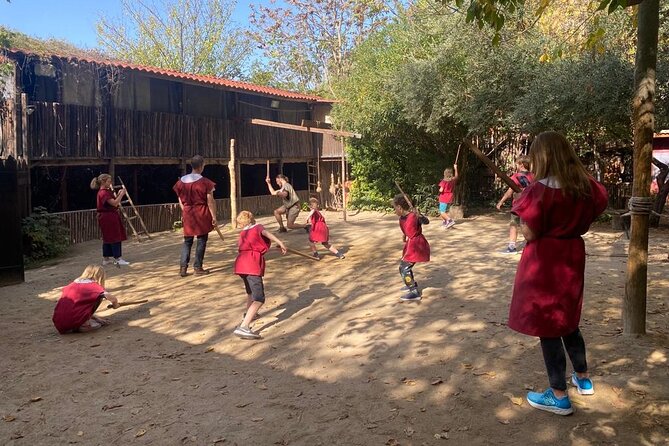
- You train in costume: The class includes a belt, tunic, leather gloves, and a training sword for the lesson.
- The museum comes first: You’ll see gladiator weapons, armor, helmets, and other Roman objects before heading outside.
- The finale is a mock battle: You learn offense and defense, then face other participants in friendly arena matches.
- It suits families best: Children from age 6 can join, and the activity is especially popular with families, though adults can take part too.
- The setting takes planning: Via Appia Antica is outside the main tourist center, with an approach that can be confusing.
- Budget around two hours: The listed price is $108.16 per person, including the class, equipment hire, museum entry, a drink, and a certificate.
What happens at the Gladiator School
The activity takes place at the Gladiator School of Rome on Via Appia Antica, near the Colosseum by Roman standards but not right beside it. The school is run by Scuola Gladiatori Roma, with lessons taught by members of the Historic Group of Rome.
You begin at the school’s museum. This is not a long museum visit, but it gives the rest of the activity a useful frame. You’ll see gladiator weapons, Roman soldier equipment, helmets, shields, armor, and display pieces that help explain the difference between military life and arena combat.
The guide may let you handle or try on some of the gear. That small detail matters, especially with children. A helmet or shield is easier to understand when you feel its weight and see how it limits movement.
The teaching style is part history lesson and part show. Instructors such as Ivan, Mirkos, Patricio, and Flama have been praised for bringing humor and energy to the session, though the exact instructor depends on the date. You should expect plenty of explanation, but not a quiet museum tour. The goal is to get you moving.
Other Rome tours people pair with this one:
- Vatican Museums & Sistine Chapel Tour with Optional Basilica
★ 4.3 · 67,413 reviews - Vatican Museums, Sistine Chapel & St Peter’s Basilica Guided Tour
★ 4.5 · 39,149 reviews - Rome: Colosseum, Palatine Hill and Roman Forum Guided Tour
★ 4.8 · 32,814 reviews
Putting on the belt, tunic, and rudis

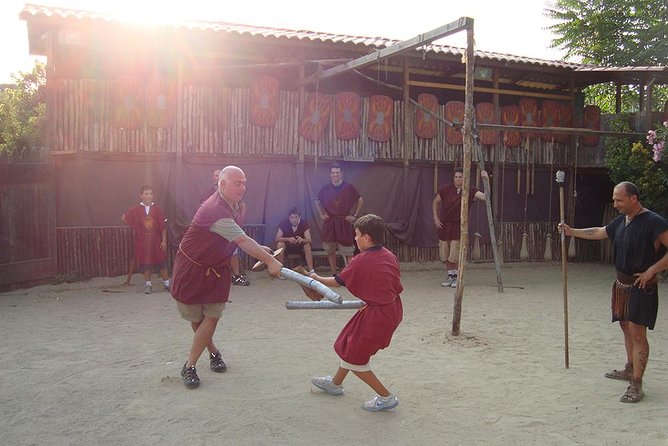
After the museum, you get dressed for training. The school provides a traditional belt, tunic, leather gloves, and a rudis, the wooden practice sword used for the lesson. You keep the clothing and weapons for the duration of the class.
This is one of the best parts for photographs. Friends and family can watch from a viewing platform, so not everyone in your party needs to take part. One adult can observe while children train, or the whole group can join the class together.
The equipment is for reenactment and practice, not real combat. Still, the lesson involves physical movement and mock fighting. Wear clothes that let you stretch and shoes that are comfortable on an outdoor training surface.
The class begins with warm-ups and basic drills. You’ll work on simple sword movements, defensive positions, and footwork. The instructors keep the language clear and the actions easy to follow, which helps when the group includes several ages and nationalities.
From warm-ups to Roman fighting drills
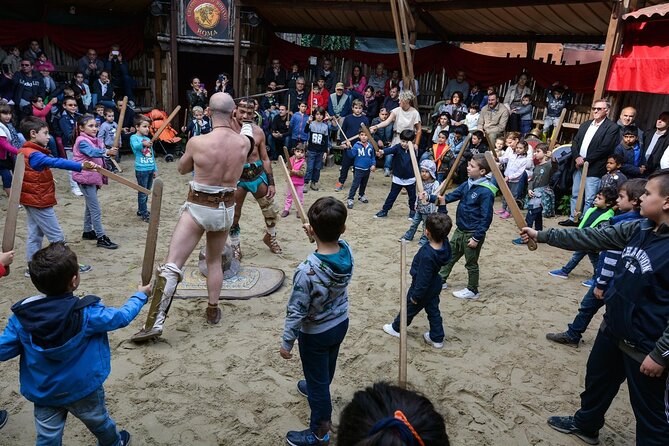
The training has a playful tone, but it is not just waving a sword around. You learn how a gladiator might hold a weapon and shield, how to move toward an opponent, and how to protect yourself. Some sessions include agility exercises, an obstacle course, and a mental game designed to get you into the gladiator mindset.
This is where the small group helps. With no more than 15 participants, the instructor can correct a stance or show a move again. In a low-season session, the class may be much smaller. One early morning class had only two participants, allowing unusually close attention from the instructor.
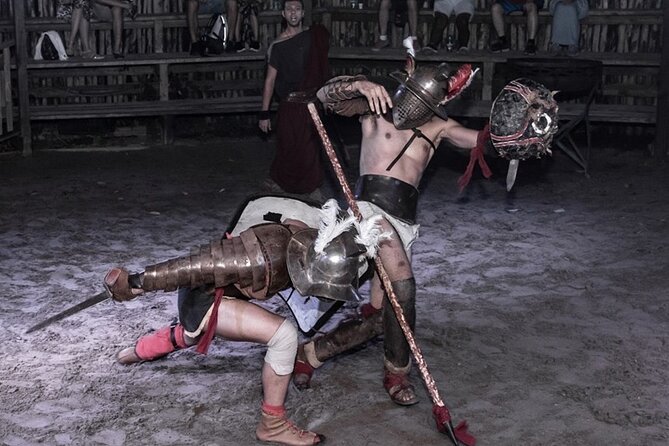
You may also get to act out scenes involving lions. The school presents these as imaginative battles, not as a serious history claim that Roman gladiators fought in exactly the same way during every contest. The lesson mixes fact, reenactment, and comic theatre.
That blend works well for families. Children often need an activity that changes pace every few minutes, and this one moves from objects to costumes to drills to a final competition. Adults who enjoy Roman history will get more from the museum explanation and the discussion of weapons and armor.
The arena battle and optional tournament
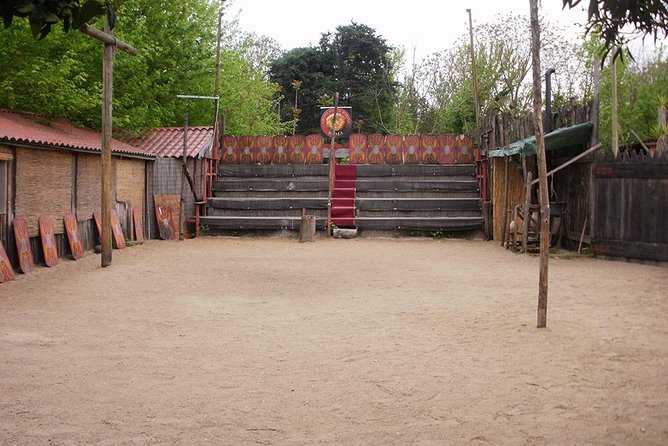
The class ends with mock matches in the arena. You use wooden swords and shields, follow the instructor’s rules, and face other members of your group. The battle is meant to be friendly, but physical contact can happen.
This point deserves attention if you are booking for young children. The minimum age is 6, but age alone does not tell you how a child will respond. Some children may find the pretend fighting thrilling. Others may become upset if they are struck or if the action feels too rough. Watch from the platform if your child would prefer to observe, or ask the instructor to adjust participation.
An optional tournament may follow, with a prize for the winner. Everyone receives a certificate of accomplishment, so the experience does not end with one child winning and everyone else losing. The tournament is best treated as comic competition rather than a test of athletic skill.
For many families, this is the moment that makes the activity memorable. A visit to the Colosseum can show you where gladiatorial spectacles took place, but here you get to understand the body mechanics and spectacle from inside a controlled reenactment.
Same city, a completely different half-day:
- Rome: Guided Tour of Colosseum, Roman Forum & Palatine Hill
★ 4.7 · 27,897 reviews - Rome: Colosseum & Forum with Audio Guide App -Optional Arena
★ 4.2 · 24,770 reviews - Rome: Colosseum, Roman Forum and Palatine Hill Guided Tour
★ 4.5 · 23,903 reviews - Rome: City Sightseeing Hop-on Hop-off Bus with Audioguide
★ 4.0 · 16,045 reviews
Why the museum matters
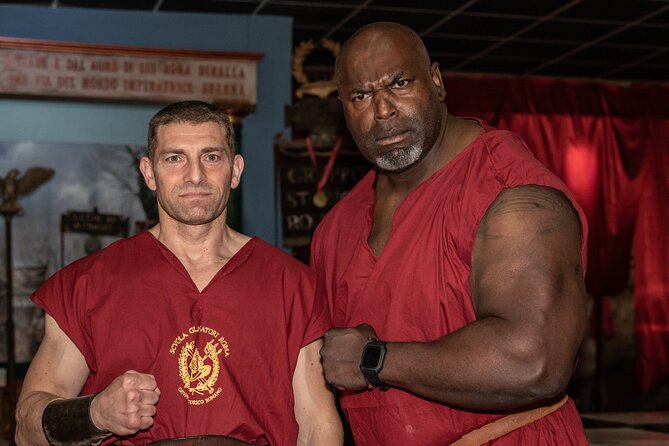
Rome has no shortage of ancient ruins, yet ruins can be hard for children to read. A broken column tells part of the story, but a helmet, shield, or sword gives the past a human scale.
The museum provides that link. You can see different types of Roman equipment and hear how gladiators and soldiers used it. The displays and dioramas help explain what you are about to imitate outside.
I would not book this solely as a museum visit. It is compact, and the main event is the training. But I would not skip the museum portion either. It gives the activity substance and makes the costumes and mock combat feel less random.
History fans should also note that the instructors are involved in Roman reenactment. The teaching can include details about gladiators, legionnaires, weapons, helmets, and training. The exact depth depends on the instructor and the size of your group.
Getting to Via Appia Antica
The meeting point is Via Appia Antica, 18, 00179 Rome. The activity begins and ends there, with no hotel pickup or drop-off.
This is the main practical weakness. The school is outside the central tourist zone, and the final driveway or entrance can be easy to miss. One useful warning: the school may not appear exactly where you expect on a map, so do not arrive at the last minute.
Several routes have been used by participants, including a taxi and the number 118 bus along the Appian Way. Public transport can be infrequent, while taxis add to the cost. Walking from the Colosseum takes roughly 45 minutes according to one account, but you should allow more time if you are unfamiliar with the area.
I would plan to arrive early, especially for a morning class. Save the meeting point on your phone, check the route before leaving, and allow time for the final approach. This is not an experience to squeeze between two timed central Rome tickets.
The setting on the Appian Way does add a sense of place. You are away from the densest part of the city, in an area tied to Rome’s ancient roads and monuments. But the location is not convenient in the way the Colosseum itself is convenient.
Who will enjoy this most

This is a strong choice for families with children, especially ages 6 through the early teen years. It gives children a role, a costume, a set of skills to practice, and a clear finish. Several children have treated it as a favorite part of a Rome visit.
It also works for adults who are willing to play along. A group of adults in their twenties can enjoy the comedy and competition, but the format is built with children in mind. If you want a serious historical seminar or a polished stage show, this is not the right match.
The activity can also work well for mixed-age families. Parents may join the drills, watch from the platform, or alternate with another adult. Most people can participate, but you should be comfortable with light physical activity and pretend combat.
The school has also received positive feedback for welcoming autistic children. That does not guarantee the same fit for every child, but the structured sequence, clear activities, and supportive instructors may help some families. If your child is sensitive to noise, touch, or mock fighting, consider watching part of the class first.
Price, time, and what you receive
The listed price is $108.16 per person for about two hours. That is not a cheap add-on, especially for a full family, but it includes more than a short sword lesson.
Your fee covers:
- The two-hour gladiator class
- Instruction from Historic Group of Rome members
- Gladiator clothing and weapons for the session
- Entry to the Gladiator School of Rome Museum
- A drink
- A certificate of accomplishment
Food is not included, apart from the specified drink, and there are few real food choices nearby. Eat before you arrive. Bring water or a snack if needed, while remembering that the included items can vary in practice, so it is sensible not to rely on the advertised drink as your only refreshment.
The value depends on what you want from Rome. If your family prefers active, participatory outings, the price buys two hours of structured entertainment plus a museum visit. If you are mainly interested in major ancient monuments, the same money might be better spent on a Colosseum-related experience.
Group discounts are available, and the maximum group size is 15. A smaller group can make the cost feel more worthwhile because you get more direct attention from the instructor.
Small details that can make the day better
Bring mosquito repellent. The school’s outdoor setting can mean mosquitoes, and several people have found this to be a real nuisance. It is a simple item that can prevent the class from becoming uncomfortable.
Wear comfortable shoes and clothes. You will warm up, move around, use a sword and shield, and take part in mock matches. Costumes are provided, but they do not replace practical footwear underneath.
Bring a camera or keep your phone ready for photographs. Dressing in Roman gear is part of the fun, and friends or family can watch from the viewing platform.
If you are visiting the Colosseum, schedule the Gladiator School on a separate half-day if possible. The school is not a quick walk across the street, and rushing between activities can turn a fun outing into a transport problem.
Cancellation is free up to 24 hours before the start time. Changes or cancellations made less than 24 hours ahead are not refunded, and the cutoff uses local Rome time.
Should you book the Gladiator School?
Book it if you want your Rome itinerary to include active history, especially if you are traveling with children. The mix of museum objects, costumes, drills, and a final arena battle gives the ancient world a physical, funny, memorable shape.
I would be more cautious if your group dislikes pretend fighting, outdoor conditions, or complicated transport. The location takes work, mosquitoes can be a problem, and the activity is more family entertainment than serious archaeological study.
For most families, the strongest plan is to visit the Colosseum first, then use Gladiator School as a different kind of follow-up. You’ll already have seen the monumental setting. At the school, you get to handle the idea of gladiator life with your own hands. That makes the $108.16 price easier to justify for a special Rome day, particularly when the class size is small and everyone joins in.
FAQ
Where does the Gladiator School experience take place?
It takes place at the Gladiator School of Rome, Via Appia Antica, 18, 00179 Rome, Italy. The school is near the Colosseum area but outside the main historic center.
How long does the activity last?
The class lasts about two hours, including the museum visit, costume and equipment use, training, and arena activities.
What age can participate?
The minimum age is 6. Most people can participate, but the activity includes warm-ups, movement, and mock fighting.
Is the museum entry included?
Yes. Admission to the Gladiator School of Rome Museum is included with the class.
What clothing and equipment are provided?
You receive a traditional belt, tunic, leather gloves, and a training sword called a rudis for the duration of the lesson. Wooden swords and shields are used during the training activities.
Can friends and family watch without taking part?
Yes. Friends and family may watch the class from the viewing platform.
Is food included?
Food is not included. A drink is listed as included, but meals and other beverages are not provided unless specified.
Is transportation provided?
No. Hotel pickup and drop-off are not included. You must make your own way to Via Appia Antica, 18.
Can I cancel for a refund?
Yes, if you cancel at least 24 hours before the experience start time. Cancellations or changes made less than 24 hours before the start are not refunded.
Newest Rome tours we have reviewed
- Private TikTok Video Making in Rome★ 5.0 · 7 reviews
- Assisi, Orvieto and Civita di Bagnoregio Full Day Tour from Rome★ 4.5 · 45 reviews
- Assisi & Saint Francis Path Tour from Rome★ 5.0 · 45 reviews
- Assisi and Cascia Private Day Tour from Rome with Lunch★ 5.0 · 10 reviews
- Art Class in the center of Rome!★ 4.0 · 4 reviews
- Art & Craft: Beer Tour with Street Art in Rome★ 4.5 · 6 reviews
- Arrival in Rome: Airport Transfer & Exclusive City Introduction★ 5.0 · 3 reviews
- From Rome: Private Day-Tour of Tuscany★ 5.0 · 16 reviews