
Reviewed · ROME COLOSSEUM TOURS
Rome: Colosseum, Arena and Palatine Hill Small-Group Tour
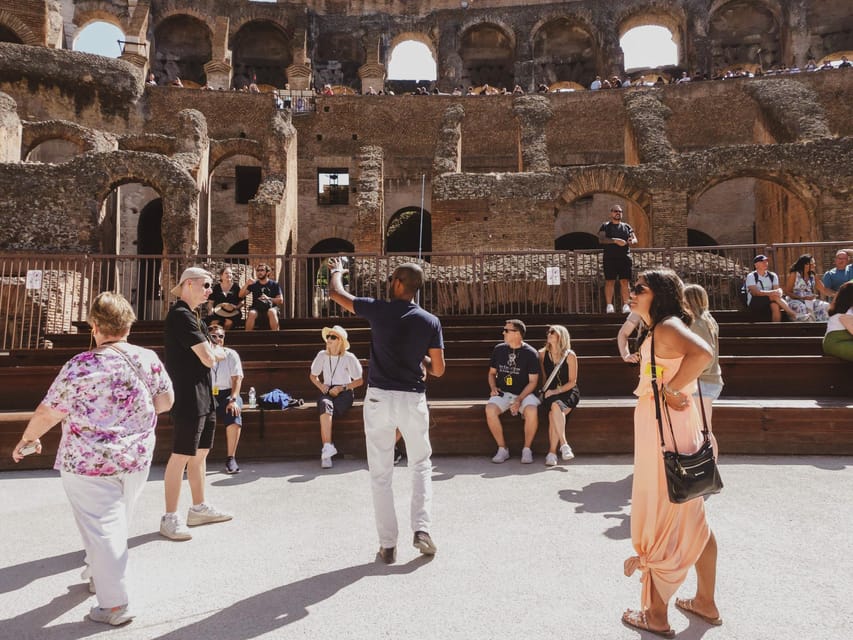
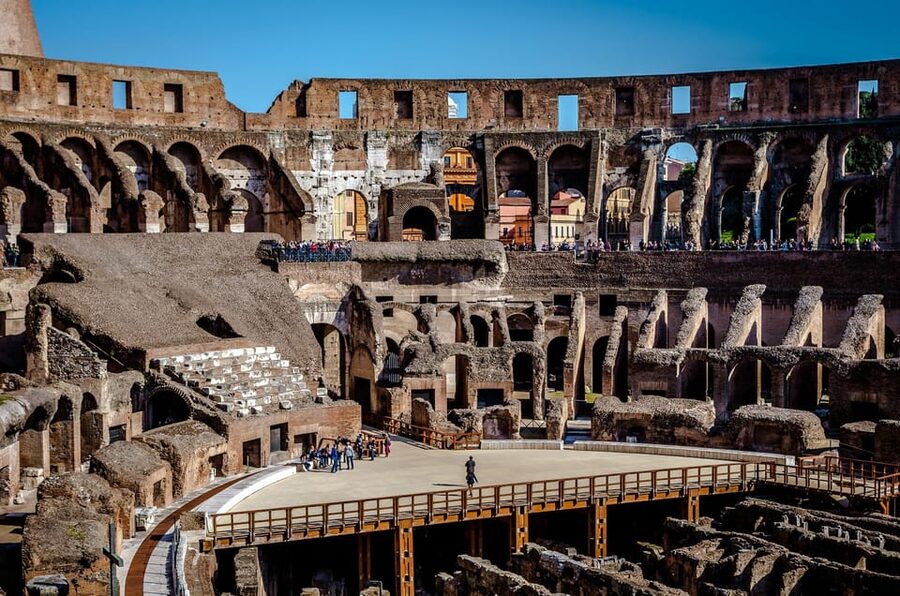
The special feature here is the Colosseum arena floor, reached through the Gladiator’s Gate, the same route once used by fighters entering before huge Roman crowds. You get a far better sense of the building from down there than from the standard viewing levels alone.
I like the small-group format and the use of headsets, which help you hear the guide among the stone walls and city noise. I also like the broad sweep of the visit: Palatine Hill puts imperial luxury beside the Colosseum’s public spectacle, while the Forum shows where ordinary Roman business took place.
The main consideration is the fixed, non-refundable price of $107.62 per person. The tour lasts three hours, but the Forum portion may feel brief if you want time to study every ruin, and the order of the stops can change according to ticket availability.
Key points at a glance
- Arena-floor access: Enter through the Gladiator’s Gate and stand where the fighting took place.
- Three major ancient sites: The tour covers the Colosseum, Palatine Hill, and Roman Forum in one guided visit.
- English-speaking local guide: Guides including Giorgio, Lynn, Ivana, Felicity, Barbara, Lia, and Susana have led this experience.
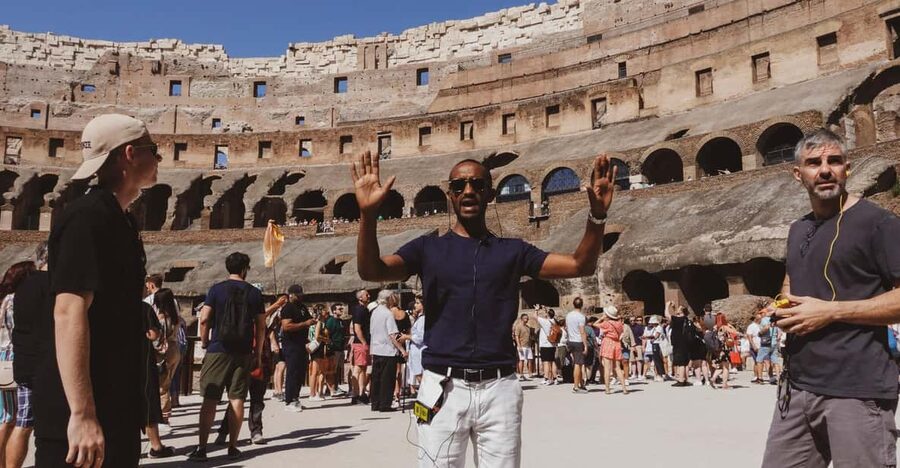
- Headsets included: You can follow the commentary while moving through large and crowded archaeological areas.
- Small-group feel: One reported group had 15 people, a manageable size for questions and picture stops, though the exact maximum is not stated.
- Flexible running order: You may begin at the Colosseum or at Palatine Hill and the Forum, depending on the ticket time secured.
Why the arena floor changes the Colosseum visit
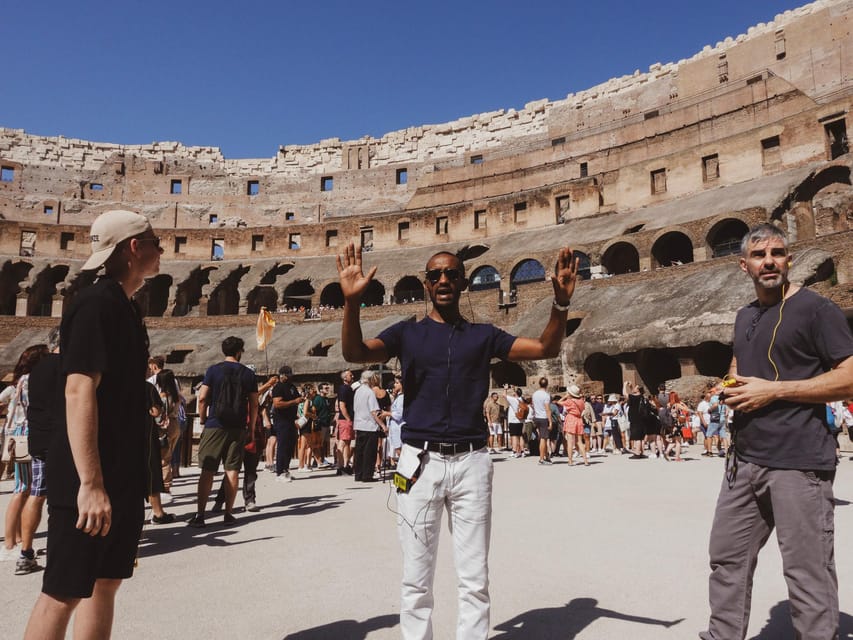
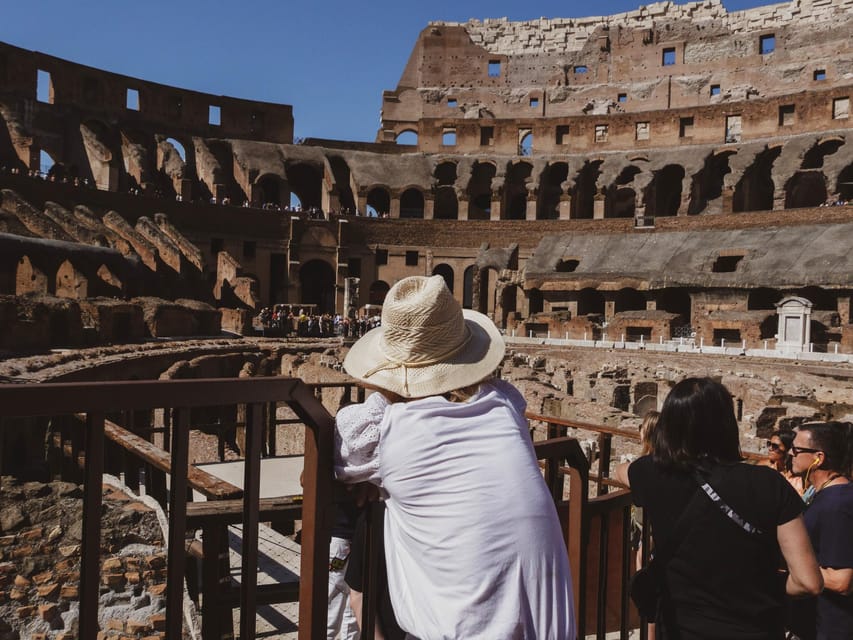
The Colosseum is easy to reduce to a giant stone shell and a list of dates. The arena floor helps correct that. From this lower level, you can look up at the seating tiers and picture how exposed a gladiator would have felt before a crowd of roughly 50,000 people.
You enter through the Gladiator’s Gate, not simply through the usual visitor route. That detail gives the visit a stronger sense of movement. You are not only looking at the building from the outside or peering down from above. You are following the path taken by performers and combatants almost 2,000 years ago.
Your guide explains how the amphitheatre worked as Rome’s great public stage. Emperors used it to display animals, fighters, and captives brought into the Roman world. The spectacle was entertainment, but it also sent a political message: Rome had the power to conquer distant places and place that power before its citizens.
The guided Colosseum portion lasts about one hour. That is enough time for a clear introduction to the building, its public purpose, and the arena access, but it is not a specialist architectural study. One person would have preferred more discussion of how the Colosseum was constructed. If engineering, masonry, and ancient building methods are your main interest, you may want a separate source or more time on your own.
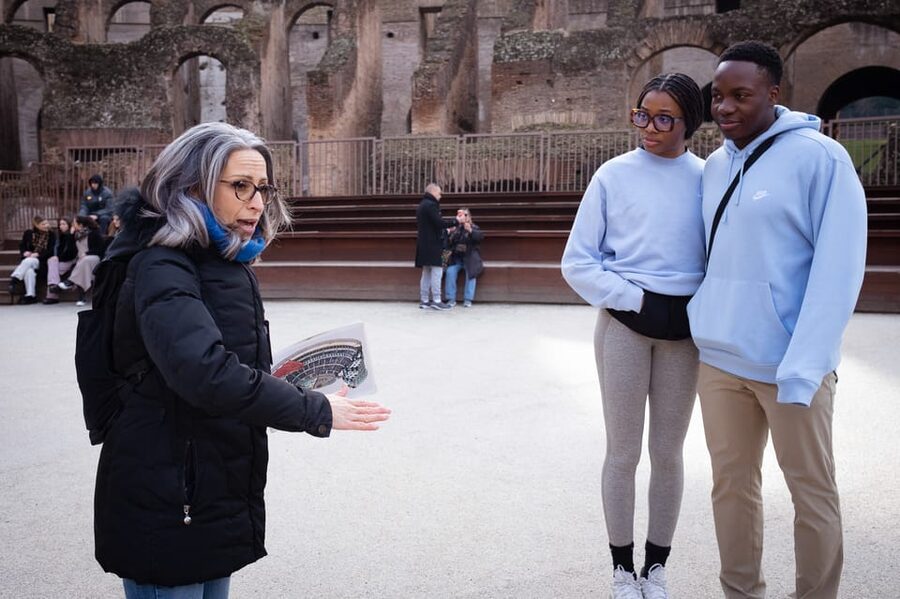
The arena floor is also the part most affected by photos and group movement. Guides such as Giorgio, Lynn, and Lia were praised for keeping the visit engaging, while another guide made an effort to find good picture spots and shade on a hot day. Those touches matter here because the experience is outdoors, active, and often sunny.
More Roman Forum and Palatine Hill tours:
- Rome: Colosseum, Palatine Hill and Roman Forum Guided Tour
★ 4.8 · 32,814 reviews - Rome: Guided Tour of Colosseum, Roman Forum & Palatine Hill
★ 4.7 · 27,897 reviews - Rome: Colosseum, Roman Forum and Palatine Hill Guided Tour
★ 4.5 · 23,903 reviews
Palatine Hill and the imperial side of Rome
After the Colosseum, the tour moves to Palatine Hill, with about 30 minutes of guided explanation. The hill is tied to Rome’s traditional foundation stories, but its physical remains also show the private side of imperial rule.
This is where emperors built palaces and wealthy Romans created large homes. Among the ruins, your guide reconstructs the old neighborhood through stories about the people who lived there. The value is not just in seeing broken walls. It is in understanding that the hill once represented status, privilege, and distance from the crowded working life below.
Palatine Hill also gives the Colosseum a useful setting. Instead of seeing the amphitheatre as an isolated monument, you connect it with the rulers who commissioned public spectacles and the elite who lived nearby. The contrast is sharp: imperial residences on one side, mass entertainment and political display on the other.
The hill is not a quick, flat indoor museum visit. You should expect to walk through an open archaeological area and listen while standing or moving between ruins. The guide’s storytelling makes a real difference. A guide with an archaeology background can explain why an exposed foundation matters, while a lively guide can make names and dates easier to follow.
The half-hour estimate also sets a useful limit. You will receive an introduction rather than a full examination of every palace complex. If Palatine Hill is your top priority, the tour’s combined format may feel fast. If you want the three main ancient sites in one morning or afternoon, the shorter section keeps the visit moving.
The Roman Forum, where Rome did its daily work
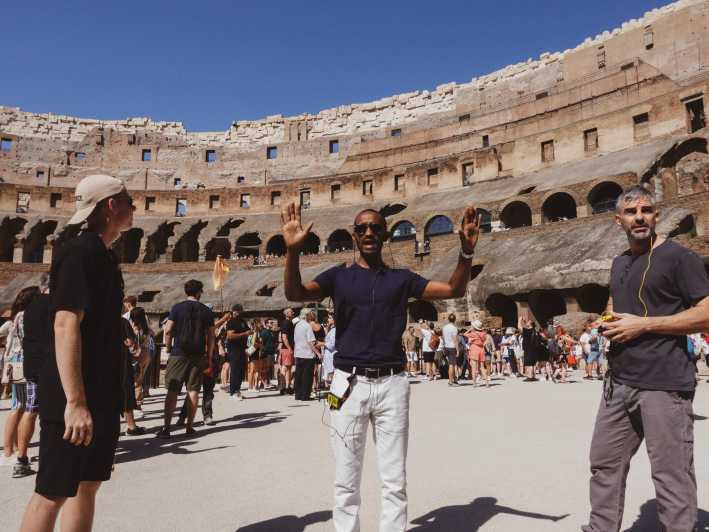
The Roman Forum was the center of public life, government, trade, ceremony, and political argument. This is where you get closest to the working city behind the grand monuments.
Your guide helps connect the ruins to different layers of Roman life. You hear about legendary founders, senators, market sellers, and the people who handled the daily business of running a huge empire. That range is important. The Forum was not only a backdrop for famous leaders. It was also a place where people bought goods, conducted business, made speeches, and carried out religious and civic duties.
The ruins can be hard to read without help. A column may look impressive but say little on its own. With a guide, a street, platform, or temple remnant can become part of a civic scene. The best guides use stories and comparisons to make the old city easier to picture. Susana, for example, was praised for connecting Roman life with the modern world and for keeping a large amount of information entertaining.
The Forum is also where you should manage your expectations. The published itinerary gives a one-hour guided visit to the Colosseum and 30 minutes at Palatine Hill, but it does not assign a separate time to the Forum. One person would have preferred more Forum time and less time inside the Colosseum. If you are especially interested in politics, public spaces, or everyday Roman life, ask at the start how the guide plans to divide the remaining time.
The route may begin at the Colosseum or at Palatine Hill and the Forum. That is controlled by the time of the tickets obtained for the group, not by a personal choice made on the day. Either way, the three sites are included, but the order can affect your energy and photographs. A morning start at the Forum may put the open-air walking first, while another schedule may place the arena visit at the beginning.
The guide makes or breaks this three-hour visit
This is a guide-led tour, and the guide’s ability matters more here than a glossy presentation. The ancient sites are enormous, spread out, and full of details that can blur together without a clear narrative.
The experience uses licensed, English-speaking local guides. Several guide names are associated with the tour, including Giorgio, Lynn, Ivana, Felicity, Barbara, Lia, and Susana. Their styles differ, but the strongest pattern is clear: you benefit most from a guide who can combine facts with stories, answer questions, and keep the group moving.
Giorgio was described as a historian who could handle questions while explaining the site. Another guide, described as holding a PhD in archaeology, was especially generous with detail. Felicity was praised for clear explanations and humor, while Barbara brought energy to the walk. These are useful signs for someone choosing between a bare entry ticket and a guided experience.
The quality may vary somewhat because you are not selecting one particular guide. That is the trade-off with a scheduled group tour. The guide you receive may be a historian, archaeologist, or an engaging generalist. The available feedback points to strong performances, but no tour operator can promise a specific person unless the booking confirms one.
Headsets are included. I consider them important, not decorative, because the Colosseum and Forum have hard surfaces that carry sound in odd ways. You can keep your eyes on the ruins rather than crowding around the guide. Headsets also make a small group feel more personal, since you can hear the explanation while standing a little apart for a photograph.
More Colosseum tours in Rome:
- Rome: Colosseum & Forum with Audio Guide App -Optional Arena
★ 4.2 · 24,770 reviews - Rome: Colosseum, Forum & Palatine Hill Tour & Optional Arena
★ 4.4 · 13,839 reviews - Rome: Colosseum, Palatine Hill & Roman Forum Guided Tour
★ 4.6 · 12,703 reviews - Colosseum: Underground and Ancient Rome Tour
★ 4.7 · 12,691 reviews
Group size, walking, and the pace of the route
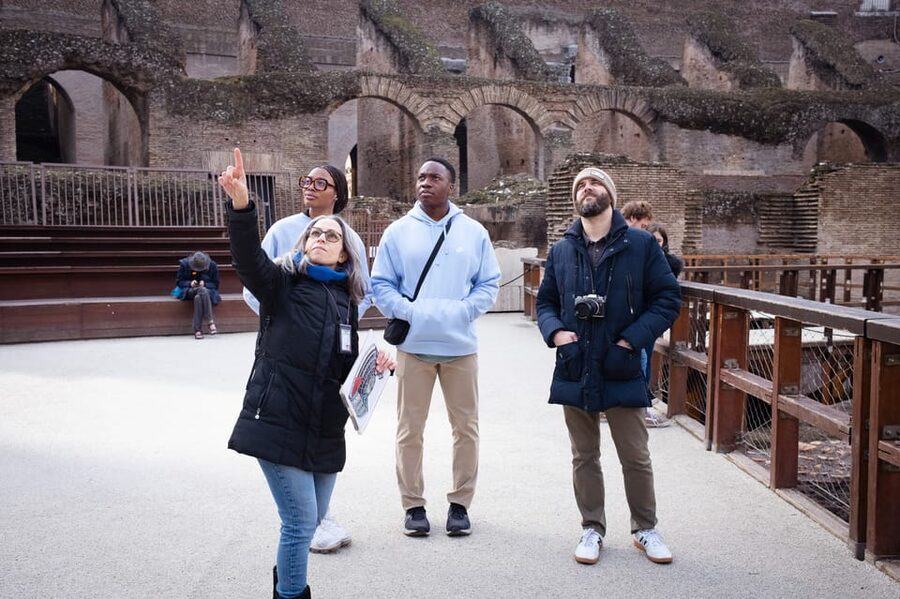
The tour is marketed as small-group, and one group was reported at 15 people. That is small enough to ask a question without creating a slow-moving procession, though the exact group limit is not provided.
Three hours is a useful middle ground. You get a serious introduction to the three headline sites without spending an entire day on ancient Rome. The price of that efficiency is pace. You will cover outdoor ruins, listen to explanations, stop for photos, and keep to the group’s schedule.
Wear shoes suited to uneven archaeological ground. The provided information does not specify accessibility conditions, so you should ask the operator directly if you have mobility concerns. Bring water and protect yourself from the sun, especially because some portions take place in open areas. Food and drink are not included.
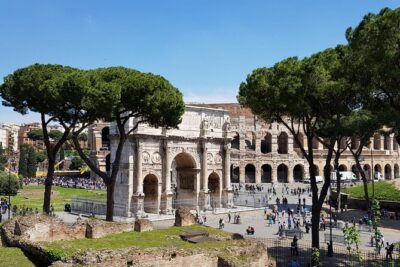
The meeting point is the Arch of Constantine. Look for the guide holding a yellow flag on the side farthest from the Colosseum. That detail is worth noting because the area around the monuments can be crowded and confusing, especially when several groups gather near the same landmarks.
Bring a passport or ID card. Full names for everyone in your party, including minors, must be supplied, and identification is especially important for children. The experience is non-refundable, so check names, timing, and date carefully before paying.
The information gives both Roman Forum as the itinerary finish and the meeting details say the activity ends back at the meeting point. Because the route order can change, confirm the final meeting instructions on your booking and listen to what the guide says at the start.
Is $107.62 a fair price?
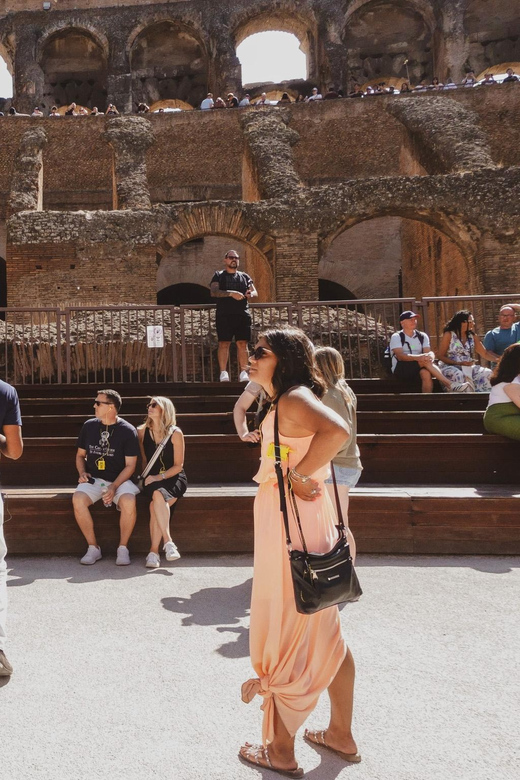
At $107.62 per person, this is not the cheapest way to enter the Colosseum area. You are paying for more than admission. The price covers a licensed guide, arena-floor access, headsets, and a guided route through three of Rome’s most important ancient sites.
The value is strongest if you want context and a smooth first visit. Without a guide, the Forum and Palatine Hill can become a long series of stones with limited explanation. Here, you get a connected story about public spectacle, imperial power, political life, and ordinary work.
The value is weaker if you prefer to set your own pace. You cannot linger freely at every ruin, and the Forum may receive less time than you would choose. The tour is also non-refundable, so last-minute changes are costly.
I would compare the price with your priorities. For a first visit, a compact guided introduction may justify the cost. For a repeat visit or a specialist interested in construction, inscriptions, or archaeology, an independent visit with more time could suit you better.
Who should book this tour?
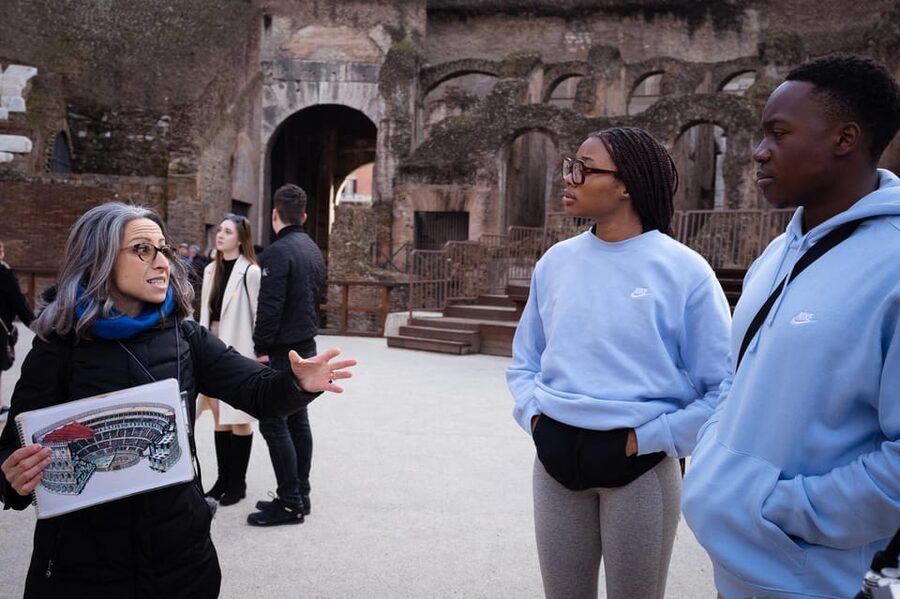
I would choose this tour for a first-time Rome visitor who wants the essential ancient sights explained in English and who places high value on entering the arena floor. It also suits families and mixed-interest groups, since the guide can keep the history moving rather than leaving one person to read every sign.
It is a good match if you enjoy stories about people and power. You will hear about emperors, gladiators, senators, founders, market sellers, and the citizens who watched Rome’s public shows. The best part is the connection between those groups, not just the monument checklist.
It may not suit you if you want a slow archaeological study, a long photography session, or a tour focused mainly on Colosseum construction. The Forum portion may also feel short if that is your main reason for visiting.
Should you book the Colosseum arena tour?
Book it if standing on the arena floor matters to you and you want a guide to connect the Colosseum with Palatine Hill and the Roman Forum. The small-group setup, headsets, and strong range of guides make the three-hour route easier to follow than an unsupported visit.
Before booking, accept three limits: the price is firm, the order may change, and the Forum time is not clearly separated from the rest of the schedule. Bring identification, meet the yellow flag at the Arch of Constantine, and arrive ready for outdoor walking.
For a first look at ancient Rome, this is a focused and useful choice. For a slow, highly technical study, choose a longer or more specialized visit instead.
FAQ
How long does the tour last?
The tour lasts three hours. Starting times vary, so check availability for the date you want.
Which sites are included?
The tour includes the Colosseum, the arena floor, Palatine Hill, and the Roman Forum.
Can I access the Colosseum arena floor?
Yes. The tour enters the arena floor through the Gladiator’s Gate, the route associated with gladiators entering the amphitheatre.
Is the tour conducted in English?
Yes. The listed live tour language is English.
Where does the tour meet?
Meet at the Arch of Constantine. The guide will hold a yellow flag on the side farthest from the Colosseum.
Will the tour always begin at the Colosseum?
No. You may begin at the Colosseum or at the Roman Forum and Palatine Hill, depending on the ticket time available.
Are headsets included?
Yes. Headphones are included so you can hear the guide during the visit.
What should I bring?
Bring a passport or ID card, including identification for any minors in your group. You must also provide the full names of everyone attending. Food and drink are not included.
Newest Rome tours we have reviewed
- Private TikTok Video Making in Rome★ 5.0 · 7 reviews
- Assisi, Orvieto and Civita di Bagnoregio Full Day Tour from Rome★ 4.5 · 45 reviews
- Assisi & Saint Francis Path Tour from Rome★ 5.0 · 45 reviews
- Assisi and Cascia Private Day Tour from Rome with Lunch★ 5.0 · 10 reviews
- Art Class in the center of Rome!★ 4.0 · 4 reviews
- Art & Craft: Beer Tour with Street Art in Rome★ 4.5 · 6 reviews
- Arrival in Rome: Airport Transfer & Exclusive City Introduction★ 5.0 · 3 reviews
- From Rome: Private Day-Tour of Tuscany★ 5.0 · 16 reviews
Rome Colosseum Tours, compared.
Colosseum, Palatine Hill and Roman Forum Guided Tour
Read our review →
Guided Tour of Colosseum, Roman Forum & Palatine Hill
Read our review →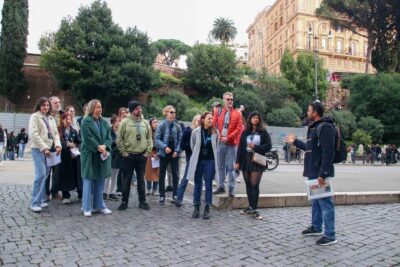
Colosseum & Forum with Audio Guide App -Optional Arena
Read our review →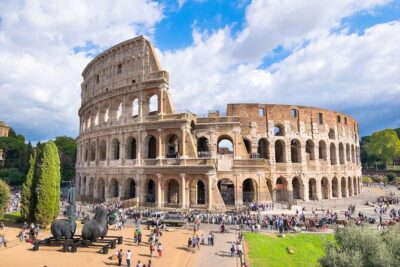
Colosseum, Roman Forum and Palatine Hill Guided Tour
Read our review →
Colosseum, Forum & Palatine Hill Tour & Optional Arena
Read our review →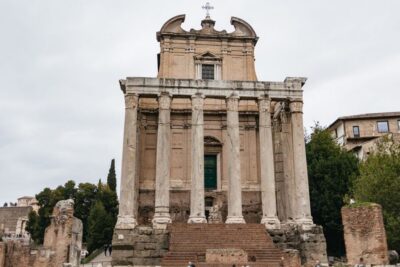
Colosseum, Palatine Hill & Roman Forum Guided Tour
Read our review →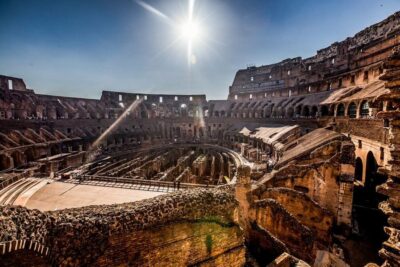
Colosseum: Underground and Ancient Rome Tour
Read our review →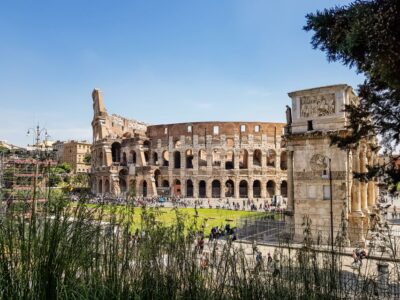
Colosseum Arena, Palatine Hill & Forum Guided Tour
Read our review →Browse the lists this tour appears in