
Reviewed · ROME
Rome: Leonardo da Vinci Exhibition Entrance Ticket
Leonardo da Vinci’s drawings can look like wild notes from a brilliant but restless mind. Here, 65 full-scale models turn those sketches into machines you can see up close and, in many cases, touch. The exhibition covers bridges, flying machines, military devices, musical instruments, tools, and studies of water, air, fire, and earth.
I like two things right away: the hands-on design makes the science easy to grasp, and the underground setting offers a cool break from Rome’s summer heat. The nine holograms and seven interactive displays add motion to what could otherwise be a display of still diagrams.
The main drawback is size. This is a small exhibition, not a grand museum, and many people finish in 45 to 60 minutes. The layout and room numbering can also feel unclear, especially if you use the audio guide.
Key points before you go
- Full-size machines: See more than 65 models based on Leonardo’s engineering drawings, with many available for hands-on use.
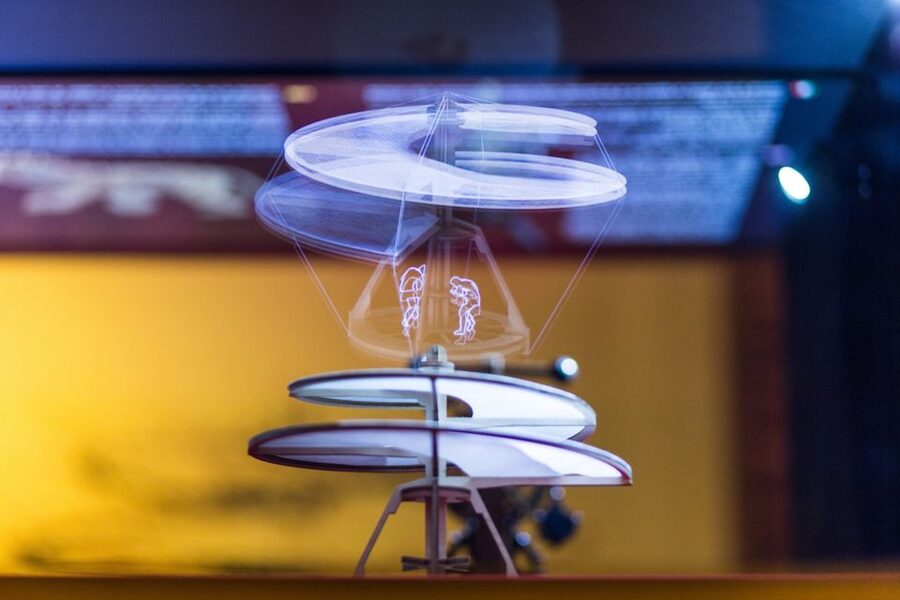
- Nine holograms: Watch 3D presentations of Leonardo’s paintings, inventions, and working ideas.
- Four themed sections: Follow his studies of water, air, fire, and earth, along with his work in science, aviation, and military engineering.
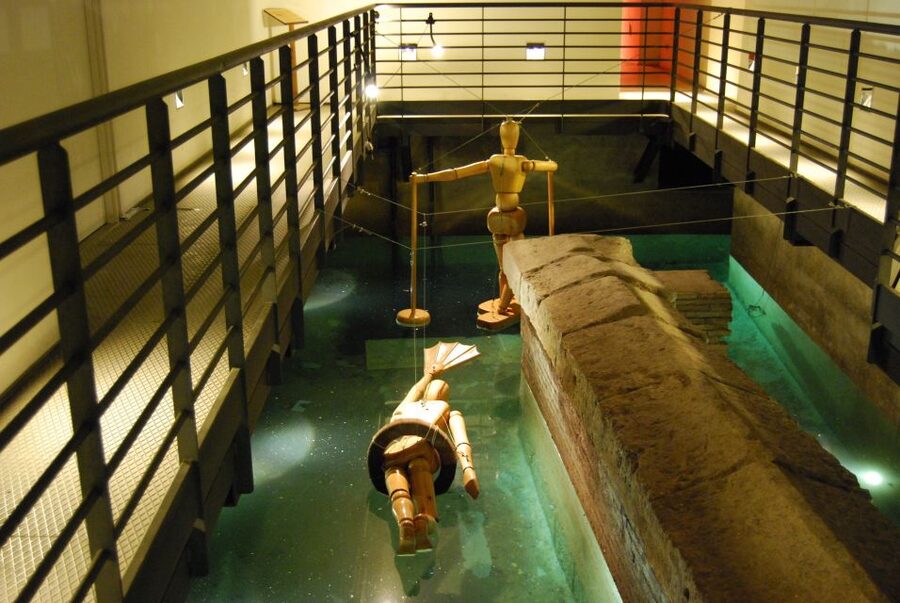
- An unusual Roman sight: Look down into an underground natural pond containing the tomb of architect Auro Irzio, dated to 43 BC.
- Good value for a short visit: At about $10 per person, it fits neatly between major Rome sights and works well for families.
- Audio guide worth considering: A guide is not included, but the optional audio presentation adds useful background and explains how several designs relate to modern transport and architecture.
Finding the exhibition inside Palazzo della Cancelleria
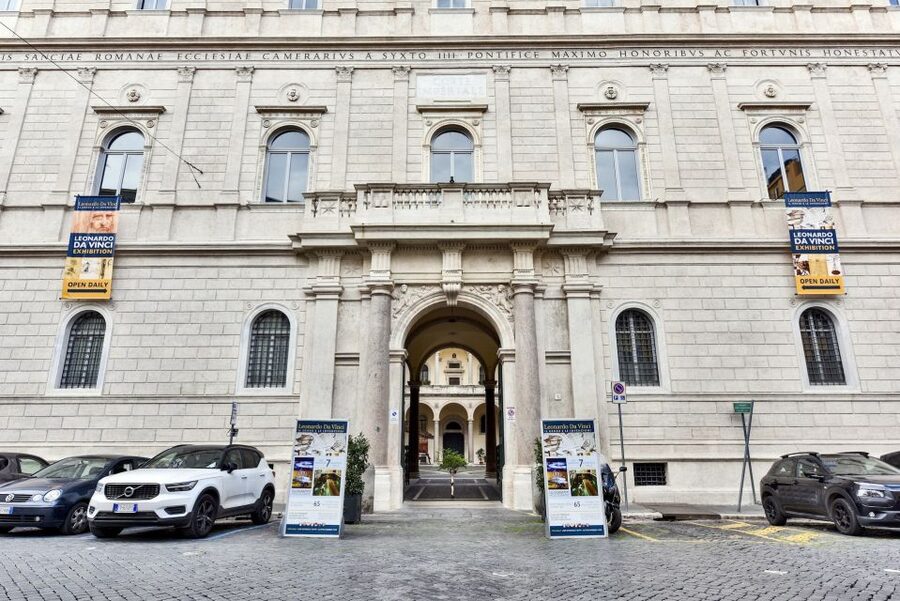
The exhibition is at Piazza della Cancelleria 1, between Campo de’ Fiori and Piazza Navona. That location makes it easy to add to a walk through central Rome. You can pair it with the nearby piazzas, churches, cafés, and market streets without setting aside a full afternoon.
The entrance is inside Palazzo della Cancelleria, a Vatican-owned building with impressive architecture of its own. The upper floor houses the Sacra Rota, the church court that handles marriage annulment cases. You are visiting the exhibition below, but the building gives the experience a layer of history beyond Leonardo’s machines.
The entrance process is simple, and the ticket includes admission rather than a guided tour. Skip-the-line entry is available, which matters if you arrive when central Rome is busy. You can enter until one hour before closing, though the activity has a one-day validity rather than a fixed tour schedule.
I would allow at least 45 minutes. You can move through quickly in that time, but an hour or two makes more sense if you want to read the English explanations, try the working models, watch the short videos, and use the audio guide.
More museums and galleries in Rome:
- Vatican Museums & Sistine Chapel Tour with Optional Basilica
★ 4.3 · 67,413 reviews - Vatican Museums, Sistine Chapel & St Peter’s Basilica Guided Tour
★ 4.5 · 39,149 reviews - Rome: Vatican Museums, Sistine Chapel & Basilica Tour
★ 4.3 · 13,872 reviews
Four sections built around Leonardo’s way of thinking
The exhibition is arranged across four areas. It is not simply a room of famous pictures. Its main purpose is to show how Leonardo observed natural forces and turned those observations into practical designs.
The sections focus on water, air, fire, and earth. These themes help connect his many interests. A machine for moving water, a flying device, a weapon, and a bridge may seem unrelated at first. The exhibition shows how the same habits of observation, measurement, and mechanical problem-solving run through them all.
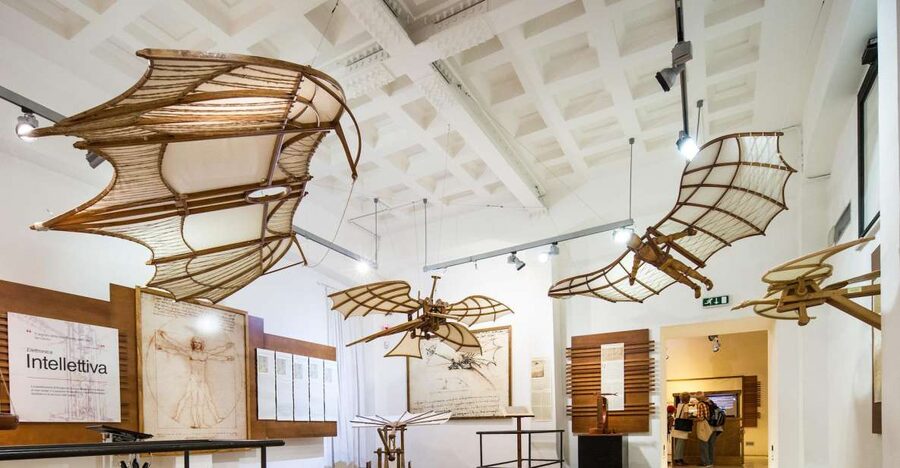
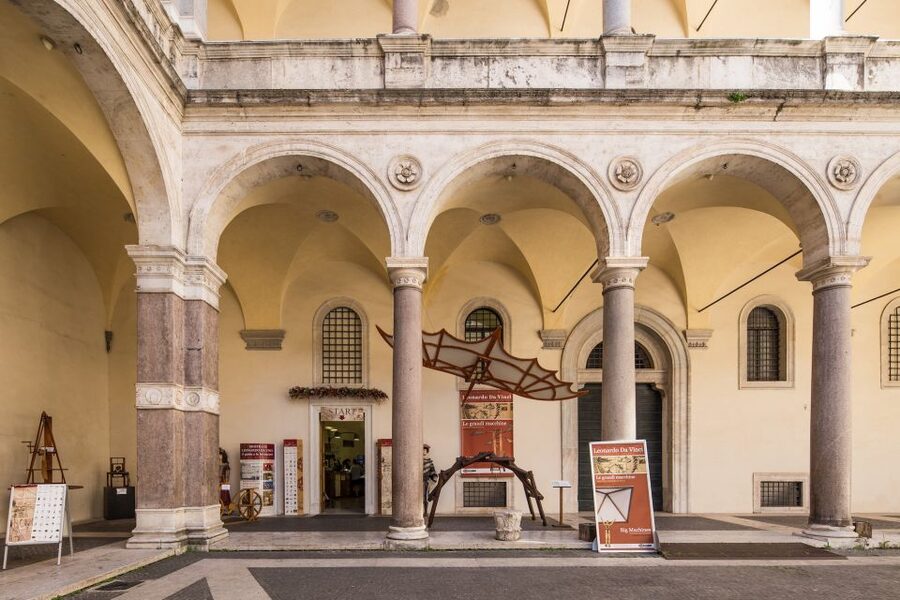
You can expect a mix of full-scale reconstructions, drawings, explanatory panels, videos, and interactive elements. The models are built from Leonardo’s surviving designs, giving you a useful sense of proportion and function. A sketch on a page can seem impossible to understand until you see the parts assembled in front of you.
The route is not always perfectly intuitive. Room numbers do not always flow in a clear order, and the audio guide may discuss pieces in a sequence different from the physical layout. I suggest taking a quick look around before starting the audio, then matching each number carefully as you proceed.
Seeing the drawings become real machines
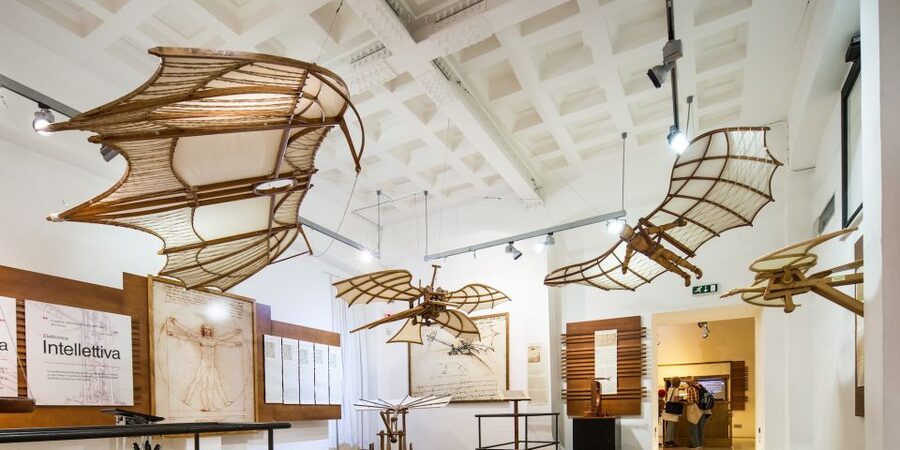
The strongest part of the exhibition is the transition from paper to object. Leonardo’s notebooks contain gears, pulleys, screws, wings, bridges, and military devices drawn from several angles. Full-size models show how these pieces might have worked together.
You can examine machines connected to aviation, transportation, architecture, science, and warfare. The point is not that Leonardo personally built every modern machine suggested by his drawings. Rather, you see his early attempts to solve problems that still matter: how to move weight, control water, create lift, transfer power, or build a stable structure.
The bridge-building activity is especially useful for children and adults. You can construct your own version of a bridge based on one of Leonardo’s designs, then see how the pieces support one another. This turns a historical idea into a small engineering problem instead of a lesson you only read about.
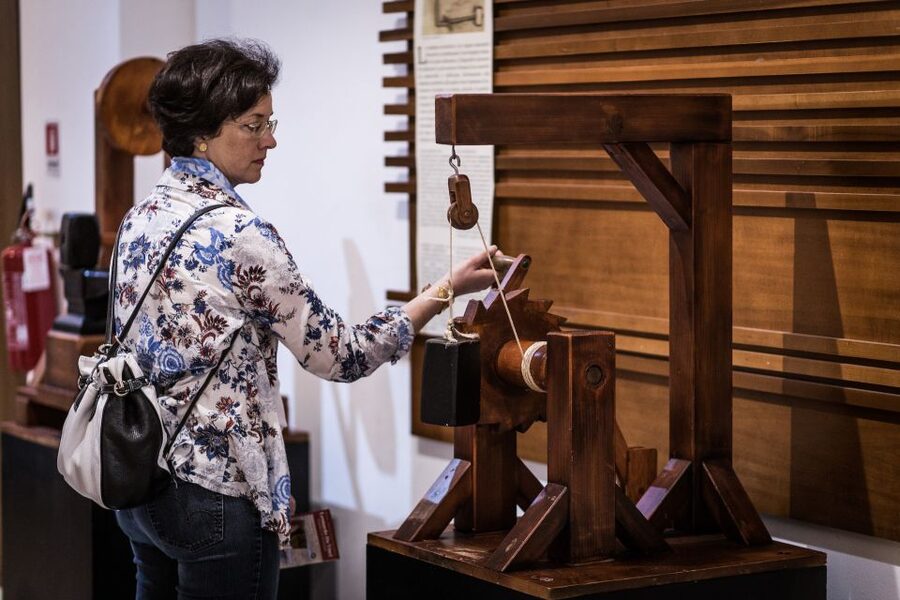
Many of the machines can be touched or operated. That is a major advantage over museums where every object sits behind glass. You get a better feel for Leonardo’s thinking when you turn a mechanism, test a lever, or look closely at how a model transfers movement.
The condition of individual models may vary. One or two machines may look worn, and the exhibition’s small size means you should not expect every reconstruction to be a polished museum centerpiece. Still, the chance to handle the mechanisms gives the collection its purpose.
Holograms, videos, and seven interactive displays
Nine holograms present Leonardo’s paintings and inventions in three dimensions. These displays add a bit of theatre without taking over the exhibition. They help explain how an idea works and give you a break from reading diagrams.
Seven interactive installations use Leonardo’s drawings as a starting point. They are helpful when you want more than a basic display label. You can explore his ideas through motion, images, and short explanations, then compare the original drawing with the full-size model nearby.
The exhibition includes a copy of The Last Supper, but the engineering displays are the real reason to come. If your main goal is to see original Renaissance paintings, this is not the right ticket. If you want to understand Leonardo as an engineer, inventor, theorist, architect, and scientist as well as an artist, the range is much more satisfying.
The presentations also make the museum work for mixed-age groups. Adults can study the ideas behind the devices, while children have physical activities and mechanisms to test. Parents should keep an eye on younger children, since the exhibition includes trip hazards and some areas where it is not immediately clear what you may touch.
More tickets and entry passes in Rome:
- Rome:Hop-On Hop-Off Panoramic Open Bus Ticket 3 Circuits x 1
★ 4.0 · 15,405 reviews - Vatican Museums & Sistine Chapel Skip-the-Line Entry Ticket
★ 4.4 · 13,838 reviews - Vatican Museums & Sistine Chapel Skip-the-Ticket-Line Tour
★ 4.3 · 10,486 reviews - Rome: St. Peter’s Basilica & Dome Entry Ticket & Audio Tour
★ 4.2 · 7,537 reviews
The underground tomb and the Palazzo setting
One unusual feature is not a Leonardo invention at all. Below the building, you can see the tomb of Auro Irzio, an architect who lived in the first century BC. The tomb dates to 43 BC and sits in an underground natural pond.
This is a small but memorable part of the visit. It gives you a Roman archaeological detail alongside the Renaissance material, and it helps explain why the building itself is worth noticing. The pond and tomb are not the main attraction, but they add variety to a museum visit that could otherwise focus entirely on machines.
The underground rooms also have a practical benefit. On hot days, the cool interior can be a welcome pause after walking through Rome. Several visitors have found the space pleasantly quiet, particularly in the later afternoon, though crowd levels can change.
Should you pay extra for the audio guide?
The entrance ticket does not include a guide. An optional audio guide is available for an additional cost, and I think it is worth considering if Leonardo’s engineering interests you.
The models often make sense at a glance, but the audio adds the reasoning behind them. It can explain what Leonardo was trying to solve, how a mechanism might operate, and how some of his ideas connect with modern transportation and architecture. English explanations are also available with the exhibits, so you can still have a worthwhile visit without the audio.
There is one practical catch: the audio sequence does not always match the order of the rooms. Give yourself a moment to locate each numbered item before pressing ahead. If you are visiting with children, you may prefer to use the written panels and let them spend more time testing the models.
The staff at the entrance are known for being friendly and helpful. That matters in a small exhibition, where a quick explanation about the route or the interactive displays can save you some confusion.
How long the visit takes and who will enjoy it
Plan on 45 to 60 minutes for a brisk visit. If you read everything, watch the videos, use the audio guide, and try the machines, you could spend up to two hours. The modest size is useful if you are building a busy Rome day around the Pantheon, Piazza Navona, Campo de’ Fiori, or nearby churches.
Families with school-age children are a particularly good match. The bridge activity, moving mechanisms, and interactive displays give children something to do, while adults can focus on the historical and technical ideas. It is less suitable for very young children who may struggle with uneven areas, trip hazards, or the difference between touchable and display-only objects.
You do not need to be an engineer. The exhibition explains the basic purpose of the machines, and the full-size models make the ideas more direct. Still, the experience is best for people curious about how things work. If you want a polished art museum with original masterpieces, choose another stop.
The exhibition also suits anyone looking for a quieter alternative to Rome’s busiest attractions. It is not usually an all-day commitment, so you can fit it between major sights without tiring yourself out.
Is $10 a fair price?
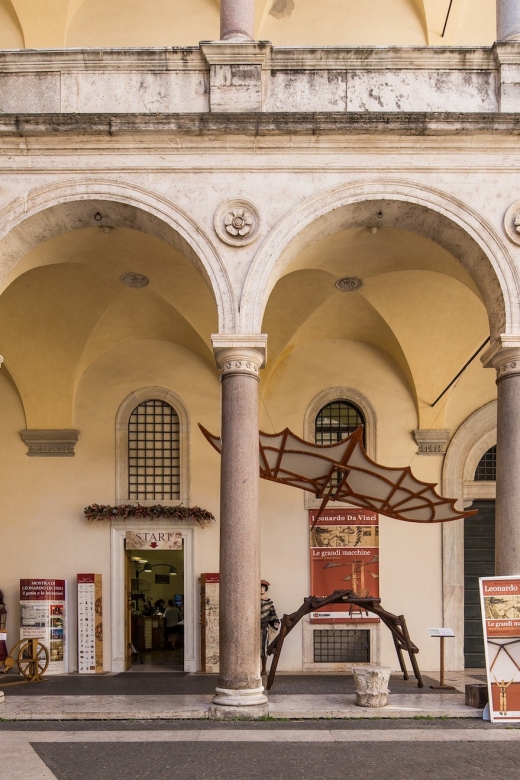
At about $10 per person, the ticket offers good value if you treat it as a focused, interactive museum rather than a major landmark. You are paying for access to more than 65 machines, nine holograms, seven interactive installations, the underground tomb, and the Palazzo setting.
The value improves for families. A child can spend time testing mechanisms instead of being asked to look at one more silent painting, and adults still get a useful introduction to Leonardo’s range. The gift shop is another plus, with books, models, and souvenirs that differ from the usual Rome merchandise.
The price is less convincing if you expect a large museum or original Leonardo works. The exhibition is small, and some reconstructions show wear. You should choose it for the ideas, the ability to handle the models, and the clear connection between drawings and machines.
Booking is flexible. You can reserve and pay later, and cancellation is free up to 24 hours before the visit. The ticket is valid for one day, with availability and entry times checked when you book. The exhibition is wheelchair accessible.
Should you book the Leonardo da Vinci Exhibition?
I would book this exhibition if you enjoy hands-on museums, have children in your group, or want a short indoor activity near Piazza Navona and Campo de’ Fiori. The full-size machines do a fine job of showing how Leonardo’s sketches might work, and the low price makes it an easy addition to a Rome itinerary.
I would skip it if you mainly want original paintings, a large collection, or a formal guided tour. The exhibition is compact, the route can be confusing, and the optional audio guide costs extra. For most curious visitors, though, an hour spent testing Leonardo’s designs is a smart change of pace from Rome’s churches and ruins.
FAQ
Where is the Leonardo da Vinci exhibition in Rome?
The exhibition is at Palazzo della Cancelleria, Piazza della Cancelleria 1, near Campo de’ Fiori and Piazza Navona.
How much does admission cost?
The listed price is $10 per person.
How long is the ticket valid?
The ticket is valid for one day. You should check availability for the entry times offered when you book.
How long should I allow for the exhibition?
A quick visit may take 45 to 60 minutes. If you read the explanations, watch videos, use the audio guide, and test the machines, you may spend up to two hours.
Is a guide included with the ticket?
No. A guide is not included. An optional audio guide is available for an additional cost.
Is the audio guide available in English?
English explanations are provided with the exhibits, and the optional audio guide is recommended by many English-speaking visitors.
Can I touch the inventions?
You can touch and operate almost all of the machines on display. The exhibition also includes interactive installations and a bridge-building activity.
Is the exhibition wheelchair accessible?
Yes, the exhibition is wheelchair accessible.
Can I cancel my booking?
Yes. You can cancel up to 24 hours in advance for a full refund. You can also reserve now and pay later.
Newest Rome tours we have reviewed
- Private TikTok Video Making in Rome★ 5.0 · 7 reviews
- Assisi, Orvieto and Civita di Bagnoregio Full Day Tour from Rome★ 4.5 · 45 reviews
- Assisi & Saint Francis Path Tour from Rome★ 5.0 · 45 reviews
- Assisi and Cascia Private Day Tour from Rome with Lunch★ 5.0 · 10 reviews
- Art Class in the center of Rome!★ 4.0 · 4 reviews
- Art & Craft: Beer Tour with Street Art in Rome★ 4.5 · 6 reviews
- Arrival in Rome: Airport Transfer & Exclusive City Introduction★ 5.0 · 3 reviews
- From Rome: Private Day-Tour of Tuscany★ 5.0 · 16 reviews