
Reviewed · ROME
Rome: Michelangelo’s Wonders at the Baths of Diocletian Tour
The most surprising part of this Rome tour is the way an ancient bath complex becomes a Michelangelo-designed church. The Basilica of St. Mary of the Angels and Martyrs uses the old Roman structure on a grand scale, so you see Roman engineering and Renaissance art in the same room. I especially like the 18th-century meridian line and the quiet Michelangelo cloister, two details many visitors miss when rushing between Rome’s bigger sights.
I also like that the tour begins near Termini Station, making it easy to fit into a day of sightseeing. Guides such as Chiara, Francesca, and Rosy have been singled out for clear, enthusiastic explanations. The main drawback is the option structure: a guided visit to Palazzo Massimo is not automatic, and the full route can take up to three hours.
Key points to know before booking
- Roman engineering on a huge scale: Diocletian’s Baths once served up to 3,000 Romans and included heated floors and pools.
- Michelangelo’s unusual church project: The Basilica of St. Mary of the Angels and Martyrs was formed from the ancient baths rather than built from scratch.
- A working piece of astronomy: The basilica contains an 18th-century meridian line used to track the sun.
- A peaceful cloister: Michelangelo’s cloister offers a calm change of pace after the vast bath halls.
- Choose the Palazzo Massimo option carefully: Entry is included, but a guided museum visit is only included with the specific upgraded option.
- Small groups help here: Groups of up to 10 people, or a private format, make it easier to hear explanations inside large, echoing spaces.
Why these old baths are worth your Rome time
Rome gives you plenty of famous ruins, but Diocletian’s Baths offer a different kind of history lesson. This was not a small neighborhood bathhouse. It was one of ancient Rome’s largest public bathing complexes, designed for thousands of people and supported by serious hydraulic and heating systems.
The baths once had heated floors and pools. That detail matters because the site was not simply a place to wash. It was a large public center shaped by Roman engineering, social life, and leisure. As you walk through the surviving spaces, you can start to picture how heat, water, stone, and people moved through the complex.
The great appeal of this tour is the contrast. One moment, you are looking at Roman construction built for public use. The next, you are inside a church shaped by Renaissance design. The buildings are not presented as separate chapters. They occupy the same physical space, which makes the story easier to understand.
I would choose this experience if you have already seen the Colosseum and Roman Forum and want a less predictable side of Rome. It is also useful early in your stay because it gives you a strong introduction to how Rome repeatedly reused its ancient buildings.
Other Rome tours people pair with this one:
- Vatican Museums & Sistine Chapel Tour with Optional Basilica
★ 4.3 · 67,413 reviews - Vatican Museums, Sistine Chapel & St Peter’s Basilica Guided Tour
★ 4.5 · 39,149 reviews - Rome: Colosseum, Palatine Hill and Roman Forum Guided Tour
★ 4.8 · 32,814 reviews
Meeting at Piazza della Repubblica
The meeting point is in front of the gate of the Basilica of St. Mary of the Angels and Martyrs at Piazza della Repubblica. Look for a staff member holding a yellow Touriks sign.
This location is practical. It is close to Termini Station, one of Rome’s main transport hubs, so you can reach it without crossing the historic center. Give yourself enough time to find the correct church entrance. Piazza della Repubblica is a busy urban setting, and the basilica can be easy to overlook if you are thinking only of the broad curve of the piazza.
Bring the passport or identification document used when booking. Each person must present a valid document matching the name supplied at the time of booking. Large bags, luggage, sharp objects, drones, shorts, short skirts, sleeveless shirts, and weapons are not allowed.
The itinerary can run in either direction. You might begin inside the basilica and then move to the baths, or start with the baths and finish at the church. That change does not alter the main sights, but it can affect how the story unfolds and how much time you have afterward.
Inside the Basilica of St. Mary of the Angels and Martyrs
The basilica is the first major surprise. Michelangelo adapted part of the ancient baths into a Christian church, allowing the old Roman structure to shape the interior. Rather than walking through a bare ruin, you see a functioning religious building with an enormous ancient skeleton.
The guided portion here lasts about 30 minutes. That is enough time to understand the main design choices, but it is not a long art lecture. Your guide points out the relationship between the Roman remains and the Renaissance work, helping you see why this church feels so unlike a standard Roman basilica.
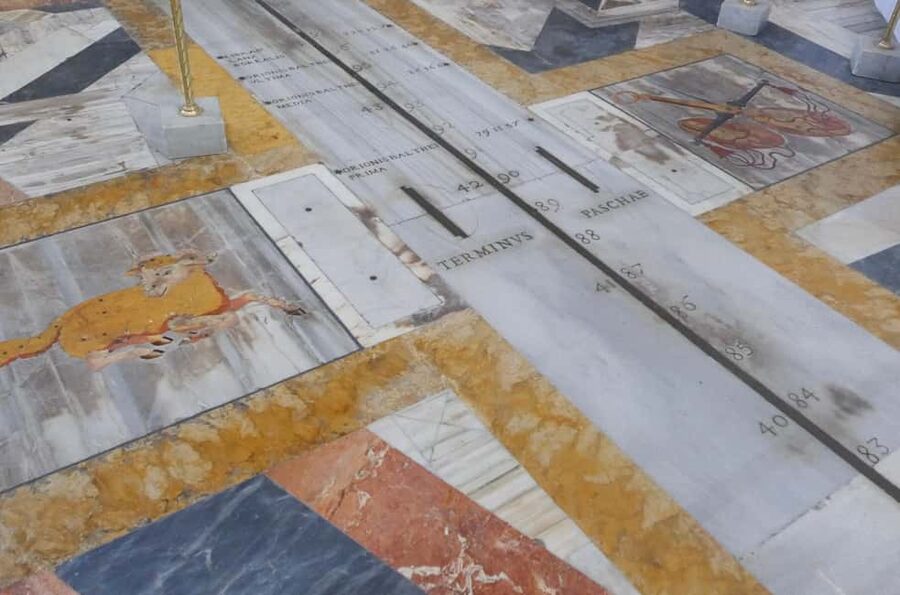
Look for the meridian line set into the floor. Created in the 18th century, it was used to track the sun’s movement. This is one of the tour’s best details because it connects the church to astronomy and measurement, not just architecture and religion.
The basilica also contains an unusual astronomical clock. Together, the clock and meridian line show how the building served as a meeting point for art, faith, science, and timekeeping. You do not need to be an astronomy enthusiast to appreciate the idea. In a city full of ancient columns and Baroque decoration, these instruments give you something precise to look at.
The church is a good example of why a guide helps. Without context, you may see a grand interior and a line in the floor. With an explanation, you can understand that the building carries several different identities at once: Roman bath structure, Renaissance church, and scientific measuring space.
The Baths of Diocletian and their vast surviving rooms
The tour then turns to the Baths of Diocletian, with about one hour devoted to the complex. This is where the scale becomes clear. The bathhouse served as many as 3,000 Romans, and the surviving vaulted rooms give you a sense of the size needed to handle that number.
I find the engineering story especially useful. Roman baths required a complex system of water supply, drainage, heating, and circulation. Heated floors and pools were not minor comforts. They depended on planning and labor on a scale that can be hard to grasp from a single ruin.
The soaring vaulted ceilings are among the strongest visual features. They also make the group format important. Large stone interiors can swallow a guide’s voice, so the included headsets help you follow the explanation without standing directly beside the guide at every moment.
You will see Roman mosaics and sculptures within the museum areas connected to the baths. These pieces add detail to the architecture. The walls show the size of the project, while the objects and decorative work help you imagine how the spaces were finished and used.
The tour is not designed as a full technical study of every surviving section. If you want to examine every mosaic, inscription, and architectural fragment at your own pace, you may want extra time after the guided portion. The tour works best as a focused introduction that gives you a framework for later exploration.
Same city, a completely different half-day:
- Rome: Guided Tour of Colosseum, Roman Forum & Palatine Hill
★ 4.7 · 27,897 reviews - Rome: Colosseum & Forum with Audio Guide App -Optional Arena
★ 4.2 · 24,770 reviews - Rome: Colosseum, Roman Forum and Palatine Hill Guided Tour
★ 4.5 · 23,903 reviews - Rome: City Sightseeing Hop-on Hop-off Bus with Audioguide
★ 4.0 · 16,045 reviews
Michelangelo’s cloister offers a quieter pause
The cloister is a welcome change after the enormous bath halls. It has a calmer feel and lets you look at Michelangelo’s work on a more human scale.
This is the part of the visit that can easily get lost in a rushed schedule. The major halls attract attention because of their height and size, but the cloister rewards a slower look. I would pause here rather than treating it as a passage between rooms.
The appeal is not only visual. The cloister shows how Renaissance design could create order and calm within a much older Roman site. Ancient stone and later architectural planning sit side by side without needing to be separated into different monuments.
If you are taking the small-group tour, this is a good place to ask your guide a question. The group size is limited to 10 people, and a private option is also available. That format should suit you if you prefer discussion over a large crowd moving from point to point.
Adding Palazzo Massimo for ancient art
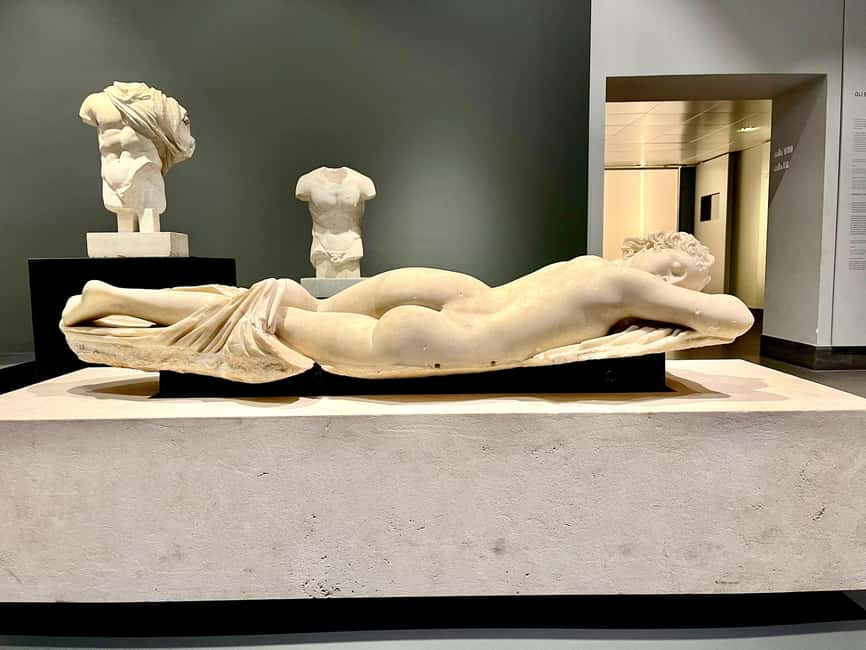
Palazzo Massimo alle Terme is part of the National Roman Museum and adds a substantial museum visit to the experience. The guided visit lasts about 1.5 hours when you select that option. This makes the full outing closer to three hours rather than the shorter 1.5-hour format.
The museum is known for ancient art, including a copy of the Sleeping Hermaphrodite. The sculpture is presented as an idealized human form, giving you a chance to compare the museum’s sculptural tradition with the architecture seen earlier in the tour.
Another major attraction is the preserved fresco work from the Villa of Livia. The paintings show lush garden scenes and peaceful outdoor settings. They are a sharp contrast to the heavy stone and vaulted interiors of the baths, so the museum makes a good second half to the visit.
Pay close attention when choosing your ticket. Entry to Palazzo Massimo and Palazzo Altemps is included, but a guided tour of Palazzo Massimo is included only if you select the option that specifically offers it. Otherwise, you receive unguided access. That can be a good value if you like wandering through museums independently, but it is not the same product as a guided museum visit.
Palazzo Altemps is also included in the ticket. The supplied details do not set out a guided route or timing there, so think of it as additional museum access rather than a guaranteed part of the guided schedule.
How the price compares with the experience
At about $77 per person, the tour is not the cheapest way to see Roman ruins. Its value depends on the format you choose and how much explanation you want.
For the basic guided visit, you are paying for access to the basilica and baths, a live guide, headsets, and a small group or private setting. That is reasonable if you want the buildings explained rather than simply entering with a ticket. The meridian line, astronomical clock, heating system, and church conversion all benefit from a guide’s context.
The price becomes easier to justify if you choose the Palazzo Massimo guided option and make use of the museum access. You can see Roman architecture, Renaissance design, ancient sculpture, and Roman frescoes in one connected outing. If you already plan to visit Palazzo Massimo separately, compare the cost and timing before paying for the guided add-on.
I would not choose this tour solely for speed. The shorter version is useful, but the site deserves time. If you are booking the longer option, allow room for the full 1.5-hour museum visit and remember that the order of stops may change.
Group size, guides, and the pace of the visit
A small group of up to 10 people is a strong fit for these interiors. You can hear the guide through the headsets, and the group is small enough for questions without the stop becoming unwieldy.
A private option gives you still more control, though the supplied details do not promise a custom itinerary or different opening hours. I would pick private touring if you want to ask many questions about Michelangelo, Roman engineering, or the astronomical instruments.
The named guides connected with this experience include Chiara, Francesca, and Rosy. Chiara is described as cheerful and informative, Francesca as friendly and very clear, and Rosy as especially passionate about the site. Those qualities matter here because the buildings need interpretation. A guide who simply lists dates will not bring out the connection between the baths, the basilica, and the museum.
The tour is offered in English, French, Portuguese, Spanish, Italian, and German. Confirm your preferred language when booking, since the language affects how useful the explanations will be.
Practical limits to keep in mind
Dress conservatively for the basilica. Shorts, short skirts, and sleeveless shirts are not allowed. Pack light, since luggage and large bags are not permitted, and bring the identification document that matches your booking.
There is no pickup or drop-off service, and food and drinks are not included. Plan to meet at Piazza della Repubblica and make your own way onward after the tour. The listed drop-off locations include the National Roman Museum, Terme di Diocletian, and Palazzo Massimo, but this is not a hotel transfer.
The free cancellation window lasts until 24 hours before the start time, and you can reserve now and pay later. Those terms are useful if your Rome schedule is still moving around, though you should still confirm the exact starting time when you check availability.
Who should book this Rome tour?
I would recommend it to you if you enjoy seeing how different eras share one building. The tour has a strong visual theme: Roman baths, Michelangelo’s adaptation, scientific instruments, a Renaissance cloister, mosaics, sculptures, and ancient frescoes.
It is especially good for repeat visitors who have already covered Rome’s headline monuments. It also suits first-time visitors who want a quieter alternative to the Colosseum, with a guide who can explain what they are seeing.
Families with older children may find the heating system, waterworks, and sun-tracking line more engaging than a long sequence of dates. Art lovers should consider the Palazzo Massimo option, while museum fans who prefer to set their own pace may want the ticket with unguided museum access.
I would think twice if you have only a short amount of time and want to see Rome’s most famous sights. The baths are large, and the longer version requires real attention. It is also not ideal if you want to carry luggage or dress casually in summer.
Should you book it?
Book this tour if you want a clear, guided look at one of Rome’s most unusual combinations: a massive Roman bathhouse reshaped into a Michelangelo church. The meridian line, astronomical clock, vaulted halls, and cloister give the visit plenty of detail beyond the basic ruins.
Choose the Palazzo Massimo guided option if ancient art and Villa of Livia’s frescoes matter to you. Choose unguided museum access if you prefer freedom and already understand the difference between the included ticket and the guided add-on.
At $77, the experience makes the most sense for you when explanation, small-group attention, and several connected sights matter more than keeping costs to a minimum. It is a thoughtful Rome choice, not a quick photo stop.
FAQ
Where does the tour meet?
Meet in front of the gate of the Basilica of St. Mary of the Angels and Martyrs at Piazza della Repubblica. Look for a staff member holding a yellow Touriks sign.
How long does the tour last?
The experience lasts between 1.5 and 3 hours, depending on the selected option. The Palazzo Massimo guided visit adds about 1.5 hours.
Is Palazzo Massimo guided?
Only the option specifically selected with a guided Palazzo Massimo visit includes that service. Otherwise, your ticket includes unguided access.
Is entry to Palazzo Altemps included?
Yes. The ticket includes entry to Palazzo Altemps, along with the Baths of Diocletian and Palazzo Massimo.
Can I join a private tour?
Yes. Private and small-group options are available. Small groups can include up to 10 people.
Which languages are available?
Live guides are available in English, French, Portuguese, Spanish, Italian, and German.
What identification do I need?
Bring a valid passport or identification document. Each person’s document must match the full name provided during booking.
Newest Rome tours we have reviewed
- Private TikTok Video Making in Rome★ 5.0 · 7 reviews
- Assisi, Orvieto and Civita di Bagnoregio Full Day Tour from Rome★ 4.5 · 45 reviews
- Assisi & Saint Francis Path Tour from Rome★ 5.0 · 45 reviews
- Assisi and Cascia Private Day Tour from Rome with Lunch★ 5.0 · 10 reviews
- Art Class in the center of Rome!★ 4.0 · 4 reviews
- Art & Craft: Beer Tour with Street Art in Rome★ 4.5 · 6 reviews
- Arrival in Rome: Airport Transfer & Exclusive City Introduction★ 5.0 · 3 reviews
- From Rome: Private Day-Tour of Tuscany★ 5.0 · 16 reviews