
Reviewed · ROME VESPA AND FIAT 500 TOURS
Rome Morning Vespa Sidecar Tour in Rome with Cappuccino
Rome is a city made for motion, and this Vespa sidecar tour covers a remarkable amount of ground in about three hours. You ride past fountains, ancient monuments, grand piazzas, and quiet lanes while a professional driver handles Rome’s traffic. The morning starts at 9:00 and returns to Piazza della Repubblica.
I like the small maximum group of 12 and the easy sightseeing pace. I also like the included Pantheon entry, cappuccino, and cornetto, since those extras turn a simple drive into a useful introduction to Rome. The main consideration is that this is a panoramic overview, not a deep visit to every monument. You will see many places, but only enter the Pantheon.
Key points to know before booking
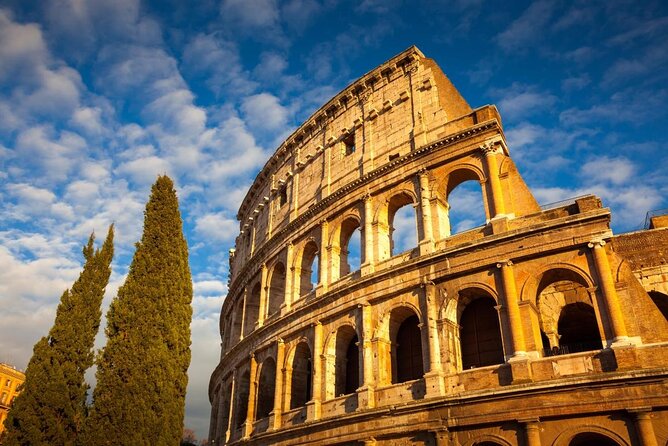
- Twelve major sights in three hours: The route links central Rome, the Vatican area, Janiculum Hill, the Colosseum, and Santa Maria Maggiore.
- You do not drive: Professional drivers manage the traffic, narrow lanes, parking, and route.
- The Pantheon entry is included: This is the only monument you enter during the planned tour.
- A real Roman breakfast stop: Expect a traditional cappuccino and cornetto, plus a comfort break.
- Clear commentary throughout: Headsets let you hear the guide while the Vespas are moving.
- Seat rules matter: Each Vespa carries two people, and solo bookings or odd-number groups may need to alternate between the sidecar and rear seat.
Why a Vespa sidecar works so well in Rome
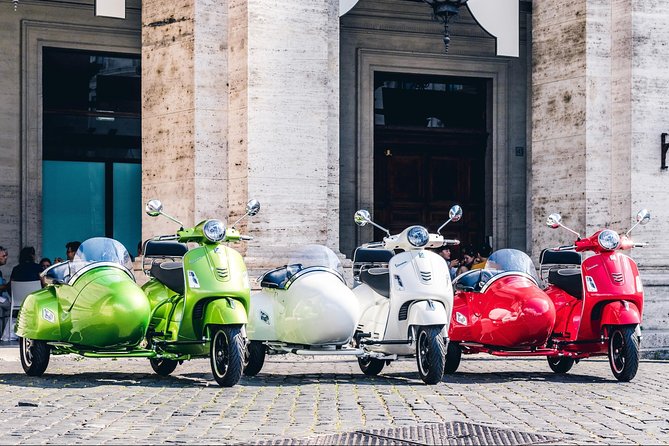
Rome is spread out in a way that can make a walking tour tiring. The Trevi Fountain, Pantheon, Vatican, Janiculum Hill, Colosseum, and Basilica of Santa Maria Maggiore are not all close together. On foot, seeing them in one morning would mean a lot of pavement and less time looking around.
The sidecar solves that problem without putting you behind a steering wheel. You can watch the streets, listen to the guide, and let the driver deal with traffic and parking. The route also reaches smaller lanes and old neighborhoods that are awkward for a large bus.
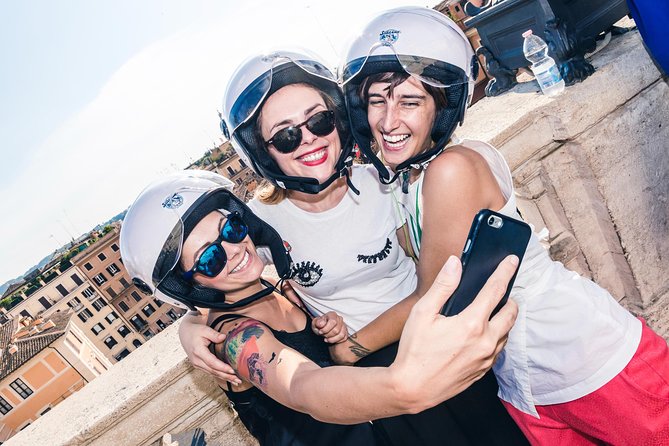
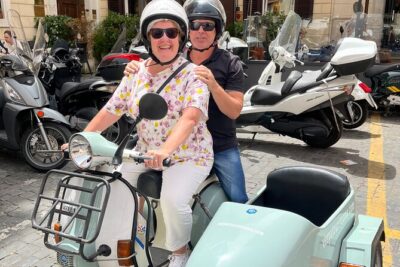
The experience has a playful quality, too. You sit low to the street, so Rome feels close rather than displayed behind a coach window. The tour team provides CE-approved helmets with sterilized disposable head covers. Some rides have also included blankets or hot water bottles in cool weather, though those touches should not be treated as guaranteed inclusions.
The audio system is important. Rome has plenty of traffic noise, and a guide speaking from another vehicle would otherwise be easy to miss. The supplied headsets allow live commentary during the ride, with time to ask questions and stop for photographs.
More Vespa and Fiat 500 tours in Rome:
- Vespa Sidecar Tour By Night with Pickup
★ 5.0 · 1,803 reviews - Rome Vespa Scooter Tour with Professional Photographer
★ 5.0 · 857 reviews - Rome: Highlights Vespa Sidecar Tour with Coffee and Gelato
★ 4.9 · 747 reviews
Starting at Piazza della Repubblica
The meeting point is Piazza della Repubblica, at P.za della Repubblica, 41. This grand circular square was shaped during Rome’s redevelopment after the city became Italy’s capital. Its centerpiece is the Fontana delle Naiadi, surrounded by imposing nineteenth-century buildings.
The square also contains the remains of the Baths of Diocletian, which help explain the odd contrast between formal city planning and ancient ruins. You get about 10 minutes here, enough for an introduction and a few photographs rather than a full visit.
Starting here is practical. Piazza della Repubblica is near public transportation and close to Termini station, making the 9:00 meeting time manageable if you are staying in central Rome. Arrive with enough time to find the exact meeting point and adjust your helmet before departure.
Quirinal Palace and the Trevi Fountain
The next short stop is Palazzo del Quirinale, one of Italy’s official presidential residences. The palace sits on the Quirinal Hill, the highest of Rome’s seven traditional hills. Its long history includes popes, kings, and presidents, making it a useful place to connect the city’s religious, royal, and modern political eras.
You spend about five minutes here, so think of this as an orientation stop rather than a palace tour. You will not go inside, but the guide can place the building within Rome’s larger story.
At Trevi Fountain, the tour allows about 30 minutes. That is enough time to admire the fountain, take photographs, and toss in a coin if you wish. The fountain marks the end of the Aqua Virgo aqueduct, whose water reached Rome in 19 BC. The present Baroque design was completed in 1762 after work by Nicola Salvi and Giuseppe Pannini.
Trevi is often crowded, and the narrow space around it can feel hectic. A Vespa tour cannot remove the crowds, but it does bring you close to one of Rome’s essential sights without requiring you to find it on foot. Keep your belongings secure and stay aware of the group’s meeting time.
Entering the Pantheon
The Pantheon is the most substantial interior visit on the route. Built in its present form around AD 126, it remains one of the best-preserved buildings from ancient Rome. Its famous oculus opens the dome to the sky and provides the main natural light inside.
The entrance ticket is included, which adds real value to the tour. You get about 30 minutes here, enough to look up into the dome, see the interior details, and hear the guide explain why the building has survived so well.
This stop also gives the morning a welcome change of pace. Much of the tour is moving through the city, but the Pantheon lets you pause in a powerful ancient space. The visit is not a replacement for a full archaeology tour, and the schedule may feel short if you want to examine every chapel and monument. Still, it is more than a drive-by photograph.
A useful detail from the route is the nearby Piazza della Rotonda, where you may have a chance to see the public fountain and refresh with Rome’s drinking water. The exact timing of small pauses can vary, but the Pantheon is the scheduled paid entrance.
More morning tours in Rome:
- Early Morning Vatican, Sistine, St. Peter’s Semi or Private Tour
★ 5.0 · 3,779 reviews - Rome: Complete Early Morning Vatican Tour | Small Group
★ 5.0 · 1,990 reviews - Rome: Early-Morning Vatican Museums and Sistine Chapel Tour
★ 4.7 · 1,778 reviews - Rome: Vatican, Sistine Chapel, St. Peter Early Morning Tour
★ 4.9 · 227 reviews
Piazza Navona and St. Peter’s Square
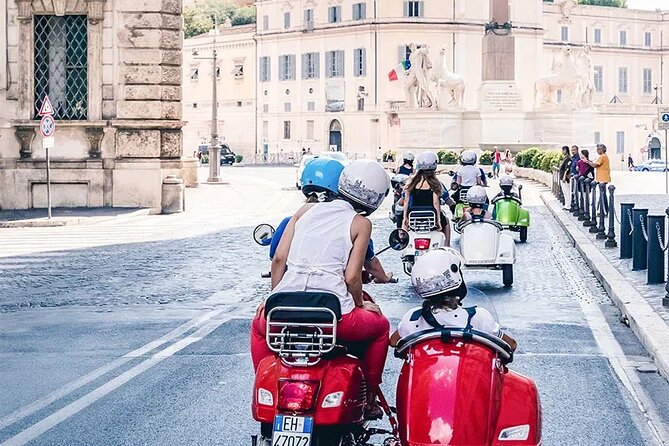
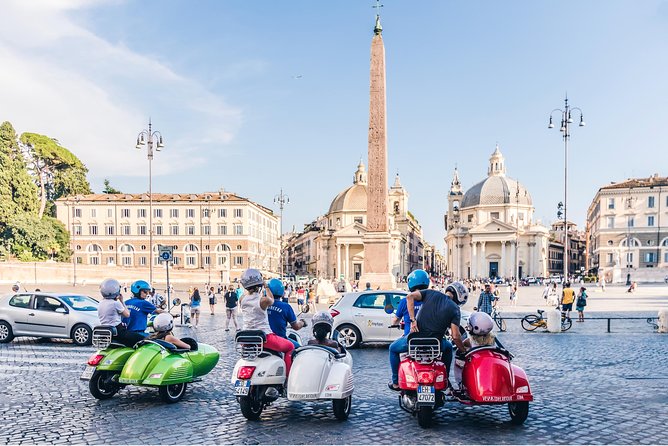
The route continues through Piazza Navona, built over the site of an ancient Roman stadium. Its long oval shape still reflects that origin. Today, it is known for Baroque buildings and fountains, especially Bernini’s Fountain of the Four Rivers.
This is a sightseeing pass rather than a dedicated stop with a set admission. That is one of the tradeoffs of the tour: you can see a wide slice of Rome, but you may want to return later for a slower look at the square, its church, and its street life.
St. Peter’s Square provides another major visual shift. Bernini designed the great colonnade in the seventeenth century, creating an open space that leads the eye toward St. Peter’s Basilica. The square can hold more than 300,000 people, though the atmosphere changes greatly depending on the time and events taking place.
The tour does not include entry to St. Peter’s Basilica or the Vatican Museums. You should plan a separate visit if those interiors are high on your list. As an introduction, though, the square gives you a strong sense of the Vatican’s scale without the time commitment of a full Vatican tour.
Janiculum Hill for Rome’s best wide view
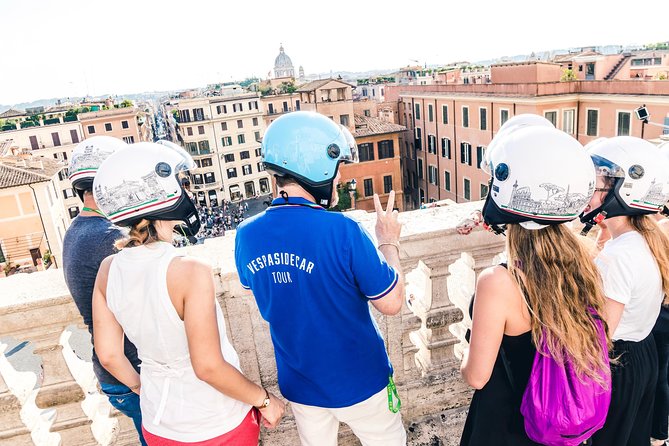
Terrazza del Gianicolo, on Janiculum Hill, is one of the morning’s most rewarding stops. Janiculum is not counted among the ancient seven hills, but it rises just outside the old city and offers broad views across Rome.
You get about 15 minutes here. That is enough for photographs and a breath of quieter air after the central streets. The view helps you understand how Rome’s domes, rooftops, and major monuments fit together.
Janiculum also carries strong Risorgimento history. Giuseppe Garibaldi and his forces fought here during the defense of the Roman Republic against French troops. Statues of Garibaldi and other figures line the hill, giving the overlook more meaning than a simple photo stop.
If panoramic views matter to you, this is one of the tour’s strongest reasons to book. The drawback is the short visit. You will not have time to stroll all of Janiculum Hill or explore every monument along its paths.
Through Trastevere and the Jewish Ghetto
The route then moves through Rome’s more intimate quarters, including the bohemian streets of Trastevere and the Jewish Ghetto. This part helps keep the tour from becoming a string of famous monuments.
Trastevere is known for narrow lanes, local trattorias, and an older neighborhood feel. From a sidecar, you get a quick look at the street pattern and everyday city life. You do not stop for a full meal, so mark down any restaurant or lane you want to revisit later.
The Jewish Ghetto offers another layer of Rome’s past and present. Its lanes connect ancient ruins, later buildings, and a living neighborhood. Again, the value is in seeing how the city’s districts fit together. If you want detailed Jewish Roman history or a food walk, arrange that separately.
This is also where the Vespa has a clear edge over a large coach. Narrow streets and quick turns make the ride more flexible. You still need to accept the noise and movement of city traffic, but you are closer to the streets than you would be on a bus.
Piazza Venezia and the Altar of the Fatherland
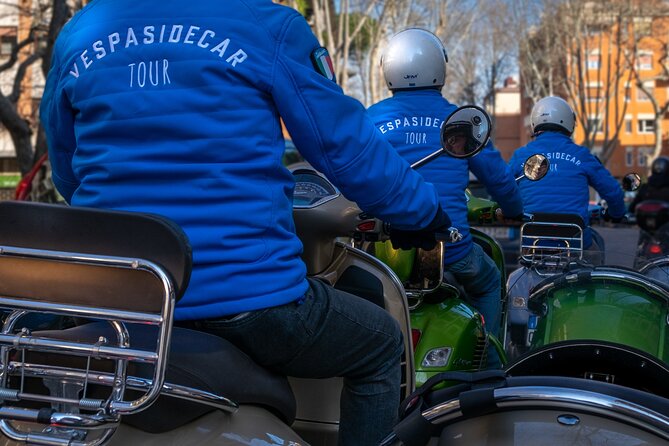
At Piazza Venezia, you see the Monumento Nazionale a Vittorio Emanuele II, often called the Altare della Patria. The enormous white structure honors Victor Emmanuel II, the first king of unified Italy. It opened in 1911 and now includes the tomb of the unknown soldier, guarded by soldiers beside an eternal flame.
The monument is a useful stop for understanding modern Italy, not just ancient Rome. Its size and white stone make it impossible to miss, although its design has long sparked strong opinions. You will see it from outside during this tour. Entry to the museum or upper terraces is not included.
The square is also an excellent place to grasp Rome’s layers. Ancient ruins, medieval streets, Renaissance churches, nineteenth-century planning, and modern traffic all meet within a short distance. That mixture is one of the reasons a moving tour works well here.
The Colosseum and Santa Maria Maggiore
The Colosseum is one of the route’s major visual rewards. The Flavian Amphitheatre dates back nearly 2,000 years and remains Rome’s clearest symbol of the ancient empire. You see the exterior, but the tour does not include an interior ticket.
That distinction matters. If you want to walk through the Colosseum, underground areas, or upper levels, book a separate timed visit. The sidecar tour is better for getting your bearings, taking photographs, and learning where the monument sits in relation to the rest of Rome.
The route also includes Basilica di Santa Maria Maggiore, one of Rome’s four major basilicas and the largest Roman church dedicated to the Virgin Mary. The supplied schedule does not list a set stop duration or interior admission here, so treat it as part of the sightseeing circuit rather than a guaranteed extended visit.
The tour ends back at Piazza della Repubblica. Depending on traffic and the pace of the group, the full experience lasts about three hours.
Breakfast, equipment, and seating
The included breakfast is simple and very Roman: a cappuccino and cornetto, the local sweet pastry commonly eaten in the morning. It is a pleasant comfort break, not a full meal. If you need a substantial breakfast, eat before meeting the group.
Water has also been provided on some tours, but the formal inclusion is the cappuccino and cornetto. Tell the operator about special dietary needs when booking. The experience is not permitted for pregnant participants.
Each Vespa carries two people, one in the sidecar and one behind the driver. If you book one seat, you share the vehicle with another participant. With an odd-numbered group, you agree to alternate seats at stops so everyone can use the sidecar.
The sidecar limit is 110 kilograms, or 242 pounds, and the maximum height is 1.90 meters. The rear saddle limit is 118 kilograms, or 260 pounds. Children must be at least five years old. Children taller than 150 centimeters may sit behind the driver; otherwise, they must sit in the sidecar and be accompanied by an adult.
These rules are not minor fine print. The sidecar is the most relaxed seat for many people, so make sure the arrangement suits you before booking.
Price, group size, and overall value
At $163.26 per person, this is not the cheapest way to see Rome. You are paying for a professional driver, a licensed guide, helmets, headsets, a three-hour route, breakfast, and Pantheon admission.
The value improves if you have only one morning to get oriented. Public transportation and walking can cover the same ground, but you would spend more time changing routes, checking maps, and finding entrances. A bus tour may cost less, but it cannot use the same narrow lanes or provide the same open-air view.
The maximum group size is 12, which keeps the experience more personal than a large coach. The guide can speak to the whole group through headsets, and stops allow photographs and questions. Still, this is not a private tour. If you want your own driver and a custom route, ask about that separately, since it is not included in the stated service.
The tour requires good weather. You can cancel for a full refund up to 24 hours before the start time. If poor weather cancels the ride, you are offered another date or a full refund. That policy matters because the experience is outdoors and Rome’s weather can change quickly.
Who should book this Rome tour?
I would choose this tour for a first morning in Rome, especially if you want to see the city’s main landmarks before deciding where to spend more time. It also suits families with children old enough to ride, couples who want something more memorable than a standard walking tour, and returning visitors looking for a fresh way to cover familiar ground.
It is less suitable if you dislike traffic, need long interior visits, or want a slow archaeological tour. The ride is active and exposed to weather, even though you are not the one driving.
Guide names such as Claudio, Matteo, Luca, Alessio, and Barbara have been associated with especially engaging commentary, while drivers including Manuel, Alessandro, Massimo, and others handle the Vespas. Assignments can change, so book for the format and route rather than a particular person.
My verdict: book it for orientation and fun
I would book this Vespa sidecar tour if I wanted a lively overview of Rome with minimal walking and no driving stress. The strongest parts are the number of sights, Janiculum Hill’s view, the Pantheon entry, and the chance to pass through neighborhoods that a big bus cannot reach.
Just keep your expectations clear. You are not getting full tours of the Colosseum, Vatican, Trevi Fountain, or every church. You are getting a well-packed morning that shows you where Rome’s major pieces fit, with a cappuccino and cornetto along the way.
If that sounds like your ideal first look at the city, the $163.26 price is reasonable for the time saved and the unusual format. If you prefer to linger indoors and study one monument at a time, spend the money on focused walking tours instead.
FAQ
Where does the Rome Vespa sidecar tour start?
The tour starts at P.za della Repubblica, 41, 00185 Rome, at 9:00 am. It ends back at the same meeting point.
How long does the tour last?
The tour lasts approximately three hours.
What sights are included on the route?
The route includes Piazza della Repubblica, Quirinal Palace, Trevi Fountain, the Pantheon, Piazza Navona, St. Peter’s Square, Janiculum Hill, Trastevere, the Jewish Ghetto, Piazza Venezia and the Altare della Patria, the Colosseum, and Santa Maria Maggiore.
Is admission to the Pantheon included?
Yes. The Pantheon entrance ticket is included. The tour does not include entrance tickets for the Colosseum, Vatican Museums, or St. Peter’s Basilica.
What food is included?
The tour includes a traditional cappuccino and cornetto. You should state any special dietary requirements when booking.
Can children join the tour?
Children must be at least five years old and accompanied by an adult. Children taller than 150 centimeters may sit behind the driver. Shorter children must sit in the sidecar.
Can I cancel the booking?
You can cancel up to 24 hours before the start time for a full refund. Changes or cancellations made less than 24 hours in advance are not accepted for a refund. If poor weather cancels the tour, you are offered another date or a full refund.
Newest Rome tours we have reviewed
- Private TikTok Video Making in Rome★ 5.0 · 7 reviews
- Assisi, Orvieto and Civita di Bagnoregio Full Day Tour from Rome★ 4.5 · 45 reviews
- Assisi & Saint Francis Path Tour from Rome★ 5.0 · 45 reviews
- Assisi and Cascia Private Day Tour from Rome with Lunch★ 5.0 · 10 reviews
- Art Class in the center of Rome!★ 4.0 · 4 reviews
- Art & Craft: Beer Tour with Street Art in Rome★ 4.5 · 6 reviews
- Arrival in Rome: Airport Transfer & Exclusive City Introduction★ 5.0 · 3 reviews
- From Rome: Private Day-Tour of Tuscany★ 5.0 · 16 reviews
Rome Vespa and Fiat 500 Tours, compared.
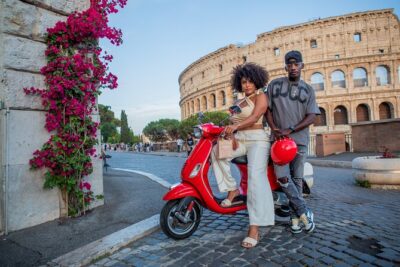
Rome Vespa Scooter Tour with Professional Photographer
Read our review →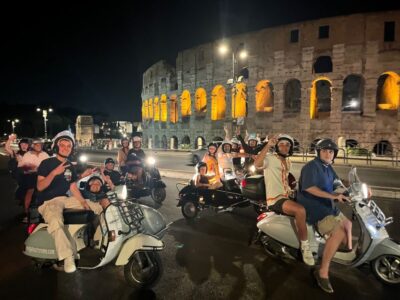
Highlights Vespa Sidecar Tour with Coffee and Gelato
Read our review →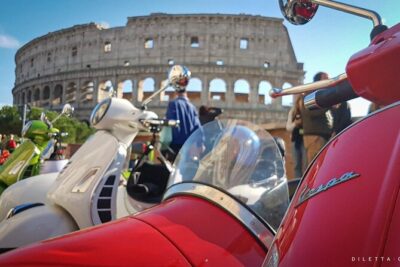
Rome Afternoon Sightseeing Vespa Sidecar Tour with Gourmet Gelato
Read our review →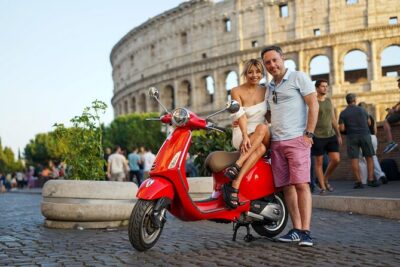
Vespa Sidecar Tour In Rome with Pickup, Drop-off, Gelato included
Read our review →
Browse the lists this tour appears in