Reviewed · ROME COLOSSEUM TOURS
Rome: Priority Access to Colosseum and Forum with Virtual Reality Tour
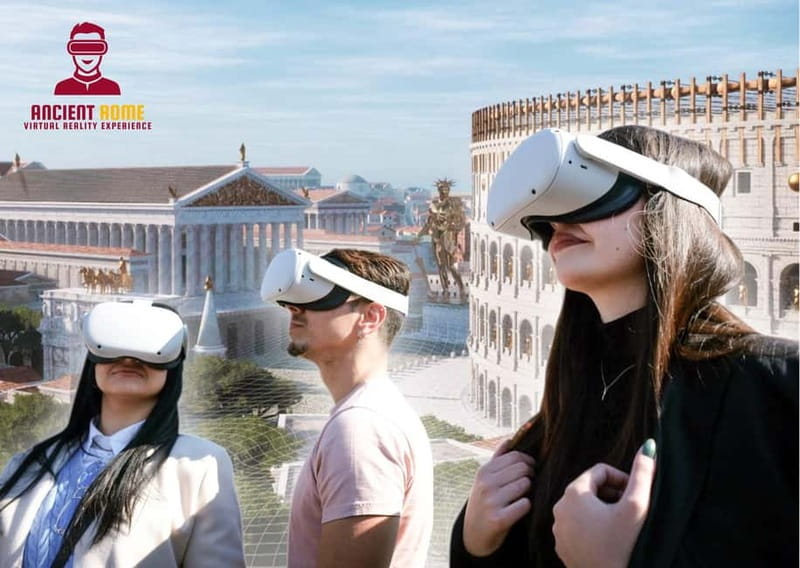
The clever part of this Rome experience comes before you enter the Colosseum. You use a latest-generation Meta Quest 2 or newer headset to see ancient Rome rebuilt in 3D, from the Colosseum and Circus Maximus to Piazza Navona, Via Appia, and Ostia Antica. I like the way this gives you a visual map before you meet the real ruins. I also like the priority admission and the tiny group, limited to six people.
The main drawback is that the virtual tour is in English and the physical visit is self-guided. You get audio commentary and technical help, but this is not a full live walking tour with a historian beside you explaining every column. At $78.17 per person, the value depends on how much you want the VR introduction as well as entry to Rome’s major ancient sites.
Key points to know before booking
- A 3D Rome before the ruins: See reconstructed versions of the Colosseum, Roman Forum, Circus Maximus, Piazza Navona, Via Appia, and Ostia Antica.
- Priority entry to three major sites: Your admission covers the Colosseum, Roman Forum, and Palatine Hill.
- A very small group: The group is limited to six participants, which should make headset setup and staff assistance easier.
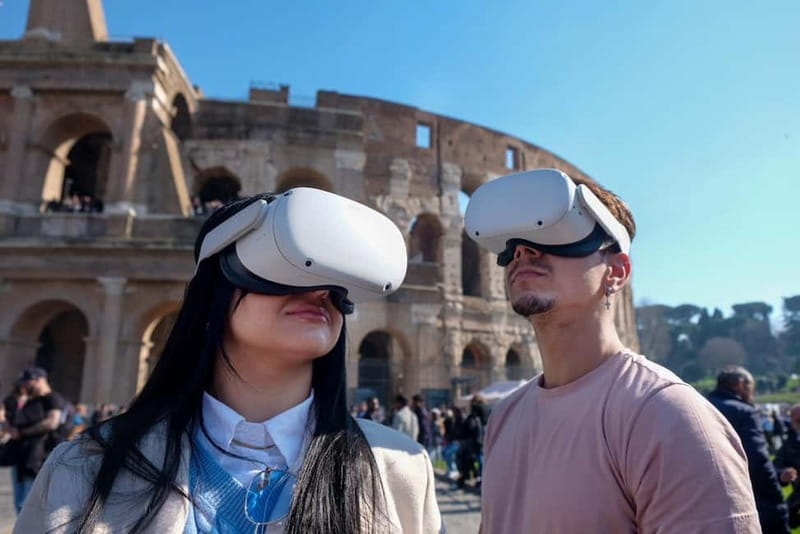
- Modern VR equipment: You use a Meta Quest 2 headset or a newer model, with English audio commentary.
- A convenient meeting point: Meet staff in Ancient Rome VR clothing beside the Arch of Constantine.
- A flexible booking policy: You can cancel up to 24 hours before the activity for a full refund, and reserve now while paying later.
Why the virtual reconstruction helps at the Colosseum
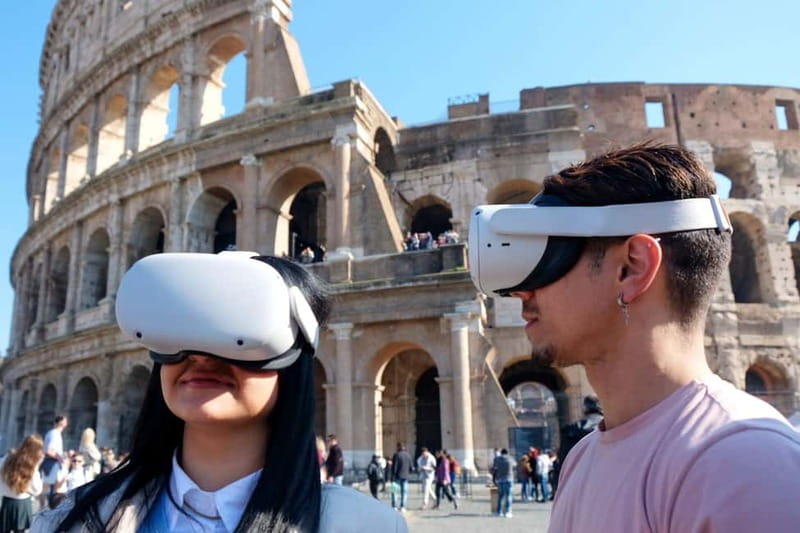
Rome’s ancient ruins can be hard to read. You see broken walls, partial arches, and scattered foundations, but the original buildings are no longer there to explain themselves. The virtual portion tackles that problem directly by showing reconstructed versions of ancient Rome in three dimensions.
You can turn 360 degrees inside each digital scene. That matters because you are not limited to a flat picture or a short film. You can look around and examine the setting from different angles while the English voice commentary explains what you are seeing.
The reconstruction includes more than the Colosseum. You also visit digital versions of the Roman Forum, Circus Maximus, Piazza Navona, Via Appia, and Ostia Antica. This broader view gives you a sense of Rome as a connected city rather than a collection of separate monuments.
The Colosseum is the obvious star, but the other locations add useful context. The Circus Maximus points to Rome’s enormous public entertainment culture. The Forum shows the civic and political heart of the city. Via Appia and Ostia Antica help place Rome beyond the center of today’s sightseeing route.
I would treat the VR session as preparation for the outdoor ruins. It does not replace seeing the real stone, weathered surfaces, and open spaces. Instead, it gives you a clearer idea of what those fragments once formed.
More Colosseum tours in Rome:
- Rome: Colosseum, Palatine Hill and Roman Forum Guided Tour
★ 4.8 · 32,814 reviews - Rome: Guided Tour of Colosseum, Roman Forum & Palatine Hill
★ 4.7 · 27,897 reviews - Rome: Colosseum & Forum with Audio Guide App -Optional Arena
★ 4.2 · 24,770 reviews
What happens at the Arch of Constantine
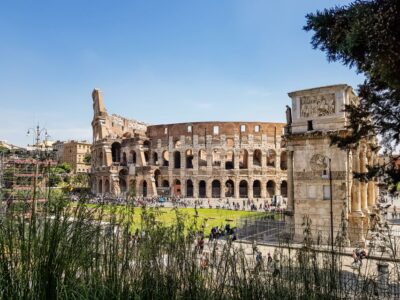
Your meeting point is beside the Arch of Constantine, directly next to the Colosseum. Look for staff wearing Ancient Rome VR clothing. This is a useful arrangement because the Colosseum area has several monuments, paths, and crowds, so a clear landmark matters.
The activity begins and ends at this same meeting point. You do not need to arrange transport between the virtual session and the archaeological sites. The provided information does not specify a separate vehicle, hotel pickup, or drop-off, so plan to reach the Arch of Constantine on your own.
Bring your passport or ID card. That requirement is easy to overlook, especially if you prefer to leave important documents at your accommodation, but you should have the required identification with you for admission.
The group is limited to six participants. That is a genuine advantage for a headset-based activity. Staff can help with fitting the visor, starting the program, and solving basic technical issues without dealing with a large crowd.
Technical assistance is included throughout the VR portion. You do not need special experience with virtual reality. If the headset feels unfamiliar, staff are there to help you get started.
The 3D tour: six places in ancient Rome
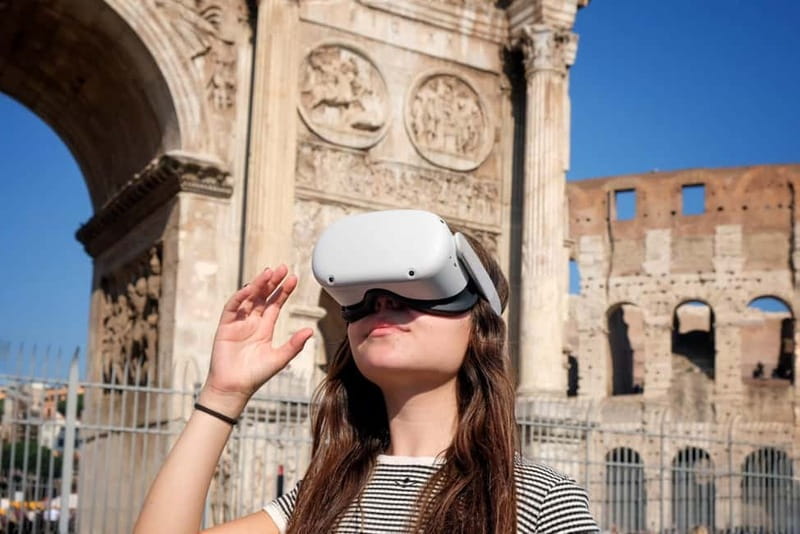
The virtual program uses voice commentary in English and reconstructed 3D scenes. The supplied details do not give a precise minute-by-minute breakdown for each location, so you should think of this as a guided visual introduction rather than a set of six full site visits.
The Colosseum
The digital Colosseum lets you see the amphitheater as a complete structure rather than only the surviving shell. That is particularly useful before your physical entry. Inside the real monument, missing walls and exposed underground areas can make the original design difficult to picture.
After the VR section, you can compare the reconstruction with the actual building. The contrast is part of the appeal. The headset shows the monument in a finished form, while the real site shows what time, damage, and later use have left behind.
Same city, a completely different half-day:
- Vatican Museums & Sistine Chapel Tour with Optional Basilica
★ 4.3 · 67,413 reviews - Vatican Museums, Sistine Chapel & St Peter’s Basilica Guided Tour
★ 4.5 · 39,149 reviews - Rome: Colosseum, Roman Forum and Palatine Hill Guided Tour
★ 4.5 · 23,903 reviews - Rome: City Sightseeing Hop-on Hop-off Bus with Audioguide
★ 4.0 · 16,045 reviews
The Roman Forum
The Forum is often the hardest ancient site for first-time visitors to understand. It is a broad area filled with foundations, columns, roads, and partial buildings. A 3D reconstruction can help you picture how those pieces related to one another.
You will later enter the real Forum as part of your priority admission. The walking visit is free time rather than a live guided route, so the VR introduction is especially useful if you want some orientation before exploring.
Circus Maximus
The Circus Maximus is one of the locations included in the virtual tour. Its enormous scale can be difficult to grasp from the present-day site. A reconstruction helps you picture why it was such an important public venue.
Because the virtual experience includes several major Roman locations, it gives you a wider frame for the Colosseum visit. You are not seeing only one monument. You are getting a quick visual tour of the city’s public spaces.
Piazza Navona
Piazza Navona is a later urban setting than the ancient Colosseum and Forum, but its inclusion shows how Rome changed across different periods. In the digital tour, you can see the site as part of the city’s long development rather than as an isolated modern square.
The available details do not specify how much time is spent at each scene. Keep that in mind if one particular location interests you more than the others.
Via Appia
The Via Appia gives the virtual journey a route beyond the city center. It helps show how Rome connected its central monuments with roads and places farther out.
This is another useful feature for anyone who wants more than a single-building visit. The physical admission does not include a visit to the Via Appia, so the VR reconstruction is the part of this activity that brings that location into your day.
Ostia Antica
Ostia Antica is also presented in the virtual program. Its inclusion expands the picture of Roman life beyond the center of Rome. You get another setting to compare with the monuments you will see in person.
The VR scenes are made with help from scholars and archaeologists, according to the activity details. That does not turn the session into a university lecture, but it does indicate that the reconstructions are intended to follow research rather than pure fantasy.
Entering the Colosseum with priority admission
Once the VR portion is complete, you enter the Colosseum using priority admission. The main practical gain is time. The Colosseum is one of Rome’s busiest sights, and avoiding a long standard ticket line can make a major difference to your day.
Priority admission does not mean you have the monument to yourself. You should still expect a major attraction with other people inside. The benefit is getting through the admission process more efficiently, not receiving a private Colosseum.
Your Colosseum visit is not described as a guided tour. You should expect to explore on your own after entry. That gives you freedom to look at the structure at your own pace, but it also means you should pay attention during the VR explanation if you want help identifying what you see.
The combination works best in that order. First, the headset supplies the missing walls and complete buildings. Then, the real Colosseum gives you the physical scale and texture. I prefer this approach to visiting the ruins cold, especially if this is your first time in Rome.
The Roman Forum and Palatine Hill afterward
Your admission also covers the Roman Forum and Palatine Hill. You can continue to these areas after the Colosseum and explore freely.
The Forum is where the virtual preparation may pay off most. In the real site, you will find remains spread across an open archaeological area. Without context, it can be tempting to see only stones and columns. With the reconstruction fresh in your mind, you have a better chance of connecting the ruins to the buildings and streets they once formed.
Palatine Hill is included as well. It is one of the places traditionally linked with Rome’s beginnings, and the activity describes it as a legendary place where Rome was born. The tour does not provide a separate live guide or a detailed walking commentary for the hill, so you will be responsible for your own pace and interpretation.
The physical portion is flexible, but flexibility has a trade-off. You are free to linger, move on, or pause for photographs. At the same time, nobody from the activity is promising to point out every notable foundation or explain each monument as you walk.
What $78.17 buys you
The price is $78.17 per person. That is more than a basic archaeological-site admission, but this is not only an entry ticket. The package combines the VR program, English audio commentary, technical assistance, and priority admission to the Colosseum, Roman Forum, and Palatine Hill.
To judge the value, ask yourself what you want from the visit. If you only need access to the three physical sites and prefer to read or explore independently, the VR element may feel like an extra cost. If you find ancient ruins difficult to picture, the reconstruction can make the visit more useful and less confusing.
The small group also matters. With no more than six people, the headset setup should be more personal than a large session. You are paying partly for a compact format and on-site technical help, not just for the digital content.
The current feedback is especially positive about two things: the unusual virtual presentation and the convenience of avoiding long lines. Those are the strongest reasons to choose this option over a plain self-guided admission.
Timing, language, and practical details
The total duration is about 2.5 hours. Starting times vary, so you need to check availability for the date you want. Allow enough time to reach the Arch of Constantine before the selected start time.
The instructor language is English, and the headset includes English audio commentary. If you need another language, this activity is not presented as a multilingual option.
The reservation can be made with payment later, which is useful if your Rome schedule is still shifting. You can also cancel up to 24 hours in advance for a full refund. Those terms give you some room to adjust plans, but you still need to check the exact starting time before committing the rest of your day.
Wear something suitable for walking through the Colosseum, Forum, and Palatine Hill. The supplied details do not give specific accessibility information, so contact the provider before booking if you have mobility or equipment concerns.
Who will get the most from this experience
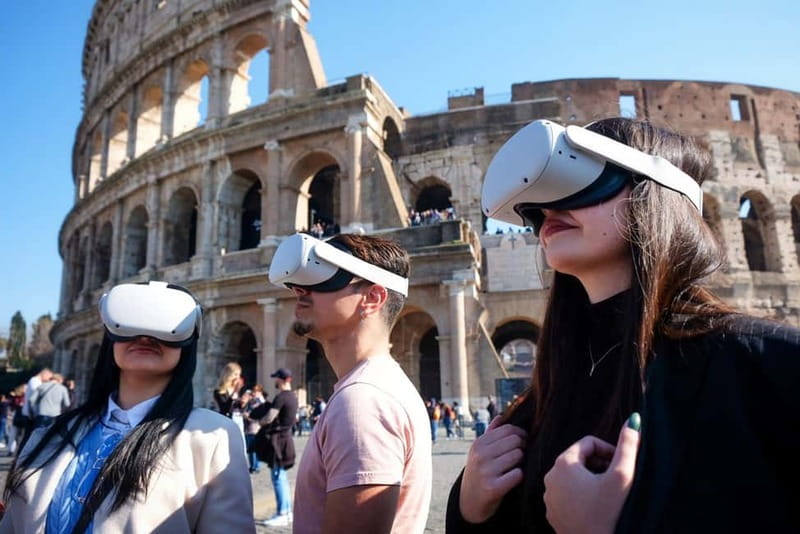
I would recommend this experience most strongly to first-time Rome visitors who want help making sense of ancient ruins. The VR scenes offer a quick visual foundation, while the physical admission lets you see the real monuments immediately afterward.
It also suits families and mixed-interest groups. A 3D reconstruction can be easier to follow than a long spoken lecture, and the headset adds a clear change of pace before the outdoor archaeological visit.
It is a good fit if you value time. Priority admission helps reduce the risk of spending a large part of your day in a ticket line, though it does not remove normal crowd levels inside the monuments.
Independent visitors should think carefully. If you want a live expert beside you from the meeting point through the Forum, this is not that kind of tour. You receive English commentary during the VR program, then visit the Colosseum, Forum, and Palatine Hill on your own.
Should you book it?
Book this experience if you want a visual explanation of ancient Rome, a small group, and priority admission to the Colosseum, Forum, and Palatine Hill. The strongest part is the pairing of a complete digital reconstruction with the incomplete real ruins.
Skip it if you already know the ancient sites well, dislike headsets, or want a traditional walking tour led by a historian. At $78.17, the price makes sense when you will use both parts: the VR orientation and the physical admission.
For many first-time visitors, that combination should make the Forum and Palatine Hill easier to understand and the Colosseum more meaningful. Just remember to bring your passport or ID, meet beside the Arch of Constantine, and allow 2.5 hours for the full activity.
FAQ
Where does the experience begin?
It begins beside the Colosseum at the Arch of Constantine. Look for staff wearing Ancient Rome VR clothing.
Where does the activity end?
The activity ends back at the meeting point beside the Arch of Constantine.
What sites are included in the physical admission?
Priority admission covers the Colosseum, Roman Forum, and Palatine Hill.
Which places appear in the virtual reconstruction?
The 3D reconstruction includes the Colosseum, Roman Forum, Circus Maximus, Piazza Navona, Via Appia, and Ostia Antica.
What virtual reality headset is used?
The experience uses a Meta Quest 2 headset or a newer model, with English audio commentary.
Is technical help included?
Yes. Technical staff assist you with the VR equipment during the experience.
How large is the group?
The group is limited to six participants.
Newest Rome tours we have reviewed
- Private TikTok Video Making in Rome★ 5.0 · 7 reviews
- Assisi, Orvieto and Civita di Bagnoregio Full Day Tour from Rome★ 4.5 · 45 reviews
- Assisi & Saint Francis Path Tour from Rome★ 5.0 · 45 reviews
- Assisi and Cascia Private Day Tour from Rome with Lunch★ 5.0 · 10 reviews
- Art Class in the center of Rome!★ 4.0 · 4 reviews
- Art & Craft: Beer Tour with Street Art in Rome★ 4.5 · 6 reviews
- Arrival in Rome: Airport Transfer & Exclusive City Introduction★ 5.0 · 3 reviews
- From Rome: Private Day-Tour of Tuscany★ 5.0 · 16 reviews
Rome Colosseum Tours, compared.
Colosseum, Palatine Hill and Roman Forum Guided Tour
Read our review →
Guided Tour of Colosseum, Roman Forum & Palatine Hill
Read our review →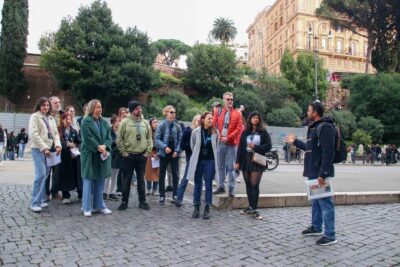
Colosseum & Forum with Audio Guide App -Optional Arena
Read our review →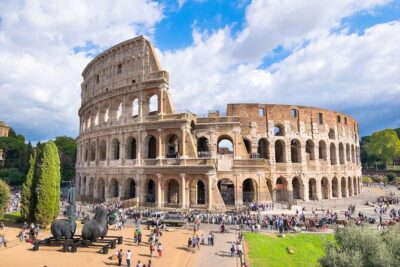
Colosseum, Roman Forum and Palatine Hill Guided Tour
Read our review →
Colosseum, Forum & Palatine Hill Tour & Optional Arena
Read our review →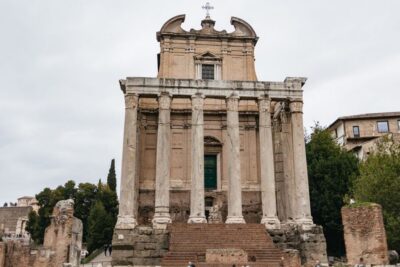
Colosseum, Palatine Hill & Roman Forum Guided Tour
Read our review →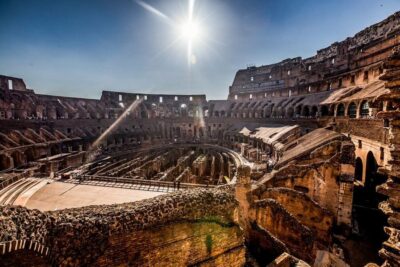
Colosseum: Underground and Ancient Rome Tour
Read our review →