
Reviewed · ROME
Rome: Private Night Walking Tour
Rome changes character after dark. The Colosseum, Imperial Road, Roman Forum, Pantheon, and Piazza Navona take on a calmer, more dramatic look, while your guide connects the ruins to the people who once lived among them. This private 2.5-hour walk is a good way to get your bearings without the daytime crush.
I like the route for two reasons: you see Rome’s biggest landmarks in one evening, and a private guide can shape the explanation around your questions. The panoramic view toward the Roman Forum from Capitol Hill is another strong point, especially for first-time visitors.
The main drawback is simple: you do not enter any sights. You will also walk about two miles over 2.5 hours, in rain or shine, so this suits people who are comfortable on their feet.
Key points to know before booking
- Rome after dark: The Colosseum, Roman Forum, Pantheon, and Piazza Navona look different under night lighting and with fewer daytime crowds.
- A private guide: You have a guide for your own group rather than joining a large shared walk. English and Italian are available.
- A strong historic route: The walk links ancient Rome, the murder site of Julius Caesar, Michelangelo’s Capitol, the Pantheon, and Baroque Piazza Navona.
- No interior visits: The sights are viewed from outside, so book this for context and atmosphere, not for access to the monuments.
- About two miles on foot: Wear comfortable shoes and plan for uneven urban walking. The tour runs in all weather.
- Good evening orientation: You finish back at the Colosseum meeting point, making this a useful first-night introduction to central Rome.
Why Rome works so well at night
Rome’s main monuments can feel crowded and visually noisy during the day. At night, the lighting draws your eye to columns, arches, domes, and stone façades. You still hear the traffic and city life, but the ancient center often feels easier to take in.
This tour is not a late-night food walk or a visit inside the Colosseum. It is a guided history walk with a broad route through the center. You get the outline of Rome’s story, from its legendary foundation and imperial power to its Baroque makeover.
I especially like this format for a first evening in the city. You can see where the main pieces fit together before returning later for museums and interior visits. It also gives you a useful sense of distance, although remember that the route ends back at the starting point rather than at Piazza Navona or the Pantheon.
The private format matters here. Rome’s streets can be crowded, noisy, and full of distractions. With your own guide, you have a better chance to ask why a building matters, how a square changed over time, or which places deserve a return visit.
The available languages are English and Italian. One guide praised in the supplied information is Martina, also referred to as Martine in one account. She is described as friendly, clear, and able to make the history enjoyable, particularly for a small family or friends traveling together.
More evening tours in Rome:
- Rome: City Highlights Open-Top Bus Night Tour
★ 4.1 · 2,038 reviews - Rome: Paranormal Night Walking Tour & Secret Backstreets
★ 4.9 · 1,921 reviews - Vespa Sidecar Tour By Night with Pickup
★ 5.0 · 1,803 reviews
Starting at the Colosseum after sunset
Meet your guide on the ground floor in front of the Colosseo Metro Station on Line B. Look for a guide holding a sign with your name, and arrive about five minutes before the scheduled start.
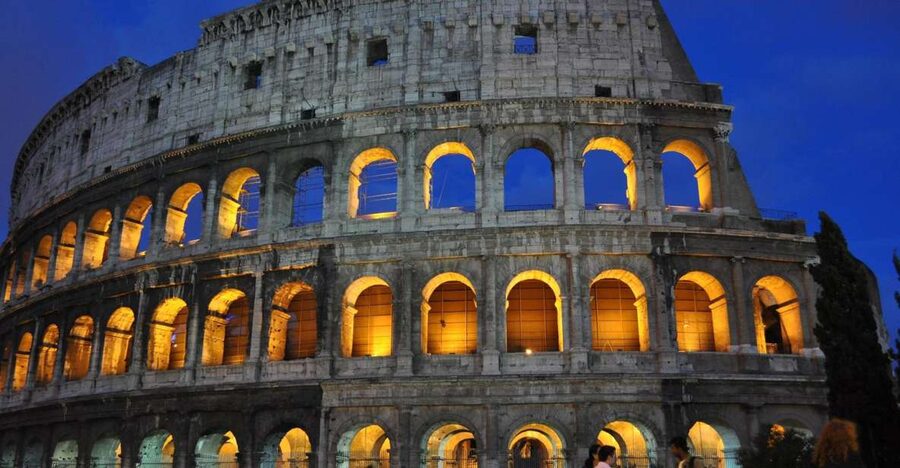
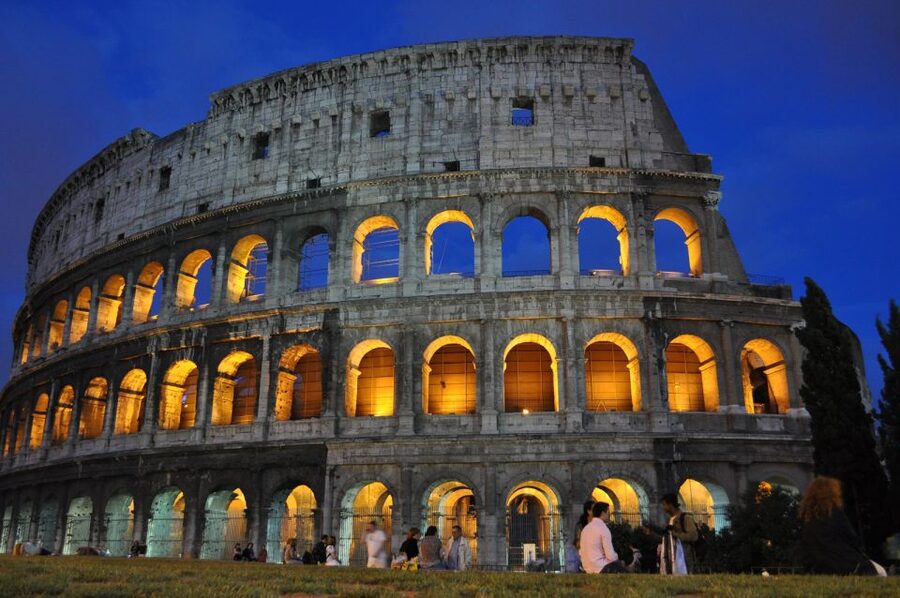
Beginning here gives the walk instant impact. The Colosseum needs little introduction, but a guide can help turn its familiar outline into a picture of ancient public life. The focus is on the exterior, so you will not walk through the amphitheater or see its inner levels.
That limitation is worth understanding before you pay. If your main goal is to enter the Colosseum, this tour will not replace a daytime admission. If your aim is to see the building lit at night while learning about the society around it, the opening stop makes good sense.
The guide also introduces the legendary foundation of Rome and the practical side of ancient life. This can help you connect the famous monument with the city that supported it: its public spectacles, political power, roads, and crowded urban life.
The night setting helps keep the stop from feeling like a checklist. Rather than spending a long time inside one monument, you get a moving overview of the city and its changing eras.
Walking the Imperial Road and Roman Forum
From the Colosseum, the route follows the Imperial Road toward the heart of ancient Rome. This is one of the most useful sections for understanding how Rome presented its power.
You see the Roman Forum from outside, with its broken columns, temples, and surviving foundations spread through the archaeological zone. At night, the low light can make the ruins feel more unified than they do under the strong midday sun.
The walk does not provide entry to the Forum. You should think of this stop as a visual lesson and orientation point. A guide can explain what the Forum meant in daily life, where political decisions were made, and how public life worked in ancient Rome.
This is also where comfortable shoes start to matter. The full route covers approximately two miles, and the walk includes hills and city streets. The supplied information does not promise a flat or easy path, and the tour is not recommended for people with limited mobility or wheelchair users.
The route’s value comes from the connections. You are not seeing the Colosseum, Forum, and later city center as isolated photo stops. You are walking through the area that links them.
Trajan’s Column and the memory of empire
The next major sight is Trajan’s Column, one of Rome’s most recognizable ancient monuments. Its carved spiral tells a military story in stone, wrapping around the tall column in a way that is hard to appreciate from a quick daytime glance.
Your guide can help you understand why the column mattered as a public symbol. It was not simply decoration. It presented imperial achievement and helped turn history into a message displayed in the middle of the city.
This is a good example of what the tour does best. You get the outline of the monument, its place in Rome, and a reason to notice details you might otherwise pass without stopping.
Again, the view is from outside. There is no entry to the monument or any other sight on the route. Bring a camera if you like night photography, but keep your expectations realistic: the tour is moving and guided, not a dedicated photography outing.
More walking tours in Rome:
- Rome: Trastevere & Campo de Fiori Street Food Walking Tour
★ 4.9 · 2,768 reviews - Rome by Night Walking Tour – Legends & Criminal Stories
★ 4.5 · 1,003 reviews - Rome: Guided City Center Evening Sightseeing Walking Tour
★ 4.4 · 953 reviews - Best of Rome Walking Tour including Trevi Fountain
★ 4.5 · 923 reviews
Capitol Hill and Michelangelo’s square
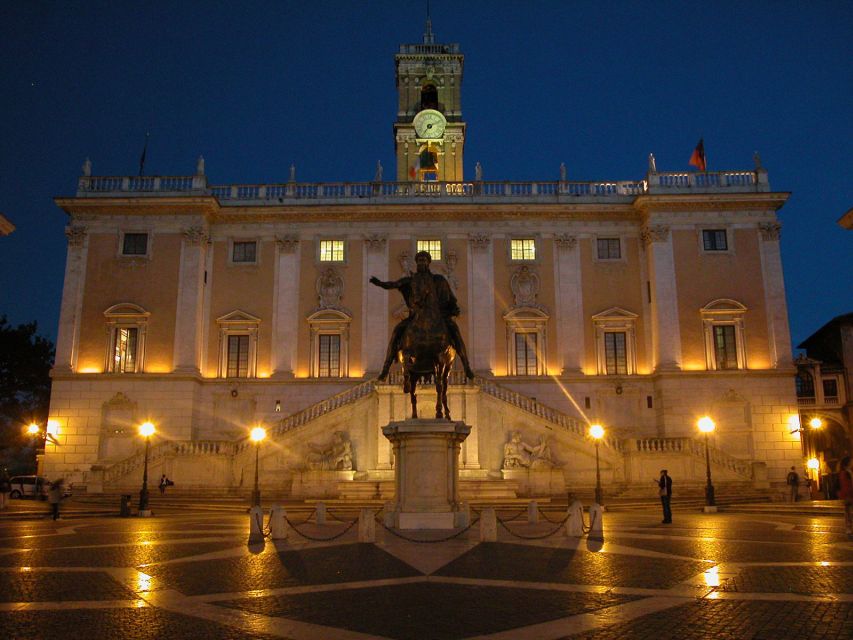
The walk then climbs Capitol Hill. This uphill section adds a bit of effort, but it rewards you with one of the most memorable parts of the route: the square designed by Michelangelo Buonarroti.
Michelangelo’s design gives the hill a grand, ordered feel. The space is a sharp contrast to the rough remains of the Forum below. Here, Rome’s later artistic identity comes forward, showing how the city repeatedly rebuilt itself around its older foundations.
The panoramic terrace in front of the Roman Forum is especially useful for orientation. From above, the ruins read as part of a larger city rather than a collection of scattered stones. You can take a photograph and pause to place the earlier stops in relation to one another.
I like this stop because it gives the evening a visual high point. It also reminds you that Rome is not only an ancient city. The tour moves from imperial monuments to Renaissance design, then onward to the Baroque center.
The climb is another reason this walk is not a good fit for everyone. If hills, steps, or two miles of walking cause trouble, choose a less demanding way to see the center.
Argentine Square and the story of Julius Caesar
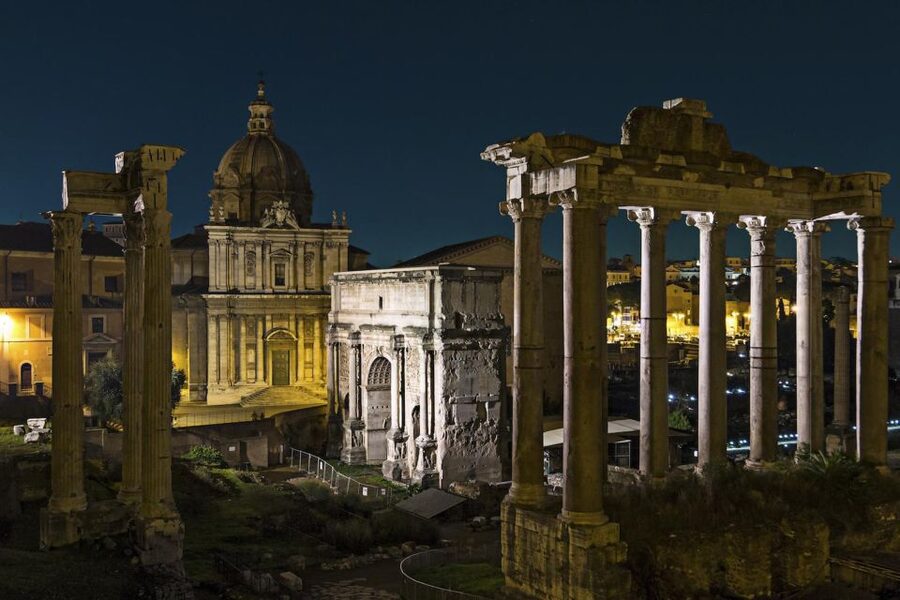
From Capitol Hill, the route moves into the city center and passes Argentine Square, associated with the murder of Julius Caesar. The site adds a human and political turn to the evening.
Caesar’s assassination is one of the best-known events in Roman history, but the setting matters. Rome’s major stories took place in real streets and public spaces, not in a distant world of names and dates. Standing near the location helps make the political conflict more concrete.
This stop also shows how different Rome’s historic layers can feel within a short walk. You move from archaeological ruins and imperial monuments into a functioning urban district, where ancient remains sit beside modern streets and buildings.
Do not expect a long stop inside a museum or archaeological site. The appeal is the guide’s explanation and the route itself. If you enjoy learning the story behind a place while walking through the present-day city, this is a worthwhile part of the evening.
The Pantheon from the outside
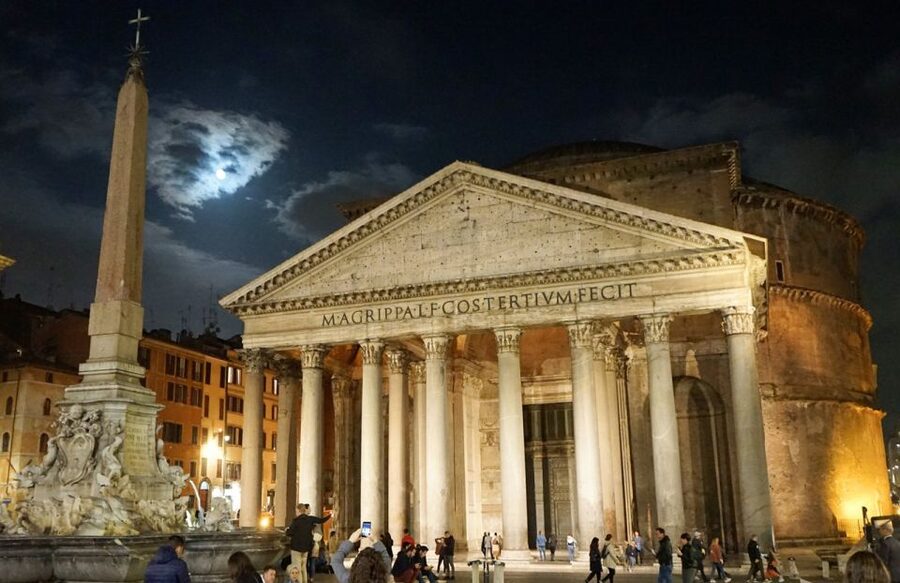
The Pantheon comes next, with its monumental façade and ancient identity as a temple to all the gods. Its exterior is one of Rome’s most recognizable architectural views, and seeing it at night gives the columns and pediment a strong sense of scale.
You will admire the façade from outside rather than enter the building. That distinction matters because the interior is a major part of the Pantheon experience. This tour gives you the context and exterior view, but you will need a separate visit if you want to see the dome and inside space.
Even without entry, the stop fits the route well. The Pantheon links ancient Roman engineering and religious life with the later Christian and civic history of the city. Your guide can help you read the building as part of Rome’s long development instead of treating it as one more famous photograph.
The route also gives you a chance to slow down after the uphill Capitol section. The exact pace depends on your private group and guide, but the walk is designed as a continuous city tour rather than a series of long seated stops.
Finishing in Baroque Piazza Navona
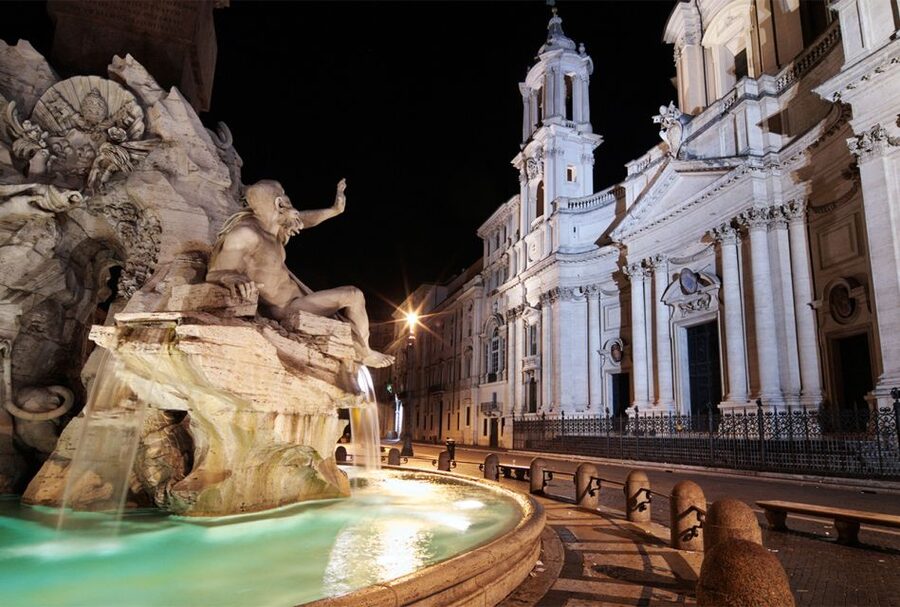
The final major sight is Piazza Navona, one of Rome’s most impressive Baroque squares. Its long shape reflects an earlier stadium, while the surrounding architecture and fountains create a very different mood from the Colosseum and Forum.
This is where the tour’s timeline reaches the later city. You begin among imperial ruins and finish in a square shaped by Baroque taste, grand public design, and Rome’s love of spectacle.
Piazza Navona is an enjoyable place to see at night because the architecture remains readable while the square takes on a social atmosphere. The experience does not include food or drinks, and the tour is not presented as a restaurant or nightlife outing. You can continue your own evening afterward, but the official activity ends back at the Colosseum meeting point.
That return detail is easy to miss. Since the route covers the central sights but finishes where it began, allow time and energy for the trip back. The meeting point is convenient for the Colosseo Metro Station, but you should not assume you can simply end your evening at Piazza Navona.
What the $124.61 price gives you
The price is $124.61 per person. For a private group, that can be fair if you value personal attention and want a guide to connect several major sights in one evening.
You are paying for a professional local guide, not admission tickets, transport, meals, or drinks. There is no hotel pickup or drop-off, and you make the entire route on foot. A private tour costs more than a shared walk, but you are also avoiding a large group and gaining more room for questions.
The value depends on your priorities. If you want to go inside the Colosseum, Forum, or Pantheon, the price may feel high because you still need separate tickets. If you want a private introduction to central Rome with strong night views, the cost is easier to justify.
I would compare this with the cost of booking several separate visits and the time needed to organize them. This tour does not replace those visits, but it can help you decide which interiors deserve your attention later.
The perfect customer is a first-time visitor, a couple, or a small family that wants a shared introduction without joining a large group. It also suits people who prefer stories and context to racing from one photo stop to another.
Practical details that affect the experience
Plan to arrive five minutes early at the Colosseo Metro Station, Line B, ground floor. Your guide will hold a sign with your name, which makes the meeting point fairly clear.
Leave luggage and large bags behind. They are not allowed on the tour, and carrying a heavy bag would make the uphill and two-mile walk less pleasant anyway.
Wear comfortable shoes and check the weather before leaving. The activity runs rain or shine, so bring suitable protection if rain is forecast. The information does not promise shelter or a change of route for bad weather.
The tour lasts 2.5 hours, with starting times depending on availability. English and Italian are offered, and the group is private. Cancellation is free up to 24 hours before the activity, and you can reserve now and pay later, which helps if your Rome schedule is still shifting.
The tour is not recommended for people with limited mobility and is not suitable for wheelchair users. The Capitol Hill climb and the total walking distance are the key concerns.
Who should book this night walk?
Book it if you want a private overview of Rome’s central monuments, enjoy walking, and like having a guide explain the links between ancient, Renaissance, and Baroque Rome.
It is particularly useful on your first evening, when you want to see the city’s major sights without committing to a full day of museum visits. The night lighting, panoramic terrace, and private format give the route a clear identity.
Skip it if you need interior access, hotel transport, a short route, or a fully accessible experience. You will see many important places, but you will not enter them.
For most mobile first-time visitors who want a well-paced introduction, I would consider it a good use of an evening. The strongest reasons are the variety of the route, the night setting, and the chance to ask a private guide questions as Rome unfolds around you.
FAQ
How long is the Rome private night walking tour?
The tour lasts 2.5 hours and covers approximately two miles on foot.
Where does the tour begin?
Meet your guide in front of the Colosseo Metro Station on Line B, at ground level. The guide will hold a sign with your name.
Where does the tour end?
The activity ends back at the Colosseo Metro Station meeting point.
Are entrance tickets included?
No. Entry to the Colosseum, Roman Forum, Pantheon, and other sights is not included. The tour views the listed landmarks from outside.
What languages are available?
The live guide is available in English or Italian.
Is the tour suitable for wheelchair users or people with limited mobility?
No. The tour is not suitable for wheelchair users and is not recommended for people with limited mobility. It includes about two miles of walking and a climb up Capitol Hill.
Newest Rome tours we have reviewed
- Private TikTok Video Making in Rome★ 5.0 · 7 reviews
- Assisi, Orvieto and Civita di Bagnoregio Full Day Tour from Rome★ 4.5 · 45 reviews
- Assisi & Saint Francis Path Tour from Rome★ 5.0 · 45 reviews
- Assisi and Cascia Private Day Tour from Rome with Lunch★ 5.0 · 10 reviews
- Art Class in the center of Rome!★ 4.0 · 4 reviews
- Art & Craft: Beer Tour with Street Art in Rome★ 4.5 · 6 reviews
- Arrival in Rome: Airport Transfer & Exclusive City Introduction★ 5.0 · 3 reviews
- From Rome: Private Day-Tour of Tuscany★ 5.0 · 16 reviews