
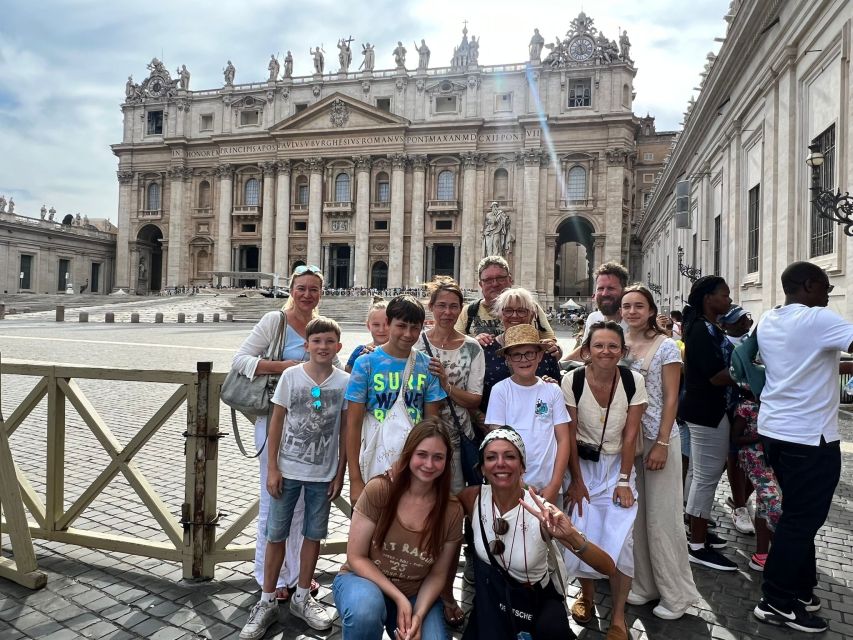
Reviewed · ROME
Rome: The Best of St. Peters’ Basilica in German
St. Peter’s Basilica is so large that the guide asks you to picture how many football fields could fit inside. That scale makes this two-hour German tour more than a quick look at famous art. You get a clear route through one of the world’s biggest churches, with the building’s many architectural styles explained as you go.
I like the focus on Michelangelo’s Pietà and Bernini’s huge bronze baldachin, which is compared with a ten-story house. I also like the practical meeting point in the center of St. Peter’s Square, where you begin with the square itself rather than rushing straight indoors.
The main thing to consider is that the cupola entrance is not included. You will admire the dome from inside the basilica, but climbing or entering the dome requires a separate arrangement. Security and strict clothing rules can also add time, so arrive prepared.
Key points at a glance
- See Michelangelo’s Pietà: One of the best-known sculptures in the basilica, presented as part of the guided route.
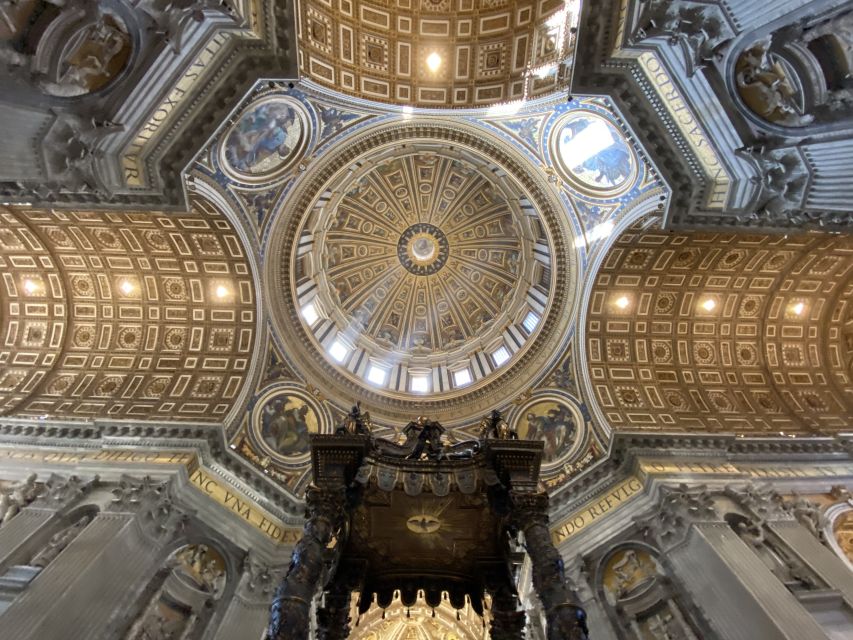
- Study Bernini’s bronze baldachin: The canopy beneath the dome is described as being as tall as a ten-story house.
- Hear the German explanations clearly: A live German guide leads the tour, with German headsets included.
- Begin in St. Peter’s Square: Meet in the middle of the square, in front of the barriers, before entering.
- Learn about papal elections: The tour explains where the smoke known as fumata comes from when a new pope is elected.
- Plan for Vatican dress rules: Shorts, short skirts, sleeveless shirts, weapons, sharp objects, and glass objects are not allowed.
Starting in the heart of St. Peter’s Square
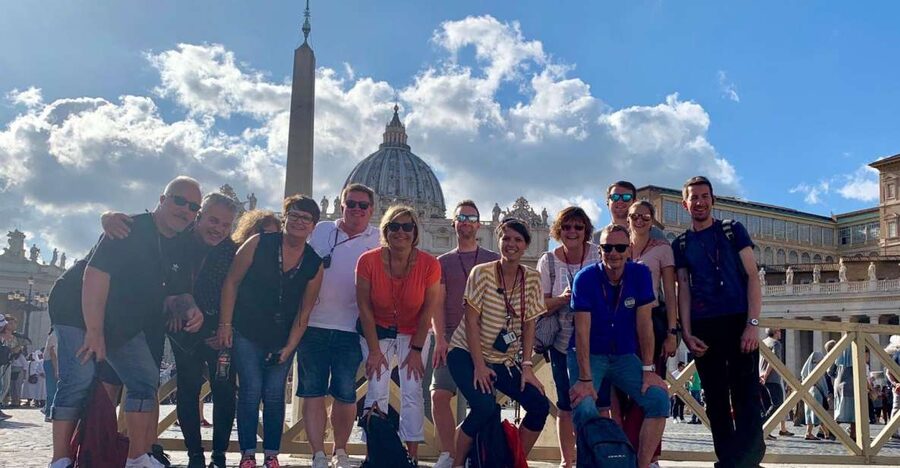
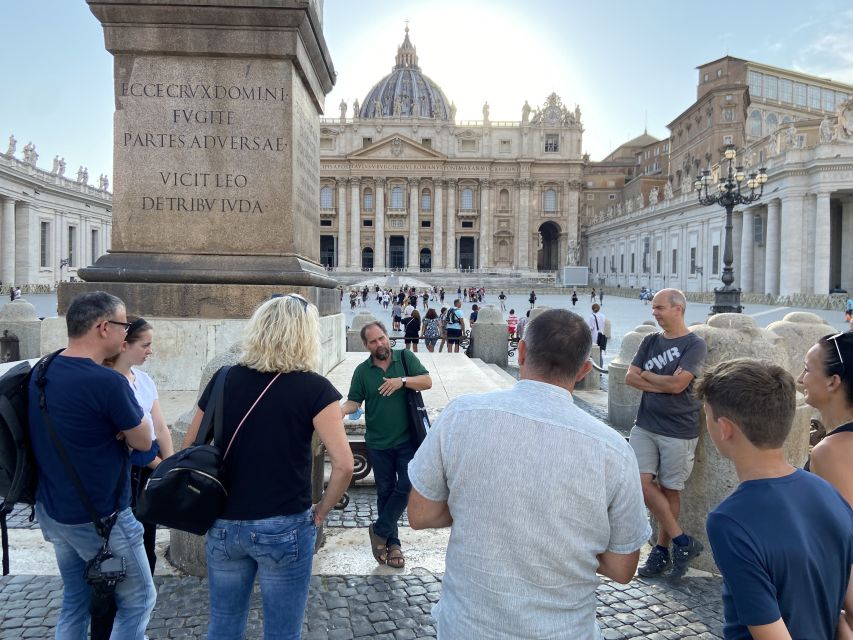
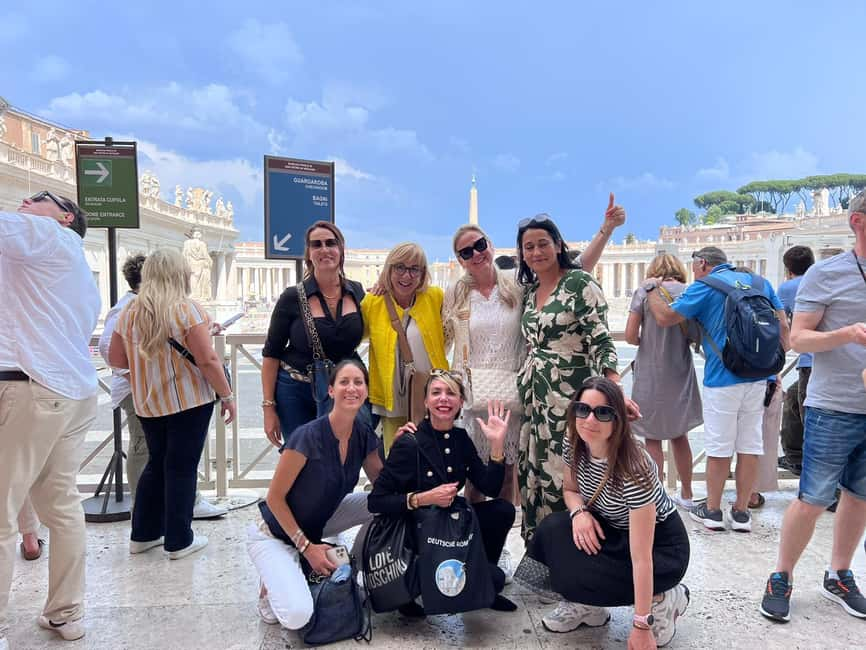
The meeting point is in the middle of St. Peter’s Square, in front of the barriers. Look for the sign marked Deutsche Römerin. One important instruction is easy to miss: do not enter St. Peter’s Square before meeting the guide.
That rule matters because the square is broad, busy, and full of people trying to orient themselves. If you cross the barriers too soon, you may make the meeting harder. Give yourself extra time to reach the square, then wait outside the marked area until the guide gathers the group.
The square itself is part of the visit. It sits in Vatican City, the world’s smallest state, and gives you your first sense of the scale and ceremony of the site. Before you enter the basilica, you can already look at the grand setting and hear why this place attracts so much attention.
The meeting details are especially helpful for a German-speaking visitor. You are not left to search for a general entrance or a vague landmark. The sign provides a clear visual target, but you still need to follow the instruction about staying outside the square until the meeting.
Other Rome tours people pair with this one:
- Vatican Museums & Sistine Chapel Tour with Optional Basilica
★ 4.3 · 67,413 reviews - Vatican Museums, Sistine Chapel & St Peter’s Basilica Guided Tour
★ 4.5 · 39,149 reviews - Rome: Colosseum, Palatine Hill and Roman Forum Guided Tour
★ 4.8 · 32,814 reviews
Security comes before the art
Everyone must pass through a security check. Weapons and sharp objects are not allowed, and glass objects are also listed as prohibited. Carrying less makes this part easier.
Dress is just as important. Shorts, short skirts, and sleeveless shirts are not permitted. You should also wear comfortable shoes, since the visit takes place in a huge church and involves walking and standing.
These rules are not a minor footnote. A small clothing problem can interrupt your visit before it begins. If you are building a full day around St. Peter’s Basilica, choose conservative clothing from the start rather than trying to change later.
The tour is listed as wheelchair accessible, which is useful information for planning. Since the site is large and the experience lasts about two hours, comfortable footwear still matters for every participant.
Michelangelo’s Pietà and the power of a single work
Michelangelo’s Pietà is one of the clear highlights. The sculpture shows Mary holding the body of Christ, and its fame can sometimes make it feel like a compulsory stop rather than a work to look at slowly. A guide gives you a better chance to pause and understand why it matters.
The value here is not just seeing a famous name. The tour places the sculpture within the larger artistic program of the basilica, alongside works by Bernini and other major architects. You get a sense of how the building became a setting for art on a giant scale.
I like that the tour promises both facts and stories. That combination can make a very large church easier to read. Instead of seeing one grand room after another, you hear who worked on the building, what changed over time, and why different architectural styles appear together.
A guided explanation is particularly useful for first-time visitors. The basilica can overwhelm you with size and decoration. A German-speaking guide can point out what deserves your attention, then help connect the sculpture to the wider story of the building.
Bernini’s bronze baldachin beneath the dome
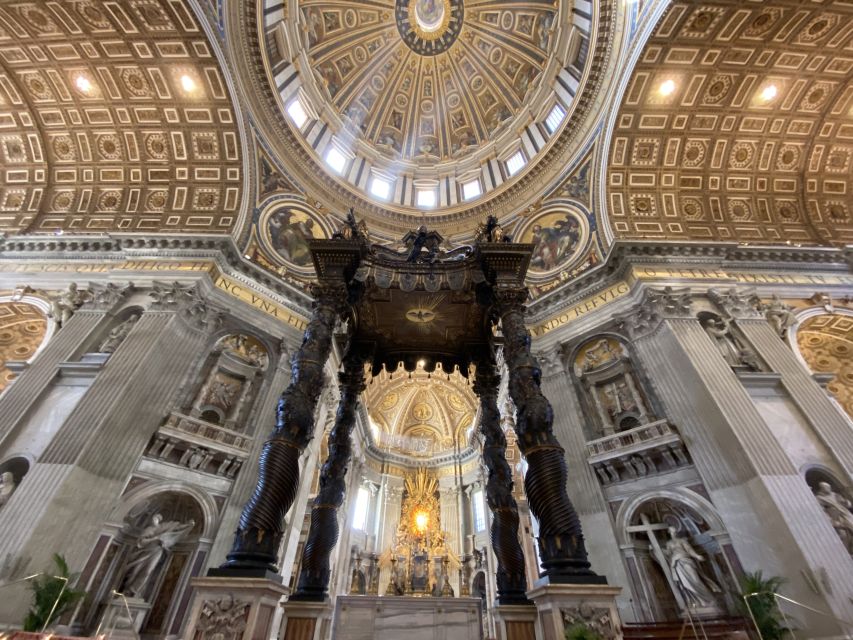
The bronze baldachin is another essential stop. It sits beneath the dome and is described as being as large as a ten-story house. That comparison helps you grasp its size better than a list of measurements would.
Look up as you approach it. The baldachin is not a small decorative canopy placed in an otherwise empty church. It anchors the central space and draws your eyes toward the dome above. This is one of the moments when the basilica’s vast scale becomes physically clear.
The tour also explains the people behind the building and its art. You hear about Bernini and other architects, along with the different styles that came together during construction. The result is a more useful visit than simply collecting famous names.
For me, this is where the tour earns much of its price. A $61 ticket is not cheap for a two-hour walk, but the baldachin, dome, Pietà, and architectural story give the guide plenty of substantial material to work with. If you only want to enter, look around, and leave, you may prefer a lower-cost option. If you want the building explained in German, the added value is easier to see.
Same city, a completely different half-day:
- Rome: Guided Tour of Colosseum, Roman Forum & Palatine Hill
★ 4.7 · 27,897 reviews - Rome: Colosseum & Forum with Audio Guide App -Optional Arena
★ 4.2 · 24,770 reviews - Rome: Colosseum, Roman Forum and Palatine Hill Guided Tour
★ 4.5 · 23,903 reviews - Rome: City Sightseeing Hop-on Hop-off Bus with Audioguide
★ 4.0 · 16,045 reviews
Reading the basilica’s many architectural styles
One of the tour’s main themes is the mixture of architectural styles in St. Peter’s Basilica. The guide explains who took part in the project and why the building developed in the form you see today.
This matters because the basilica is not a single, simple design. Its appearance reflects a long process and the work of several major figures. Without context, you may notice that the spaces feel different but not understand why. With the guide’s explanation, those changes become part of the story.
The tour also addresses why the building divided the Christian church. That is a serious topic, and it gives the visit more depth than a standard art walk. You are not only looking at marble, bronze, and architecture. You are also hearing about the religious and institutional conflict connected with the church’s creation.
The subject should suit you if you want background along with visual highlights. It may be less suitable if you prefer a quiet, unstructured visit with no historical interpretation. The advertised focus is firmly on explanation, and the German guide is central to the experience.
The dome from inside the basilica
The dome is one of the major visual rewards. The tour lets you admire it from inside the church and explains its place in the building’s design.
Keep in mind that entrance to the cupola is not included. This distinction is important. You can see the great dome as part of the basilica visit, but this activity does not include going up into the cupola.
If climbing the dome is a top priority, you should treat this tour and the cupola as separate plans. The listing does not promise a cupola visit, so do not book expecting rooftop or elevated views.
For many people, seeing the dome from the basilica floor will be enough. The interior view gives you the scale of the church and fits naturally into the architectural explanation. The separate cupola issue only becomes a drawback if you hoped to combine both activities in one booking.
Finding the smoke of a papal election
A small but memorable detail is the explanation of fumata, the smoke that signals the election of a new pope. The tour identifies where the smoke comes out, turning a modern symbol into a physical feature you can locate.
This is exactly the kind of detail I like in a city tour. It connects a major world event with a specific place in the building. You are not only hearing that papal elections happen here. You are learning where one of the best-known signals can be seen.
The detail also gives the visit a practical sense of place. St. Peter’s Basilica is not only an art museum or a giant church. It remains tied to the life of the Catholic Church, and the guide uses the building to explain that role.
What the German guiding is like
The tour includes a live German guide and German headsets. The headsets should help you follow the commentary inside a vast church, where distance and surrounding noise can make ordinary conversation difficult.
Several guides are named in the available information. Inga is described as highly capable and well organized. Julia led a visit that covered many important points in an entertaining way, with two and a half hours passing quickly. Paula is noted for humor and interesting facts, while Gian-Carlo gave a detailed account of the German cemetery and St. Peter’s Basilica.
The listed duration is two hours, though one account describes a two-and-a-half-hour visit. That suggests you should allow a little flexibility rather than arranging a tight connection immediately afterward. The difference may reflect the actual pace, extra discussion, or the way the visit was recorded.
The strongest pattern is the emphasis on guides who combine detail with a lively delivery. That matters in a building where a long list of dates and names could become tiring. If you have some prior knowledge, Gian-Carlo’s detailed approach may appeal to you. If you prefer a lighter tone, Paula’s humorous style sounds like a better match.
Is $61 a fair price?
At $61 per person, this is a mid-to-high priced guided visit rather than a basic entrance. The value depends on what you want from St. Peter’s Basilica.
The price makes more sense if you:
- Want a full German-language explanation
- Care about Michelangelo, Bernini, and the dome
- Prefer a guide to organize the visit
- Want historical context about the church’s development
- Like having headsets in a large, echoing interior
The price is harder to justify if you only want a quick look inside or already know the basilica well. The cupola is not included, and the tour lasts about two hours, so you are paying mainly for the guide’s interpretation and the organized visit.
The available rating is five out of five from eight reviews, with comments repeatedly praising organization, detail, humor, and the guides’ ability to keep the visit moving. One rating is four out of five, describing the tour as excellent and the setting as impressive. That is a strong record, but a small sample, so I would treat it as encouraging rather than a guarantee of your exact guide or pace.
Who should book this Basilica tour?
I would recommend it most to German-speaking visitors who want the building explained rather than simply entered. It also suits anyone who finds major churches difficult to understand without a route and commentary.
First-time visitors should get a lot from the combination of art, architecture, papal history, and practical orientation. People with prior knowledge may still enjoy it, especially if they prefer detailed discussion of the architects and the church’s wider story.
Families may appreciate the football-field comparison and the story about the smoke signal, though the dress rules and security process still require preparation. Visitors using wheelchairs can consider it because the activity is listed as wheelchair accessible.
I would hesitate only if your main goal is the cupola, if you dislike guided visits, or if $61 feels too high for a two-hour church tour. In those cases, the missing cupola access and formal pace may leave you wanting more freedom.
Should you book it?
Book this tour if you want St. Peter’s Basilica explained in German, with a clear focus on Michelangelo’s Pietà, Bernini’s baldachin, the dome, the church’s different architectural styles, and the story behind papal election smoke.
Before you go, wear suitable clothing, comfortable shoes, and bring a passport or ID card. A copy is accepted. Keep sharp objects and glass items at home, meet in front of the barriers in the center of St. Peter’s Square, and do not enter the square before the guide arrives.
The best reason to choose this experience is the combination of famous art and useful context. The best reason to skip it is simple: the cupola costs extra, and independent visitors may not want to pay for a guided route. For a German-speaking visitor who wants the basilica to make sense, $61 is a reasonable investment.
FAQ
What language is the tour conducted in?
The live tour guide speaks German, and German audio headsets are included.
How long does the tour last?
The stated duration is two hours. One account describes a visit lasting two and a half hours, so allow some extra time in your schedule.
Where is the meeting point?
Meet in the middle of St. Peter’s Square, in front of the barriers. Look for the sign marked Deutsche Römerin.
Can I enter St. Peter’s Square before meeting the guide?
No. The instructions say not to enter St. Peter’s Square beforehand. Wait in front of the barriers until you meet the guide.
Is entrance to the cupola included?
No. Entrance to the cupola is not included in the tour price.
What clothing is required?
Shorts, short skirts, and sleeveless shirts are not allowed. Comfortable shoes are recommended.
Is the tour wheelchair accessible?
Yes. The activity is listed as wheelchair accessible.
Newest Rome tours we have reviewed
- Private TikTok Video Making in Rome★ 5.0 · 7 reviews
- Assisi, Orvieto and Civita di Bagnoregio Full Day Tour from Rome★ 4.5 · 45 reviews
- Assisi & Saint Francis Path Tour from Rome★ 5.0 · 45 reviews
- Assisi and Cascia Private Day Tour from Rome with Lunch★ 5.0 · 10 reviews
- Art Class in the center of Rome!★ 4.0 · 4 reviews
- Art & Craft: Beer Tour with Street Art in Rome★ 4.5 · 6 reviews
- Arrival in Rome: Airport Transfer & Exclusive City Introduction★ 5.0 · 3 reviews
- From Rome: Private Day-Tour of Tuscany★ 5.0 · 16 reviews