
Reviewed · TRASTEVERE TOURS
Rome: Trastevere and Roman Ghetto Guided Walking Tour
Rome’s most rewarding walks often link places that are easy to visit separately but more meaningful together. This route moves from bohemian Trastevere to the Jewish Ghetto, then ends at the ancient Theatre of Marcellus. Along the way, your guide connects churches, squares, food traditions, Roman legends, and Jewish history.
I like the leisurely pace, which leaves room to look up at buildings, ask questions, and pause in the market. I also like the chance of a very small group: some departures have had only two or three people, making the walk feel almost private. The main drawback is practical: two and a half hours without a planned toilet stop can feel long, especially in hot weather.
Key points
- A cross-section of Rome: See Trastevere, Campo de’ Fiori, the Jewish Ghetto, and the Theatre of Marcellus in one walk.
- Strong individual guides: Estefi, Celia, Sarah, Giuseppe, Gabriella, and others have been praised for clear explanations, humor, patience, and local advice.
- Small groups are possible: Some departures have had only two or three participants, while groups are limited enough to keep the guide within easy reach.
- A useful food angle: Guides can point you toward local places and market snacks, with one past group stopping for coffee and juice.
- History beyond the headline sights: The tour covers Rome’s Jewish community, the Great Synagogue, and the less familiar story of the Theatre of Marcellus.
- Walking conditions matter: Bring water, wear comfortable shoes, and note that the route is not suitable for wheelchair users or people with mobility impairments.
Why this Rome walk works so well
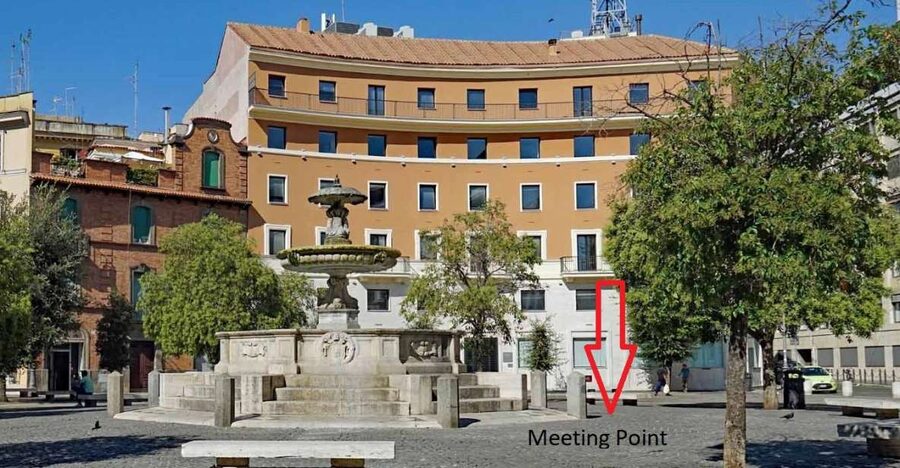
This is a good choice if you want Rome to make sense as a lived-in city, not just a set of famous monuments. Trastevere supplies the narrow streets and neighborhood character. The Jewish Ghetto adds a serious historical layer. Campo de’ Fiori brings daily Roman life into the picture, and the Theatre of Marcellus finishes the walk with ancient stone.
The route is especially useful early in your stay. I would use it to get your bearings and collect ideas for later meals, churches, and short independent walks. It is not built around entering major monuments, so you are paying for the guide’s storytelling and connections rather than admission tickets.
The average rating is 4.7 from 79 reviews, with repeated praise for the guides. That matters here because the streets themselves are free to explore. A good guide turns familiar-looking squares into places with names, personalities, conflicts, and surprising links.
More Trastevere tours:
- Winner 2025 Rome Twilight Trastevere Food Tour by Eating Europe
★ 5.0 · 5,157 reviews - Rome: Trastevere or Jewish Quarter Street Food Tour
★ 4.8 · 3,839 reviews - Rome: Trastevere Food tour with Free-Flowing Fine Wine
★ 5.0 · 2,853 reviews
Starting at Piazza Mastai in Trastevere
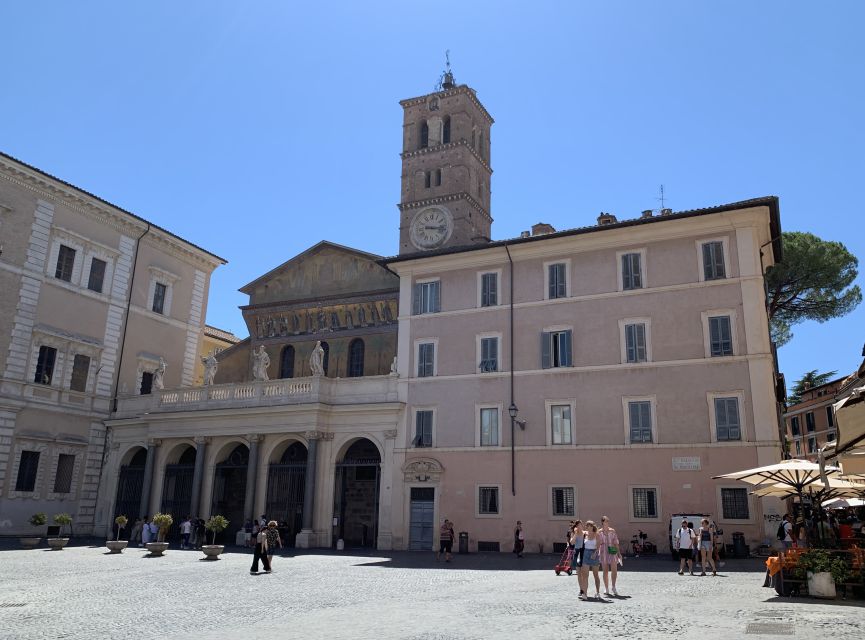
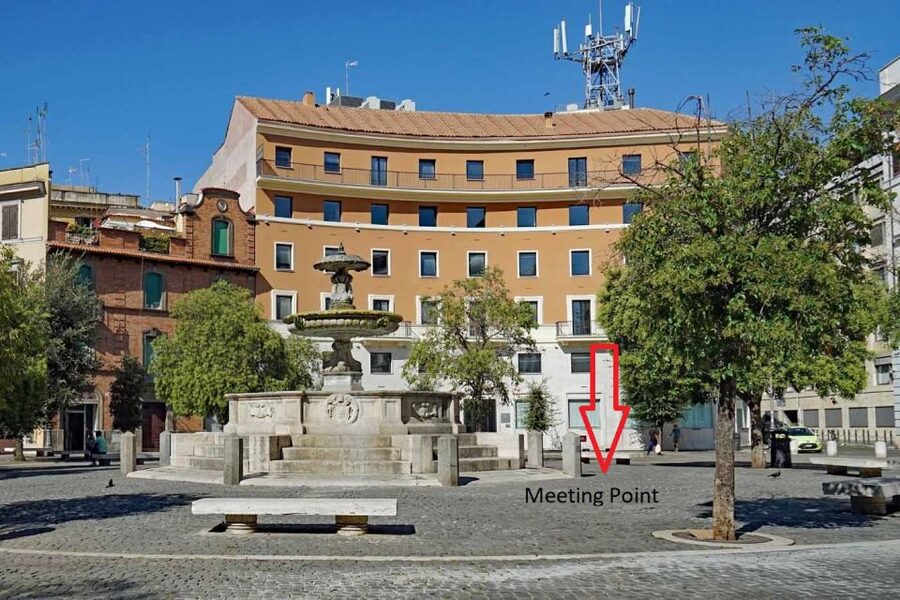
Meet around the main fountain in Piazza Mastai, where the guide waits 15 minutes before the start with a sign bearing the tour name. This is a sensible meeting point in Trastevere, but give yourself enough time to arrive without rushing. Hotel pickup is not included.
Piazza Mastai sets the mood. You begin in a neighborhood known for its informal feel, old lanes, cafés, and Roman character. The opening section is less about checking off a monument and more about understanding why Trastevere feels different from the grand avenues across the river.
I like starting here because it gives the guide room to explain the district before the tour reaches its better-known sights. Ask questions early. The strongest part of this experience is the exchange between guide and group, and past guides such as Estefi, Sarah, and Giuseppe have been praised for making that exchange easy.
Santa Maria in Trastevere and its 12th-century mosaics
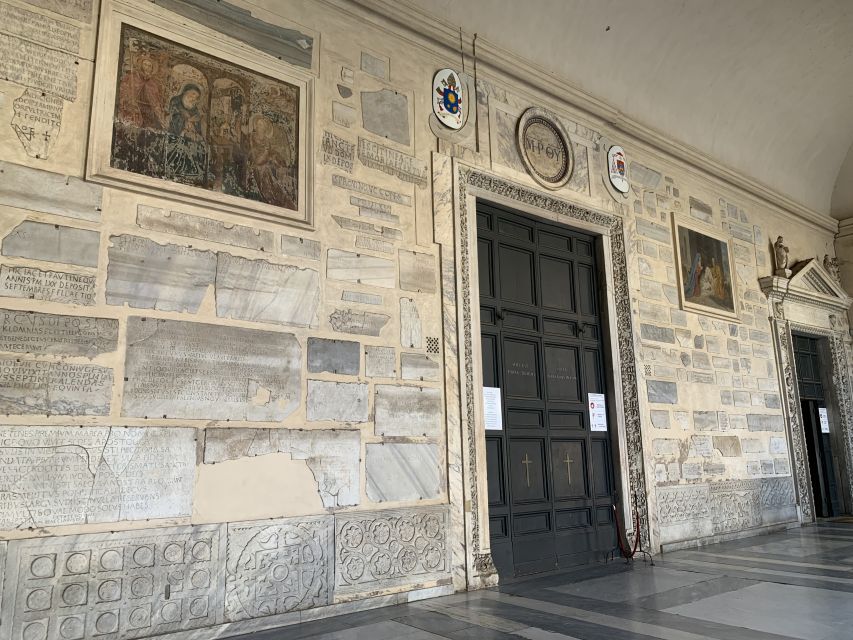
The first major stop is Piazza di Santa Maria in Trastevere, home to the Basilica of Santa Maria. The church dates to the 12th century and is known for its mosaics, while the fountain in the square gives the setting a calm center.
You can expect about 20 minutes of guided walking to reach this stop from the meeting point, followed by an explanation of the square and basilica. The value is not simply seeing an old church. Your guide can point out how art, worship, architecture, and neighborhood life meet in one compact Roman space.
This is also a good place to slow down and look carefully. Rome can train you to rush from one major sight to the next, but the visual details here reward a few quiet minutes. If your guide is Estefi, Celia, or another of the named guides praised for answering questions, ask about the mosaics and the role of the square in local life.
The tour does not promise a dedicated interior visit, so you should think of this as a guided look at the church and piazza rather than a full church tour. That distinction helps set fair expectations.
Piazza Trilussa and the city’s street-level character
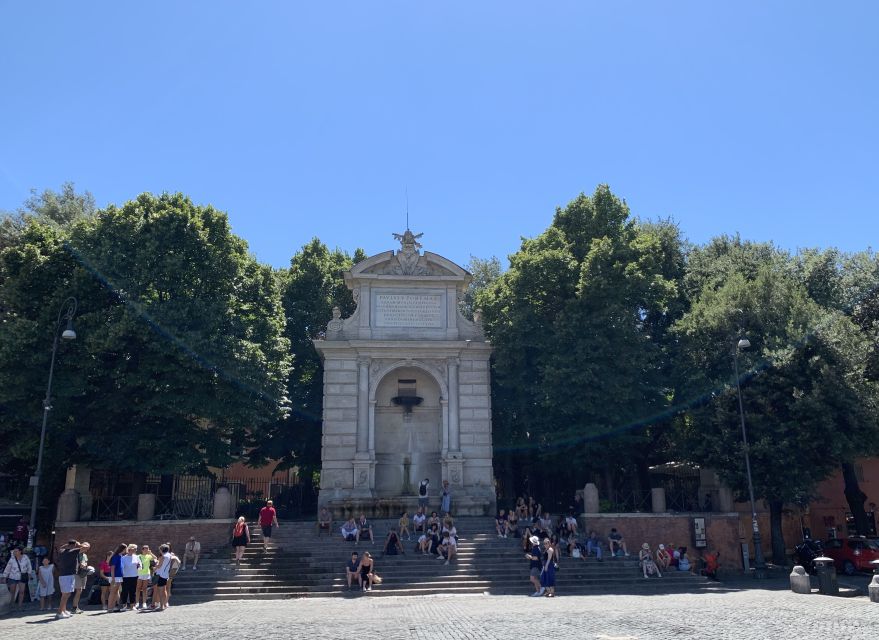
From Santa Maria, the walk continues to Piazza Trilussa, named after Carlo Alberto Salustri, the Roman poet known by his pen name, Trilussa. The square is a social spot, with street performers and plenty of movement around its fountain and steps.
This stop gives the tour a lighter rhythm after the church. The guide can explain how Roman humor and local identity appear in poetry, public spaces, and everyday conversation. I find that useful because Rome’s history is not only imperial dates and papal architecture. It also lives in the language and personalities of the city.
Past groups have appreciated guides who mix facts with humor, and that quality is important here. A dry lecture would miss the point of Piazza Trilussa. The best version of this stop should feel conversational, with time to take photographs and watch the square rather than simply hear its name and move on.
The route uses roughly 20-minute walking sections between key points. That does not mean every stop lasts exactly 20 minutes, but it gives you a sense of the pace. You are walking steadily, not racing.
More walking tours in Rome:
- Rome: Trastevere & Campo de Fiori Street Food Walking Tour
★ 4.9 · 2,768 reviews - Rome: Paranormal Night Walking Tour & Secret Backstreets
★ 4.9 · 1,921 reviews - Rome by Night Walking Tour – Legends & Criminal Stories
★ 4.5 · 1,003 reviews - Rome: Guided City Center Evening Sightseeing Walking Tour
★ 4.4 · 953 reviews
Campo de’ Fiori, market life, and a useful pause
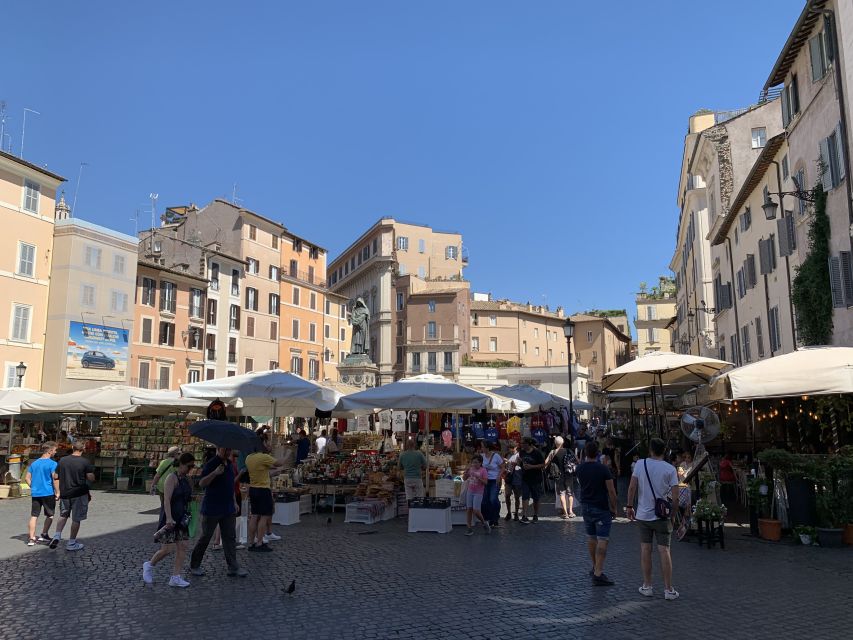
The next stop is Campo de’ Fiori, one of Rome’s best-known public squares. It brings a different kind of energy to the route, with its market atmosphere and long connection to Roman public life.
This is where the tour can feel most practical. One past group had time to pick up coffee and juice in the market, and a guide offered food suggestions along the way. The experience does not include food, so any purchase is your own responsibility, but the stop gives you a chance to notice what locals buy and how the square changes through the day.
I would not treat Campo de’ Fiori as merely a snack stop. Listen for the historical stories attached to the square, then take a moment to study the stalls and surrounding buildings. The market makes a useful contrast with Trastevere. Trastevere feels like a neighborhood to wander; Campo de’ Fiori feels more like a public stage.
There is one comfort issue to keep in mind. A two to two and a half hour walk has no scheduled toilet break listed. One participant specifically wanted a mid-tour bathroom stop. If you need one, handle it before meeting the group or ask your guide at a suitable point.
Entering Rome’s Jewish Ghetto
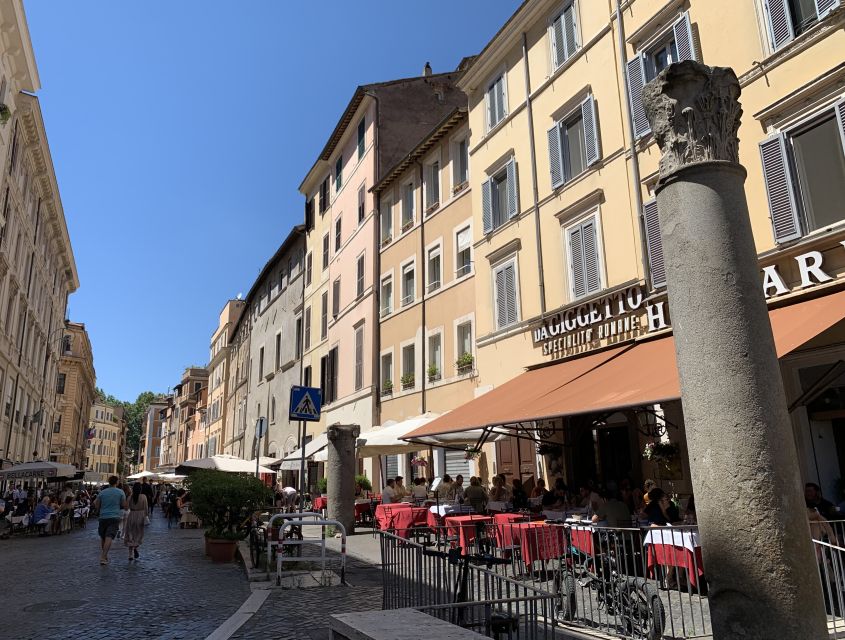
The most serious section begins when the route reaches Rome’s Jewish Ghetto. Here, the guide shifts from streets and market life to the long, difficult story of the city’s Jewish community.
This part gives the tour its strongest sense of purpose. You are not simply looking at attractive façades. You are hearing about a community that has lived through restrictions, hardship, survival, and continuity across centuries. The supplied tour information describes this as a place of profound cultural importance, and the route is designed to explain that meaning rather than pass through quickly.
The guide’s role matters greatly here. History connected to persecution and discrimination needs care, context, and room for questions. Gabriella, Fabiano, and other guides have been praised for answering questions and explaining architecture and history clearly. That is exactly the kind of approach you want in the Ghetto.
I also appreciate that this section is placed after Trastevere and Campo de’ Fiori. The contrast helps. You first see Rome as a social, artistic city, then encounter the painful stories that shaped one of its communities. The shift encourages you to think about who had access to the city, who was excluded, and how public spaces carry memory.
The Great Synagogue of Rome
Within the Ghetto, the route includes the Great Synagogue of Rome, described as a symbol of strength and endurance. It is an important stop even if you have no previous knowledge of Rome’s Jewish community.
The guide explains what the building represents within the neighborhood and the wider story of Jewish life in Rome. The tour information does not promise entry into the synagogue, so plan to view it as part of the exterior walking route unless your guide says otherwise.
This is a good moment to listen rather than hurry toward the next photograph. The significance is not only architectural. The building represents a community that has continued to maintain its identity in a city marked by dramatic political and religious change.
If you want a lighter food note after the historical discussion, some guides can suggest local dishes and places to eat. One past participant tried an artichoke dish that was memorable but not personally appealing. That is a useful reminder that local recommendations are suggestions, not guarantees of your taste.
Ending at the Theatre of Marcellus
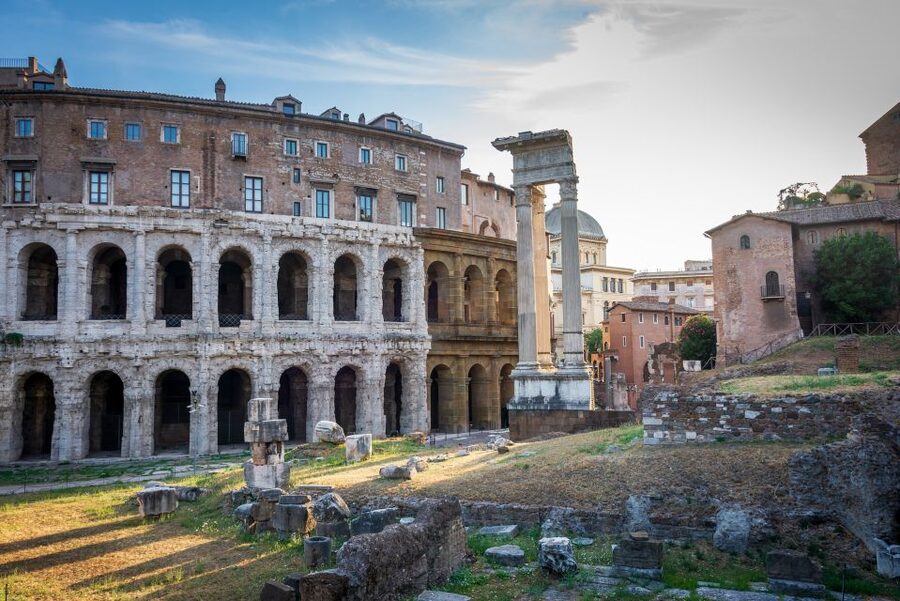
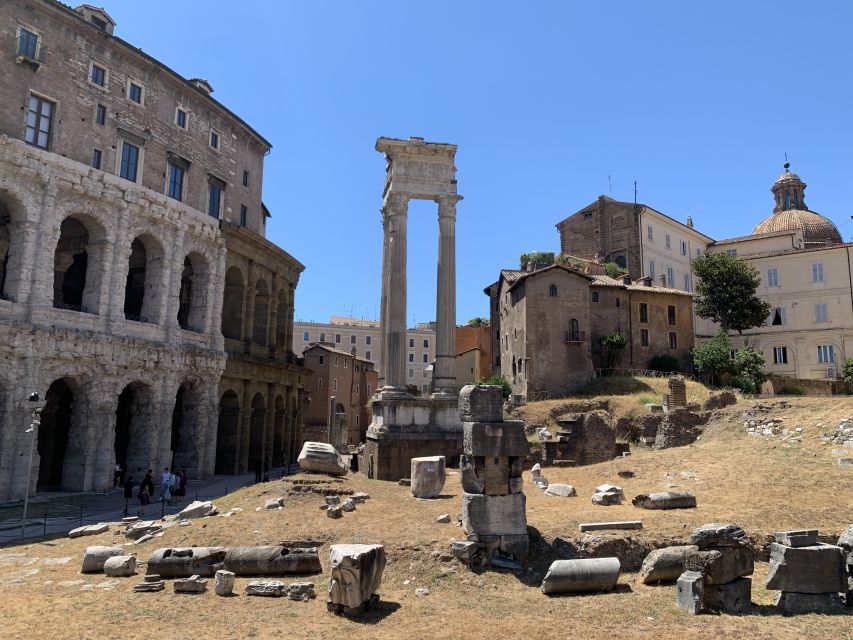
The final destination is the Theatre of Marcellus, an ancient Roman amphitheater dating to 13 BC. It gives the tour a strong closing image: ancient Rome still present within the modern city.
Unlike a walk focused only on imperial landmarks, this stop shows how Rome’s old structures remain part of the urban fabric. The Theatre of Marcellus is not presented as a separate ticketed visit here. It is the endpoint for the guided walk, where you can hear about its age and place in Roman history.
I like this ending because it links the whole route. You have moved through a medieval church setting, a Roman literary square, a market, a Jewish neighborhood, and finally an ancient monument. The experience does not attempt to cover all of Rome. Instead, it shows how several layers can occupy the same few city blocks.
By this point, you will have walked for two to two and a half hours. The final stretch may feel easy for a regular walker but tiring for anyone with mobility concerns, particularly in summer. Wear shoes you can trust on city streets and bring water or a reusable bottle.
Guide quality and group size
The clearest strength of this tour is the guide. Names praised in the supplied feedback include Estefi, Estefania, Celia, Sarah, Giuseppe, Gabriella, Fabiano, and Francesco. The descriptions consistently point to clear explanations, friendly conversation, humor, patience with questions, and useful food advice.
Some departures have been nearly private, with one group of two and another of only three people. A small group lets you hear without strain and gives the guide more freedom to adjust the pace. It also means you can ask about a church detail, a restaurant, or a historical point without waiting through a long line of questions.
The tour uses headsets when the group has more than 10 people. Smaller groups may not need them, which some people will prefer. If you dislike wearing audio equipment, a small departure could make the experience more natural.
Group size can change, so do not book on the assumption that you will always have a private guide. The important point is that the format allows direct contact, and the guide quality has been the main reason this walk earns strong marks.
Is $41 a fair price?
At $41 per person, I see this as a reasonable price if you value guided context. You are not paying for entry to a major museum or an elaborate meal. You are paying for two to two and a half hours of route planning, explanation, and access to stories that are easy to miss when walking alone.
The value is strongest if Rome is new to you, if you want help understanding the Jewish Ghetto, or if you enjoy asking questions. It is less compelling if you already know Trastevere and Campo de’ Fiori well and prefer to wander independently.
The price also compares favorably when the group is very small. A nearly private walk with a strong guide can feel more personal than a large sightseeing circuit. Still, remember that food, drinks, hotel transfers, and monument admission are not included.
Free cancellation is available up to 24 hours before the tour for a full refund, and you can reserve now and pay later. The tour runs in English, Spanish, or French. Check the available starting time when booking, since the exact schedule is not fixed in the supplied details.
Who should book this walk?
I would recommend it to first-time Rome visitors who want a human-scale introduction to the city. It also suits couples, families with older children, and curious adults who prefer stories and neighborhoods to a rapid list of major sights.
The tour is particularly useful for anyone interested in Jewish history, Roman architecture, and food culture. It gives you enough structure to understand what you are seeing, then leaves you with several areas worth revisiting on your own.
I would be more cautious if you have mobility limitations. The activity is specifically not suitable for wheelchair users or people with mobility impairments. You should also reconsider it if you need a planned bathroom stop or dislike walking for more than two hours.
Should you book the Trastevere and Jewish Ghetto walk?
Book it if you want a relaxed introduction to two sides of Rome: the easygoing streets of Trastevere and the serious history of the Jewish Ghetto. The route is well chosen, the final ancient monument adds weight, and the guides appear to be the main reason the experience works so well.
For the best experience, bring water, arrive 15 minutes early at the fountain in Piazza Mastai, use the bathroom beforehand, and leave room for a market drink or a food recommendation. If you want a private tour guaranteed, this is not presented as one. But if you are happy with a small shared group and a guide who welcomes questions, $41 is a fair way to spend an afternoon or morning in Rome.
FAQ
Where does the tour begin?
The tour begins at Piazza Mastai in Trastevere. Your guide waits near the main fountain, holding a sign with the tour name.
How early should I arrive?
The guide waits 15 minutes before the scheduled start. Arriving early gives you time to find the fountain and meet the group without rushing.
How long does the walking tour last?
The tour lasts between two and two and a half hours.
Which places are included?
The route includes Piazza Mastai, Piazza di Santa Maria in Trastevere, Piazza Trilussa, Campo de’ Fiori, Rome’s Jewish Ghetto, the Great Synagogue of Rome, and the Theatre of Marcellus.
What languages are available?
The live guide is available in English, Spanish, or French.
Are hotel pickup and drop-off included?
No. You must make your own way to Piazza Mastai, and hotel pickup and drop-off are not included.
Is the tour suitable for wheelchair users?
No. The activity is not suitable for wheelchair users or people with mobility impairments.
Newest Rome tours we have reviewed
- Private TikTok Video Making in Rome★ 5.0 · 7 reviews
- Assisi, Orvieto and Civita di Bagnoregio Full Day Tour from Rome★ 4.5 · 45 reviews
- Assisi & Saint Francis Path Tour from Rome★ 5.0 · 45 reviews
- Assisi and Cascia Private Day Tour from Rome with Lunch★ 5.0 · 10 reviews
- Art Class in the center of Rome!★ 4.0 · 4 reviews
- Art & Craft: Beer Tour with Street Art in Rome★ 4.5 · 6 reviews
- Arrival in Rome: Airport Transfer & Exclusive City Introduction★ 5.0 · 3 reviews
- From Rome: Private Day-Tour of Tuscany★ 5.0 · 16 reviews
Trastevere Tours, compared.

Winner 2025 Rome Twilight Trastevere Food Tour by Eating Europe
Read our review →
Trastevere or Jewish Quarter Street Food Tour
Read our review →
Trastevere Food tour with Free-Flowing Fine Wine
Read our review →
Trastevere & Campo de Fiori Street Food Walking Tour
Read our review →
Award Winning Trastevere Group Food Tour with Wine
Read our review →

Rome Food Tour: Hidden Gems of Trastevere with Dinner & Wine
Read our review →Browse the lists this tour appears in