
Reviewed · APPIAN WAY AND AQUEDUCTS TOURS
Rome Underground: Catacombs Tour, Aqueducts and Appian Way
Rome’s most memorable ancient sights are not all inside the Colosseum or Roman Forum. This half-day outing takes you beyond the city center, where you can walk on the old Appian Way, look up at enormous aqueducts, and descend into Christian burial tunnels.
I like the way this tour combines three hard-to-reach sights in one outing, and I like the small group limit of 18 people, which makes it easier to hear the guide. The air-conditioned minibus also matters on a hot Roman afternoon. The main drawback is time: you see each place briefly, so this works best as an introduction rather than a slow, detailed study of the Appian Way or catacombs.
Key points to know before booking
- Walk on the ancient Appian Way: Expect uneven paving stones and a moderate walking pace rather than a gentle city stroll.
- See Rome’s aqueducts in an open park: The Aqueducts Park gives you a very different view of Roman engineering, with plenty of room to look and take photos.
- Visit San Sebastiano or Domitilla: The catacomb site changes by day, so you cannot always choose between the two.
- Enter the tunnels late in the day: The final catacomb visit can feel quiet and atmospheric, though the narrow passages are not ideal for anyone with claustrophobia.
- Ride between scattered sights: Private, air-conditioned minibus transport saves you the trouble of arranging separate buses or taxis.
- Allow extra time to find Piramide: The meeting point is near Piramide Metro station, not necessarily at the famous pyramid itself.
Why this tour gets you beyond the usual Rome circuit
Central Rome can fill every hour with famous monuments. That is both its gift and its problem. You can spend days around the Colosseum, Forum, Pantheon, and Vatican without ever seeing the old roads and water systems that allowed the city to grow.
This tour shifts the focus to infrastructure, burial customs, and the countryside just outside the ancient walls. You walk where Roman legions and merchants once traveled, see how water crossed the countryside, and enter underground spaces tied to early Christianity.
The result is a useful change of pace. It is not as visually packed as the Colosseum and Forum, and it does not offer one grand centerpiece. Instead, the tour helps you understand how Rome functioned beyond its public monuments.
The English-speaking guide supplies the thread connecting the stops. Guides on this experience have included Sylvia, Antonella, Francesca, Andre, Annamaria, Flavia, Chiara, and others. The strongest guides keep the three-hour program lively with stories, practical explanations, and answers to questions.
More Appian Way and aqueduct tours:
- Rome EBike Tour: Appian Way, Catacombs & Roman Aqueducts
★ 5.0 · 1,766 reviews - Rome: Appian Way, Catacombs, & Roman Aqueducts E-bike Tour
★ 4.9 · 1,421 reviews - Rome:Appian Way E-bike Tour with Catacombs, Aqueducts & Food
★ 4.9 · 1,210 reviews
Starting near Piramide and riding into the countryside
The tour begins at Piramide, a convenient transport area in southern Rome. Still, the meeting point can cause confusion. The famous pyramid and the Piramide Metro station are close, but they are not the same landmark, and the pickup is described in relation to the station.
Give yourself extra time. Look for the guide with a small sign near the metro station rather than assuming the tour minibus will be waiting beside the pyramid or among the city buses. This is one place where a careful map check before leaving your hotel is worth the effort.
Once the group is assembled, you board a small, air-conditioned minibus. The maximum group size is 18, which is much more manageable than a large coach. Several stops involve walking and listening outside, so a smaller group lets you stay close to the guide.
The ride also makes the schedule practical. The Appian Way, Aqueducts Park, and catacombs are spread out, and arranging public transport between all three would take more effort than the sights themselves deserve. Here, you can focus on the history instead of watching bus routes.
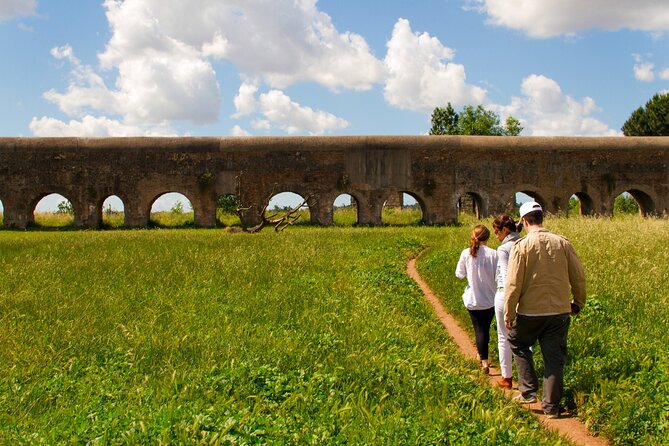
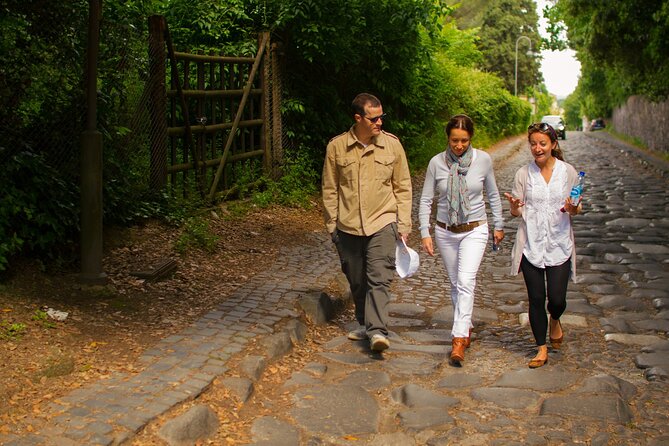
Walking the Appian Way on uneven Roman paving
The Via Appia Antica was one of Rome’s earliest and most important roads. Your visit includes a walk on a section of this ancient route, with old paving stones beneath your feet and tombs and ruins along the way.
Do not picture a smooth pedestrian avenue. The stones are uneven, and sandals are a poor choice. Wear shoes with a firm sole, especially if you want to walk with confidence rather than stare at every step.
The appeal is partly physical. You are not viewing the road only from behind a barrier. You are walking along the same route used by legions, merchants, and other travelers of the ancient Roman world. The setting also feels more open and less crowded than central Rome.
The scheduled time here is about 25 minutes, so this is an introduction rather than a long hike. You will hear about the road’s role in Roman expansion and see how tombs lined routes leading out of the city. The guide’s explanation helps turn a short walk over old stones into a lesson about Roman movement and power.
If the Appian Way is your main reason for booking, understand the limits. You will not spend hours exploring the entire road, and the stop may feel short if you want extensive photography or archaeological detail. For most people, though, the brief walk offers a satisfying taste of a side of Rome that is difficult to reach alone.
Cecilia Metella and the language of Roman status
The next stop is the Mausoleum of Cecilia Metella, a large circular tomb from the first century BCE. Its size and position make the message clear: this was not an ordinary burial.
The guide explains the powerful family behind the monument and how the structure survived through the centuries. That context matters because Roman tombs were also public statements. Families placed impressive monuments along major roads where passersby could see their wealth and importance.
You have about 25 minutes here. That gives you enough time to understand the site and admire the architecture, but not enough for a lengthy archaeological examination. The stop works best when you pay attention to the guide’s explanation rather than expecting a large museum-style visit.
This is also a good reminder that the Appian Way was lined with more than paving stones. It was a route of movement, memory, and family ambition. Cecilia Metella’s tomb gives a human face to the grand Roman habit of building for the public eye.
More catacombs tours in Rome:
- Rome: Crypts and Catacombs Underground Tour with Transfers
★ 4.6 · 5,341 reviews - The Original Roman Crypts and Catacombs Tour with Transfers
★ 4.5 · 4,896 reviews - Rome: Catacombs of St. Callixtus Entry Ticket & Guided Tour
★ 4.6 · 3,037 reviews - Rome: Guided Roman Catacombs Tour with Transfers
★ 4.6 · 1,830 reviews
Aqueducts Park and Rome’s engineering talent
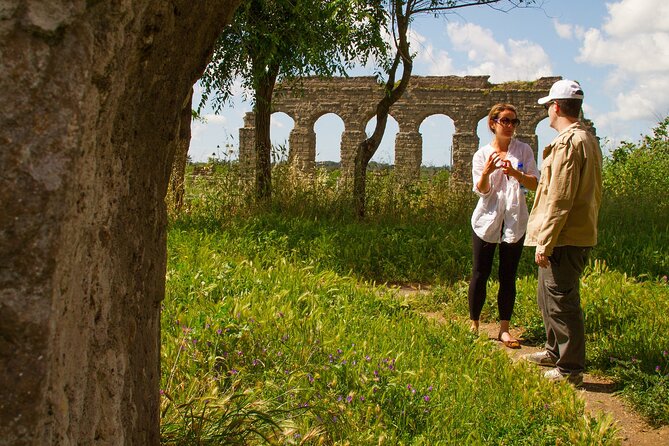
Aqueducts Park offers one of the tour’s most striking changes in scenery. Instead of close-set ruins and narrow streets, you find open space beneath the remains of ancient aqueducts.
The structures show how Roman engineers carried water toward the city. Their arches are visually simple, but the system behind them required careful planning, grading, construction, and maintenance. This is the practical side of Roman power: clean water supported homes, baths, fountains, and public life.
You spend about 45 minutes in the park. The walking here is not as rough as the Appian Way, though you should still expect a fair amount of time on foot. Bring water, particularly during Rome’s hot months. The open setting can feel exposed in strong sun, even though the aqueducts provide an impressive backdrop.
I consider this one of the tour’s best stops because it gives you room to absorb what you are seeing. The aqueducts are large enough to read from a distance, and the guide can explain how their engineering connected with daily life in ancient Rome.
The stop also appeals to people who are not especially interested in burial sites. If the catacombs sound uncertain to you, the aqueducts may be the part you remember most. One caution: the time is still limited, so you will see a section of the system rather than explore every feature of the park.
Entering the catacombs at the end of the day
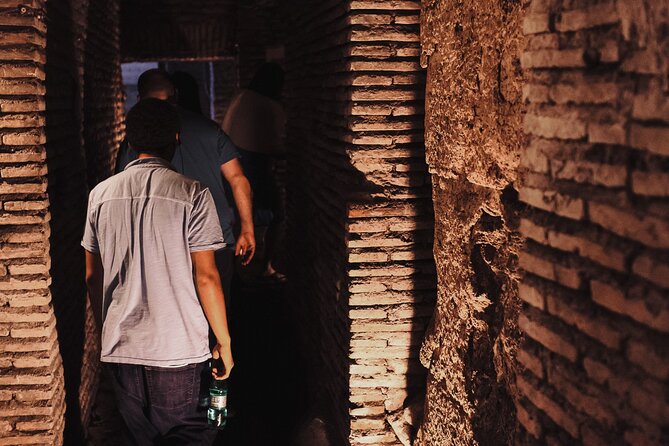
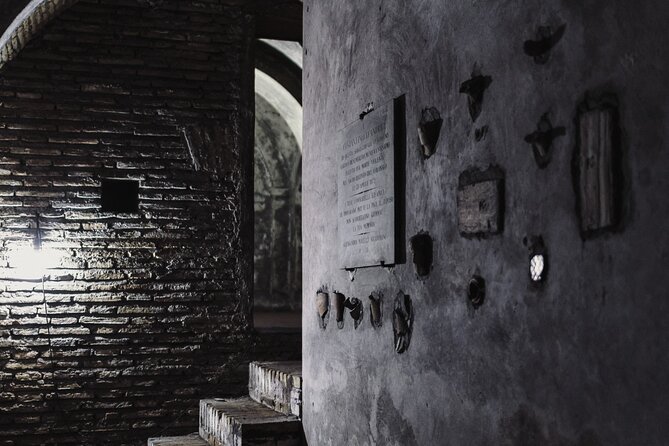
The final major stop is the underground portion of the tour. Depending on the day, you visit the Catacombs of San Sebastiano or the Catacombs of Domitilla. The schedule does not guarantee one specific site, so book this experience with the general catacomb visit in mind.
At San Sebastiano, the visit lasts about 1 hour and 20 minutes in the stated program. You descend into narrow underground passages associated with early Christian burial. The guide explains the burial spaces, religious history, and the way these sites fit into Rome’s development outside the ancient city center.
The catacombs are not presented as a horror attraction. Their value comes from the sense of ordinary people, faith, and burial customs beneath the monumental Rome seen above ground. You may also hear about the Mithraic religion, a secretive ancient faith that remains difficult to understand in full. This adds another layer to Rome’s religious past, though the exact discussion depends on the guide and the site used that day.
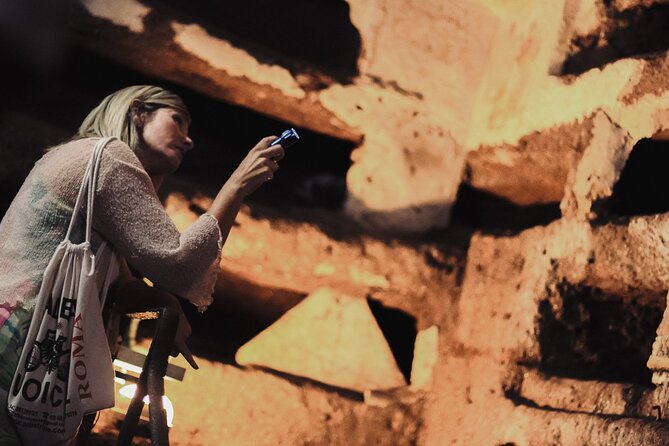
The tunnels can be chilly, but some sections may still feel stuffy. Anyone with claustrophobia should think carefully before booking. The passages are tight, and you cannot simply spread out as you would in a museum gallery.
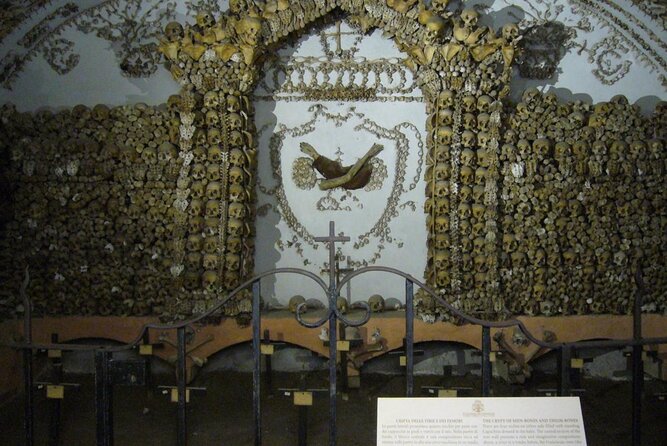
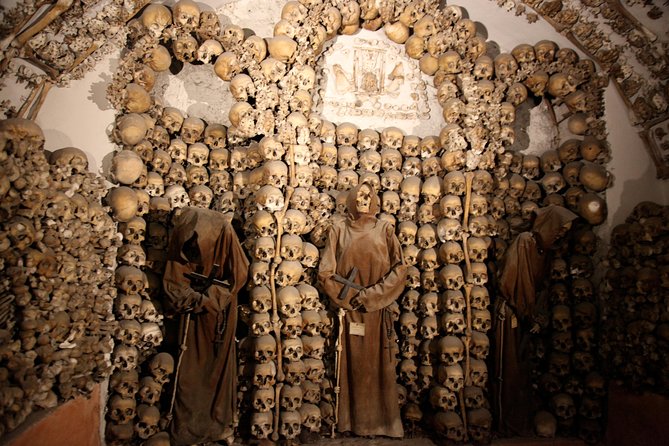
Do not expect rows of visible bones. The burial remains are not the main sight here, and much of the experience centers on the tunnels, chambers, inscriptions, frescoes, and historical explanation. If you want a dramatic display of skeletons, this may not match your expectation. If you are interested in early Christian burial and underground Rome, it can be the most memorable part of the afternoon.
The late timing is a useful feature. Visiting as the final group of the day can make the underground setting feel calmer and less crowded. It also gives the tour a natural climax: open roads and aqueducts first, then a descent into a quieter world beneath the surface.
How the guides shape the experience
The subject matter needs explanation. A road, a tomb, and a line of arches can look impressive, but without context they can blur together. The guide’s work is to explain why each place mattered and connect engineering, social status, religion, and Roman expansion.
The strongest guide performances on this tour have come from people who combine detail with energy. Antonella has been praised for keeping a group engaged for the full three hours. Francesca has been noted for humor and clear explanations. Sylvia has led family groups with an easy command of the material, while Andre has been singled out for making each stop meaningful.
These names are not a guarantee of who will lead your departure. They do show the range of the guiding style you may encounter. Some guides give a broad overview, while others offer more specific detail about Roman roads, aqueduct construction, and religious practice.
Headsets are used, and they have been described as clear and easy to operate. That matters when you are standing outside with traffic, wind, or a group spread across a path. A small group also helps, but stay near the guide so you do not miss the explanation while taking photos.
What the $65.30 price really covers
At $65.30 per person, this tour is priced as a convenient small-group outing rather than a simple admission ticket. The cost includes an English-speaking guide, guided walking, entry to the selected catacombs, and minibus transport between the sights.
The value depends on how you would otherwise arrange the day. If you tried to visit the Appian Way, Aqueducts Park, and catacombs separately, you would need to manage several routes and entry arrangements. The included transport removes that friction and lets you see all three in just over three hours.
It is less compelling if your Rome schedule is very short. If you have only two or three days and still need the Colosseum, Roman Forum, Vatican Museums, and Pantheon, those central sights may deserve priority. The outlying sites are worthwhile, but they do not replace Rome’s headline monuments.
For a stay of five or six days, or for anyone returning to Rome, the calculation improves. You can cover the essential city-center sights first, then use this tour to see a quieter and more specialized side of ancient Rome without losing half a day to transport planning.
Walking, weather, and what to bring
The tour lasts approximately 3 hours and 15 minutes. You should be able to walk at a moderate pace without difficulty. The roads and paths are not presented as a demanding hike, but uneven surfaces and outdoor walking are part of the program.
Pack:
- Comfortable shoes with a firm sole
- A bottle of water
- Sun protection during warm weather
- A light layer for the catacombs
- A phone or camera for the aqueducts and Appian Way
The tour requires good weather. Free cancellation is available up to 24 hours before the start time for a full refund. If poor weather causes the operator to cancel, you are offered another date or a full refund. Last-minute changes within 24 hours are not accepted.
Hotel pickup and drop-off are not included. You return to the original meeting point near Piramide, so plan your onward route from there rather than assuming you will finish near the Colosseum or Termini.
Who should book this Roman history outing
I would choose this tour if you have already seen, or have set aside time for, Rome’s major central monuments. It is especially good for people who enjoy Roman engineering, ancient roads, burial customs, and the less polished edges of the city.
Families can also find it useful because the minibus reduces complicated transfers and the guide keeps the history moving. The underground visit may not suit every child, and the uneven road requires sensible footwear, but the mix of outdoor and indoor stops prevents the afternoon from becoming one long museum visit.
I would skip it if you dislike enclosed spaces, want a relaxed walking pace, or have only a short first visit to Rome. I would also avoid treating it as a full archaeological tour. The program gives you a clear introduction to several sites, not exhaustive time at any one of them.
Should you book the Appian Way and catacombs tour?
Book it if you want to see three outlying Roman sites in one efficient half-day, especially with air-conditioned transport and a small group. The Appian Way provides the sense of place, the aqueducts show Roman engineering at its grandest, and the catacombs offer a quieter look at religious and burial life.
Skip it if the Colosseum, Forum, or Vatican still dominate your must-see list and your time in Rome is limited. For everyone else, this is a practical way to step outside the usual circuit and see how Rome’s roads, water, tombs, and underground communities fit together.
FAQ
How long does the tour last?
The experience lasts approximately 3 hours and 15 minutes, including transport between the sites and the return to the meeting point near Piramide.
Which catacombs will I visit?
You will visit the Catacombs of San Sebastiano or the Catacombs of Domitilla, depending on the day. The specific site is not guaranteed in advance.
Is transportation included?
Yes. Transportation between the sites is provided by an air-conditioned minibus. Hotel pickup and drop-off are not included.
Where does the tour start and finish?
The tour starts near Piramide, Rome, and finishes back at the same meeting point.
How large is the group?
The maximum group size is 18 people.
Is the tour suitable for someone with claustrophobia?
The catacombs have tight underground passages, so anyone with claustrophobia may want to choose another activity.
Can I cancel for a full refund?
Yes. You can cancel at least 24 hours before the experience start time for a full refund. Changes or cancellations made less than 24 hours before the start time are not accepted.
More underground Rome tours
- Colosseum: Underground and Ancient Rome Tour
★ 4.7 · 12,691 reviews - Expert Guided Tour of Colosseum Arena OR Underground, and Forum
★ 4.5 · 5,041 reviews - Rome: Colosseum Underground Small Group Guided Tour
★ 4.7 · 4,844 reviews - Rome: St. Peter’s Basilica, Dome Climb, and Underground Tour
★ 4.8 · 3,404 reviews
Newest Rome tours we have reviewed
- Private TikTok Video Making in Rome★ 5.0 · 7 reviews
- Assisi, Orvieto and Civita di Bagnoregio Full Day Tour from Rome★ 4.5 · 45 reviews
- Assisi & Saint Francis Path Tour from Rome★ 5.0 · 45 reviews
- Assisi and Cascia Private Day Tour from Rome with Lunch★ 5.0 · 10 reviews
- Art Class in the center of Rome!★ 4.0 · 4 reviews
- Art & Craft: Beer Tour with Street Art in Rome★ 4.5 · 6 reviews
- Arrival in Rome: Airport Transfer & Exclusive City Introduction★ 5.0 · 3 reviews
- From Rome: Private Day-Tour of Tuscany★ 5.0 · 16 reviews
Appian Way and Aqueducts Tours, compared.
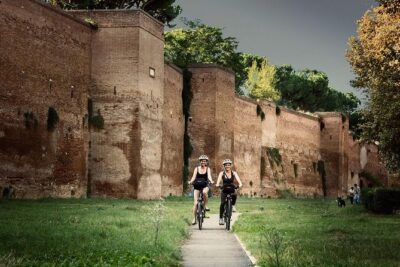
Rome EBike Tour: Appian Way, Catacombs & Roman Aqueducts
Read our review →
Appian Way, Catacombs, & Roman Aqueducts E-bike Tour
Read our review →
Appian Way E-bike Tour with Catacombs, Aqueducts & Food
Read our review →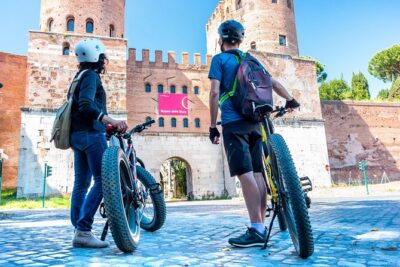
Appian Way Aqueducts Bike Tour (Catacombs & Lunch Option)
Read our review →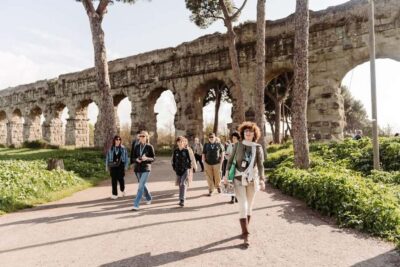
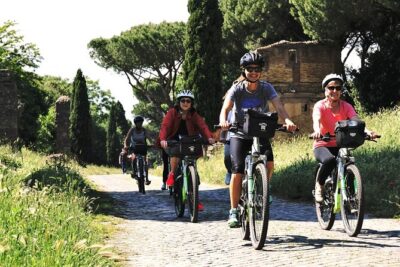
Appian Way, Catacombs and Aqueducts Park Tour with Top E-Bike
Read our review →
Appian Way E-Bike Tour Catacombs, Aqueducts & Picnic
Read our review →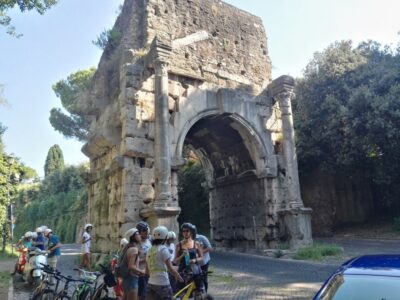
Appian Way Aqueducts Bike Tour (UPG Catacombs & Lunch)
Read our review →Browse the lists this tour appears in