
Reviewed · ROME
Rome: Walking Tour of World War 2 in Rome
Rome’s familiar monuments take on a harder edge on this World War II walking tour. Trajan’s Column, Piazza Venezia, the Roman Forum, the Jewish Ghetto, and Piazza Navona become clues to Fascist power, Nazi occupation, Jewish persecution, and liberation.
I especially like the route’s small group size of no more than 10 and the way it points out details most visitors walk past. The use of historical photos and video can make the story easier to picture, and guides such as James bring strong expertise to questions about wartime Italy. The main drawback is that this is a serious history walk, not a general sightseeing tour, and Rome’s heat, uneven streets, and steady pace can be tiring.
Key points
- Mussolini’s balcony in Piazza Venezia: See the square that served as the public stage for Fascist Italy.
- Ancient Rome used for modern politics: Learn how Mussolini exposed and reshaped Roman ruins to connect his regime with imperial power.
- Jewish Ghetto and wartime Rome: Hear about Rome’s Jewish community and the pressure placed on it during the occupation.
- Small group, open questions: With up to 10 people, you have a better chance to ask about people, places, and events that interest you.
- Liberation along the Tiber: Follow the story toward June 1944, when German forces left and the US Fifth Army entered Rome.
- Bring practical gear: Wear comfortable shoes, carry water, and pack sun protection or rain cover because the tour runs outdoors in most weather.
Why this Rome WWII walk changes the city around you
Rome is often presented through emperors, popes, fountains, and Renaissance palaces. This walk adds the recent past, when the city served as the capital of Fascist Italy for two decades, endured nine months of Nazi occupation, and was liberated in June 1944.
That recent history is not kept in one museum or one memorial. It is spread across squares, roads, ruins, churches, and buildings you may already plan to see. The value of this tour is the connection between those places. You are not simply hearing a timeline. You are learning how politics shaped the streets beneath your feet.
I would take this tour early in a Rome visit if you have a strong interest in modern European history. It can sharpen your eyes for the rest of your stay. After hearing how Fascist leaders used ancient symbols, you may notice the political messages in monuments and street plans that otherwise look like ordinary parts of Rome.
The guide speaks English, and the group is limited to 10 people. That matters on a subject with many questions and difficult details. A large crowd can turn a history walk into a one-way lecture. Here, you should have more room to ask how Fascism affected ordinary life, how the Church responded, or what happened during the final days of the occupation.
More walking tours in Rome:
- Rome: Trastevere & Campo de Fiori Street Food Walking Tour
★ 4.9 · 2,768 reviews - Rome: Paranormal Night Walking Tour & Secret Backstreets
★ 4.9 · 1,921 reviews - Rome by Night Walking Tour – Legends & Criminal Stories
★ 4.5 · 1,003 reviews
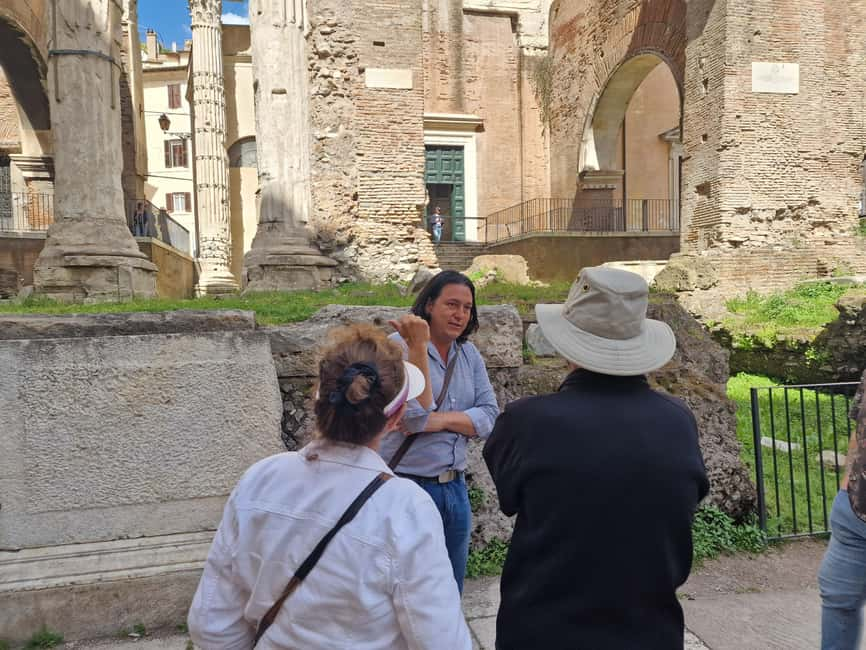
Trajan’s Column and the meeting point
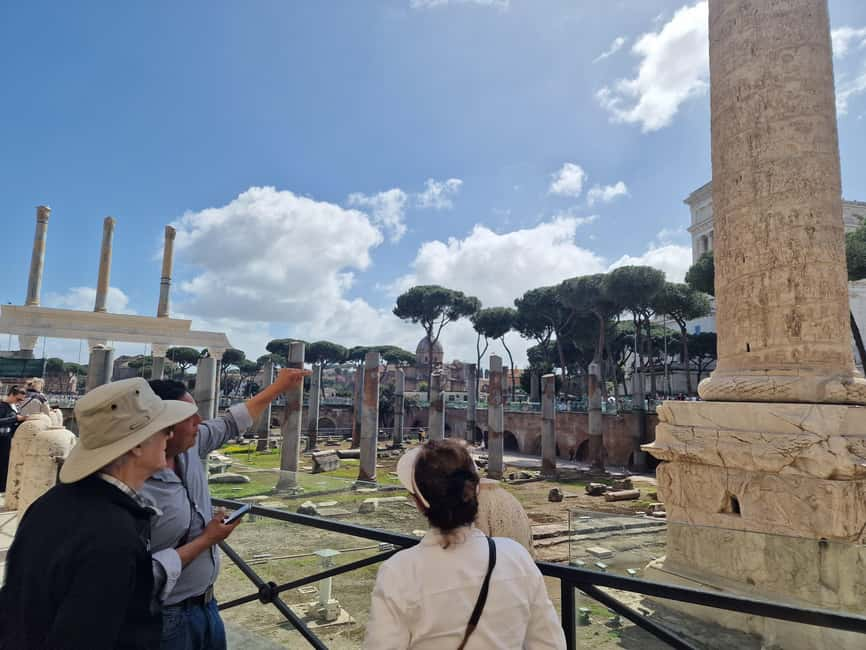
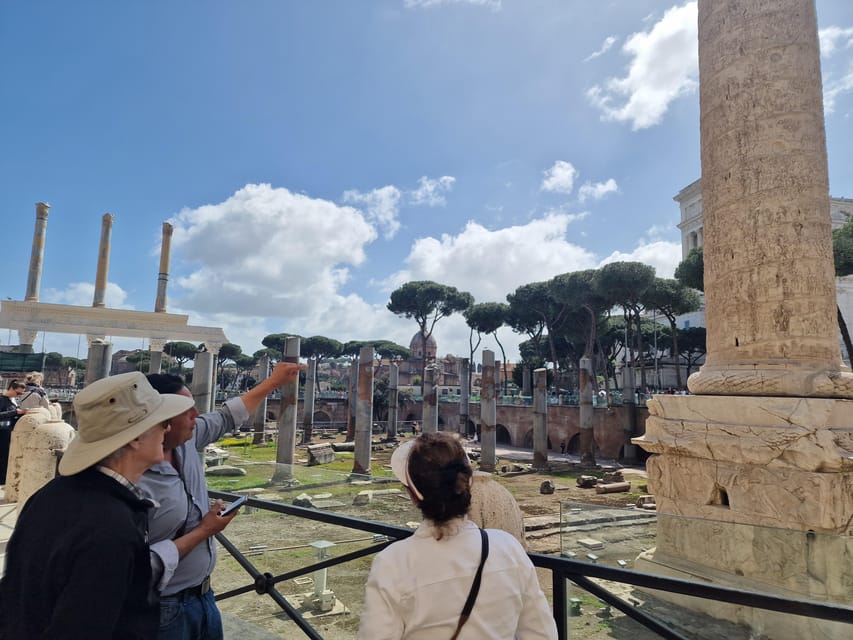
The tour begins near Trajan’s Column, beside the cafe and along the fencing. Look for the guide holding an orange sign with a lion head. Arrive 15 minutes early. The group leaves promptly, and late arrivals are not refunded.
Trajan’s Column is a fitting starting point because the tour quickly asks you to compare ancient imperial power with modern political power. The column itself is an ancient monument, but the surrounding area also helps explain Mussolini’s desire to make modern Fascist Italy appear linked to Rome’s imperial past.
This opening sets the tone. You will not spend the whole walk looking at obvious World War II memorials. Much of the experience comes from learning how to read older monuments and modern city planning together.
The meeting point is central, but transportation to it is not included. You will need to make your own way there, and there is no transportation during the walk. Plan your route before the start rather than counting on finding the guide at the last minute.
Piazza Venezia, where Fascism took the public stage
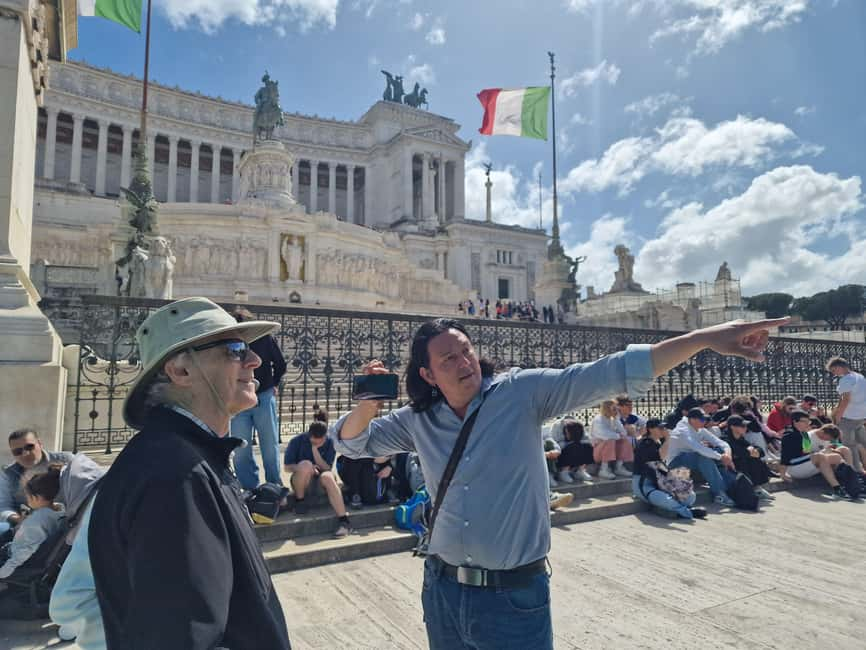
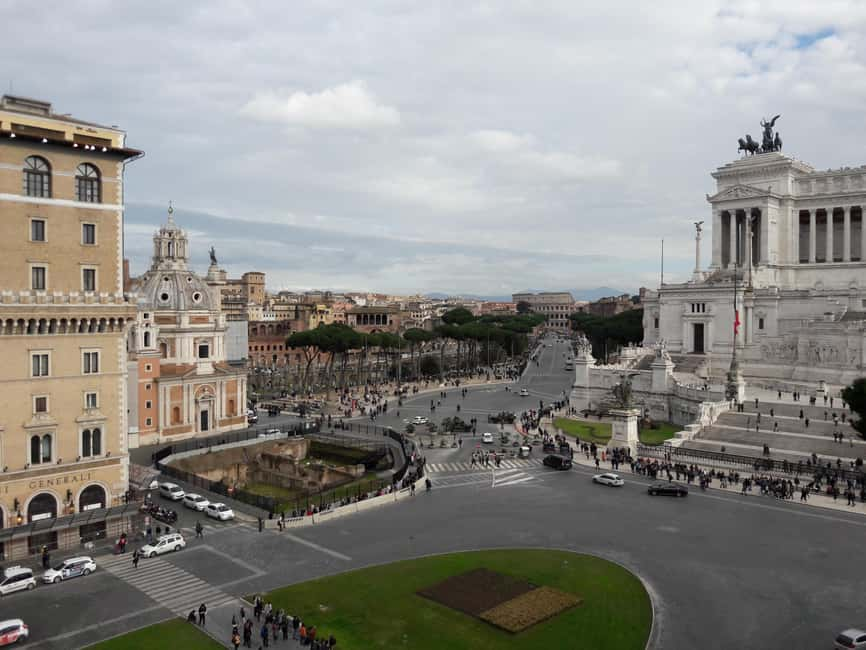
From Trajan’s Column, the walk moves to Piazza Venezia. This was the center stage of Fascist Italy, where Mussolini addressed crowds from his famous balcony.
The square is already one of Rome’s most dramatic urban spaces. The tour adds the political theater. You can picture how architecture, crowds, speeches, and the carefully chosen location helped turn the piazza into a tool of mass persuasion.
This is one of the strongest stops for visitors who know Rome mainly through its ancient and Baroque monuments. The guide explains how Fascism used the city itself to project authority. The square was not just a place to pass through. It was a setting designed to make power visible.
Expect discussion of politics and public culture rather than a parade of military dates. The tour focuses on the effect of Fascism on Roman society and on the symbols used to support the regime. That makes the stop useful even if you are more interested in social history than battlefield movements.
The Roman Forum and Mussolini’s ancient model
The route continues toward the Roman Forum, where Mussolini’s obsession with Ancient Rome left a clear mark on the city.
The Forum is one of Rome’s great archaeological areas, but it can be hard to understand as a political project. Here, you learn how Fascist leaders used ancient ruins and imperial imagery to support the idea of a powerful, revived Italy. The exposure of ancient sites was not simply an act of archaeology. It also served a modern political message.
This part of the walk helps explain why certain ruins were cleared, opened up, or placed into grand modern views. You may begin to see the Forum not only as a collection of temples and columns, but also as part of a twentieth-century campaign to link the Fascist state with ancient Roman authority.
The tour does not replace a full Forum visit. If you want detailed information about every temple, arch, and basilica, book a separate archaeological tour or use a guidebook. This walk uses the Forum for a different purpose, showing how the ancient city was interpreted and used by a modern dictatorship.
Same city, a completely different half-day:
- Vatican Museums & Sistine Chapel Tour with Optional Basilica
★ 4.3 · 67,413 reviews - Vatican Museums, Sistine Chapel & St Peter’s Basilica Guided Tour
★ 4.5 · 39,149 reviews - Rome: Colosseum, Palatine Hill and Roman Forum Guided Tour
★ 4.8 · 32,814 reviews - Rome: Guided Tour of Colosseum, Roman Forum & Palatine Hill
★ 4.7 · 27,897 reviews
Capitoline Hill and the clues hiding in plain sight
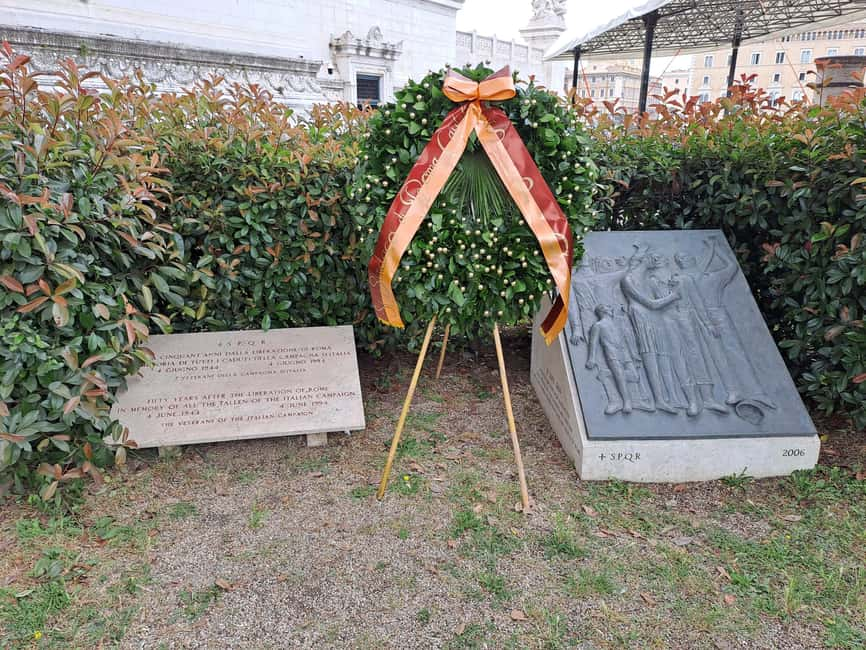
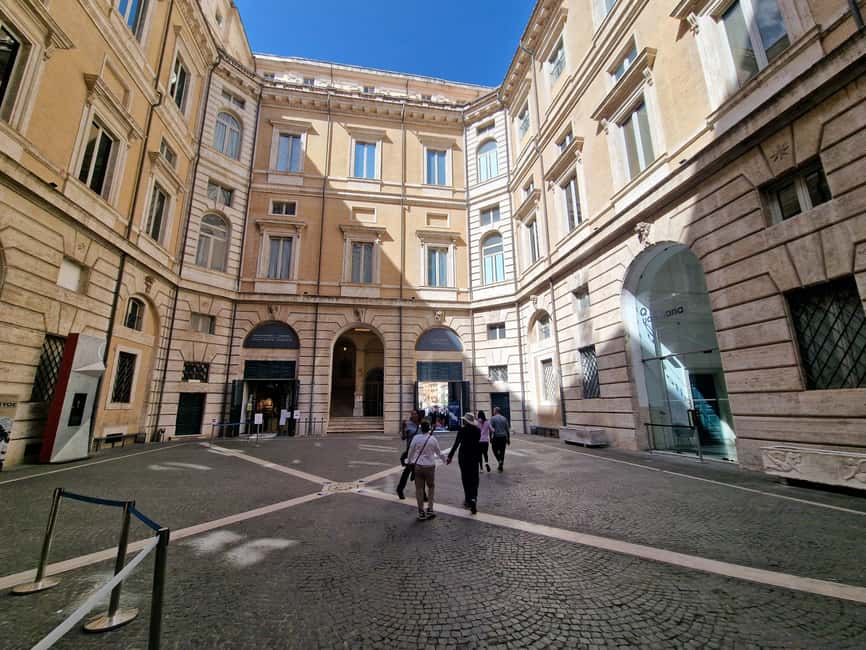
The route includes the area around Capitoline Hill, and it can also bring you to the site associated with Julius Caesar’s assassination. One useful feature is that the guide calls attention to details you might otherwise pass without a second look.
Historical photos and video may be used to connect the present-day streets with wartime Rome. That visual material is especially helpful when modern buildings or traffic make it hard to imagine the city under occupation. Seeing a place as it appears now, then comparing it with an older image, gives the history a physical anchor.
I like this method because it avoids treating the city as a stage set. Rome has changed repeatedly, and the walk shows those layers rather than pretending the past is still perfectly visible. You may leave with a better sense of how to identify Fascist-era buildings, columns, memorials, and other public clues.
The Caesar site is not a World War II location, of course. Its place on the route helps keep the city’s long history in view. Rome’s ancient past was not separate from twentieth-century politics. It was part of the language Mussolini used to shape national identity.
The Jewish Ghetto and Rome’s wartime community
The walk then reaches the Jewish Ghetto, where the guide discusses the history of Rome’s Jewish community and the impact of the war.
This is among the most important sections of the route. The neighborhood is not presented only as a picturesque quarter with restaurants and old streets. You hear about the people who lived there, the pressures created by Fascist rule, and the dangers that grew during Nazi occupation.
The stop adds a human scale to the larger political story. Piazza Venezia can show the public face of power. The Jewish Ghetto shows how that power affected a community.
Give this part your attention. It is easy in Rome to move from monument to monument, taking photographs and chasing the next sight. A guide who can connect the city’s Jewish history to Fascist policy and the occupation makes the consequences much clearer.
The tour is not advertised as a dedicated Jewish history walk, so you should not expect every aspect of Roman Jewish life to receive equal treatment. Still, this stop makes the route more than a study of Mussolini’s architecture and military events. It brings society, persecution, and memory into the story.
Piazza Navona and the Church during Fascist rule
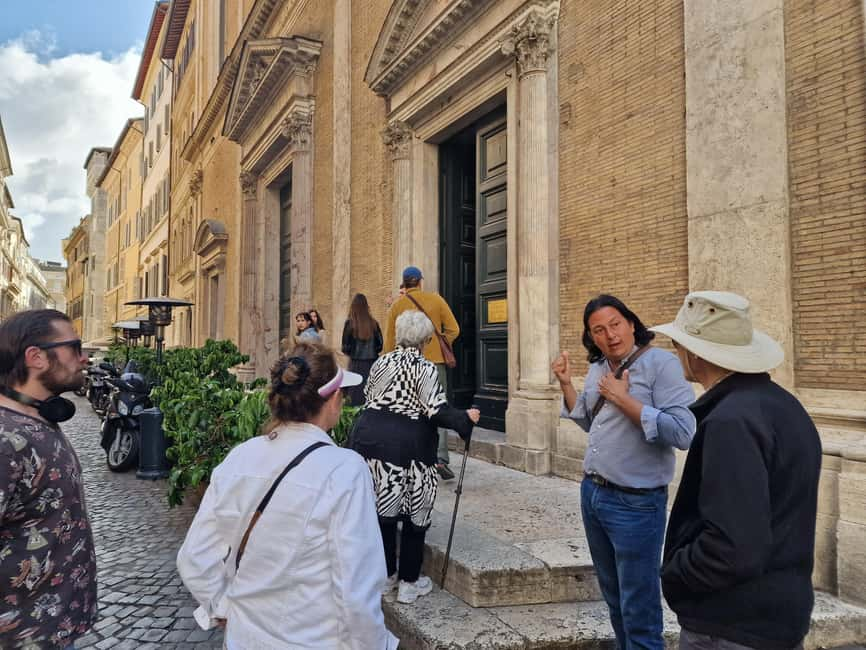
From the Jewish Ghetto, the route continues through Piazza Navona. The piazza is one of central Rome’s most famous public spaces, known for its grand fountains and Baroque setting. On this walk, it becomes a place to discuss the Church’s position during the Fascist period and the war.
That subject is complicated, and the tour’s value lies in showing that Rome’s wartime story cannot be told through government and army actions alone. The Church held enormous influence in the capital, and its relationship with Fascist power shaped the period.
The exact balance of this discussion depends on the guide and the questions from the group. James, named by several participants as a guide on this experience, is especially suited to groups that want to stop and ask follow-up questions. A small party gives you a better chance to examine difficult issues instead of simply moving on when the scheduled time arrives.
You may discuss a church connection during the walk, but the experience is primarily outdoors. Bring a cover for bare shoulders if you may enter any church. The tour information specifically recommends this in warmer months.
The Tiber and Rome’s June 1944 liberation
The final part of the route leads toward the Tiber River and recalls June 1944, when German forces fled Rome and the US Fifth Army entered the city.
This conclusion gives the walk a strong sense of movement. You have started with ancient imperial symbols, passed through the public theater of Fascism, considered the Jewish community and the Church, and ended with the collapse of Nazi control and the arrival of Allied forces.
The story of liberation is not treated as an isolated military event. It is tied to the streets and public spaces where Roman life resumed after occupation. The image of jubilation helps explain why June 1944 remains such an important moment in the city’s modern memory.
The route’s ending near the river also means you are not finishing at the same place where you began. Allow time afterward to reach your next destination. Since there is no included transportation, you should not schedule a tight connection immediately after the tour.
What the $88 price buys you
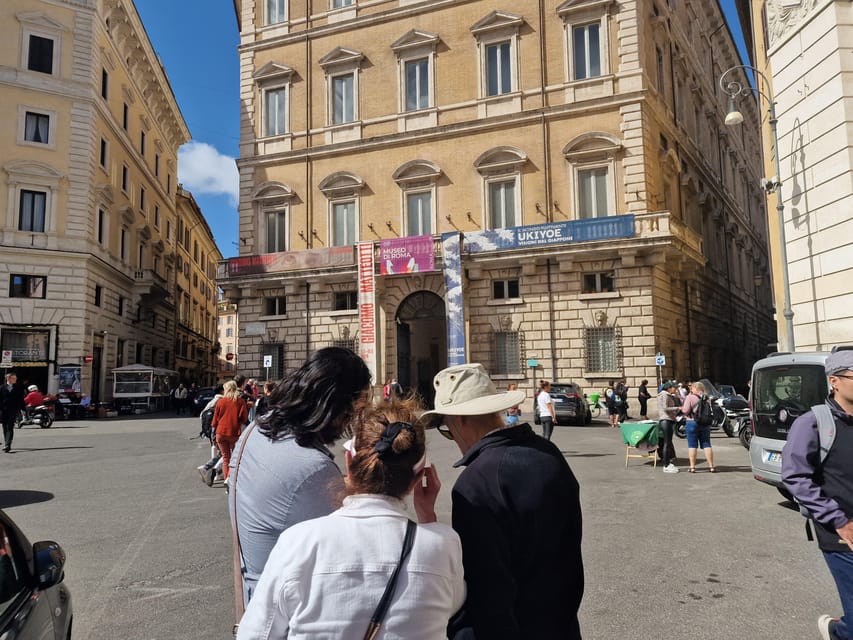
At $88 per person, this is not a cheap orientation walk. You are paying for a specialist subject, a live English-speaking guide, and a small group rather than transportation, meals, or entry to a major monument.
The value depends on how much you want to understand modern Rome. If World War II, Fascism, the Italian campaign, or political history interests you, the price can be fair because the guide provides a focused interpretation that is hard to gain from simply wandering between major sights.
The small group is important here. With a limit of 10, the guide can use questions to shape the discussion. Some departures may be much smaller. One group had only four people, while another tour had just two, allowing plenty of time for questions and extra explanation.
You should compare this with your own priorities. If you want to see inside famous monuments, this is not the best use of $88. If you want a specialist to reveal wartime evidence in places you already plan to visit, it offers more than a standard city introduction.
The tour runs for 2.5 hours, though one account describes a visit lasting closer to three hours. Plan for at least the scheduled duration and avoid booking another fixed activity too tightly afterward.
Walking conditions, weather, and who should book
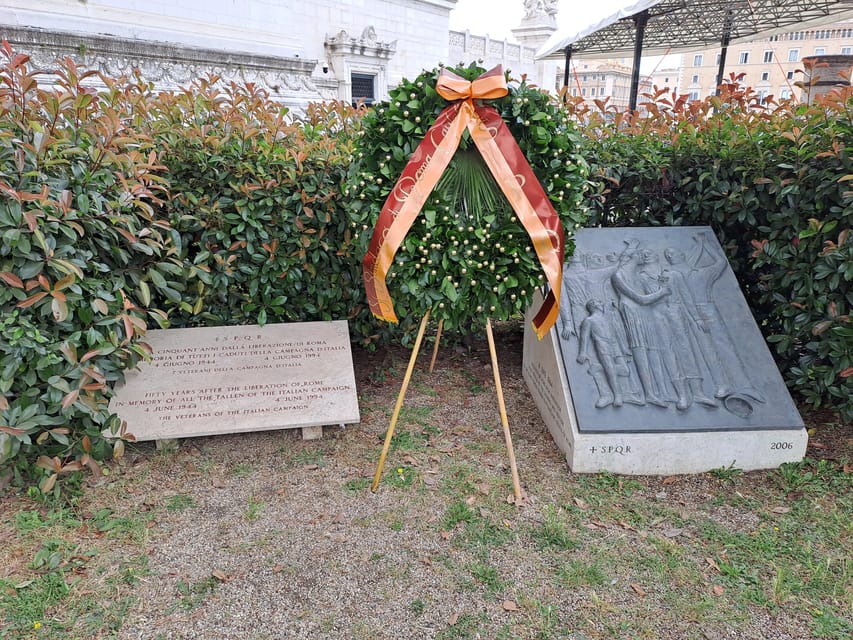
You will be outside for the full route, moving across central Rome between several major areas. Comfortable walking shoes are essential. Bring bottled water, sunscreen, a hat, and an umbrella. The tour operates in all weather unless authorities close a site for safety.
Dress warmly in cold weather. In summer, protect yourself from the sun and carry something to cover bare shoulders inside churches. These are basic tips, but they matter more on a history walk because stopping to listen can leave you standing in direct sun.
The tour is listed as wheelchair accessible. Still, central Rome can involve crowded streets and uneven surfaces, so you may want to confirm current route conditions before booking if you have specific mobility needs.
I would recommend this experience to:
- People who want modern history alongside Rome’s ancient monuments
- Visitors who already know the main sights and want a new way to read them
- Anyone interested in Fascism, Nazi occupation, Jewish history, or liberation
- Small groups that enjoy questions and extended discussion
- Families with older children who can engage with serious historical topics
I would think twice if your main goal is a relaxed introduction to Rome, a food walk, or a tour focused on entering monuments. The subject is serious, the route is information-heavy, and the weather can affect your comfort.
Should you book the Rome WWII walking tour?
Book it if you want Rome to make more sense as a twentieth-century capital, not just an ancient and Baroque showpiece. The strongest parts are the links between Mussolini’s public speeches, his use of ancient Rome, the Jewish Ghetto, the Church, and the June 1944 liberation.
I would schedule it near the beginning of your stay. The tour can change how you look at Piazza Venezia, the Forum, and central Rome for the rest of your visit. Arrive early, wear good shoes, carry water, and leave room for questions.
Skip it if your time in Rome is very short and you want only the classic monuments. But if you are drawn to the difficult, less visible history behind those monuments, this is a focused and worthwhile choice at $88.
FAQ
Where does the tour meet?
The meeting point is in front of the cafe at Trajan’s Column, along the fencing. Your guide will hold an orange sign with a lion head.
How early should I arrive?
You should check in 15 minutes before the scheduled start. The tour departs promptly, and late arrivals or missed tours are not refunded.
How long does the walk last?
The scheduled duration is 2.5 hours. One description of a tour gives a duration closer to three hours, so allow extra time if your plans afterward are fixed.
What language is the tour in?
The live tour guide speaks English.
How large is the group?
The tour is limited to 10 participants. Some departures may have fewer people, allowing more time for questions.
Is the tour wheelchair accessible?
Yes, the activity is listed as wheelchair accessible.
What should I bring?
Bring bottled water, sunscreen, a hat, and an umbrella. Wear comfortable walking shoes, dress warmly in cold weather, and carry a cover for bare shoulders if you may enter a church.
Can I cancel the booking?
You can cancel up to 24 hours in advance for a full refund. The reserve-now, pay-later option lets you hold a place without paying immediately.
Newest Rome tours we have reviewed
- Private TikTok Video Making in Rome★ 5.0 · 7 reviews
- Assisi, Orvieto and Civita di Bagnoregio Full Day Tour from Rome★ 4.5 · 45 reviews
- Assisi & Saint Francis Path Tour from Rome★ 5.0 · 45 reviews
- Assisi and Cascia Private Day Tour from Rome with Lunch★ 5.0 · 10 reviews
- Art Class in the center of Rome!★ 4.0 · 4 reviews
- Art & Craft: Beer Tour with Street Art in Rome★ 4.5 · 6 reviews
- Arrival in Rome: Airport Transfer & Exclusive City Introduction★ 5.0 · 3 reviews
- From Rome: Private Day-Tour of Tuscany★ 5.0 · 16 reviews