
Reviewed · VATICAN MUSEUMS AND SISTINE CHAPEL TOURS
Vatican City: Sistine Chapel, Museums, Basilica Private Tour
The Vatican’s greatest strength is its scale, and this private tour gives you a clear path through it. In four hours, you move from Egyptian antiquities and ancient sculpture to Raphael’s painted rooms, Michelangelo’s Sistine Chapel, and Bernini’s vast canopy in St. Peter’s Basilica. The art comes in layers, not as a blur of famous names.
I like the private format and the skip-the-ticket-line entry to the Vatican Museums. I also like the range of guides, including Yevgen, Fabio, Julia, Paola, and Oksana, who are praised for explaining difficult art in a warm, lively way. The main drawback is the crowding. Even a good guide cannot make the Vatican feel quiet, and some sections may feel rushed.
Key points to know before you book
- A four-hour private route: You get a focused tour of the museums, Sistine Chapel, basilica, and square rather than a quick visit to one highlight.
- Strong guide feedback: Guides such as Yevgen and Fabio are often praised for clear explanations, energy, patience, and good handling of families.
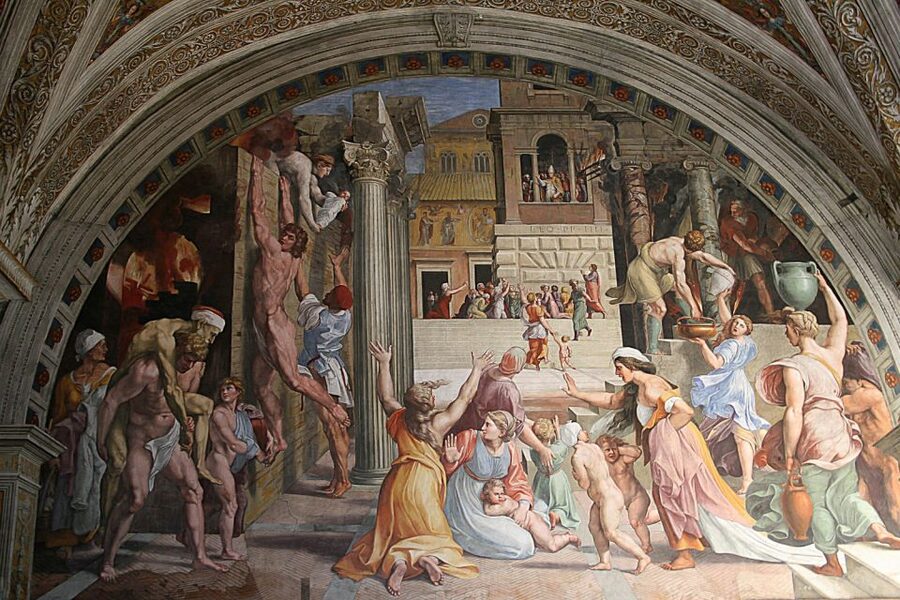
- A serious art itinerary: Expect the Egyptian Museum, Pine Cone Courtyard, Gallery of Maps, Raphael’s apartments, and the Borgia rooms.
- The basilica is part of the plan: You see Michelangelo’s Pietà and Bernini’s St. Peter’s Baldachin after the museums and chapel.
- Good for mixed-age groups: Guides have adapted the pace for children, older adults, asthma, and wheelchair users.
- Dress and entry rules matter: Bring a passport or ID card, and avoid shorts, short skirts, and sleeveless shirts.
What this private Vatican tour actually covers
This is not just a Sistine Chapel visit with a quick look at St. Peter’s. The route takes you through the Vatican Museums first, then into the Sistine Chapel, onward to St. Peter’s Basilica, and finally out into Saint Peter’s Square.
The private setup matters because the Vatican can feel like a giant maze. Your guide chooses the route, explains why each room matters, and keeps the tour moving through crowded corridors. You can also ask questions and adjust the pace more easily than you can in a large group.
The tour lasts four hours. That is enough time for a solid introduction, but not enough to study every room or painting. I would treat it as a guided survey of the Vatican’s major works, not as an exhaustive museum visit.
The listed price is $717.06 per group up to one person. Since the price structure is unusual, check the final amount carefully for your party before paying. For one person, it is expensive. For a private group that can share the cost, the value improves, especially if you care about having your own guide, entering through the museum’s skip-the-line channel, and avoiding the work of planning a route through miles of galleries.
More Vatican Museums and Sistine Chapel tours:
- Vatican Museums & Sistine Chapel Tour with Optional Basilica
★ 4.3 · 67,413 reviews - Vatican Museums, Sistine Chapel & St Peter’s Basilica Guided Tour
★ 4.5 · 39,149 reviews - Rome: Vatican Museums, Sistine Chapel & Basilica Tour
★ 4.3 · 13,872 reviews
Meeting at the Vatican Museums entrance
The meeting point is at the entrance of the Vatican Museums on Viale Vaticano 99, at the exit of Tmark Hotel Vaticano. The tour finishes at Piazza San Pietro in Vatican City.
Give yourself time to find the correct entrance. The meeting instructions refer to the museum entrance and a white staircase, but that description can be confusing when the area is crowded. Look for the museum entrance arch and keep your booking details handy. A clear picture of the entrance would help, so do not rely only on a vague landmark.
You need a passport or ID card. The clothing rule is strict: no shorts, short skirts, or sleeveless shirts. Wear clothing that covers your shoulders and knees so you do not risk a problem at the religious sites.
The Vatican is a place where comfort affects your enjoyment. You will spend four hours walking and standing, often among crowds. Sensible shoes, water before the tour, and a light approach to luggage will help.
Vatican Museums: a smart route through huge collections
The first two hours are devoted to the Vatican Museums. The museums contain far more than anyone can absorb in one visit, so the guide focuses on major rooms and objects rather than trying to cover every gallery.
Your first major stop is the Cortile della Pigna, or Pine Cone Courtyard. Its large pine cone fountain once stood beside the Temple of Isis. This is a useful first lesson in how Rome’s ancient objects were moved, reused, and given new meaning over time.
You then reach the Cortile Ottagono, the octagonal courtyard. It is associated with some of the Vatican’s best-known ancient sculpture. The courtyard gives you a pause from the long indoor galleries, though you should not expect solitude. Crowds can gather here quickly.
The Egyptian Museum adds a different note to the tour. You see antiquities from Ancient Egypt, which helps broaden the visit beyond the Renaissance art most people expect. If you have children in your group, this section may give them a more direct way into the museum, since ancient objects can be easier to discuss than complex religious painting.
The Gallery of the Candelabra follows. Its 2nd-century candelabra from Otricoli show the craftsmanship and decorative taste of the Roman world. Your guide can help you look past the objects that seem merely ornamental and notice how the Vatican presents ancient pieces as part of a long story of collecting and display.
Maps, tapestries, and the rooms painted for Julius II
The Gallery of Tapestries gives you a chance to examine Flemish works made by some of Raphael’s students. These are not just wall coverings. They combine painting, design, textile skill, and religious storytelling, and the guide can point out how the images change when translated from a painted surface into woven fabric.
The Gallery of Maps is one of the most memorable sections for many people. Historic maps line the walls, offering a view of how the world was understood and pictured in an earlier age. Even if you are not a map enthusiast, the long gallery gives the tour a strong sense of place and progression.
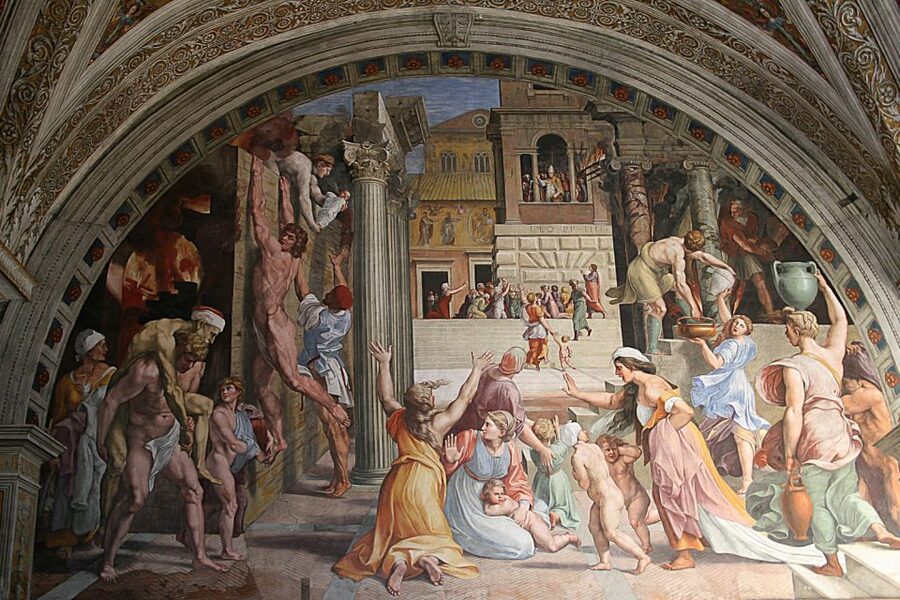
The route then reaches the apartments painted by Raphael for Julius II. This is one of the tour’s key moments. Raphael’s work here lets you see Renaissance art in the setting for which it was intended, not only as an isolated panel in a modern gallery.
The rooms reward a guide who can explain the politics, religion, and artistic competition behind the decoration. Julia, one of the guides praised for this tour, is noted for adjusting the pace and spending more time on the pieces that matter most to your group. That kind of flexibility is useful here, since some people want the painting explained in detail while others mainly want to see the famous rooms.
You also visit the private chambers of Alexander VI, the Borgia Pope. These rooms offer a change in mood and decoration. The name alone attracts attention, but the value of the stop is seeing how different papal spaces can feel from one another.
More museums and galleries in Rome:
- Vatican Museums & Sistine Chapel Skip-the-Line Entry Ticket
★ 4.4 · 13,838 reviews - Rome: Vatican Museums, Sistine Chapel & Basilica Tour
★ 4.7 · 13,217 reviews - Rome: Vatican Museums & Sistine Chapel Guided Tour
★ 4.3 · 12,117 reviews - Vatican Museums & Sistine Chapel Skip-the-Ticket-Line Tour
★ 4.3 · 10,486 reviews
Sistine Chapel: the quiet pause in a crowded route
The Sistine Chapel visit lasts about 30 minutes. The chapel is famous for Michelangelo’s ceiling and the Last Judgment, but the short visit works best if you know what you are looking for before you enter.
Your guide can prepare you by explaining the main scenes, the arrangement of the ceiling, and the difference between Michelangelo’s ceiling frescoes and the Last Judgment on the altar wall. Once inside, the atmosphere changes. Talking is restricted, and you cannot rely on a running explanation from the guide in the same way you can in the museum galleries.
Look up, but do not forget the walls. The chapel is not only about the ceiling. The overall effect comes from the relationship between the ceiling, the altar wall, and the surrounding decoration.
The half-hour allocation is enough for orientation and viewing, but it is not a long study session. You may feel that the visit passes quickly, especially when the chapel is full. That is one reason the guide’s preparation matters. A few clear points before entering can make the time inside more meaningful.
Photography rules and chapel behavior can change, so follow the instructions given on the day. This is a religious space as well as a major art site, and the visit feels better when treated with some quiet respect.
St. Peter’s Basilica: Michelangelo and Bernini on a grand scale
The tour continues to St. Peter’s Basilica for about one hour. The building changes the scale completely. After rooms filled with paintings and objects, you enter a vast church where architecture, sculpture, and ceremony work together.
Michelangelo’s Pietà is one of the essential stops. The sculpture is famous, but seeing it in person gives you a better sense of its polish, stillness, and emotional restraint. The work is protected behind glass, so you should not expect to stand right beside it, but the guide can help you notice details that disappear in a quick glance.
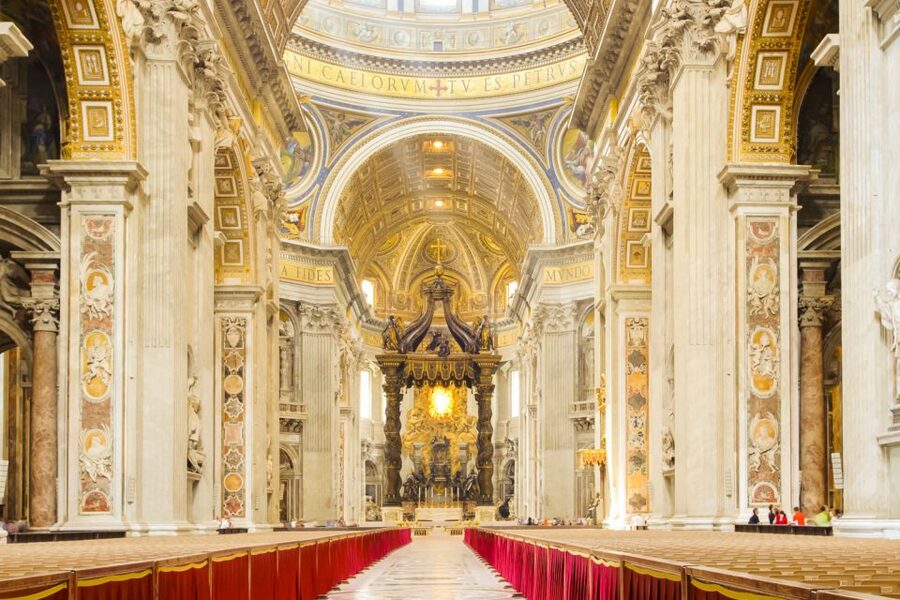
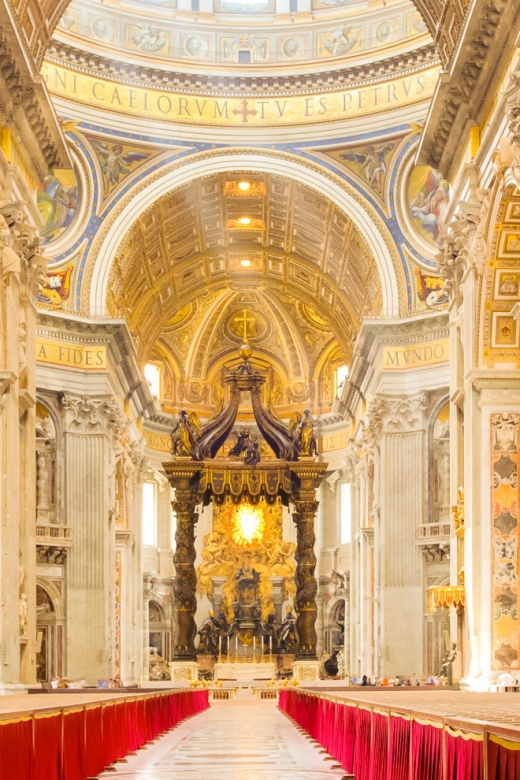
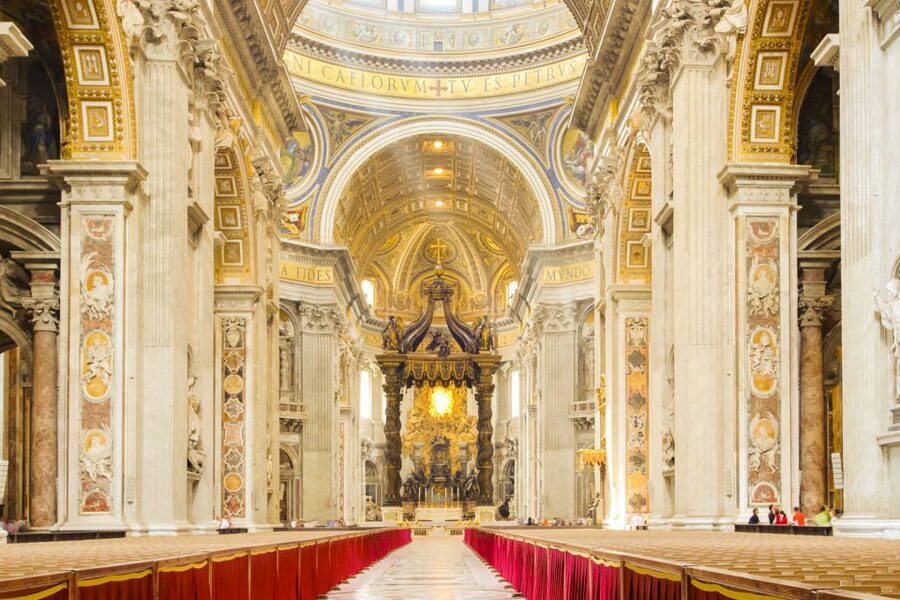
Bernini’s St. Peter’s Baldachin is another major highlight. The enormous bronze canopy marks the center of the basilica and draws your eye upward. It also helps you understand how the building was designed to guide attention toward the altar and the church’s central space.
The basilica visit is not simply an extra church stop added at the end. It completes the artistic story. You have seen painting in the Vatican galleries, frescoes in the Sistine Chapel, and then monumental sculpture and architecture in St. Peter’s.
The basilica can be busy, and one lower-rated experience noted that crowds made parts of the Vatican harder to enjoy. That is a fair warning. A private guide helps you understand what you are seeing, but cannot control how many people are in the building.
Saint Peter’s Square and the final half hour
The final 30 minutes take place in Saint Peter’s Square. This gives you room to step back from the interior spaces and see how St. Peter’s works as a public and ceremonial setting.
The square is also a useful place to review the route. From here, you can connect the museum collections, the Sistine Chapel, the basilica, and the larger role of the Vatican in one view. The tour ends at Piazza San Pietro.
This last section is guided, not just a walk to the exit. If you have questions about the basilica or the Vatican complex, this is a good time to ask them. You are no longer trying to keep up with the route, and the open space makes conversation easier.
Guides, language, and the private format
The tour offers guides in Spanish, Dutch, English, French, Portuguese, German, Italian, and Russian. The specific guide you receive depends on availability, but several names connected with this experience are worth noting.
Yevgen is praised for turning the visit into an engaging art and history lesson while also taking care of mobility needs. Fabio is described as lively and effective with a mixed-age group that included an eight-year-old. Julia is noted for adapting the pace and making sure the group saw its priorities.
Paola guided a French-speaking family and explained the material clearly while keeping children involved. Oksana is noted for patience with questions and for engaging a six-year-old. Stefania and Kees are also praised for clear and engaging tours.
These details matter because a guide can make or break a museum visit. The strongest pattern is not merely factual skill. It is the ability to adjust explanations for adults, children, older relatives, and people who need more time.
For groups of more than five people, headsets are necessary and cost €3 per person. In a private group, ask how many people are included and how the headset charge will be handled. You want to hear the guide clearly in the large galleries and crowded corridors.
Accessibility, children, and the pace of the visit
The activity is wheelchair accessible. A guide helped a mother using a wheelchair, and other guides adapted for asthma and mobility limits. That does not remove every challenge created by crowds and long distances, but it suggests that the private format can be useful for a group with different physical needs.
Tell the provider about mobility concerns before the tour. The guide can then understand that your group may need pauses or a slower pace. The four-hour duration is substantial, especially in hot weather.
Families can also benefit from the private arrangement. Fabio kept children involved, and Oksana engaged a six-year-old. You should still prepare children for a long art-focused visit. The Egyptian Museum, ancient sculpture, maps, and dramatic ceiling paintings offer variety, but the Vatican is not a short attraction.
The main drawbacks to weigh
The crowds are the biggest concern. The Vatican can feel packed, and a private booking does not turn it into a quiet museum. You may need to move with the flow, wait for space in front of key works, and accept that some rooms are easier to see than others.
The tour can also feel uneven in pace. One account describes some parts as rushed while the guide spent longer on other sections. That can happen on a route with so many stops. If a particular work matters most to you, say so early and ask your guide to give it proper attention.
The price is another consideration. At $717.06 per group up to one, this is not a budget visit. The value is strongest for people who want a private guide and a carefully managed route through several major Vatican sites. If you only want to see the Sistine Chapel quickly, a less expensive option may make more sense.
Free cancellation is available up to three days in advance for a full refund. Food, drinks, hotel pickup, and hotel drop-off are not included, so plan those needs yourself.
Who should book this Vatican tour?
I would choose this tour for a first Vatican visit when you want the major art, the basilica, and a guide who can answer questions in your language. It is also a good fit for families, mixed-age groups, and anyone who would rather not navigate the museum alone.
The private format is especially useful when one person in your group needs a slower pace. It also suits people who care about context. The guide can connect the Egyptian antiquities, ancient sculpture, Renaissance rooms, Michelangelo’s frescoes, and Bernini’s sculpture instead of leaving you with a list of famous names.
I would think twice if your budget is tight, if you dislike crowded museums, or if you prefer to linger for a long time in one gallery. Four hours gives you a strong overview, but the route keeps moving.
Should you book it?
Book this private Vatican tour if you want a well-planned half-day with the museums, Sistine Chapel, St. Peter’s Basilica, and Saint Peter’s Square all included. The guide quality appears to be its greatest strength, with Yevgen, Fabio, Julia, Paola, Oksana, and others praised for warmth, patience, and clear explanations.
Before booking, confirm the price for your exact group, check the guide language, and make sure everyone can follow the dress rules. If you can accept crowds and the high cost, this is a practical way to make sense of a huge and sometimes overwhelming collection.
FAQ
How long does the Vatican tour last?
The tour lasts four hours. The planned schedule includes two hours in the Vatican Museums, 30 minutes in the Sistine Chapel, one hour in St. Peter’s Basilica, and 30 minutes in Saint Peter’s Square.
Where does the tour begin?
You meet at the entrance of the Vatican Museums on Viale Vaticano 99, at the exit of Tmark Hotel Vaticano.
Where does the tour end?
The activity ends at Piazza San Pietro in Vatican City.
Is the Vatican Museums entrance skip-the-line?
Yes. A skip-the-ticket-line ticket for the Vatican Museums is included.
Is the Sistine Chapel admission included?
Yes. Admission to the Sistine Chapel is included in the tour.
Is St. Peter’s Basilica included?
Yes. The tour includes a guided visit to St. Peter’s Basilica.
What languages are available?
Guided tours are available in Spanish, Dutch, English, French, Portuguese, German, Italian, and Russian.
What should I wear?
Do not wear shorts, short skirts, or sleeveless shirts. Dress in clothing that meets the Vatican’s requirements for visiting religious sites.
Is the tour wheelchair accessible?
Yes, the activity is listed as wheelchair accessible. Tell the provider about mobility needs in advance so the guide can plan accordingly.
Newest Rome tours we have reviewed
- Private TikTok Video Making in Rome★ 5.0 · 7 reviews
- Assisi, Orvieto and Civita di Bagnoregio Full Day Tour from Rome★ 4.5 · 45 reviews
- Assisi & Saint Francis Path Tour from Rome★ 5.0 · 45 reviews
- Assisi and Cascia Private Day Tour from Rome with Lunch★ 5.0 · 10 reviews
- Art Class in the center of Rome!★ 4.0 · 4 reviews
- Art & Craft: Beer Tour with Street Art in Rome★ 4.5 · 6 reviews
- Arrival in Rome: Airport Transfer & Exclusive City Introduction★ 5.0 · 3 reviews
- From Rome: Private Day-Tour of Tuscany★ 5.0 · 16 reviews
Vatican Museums and Sistine Chapel Tours, compared.
Vatican Museums & Sistine Chapel Tour with Optional Basilica
Read our review →
Vatican Museums, Sistine Chapel & St Peter’s Basilica Guided Tour
Read our review →
Vatican Museums, Sistine Chapel & Basilica Tour
Read our review →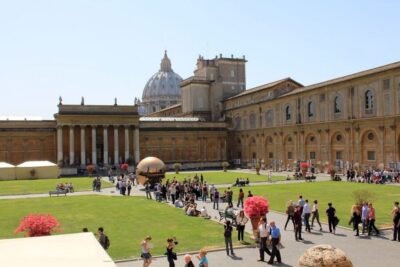
Vatican Museums & Sistine Chapel Skip-the-Line Entry Ticket
Read our review →Vatican Museums, Sistine Chapel & Basilica Tour
Read our review →
Skip-the-Line Group Tour of the Vatican, Sistine Chapel & St. Peter’s Basilica
Read our review →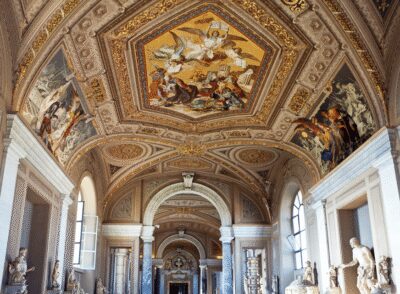
Vatican Museums & Sistine Chapel Guided Tour
Read our review →
Vatican Museums & Sistine Chapel Skip-the-Ticket-Line Tour
Read our review →Browse the lists this tour appears in