
Reviewed · ROME
Via Roma: A Journey Through Time
Rome is at its most atmospheric after sunset, when the Pantheon, Trevi Fountain, ancient forums, and Colosseum take on a softer, more dramatic look. This two-hour walk links famous sights with less obvious stops, including St. Ignazio’s trompe-l’œil ceiling and the underground remains of Vicus Caprarius.
I like the way the tour brings together Rome’s Baroque fountains and ancient ruins in one walk, and I like the chance to see the city without the daytime heat. Guides such as Sara have been praised for making the history lively and clear. The main drawback is the pace: this is a long urban walk, not a relaxed café-to-café stroll, and it is not suitable for wheelchair users or people with mobility impairments.
Key points
- Rome after dark: See major monuments illuminated, from the Pantheon and Trevi Fountain to the Colosseum.
- A strong mix of eras: The route moves from Renaissance and Baroque churches to ancient Roman ruins.
- St. Ignazio’s optical illusion: Look up at a ceiling that appears to open into a grand architectural space.
- A walking tour with real mileage: Comfortable shoes and water matter, especially if the tour runs closer to two and a half hours.
- English and Spanish guides: Sara has earned particular praise for her friendly, engaging explanations.
- Good value at $32: The price covers a professional guide and the walking tour, but not food or attraction entry fees.
Why Rome is better after sunset
Rome changes character at night. The harsh glare on pale stone fades, fountains catch the light, and the city’s grand buildings feel less like a checklist of sights and more like part of one long story.
This tour focuses on the historic heart of Rome. You move between broad piazzas, churches, government buildings, ancient columns, and archaeological remains. It is not a museum tour with long indoor visits. It is a guided walk that gives you orientation, context, and a chance to see familiar monuments in a different setting.
The route is especially appealing in warm weather. One participant described it as a good way to see Rome at night and avoid the worst summer heat. That benefit comes with a tradeoff: Rome’s old center is made for walking, and the tour covers a lot of ground in a short time.
The advertised duration is two hours, although one experience lasted about two and a half hours. Plan your evening with some flexibility. You will get more from the walk if you are not rushing off to a dinner reservation across town.
Other Rome tours people pair with this one:
- Vatican Museums & Sistine Chapel Tour with Optional Basilica
★ 4.3 · 67,413 reviews - Vatican Museums, Sistine Chapel & St Peter’s Basilica Guided Tour
★ 4.5 · 39,149 reviews - Rome: Colosseum, Palatine Hill and Roman Forum Guided Tour
★ 4.8 · 32,814 reviews
Starting quietly at Piazza di Sant’Agostino
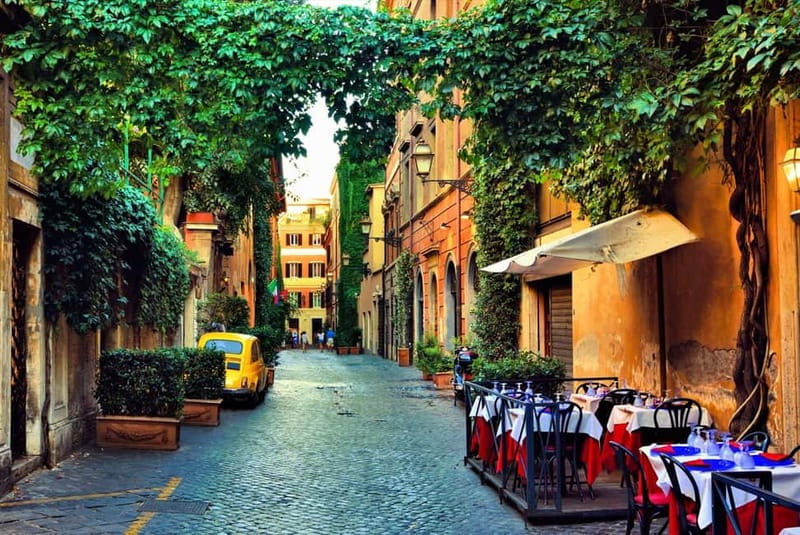
The tour begins at Piazza di Sant’Agostino, a calmer opening than the crowded spaces later in the route. The square gives you a first look at Rome’s Renaissance character and sets the tone before the monuments become more dramatic.
This is a useful starting point because the walk does not throw you straight into the busiest tourist crossroads. Your guide can introduce the city’s layers before you reach Piazza Navona and the Pantheon.
Your exact meeting point may vary by booking option, so check the confirmation carefully. The end point is described as back at the meeting point, while the route itself is described as finishing at the Colosseum. Because those details do not perfectly match, I would confirm the meeting and ending arrangements before booking if you need a precise finish near your hotel or a timed dinner.
Piazza Navona and Rome’s Baroque show
Piazza Navona is one of the tour’s strongest evening stops. The long, open square follows the shape of an ancient Roman stadium, but the visual effect you see today is Baroque: fountains, elaborate façades, and grand urban space arranged for spectacle.
The evening light helps here. The fountains become the focus, especially as the surrounding buildings darken. Your guide can explain how the square developed and point out the details that are easy to miss when you simply cross it on your own.
Piazza Navona also gives you a good sense of Rome’s scale. This is not a single monument viewed from one angle. It is a whole public room, designed to impress from the center as well as from the edges.
Take a moment to look around rather than aiming every photo at the nearest fountain. You will get better pictures by including the surrounding buildings and the open space. The tour does not include food or drinks, so do not count on a meal stop here.
The Pantheon under the evening sky
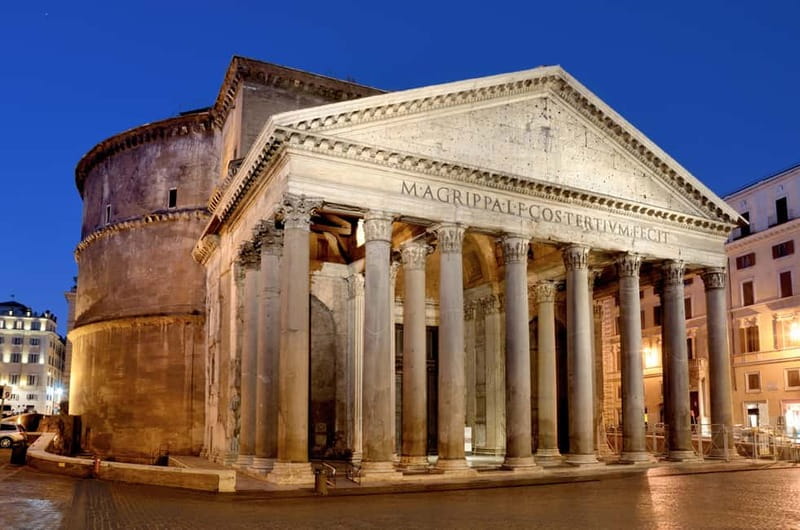
The Pantheon is one of Rome’s most powerful sights because its exterior is both simple and monumental. The massive dome and central oculus create a sense of scale that is hard to grasp from photographs.
The tour includes the Pantheon as a major landmark, but no entrance fees are included. That means the experience may focus on the exterior unless your guide and timing allow access under the conditions of the day. Do not assume that an indoor visit is part of the $32 price.
Even from outside, the building rewards close attention. Look at the ancient columns, the deep porch, and the way the structure occupies the surrounding square. The Pantheon is a good example of why a guide helps on a walking route: the building can look familiar, yet its design makes more sense when someone points out how the dome and oculus work together.
If seeing the interior is essential to you, ask before booking what is planned for your date. The supplied details promise the landmark, not an included entry ticket.
Same city, a completely different half-day:
- Rome: Guided Tour of Colosseum, Roman Forum & Palatine Hill
★ 4.7 · 27,897 reviews - Rome: Colosseum & Forum with Audio Guide App -Optional Arena
★ 4.2 · 24,770 reviews - Rome: Colosseum, Roman Forum and Palatine Hill Guided Tour
★ 4.5 · 23,903 reviews - Rome: City Sightseeing Hop-on Hop-off Bus with Audioguide
★ 4.0 · 16,045 reviews
St. Ignazio and the ceiling that fools your eyes
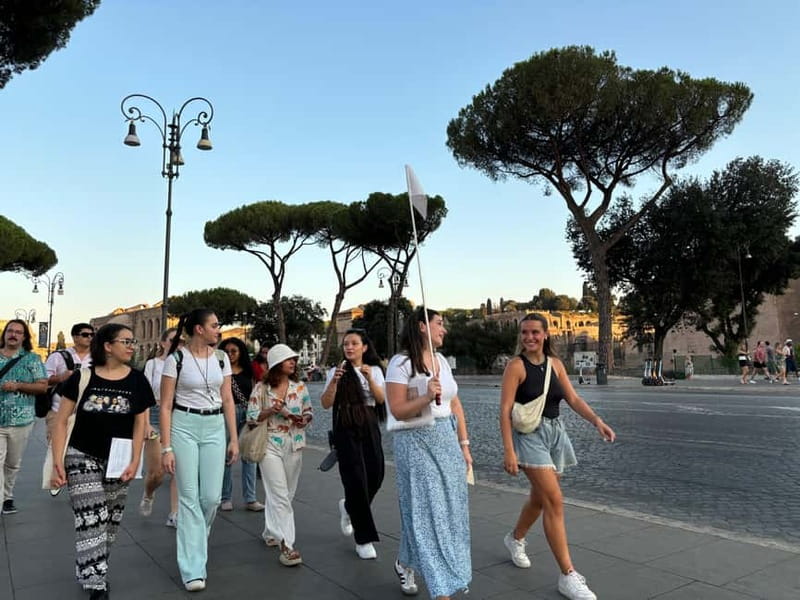
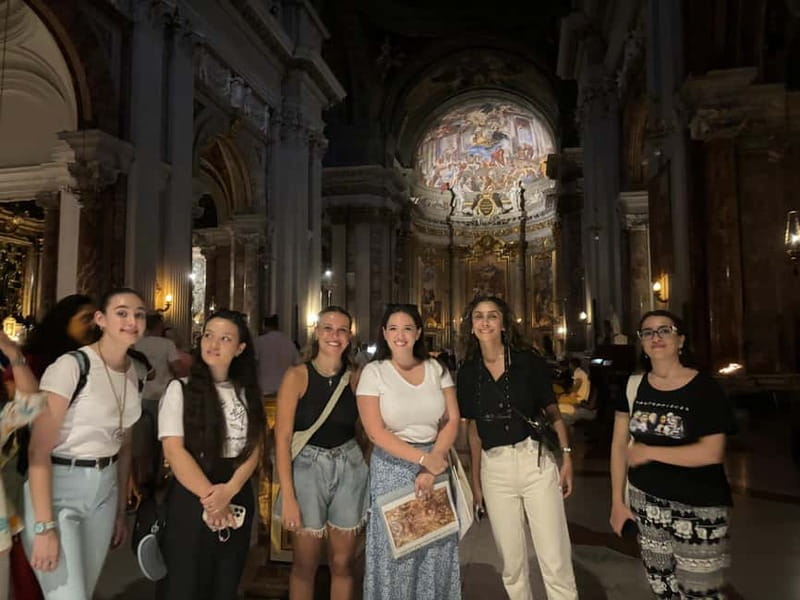
St. Ignazio di Loyola Church is one of the most memorable stops because it offers a surprise inside an otherwise traditional church visit. The ceiling uses trompe-l’œil painting to create the appearance of architectural depth, making a flat surface seem to open upward.
This is often called the Instagram Roman Church, but the nickname should not distract from the real reason to visit. The optical illusion is a clever piece of art and perspective. Soft evening light can make the effect even more striking.
Look carefully before taking your picture. The illusion depends on how the painted lines, figures, and false architecture work together. A good guide can explain what you are seeing instead of leaving you with a quick photo and no context.
Flash photography is not allowed in certain areas, so bring your camera but keep the flash off. Lighting and opening conditions can change, and the tour details do not promise a private or extended church visit. Still, this stop adds variety to the route and gives you something beyond Rome’s usual headline monuments.
Galleria Sciarra and an Art Nouveau pause
Galleria Sciarra offers a change of mood. Instead of ancient stone or vast Baroque space, you see an enclosed passage decorated with intricate frescoes and Art Nouveau details.
It is the sort of place many people walk past without realizing they are near anything special. The evening glow can bring out the colors and patterns, though the exact lighting may vary.
This stop works well in the middle of the walk because it gives your eyes a break from huge monuments. You move from public grandeur to a more intimate setting, where decoration and design matter more than size.
Do not expect a large museum or a long indoor visit. The appeal is the brief encounter with a richly decorated passage that helps you see how many different periods sit close together in Rome.
Vicus Caprarius, Rome’s underground water world
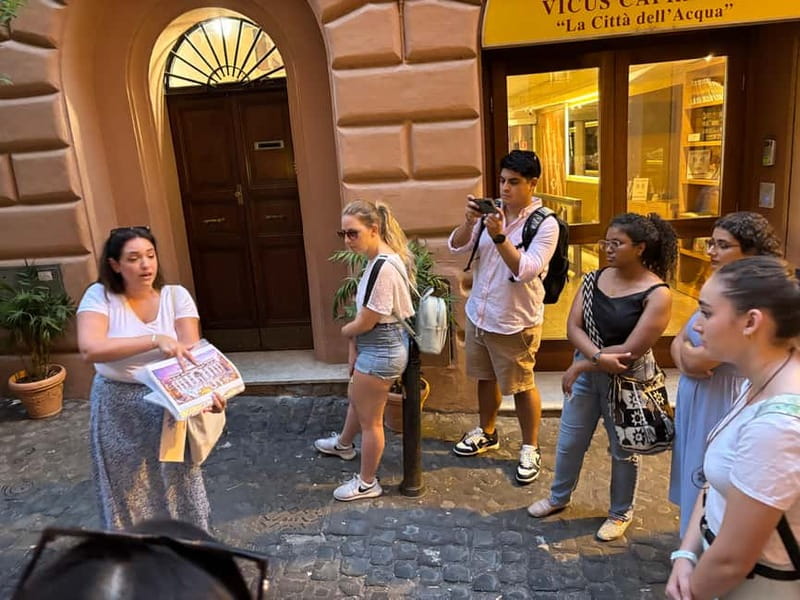
Vicus Caprarius, also called the City of Water, takes the tour below the level of modern Rome. The remains offer a look at ancient structures and the water systems that still shape the city’s story.
This stop is important because Rome’s past is not only visible in temples, columns, and triumphal monuments. It also survives beneath streets and buildings. The underground setting gives you a more physical sense of the city’s layers.
Entrance fees to attractions are not included. If the tour enters the site, you should confirm how admission is handled and whether a separate ticket is required. The supplied details list Vicus Caprarius as part of the experience, but they do not state that an entry fee is covered.
For anyone interested in archaeology, this may be one of the most rewarding parts of the route. For someone who prefers a simple outdoor walk, it may feel like a more involved stop. Either way, it breaks up the usual procession of piazzas and fountains.
Trevi Fountain and the familiar coin ritual
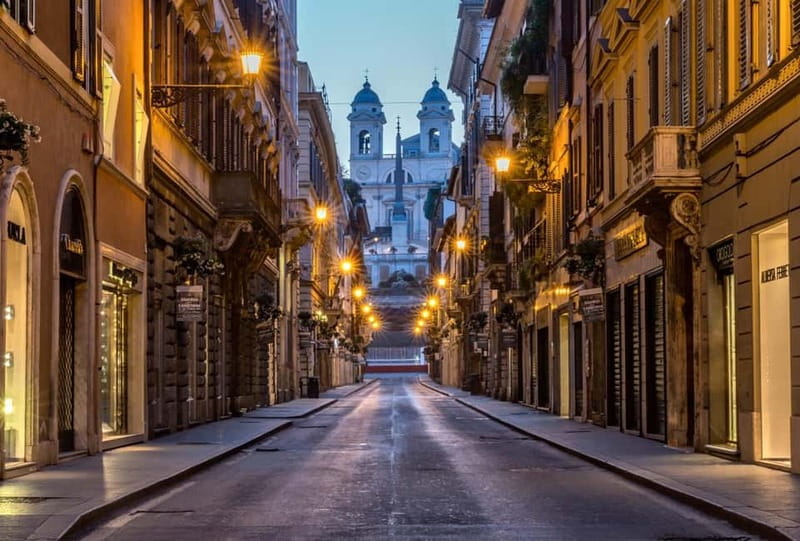
Trevi Fountain is at its most theatrical at night. Water, stone, and lighting combine to make the fountain feel almost larger than the surrounding streets.
The standard coin toss is part of the experience. Tossing a coin into the fountain is meant to ensure your return to Rome, and it is a simple bit of tradition that fits the mood of the evening.
Do not confuse this stop with a quiet private moment. Trevi is one of Rome’s best-known sights, and the area can be crowded. Your guide can help you understand the fountain’s design and symbolism, but you may have limited time to linger in the best photo position.
Keep your belongings secure and avoid blocking the narrow edges around the fountain. The tour is about seeing the monument and learning its story, not about having the place to yourself.
Piazza Venezia, columns, and the city’s political center
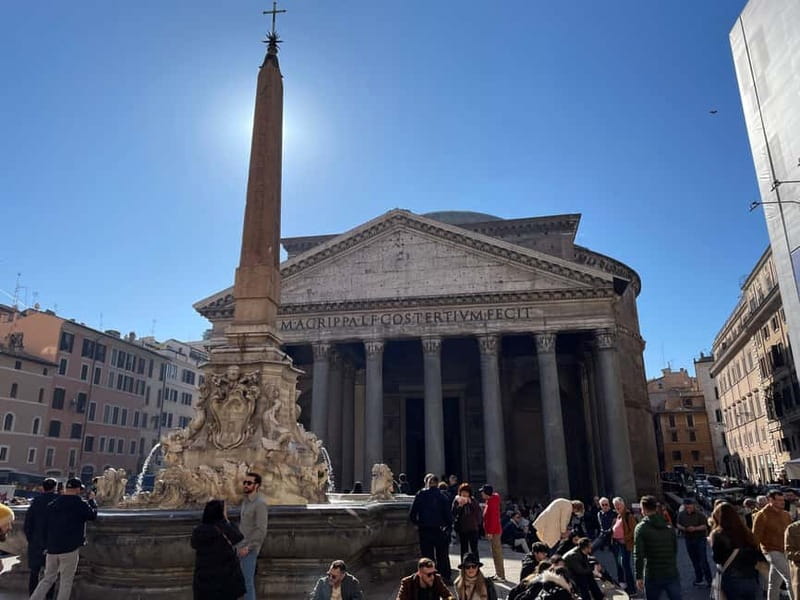
The walk continues toward Piazza Venezia, where Rome’s political and civic history comes into view. Palazzo Venezia and Palazzo delle Assicurazioni Generali frame the area, while the Vittoriano Monument adds a huge white presence above the square.
You will also see Trajan’s Column and Trajan’s Market. The column is especially useful for understanding how ancient Rome told stories in stone. Its carved surface was designed to be read from below, though the details are difficult to see without help.
This part of the route can feel grand and busy compared with the quieter opening at Sant’Agostino. That contrast is useful. Rome is not one consistent style. It is a city where ancient monuments, Baroque churches, nineteenth-century civic buildings, and modern traffic all occupy the same few blocks.
The Vittoriano area also gives you a chance to look across Rome’s illuminated skyline. The view is not described as a separate rooftop visit, so think of it as a street-level and piazza-based viewpoint rather than a formal panoramic attraction.
Palazzo Bonaparte and the road toward the Colosseum
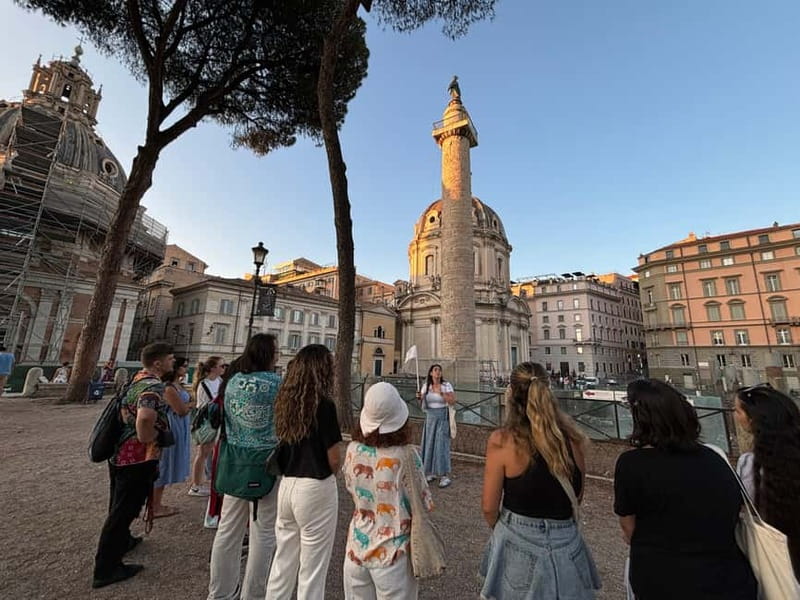
Palazzo Bonaparte adds another historic façade to the route before the walk turns toward the ancient center. Its Baroque character fits the changing architectural story of the evening.
From there, the route reaches Via dei Fori Imperiali. This broad avenue provides a dramatic approach to the ancient Roman forums. At night, the ruins can look especially striking, with broken columns and walls picked out against the darkness.
The walk is not just about reaching the Colosseum. The approach matters. Moving along Via dei Fori Imperiali lets you see the ancient remains as part of a larger urban setting, rather than as an isolated monument viewed from a single photo stop.
You should expect walking on uneven or hard urban surfaces. The activity is specifically not suitable for wheelchair users or people with mobility impairments. Even if you normally walk well, wear shoes with solid support.
Finishing beneath the Colosseum
The Colosseum is the natural climax of the route. Its size becomes more impressive at night, when the surrounding area is quieter in appearance and the illuminated arches draw your attention upward.
This is an exterior visit. Entrance fees are not included, and the tour information does not promise admission inside the Colosseum. If you want to explore the arena and underground levels, you will need a separate ticket and a different plan.
As a final stop, the Colosseum gives the evening a clear sense of arrival. You have moved from Renaissance Rome through Baroque Rome and into the ancient world. That progression is one of the tour’s best features.
The end-of-tour details need a quick check. The route description finishes at the Colosseum, while the activity information says the tour ends back at the meeting point. Since meeting points can vary by option, confirm the precise ending location before you rely on the walk for your next connection.
What $32 gets you
At $32 per person, the tour is priced as an affordable guided orientation to central Rome. You are paying for a professional guide, a planned route, and live explanations in English or Spanish. You are not paying for meals, drinks, hotel transport, or attraction admission.
I think the value is strongest if you are new to Rome, short on time, or want a well-organized evening introduction. A guide can connect the Pantheon, Trevi Fountain, Trajan’s Column, and the Colosseum in a way that is harder to achieve by wandering alone.
The value is weaker if you already know central Rome well or want long, detailed visits inside museums and churches. This is a broad walking tour, not a specialist archaeology tour and not a ticketed monument package.
Free cancellation up to 24 hours before the activity and the reserve-now, pay-later option make the booking fairly flexible. Those terms are useful in Rome, where weather, fatigue, and changing plans can affect an evening.
Who will enjoy this walk most
I would choose this tour if you want to see many major sights in one evening and prefer explanation over simply following a map. It also suits solo visitors. One person specifically found it a good fit for single travelers who enjoy walking, and the guided structure can make a first night in Rome feel easier.
It is also a smart summer option. The cooler evening hours can make a long route more comfortable than the same walk in midday heat.
You should think twice if you have limited mobility, use a wheelchair, or dislike sustained walking. The route covers a large section of the historic center, and the advertised two hours may stretch longer.
The tour is available in English and Spanish. Guides such as Sara have been praised for friendly, engaging delivery, with clear explanations that keep the history moving rather than turning the walk into a lecture.
Practical advice before you go
Wear comfortable shoes. This is the single most important preparation, since the tour links many parts of central Rome on foot.
Bring water and a camera. Food and drinks are not included, and the route may run beyond the advertised two hours. Pack lightly so you can move easily through busy streets and crowded piazzas.
Keep your flash off. Flash photography is not allowed in certain areas, particularly relevant when you visit churches or decorated interiors.
Check your starting point carefully because it may vary by option. Also confirm where the walk finishes, especially if the Colosseum is your expected endpoint.
The overall rating is 4.1 from 30 ratings, with especially strong praise for guide quality, organization, and the atmosphere of Rome at night. That pattern fits the tour’s real strength: the route is broad, the setting is beautiful, and a good guide makes the connections memorable.
Should you book Via Roma?
Book it if you want a lively, evening overview of Rome’s historic center for $32, with famous sights, unusual stops, and a guide to tie them together. The combination of Piazza Navona, St. Ignazio, Vicus Caprarius, Trevi Fountain, Piazza Venezia, and the Colosseum gives you more variety than a simple fountain walk.
Skip it if you need wheelchair access, dislike long walks, or want guaranteed entry into the Pantheon, Colosseum, or other attractions. For everyone else, this is a practical first-night tour, especially in summer, when Rome’s monuments look good and the cooler hours make the walking easier.
FAQ
How long does the tour last?
The stated duration is two hours. One reported experience lasted about two and a half hours, so allow extra time rather than scheduling a tight dinner or appointment afterward.
What languages are available?
The live guide is available in English and Spanish.
Where does the tour start?
The starting meeting point may vary depending on the booking option. Check the details for your selected option before setting out.
Where does the tour end?
The activity information says it ends back at the meeting point, while the route description presents the Colosseum as the final sight. Confirm the exact ending point for your booking.
Is hotel pickup included?
No. Hotel pickup and drop-off are not included.
Are entrance fees included?
No. Entrance fees to attractions are not included in the $32 price.
Is the tour suitable for wheelchair users?
No. The activity is not suitable for wheelchair users or people with mobility impairments.
What should I bring?
Bring comfortable walking shoes, water, and a camera. Flash photography is not allowed in certain areas, and food and drinks are not included.
Newest Rome tours we have reviewed
- Private TikTok Video Making in Rome★ 5.0 · 7 reviews
- Assisi, Orvieto and Civita di Bagnoregio Full Day Tour from Rome★ 4.5 · 45 reviews
- Assisi & Saint Francis Path Tour from Rome★ 5.0 · 45 reviews
- Assisi and Cascia Private Day Tour from Rome with Lunch★ 5.0 · 10 reviews
- Art Class in the center of Rome!★ 4.0 · 4 reviews
- Art & Craft: Beer Tour with Street Art in Rome★ 4.5 · 6 reviews
- Arrival in Rome: Airport Transfer & Exclusive City Introduction★ 5.0 · 3 reviews
- From Rome: Private Day-Tour of Tuscany★ 5.0 · 16 reviews