
Reviewed · APPIAN WAY AND AQUEDUCTS TOURS
Ancient Appian Way PRIVATE Bike Tour
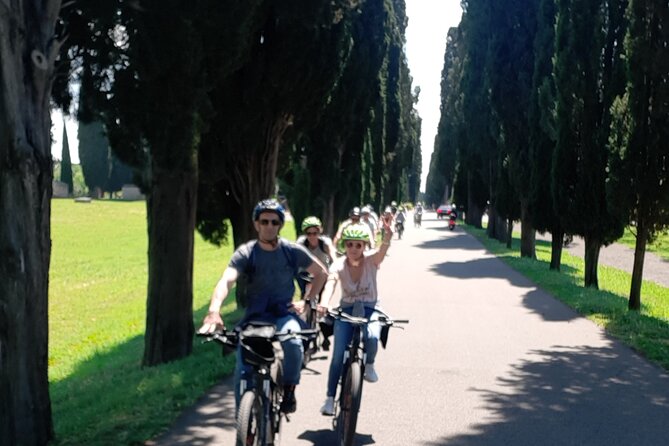
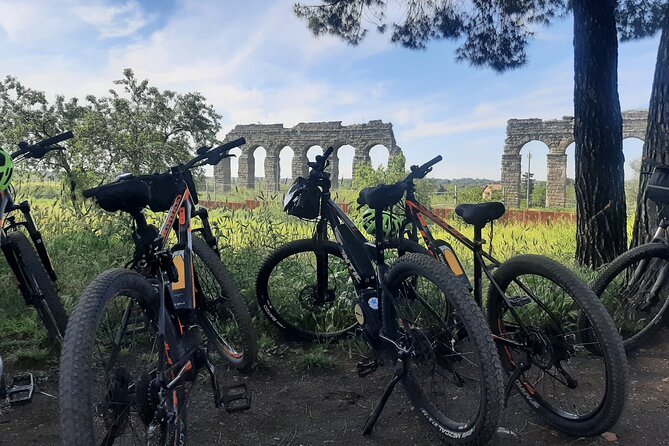
Rome’s ancient Appian Way is where the city suddenly opens into fields, stone roads, aqueducts, and Roman ruins. This private four-hour e-bike ride covers far more ground than you could manage on foot, from Porta San Sebastiano to the Circus of Maxentius and the Baths of Caracalla.
I like the quiet green setting and the chance to see Roman engineering up close, especially the long aqueducts in Aqueduct Park. I also like the private format: guides such as Valerio, Sara, Claudio, Nico, and Marco can adjust the pace and explain the ruins without herding you through a large group.
The catch is city traffic. About 20 percent of the ride may be on streets with Roman drivers, and the e-bikes require active pedaling. You need to ride a bicycle well and feel comfortable on cobblestones, park paths, and roads.
Key points to know before you ride
- You cover about 14 miles in four hours: The e-bike makes a long route manageable, but this is still an active outing.
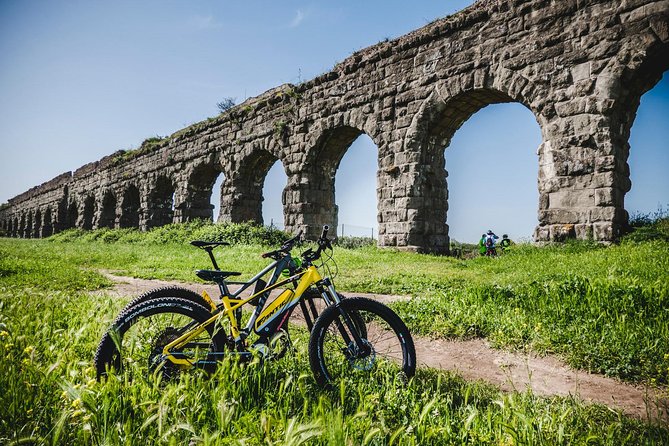
- The ancient aqueducts are the star: Aqueduct Park gives you some of Rome’s most striking views, with sections still in use.
- The tour is private: Your group rides alone with the guide, allowing room for questions, breaks, and a flexible pace.
- City traffic is part of the deal: Expect roughly one-fifth of the ride on public roads, including streets with heavy traffic.
- Families have useful options: Child seats are available up to 25 kilograms, and children ages 6 to 10 may use a trailer bike if under 143 centimeters tall.
- The bikes are pedal assist, not electric scooters: There is no throttle, so you still do a fair amount of pedaling.
Why the Appian Way works so well by e-bike
Rome’s historic center is packed with famous sights, but the Appian Way offers a very different day. Instead of moving from one crowded monument to another, you follow an ancient route through open parkland and scattered ruins.
Walking the full route would take too long, and a car would put you behind glass. The e-bike gives you both reach and fresh air. You can cover the distance to Aqueduct Park, see the major sites, and still stop often enough to hear the stories behind them.
The route is also varied. You may ride through city streets, over old cobbles, along park paths, and beside ancient stonework. That variety is part of the appeal, though it also means you should not expect a smooth recreational bike path from start to finish.
The tour begins at Via dei SS. Quattro, 58, in central Rome, and returns to the same meeting point. The supplied equipment includes a high-quality e-bike, helmet, mobile phone holder, and handlebar holder. Those small fittings matter on a four-hour ride, especially if you want to keep your phone handy for navigation or photographs.
More Appian Way and aqueduct tours:
- Rome EBike Tour: Appian Way, Catacombs & Roman Aqueducts
★ 5.0 · 1,766 reviews - Rome: Appian Way, Catacombs, & Roman Aqueducts E-bike Tour
★ 4.9 · 1,421 reviews - Rome:Appian Way E-bike Tour with Catacombs, Aqueducts & Food
★ 4.9 · 1,210 reviews
Porta San Sebastiano, Rome’s old southern gate
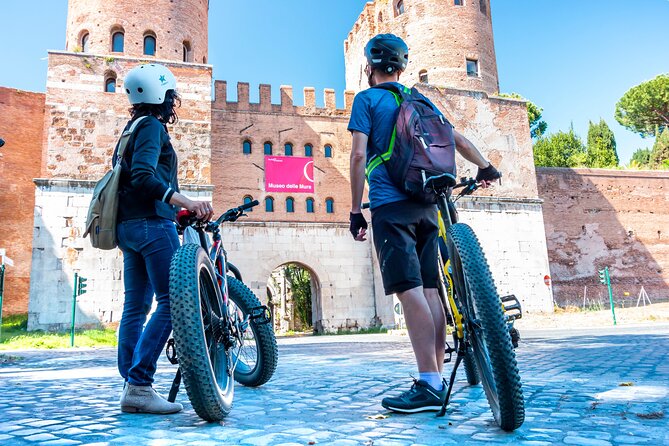
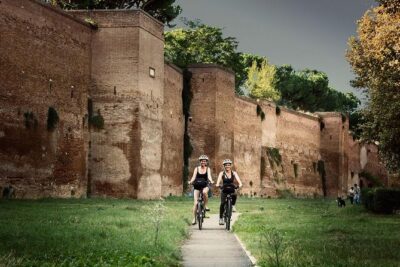
The first stop is Porta San Sebastiano, an imposing gateway in the Aurelian Walls. Built around 275 AD, the gate marks the start of the historic Via Appia Antica.
This is a good introduction because you see the Appian Way not as an isolated country road, but as a route that once began at the edge of imperial Rome. Medieval graffiti on the gate recalls the pilgrims who passed through over many centuries.
You spend about 20 minutes here. Admission is included at no extra charge, and the stop gives your guide a chance to set the historical scene before the ride moves into greener surroundings.
Caffarella Park and the Ninfeo di Egeria
Caffarella Park is one of the largest green areas in Rome and part of the Appia Antica Regional Park. Its paths and groves contain remains of ancient buildings, but the main pleasure is the sudden change in atmosphere.
This is one of the places where you’ll understand why a bike is useful. You can move through a broad area that would be tiring to cross on foot, while still slowing down for archaeological remains and stories.
The stop at the Ninfeo di Egeria adds a touch of legend. According to the Roman story, the nymph Egeria loved Numa Pompilius, Rome’s second king. When she learned of his death, her tears formed a spring. The site combines a natural water source with one of Rome’s old foundation stories.
You spend around 20 minutes at each stop. That is enough for an explanation and a look around, though anyone hoping for long archaeological visits should know that the tour is designed as a moving overview rather than a series of extended museum stops.
Aqueduct Park, the visual high point
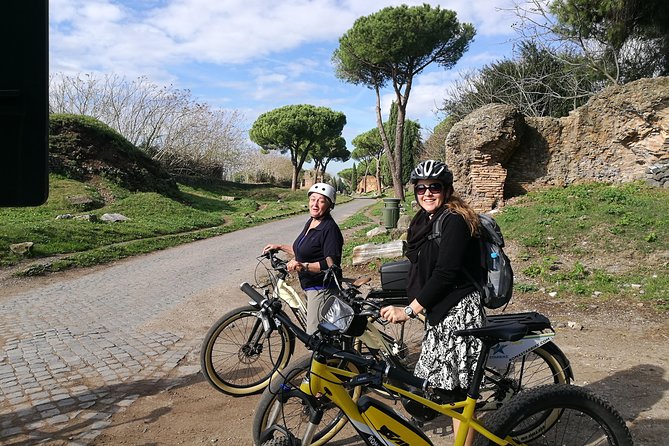
Aqueduct Park is likely to be the most memorable part of the route. This large open area was crossed by the Via Latina, described in the tour information as Rome’s oldest road, and it became a major meeting point for the city’s ancient water network.
The surviving aqueducts show the scale and confidence of Roman engineering. Their arches stretch across the open space, creating the kind of view that is difficult to grasp from a history book or a crowded city street.
One especially interesting detail is that some aqueduct structures are still functioning. You are not only looking at dead ruins. You are seeing parts of a water system that has continued to matter long after the emperors who built it disappeared.
Several people who took this ride found the aqueducts to be the highlight, especially because the area can feel remarkably empty compared with central Rome. You may find this the best place for photographs, but keep your attention on the guide too. The value here is not just the view. It is understanding how the water reached the city and why the system required such massive construction.
More e-bike tours in Rome:
- Rome: Top Highlights & Hidden Gems Tour by Cannondale E-Bike
★ 4.9 · 1,760 reviews - Rome City Small Group Bike Tour with quality Cannondale EBike
★ 5.0 · 1,380 reviews - Rome by Night – Ebike Small Group Tour – Food and Wine (Option)
★ 5.0 · 1,275 reviews - Rome: E-Bike Night Tour with Food and Wine Tasting
★ 4.9 · 1,131 reviews
Villa dei Quintili and Santa Maria Nova
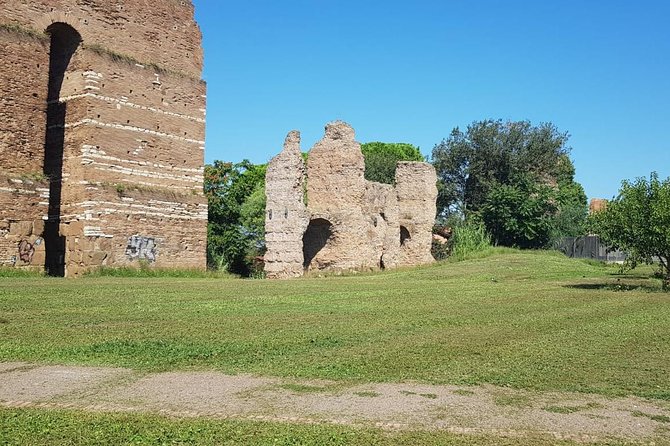
At the fifth mile of the Appian Way, you reach the remains of Villa dei Quintili. The villa belonged to the brothers Sextus Quintilius Condianus and Maximus Valerius, consuls in the second century AD.
Their wealth brought them a grand country residence, but imperial politics changed their fortunes. Emperor Commodus had the brothers killed and confiscated the property, turning the villa into imperial land.
That story helps make the ruins easier to read. You are not just looking at walls and foundations. You are seeing the remains of a luxurious estate shaped by the power struggles of Roman rulers.
The tour allows about 20 minutes here. You’ll get an overview rather than a full archaeological visit, but the stop adds a strong human and political angle to the route.
Cecilia Metella and the Caetani complex
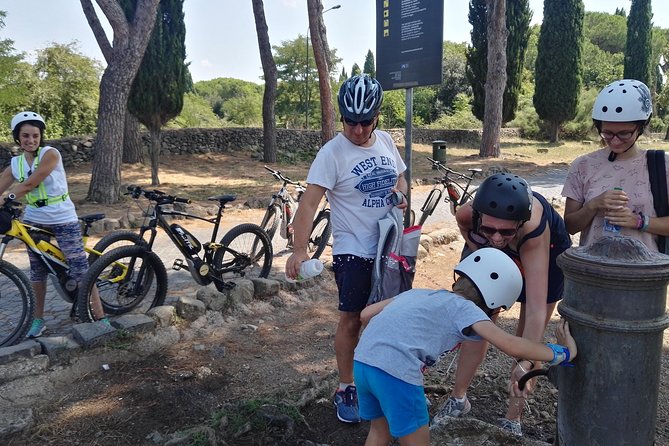
The Mausoleum of Cecilia Metella is one of the best-preserved tombs on the Appian Way. It dates to the first century BC and was built as a pagan tomb for Cecilia Metella.
Its later use gives the site another layer. The tomb was incorporated into the medieval Castrum Caetani, a fortified complex associated with the wealthy Caetani family. Nearby are the remains of their medieval house and the perimeter walls of the church of San Nicola.
This stop shows how the Appian Way kept changing long after ancient Rome. A Roman tomb became part of a medieval stronghold, and the road continued to serve people in different eras.
The site is visually strong, but the short stop means you should listen closely to your guide. A private guide can explain the Roman and medieval parts in one connected story, rather than leaving you to guess why different periods appear side by side.
The Circus of Maxentius and its lost obelisk
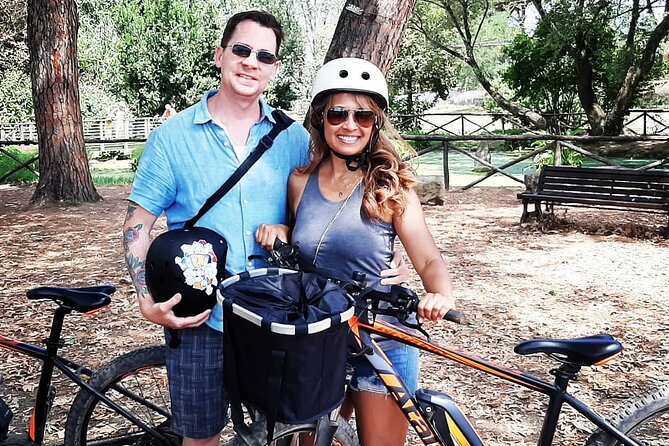
The Circus of Maxentius is considered the best-preserved Roman circus of its kind. You can still see the central spine, known as the spina, that once divided the racing track.
The circus originally held an obelisk on that central line. During the Renaissance, the obelisk was moved to Piazza Navona, where it now forms part of the Fountain of the Four Rivers.
That connection is useful if you have already seen Piazza Navona. The familiar fountain in the city center is linked to a much older sporting complex on the Appian Way.
This stop is another 20-minute look at a large site. You are likely to get a better sense of Roman public entertainment here than from a small fragment in the center, since the shape of the circus remains easy to imagine.
Returning to the Baths of Caracalla
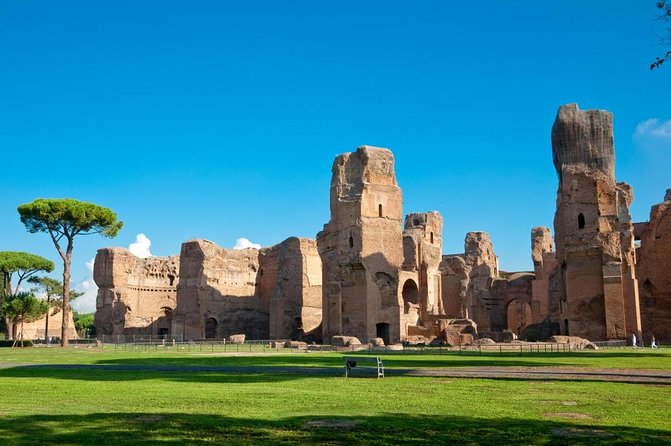
The final listed stop is the Baths of Caracalla, built by the emperor of the same name. For roughly a century, they were the largest public baths in the Roman world.
Much of the structure still survives, including the enormous walls that convey the scale of the complex. A branch of the Aqua Marcia supplied water through the Antoninian aqueduct, connecting the baths to the water system you saw earlier.
The stop creates a useful ending because it brings together two major themes of the ride: Roman public life and Roman engineering. The aqueducts moved water across the countryside, and the baths turned that supply into a huge social complex.
Small remains of the water system can also be seen at Porta San Sebastiano, linking the final stop back to the start. The activity ends at the original meeting point, so you do not need to arrange a separate return from the far side of Rome.
What the private format really adds
A private tour is more than a smaller group. It gives you a better chance to control the rhythm of a physically active day.
If you want more explanation at the aqueducts, you can ask. If your children need a short pause, the guide can adapt. If your group already knows Roman history, you can focus on engineering, politics, or daily life instead of hearing a fixed speech meant for everyone.
The guides praised most strongly in the supplied feedback include Chris, Alex, Iman, Valerio, Nico, Claudio, Sara, Sarah, and Marco. Valerio was especially appreciated for helping with bike fitting and for combining patience with detailed Roman history. Nico’s background in ancient Greek, Latin, and ancient history made the stories especially lively. Sara was praised for showing parts of Rome that would be easy to miss without a guide.
Guide quality can vary from person to person, but this experience gives the guide room to matter. You are not simply following a route with an audio track.
Families and the physical side of the ride
The tour is a good family option, provided everyone understands the cycling requirement. Child seats are available for children up to 25 kilograms. A child discount for ages 6 to 10 applies only when the child is under 143 centimeters tall, because the child uses a trailer bike rather than riding a bike alone.
One family covered about 14 miles with four children, ages 11, 9, 7, and 5, and found the route manageable. That does not mean every family will find it easy. The children must be comfortable on a long outing, and the adults need to feel in control around traffic and on uneven surfaces.
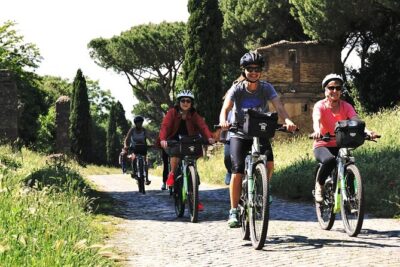
The e-bikes provide pedal assistance, but they do not have a throttle. You still need to pedal, especially on a route that includes roads, cobbles, and off-road paths. If you rarely ride a bicycle, this is not the place to learn.
The tour information calls for moderate physical fitness and says you must know how to ride a bike well. Take that seriously. The ride is not an extreme athletic challenge, but it is active and lasts about four hours.
Traffic, weather, and what to bring
The most important practical warning is city traffic. One account estimates that around 20 percent of the ride takes place in traffic. You may share the road with impatient Roman drivers, and that can make the opening or return portion less relaxing than the park sections.
A guide helps you navigate, but a guide cannot remove the traffic. If cars make you nervous on a bicycle, this may not be your ideal Rome activity. If you ride regularly and can stay alert, the traffic is a manageable tradeoff for reaching the Appian Way efficiently.
Hot weather can also change the experience. One ride took place on a very hot day, yet the group still enjoyed it. Bring water, wear practical clothing, and expect sun exposure in the open park areas. The supplied equipment includes helmets, but the information does not list water, food, or weather gear, so plan those needs yourself.
Is $147.54 per person good value?
At $147.54 per person, this is not the cheapest way to see Roman ruins. It is also not simply a bike rental. The price covers a private guide, a high-quality e-bike, safety equipment, a long route, and access to an area that is difficult to cover efficiently on foot.
The value is strongest for a pair, family, or small private group that wants history and scenery in the same half-day. You can see gates, parks, springs, aqueducts, villas, tombs, a circus, and imperial baths without arranging multiple taxis or public transport connections.
The price is less attractive if you only want a short, easy ride or if your main interest is entering archaeological sites for long periods. The route gives you about 20 minutes at each listed stop, so it favors breadth and movement over extended indoor visits.
The tour is recommended by 99 percent of participants and carries a 5 rating from 89 reviews. Those figures suggest strong satisfaction, but the practical details matter more for your decision: bike confidently, accept some road traffic, and value a private guide.
Should you book the Appian Way bike tour?
Book it if you have already seen some of central Rome and want a different side of the city. Book it if aqueducts, Roman engineering, and open parkland appeal to you more than another crowded piazza. Families with older children can also get a great deal from the private format and flexible pace.
Think twice if you are uncomfortable in traffic, cannot pedal for several hours, or want a slow visit inside each archaeological site. This is an active sightseeing route with frequent stops, not a relaxed electric vehicle tour.
For most confident cyclists, I think the combination is excellent: a capable e-bike, a private guide, ancient roads, and some of the most striking Roman remains outside the center. The aqueducts alone can justify the outing, while the Appian Way and Cecilia Metella give the ride a strong sense of place.
FAQ
How long is the Ancient Appian Way private bike tour?
The tour lasts approximately four hours.
How much does the tour cost?
The listed price is $147.54 per person.
Where does the tour start and finish?
It starts at Via dei SS. Quattro, 58, 00184 Rome, Italy, and ends back at the same meeting point.
Is the tour private?
Yes. Only your group participates in the private activity.
What equipment is included?
The tour includes a high-quality e-bike, helmet, mobile phone holder, and handlebar holder.
Can children join the tour?
Yes. Child seats are available for children up to 25 kilograms. The child discount for ages 6 to 10 applies only to children under 143 centimeters tall, because they use a trailer bike rather than riding a bike alone.
Do I need to be an experienced cyclist?
You must know how to ride a bike well. The tour requires moderate physical fitness, includes some city traffic, and uses pedal-assist e-bikes that still require active pedaling.
Newest Rome tours we have reviewed
- Private TikTok Video Making in Rome★ 5.0 · 7 reviews
- Assisi, Orvieto and Civita di Bagnoregio Full Day Tour from Rome★ 4.5 · 45 reviews
- Assisi & Saint Francis Path Tour from Rome★ 5.0 · 45 reviews
- Assisi and Cascia Private Day Tour from Rome with Lunch★ 5.0 · 10 reviews
- Art Class in the center of Rome!★ 4.0 · 4 reviews
- Art & Craft: Beer Tour with Street Art in Rome★ 4.5 · 6 reviews
- Arrival in Rome: Airport Transfer & Exclusive City Introduction★ 5.0 · 3 reviews
- From Rome: Private Day-Tour of Tuscany★ 5.0 · 16 reviews
Appian Way and Aqueducts Tours, compared.
Rome EBike Tour: Appian Way, Catacombs & Roman Aqueducts
Read our review →
Appian Way, Catacombs, & Roman Aqueducts E-bike Tour
Read our review →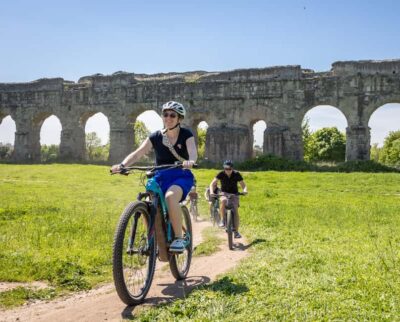
Appian Way E-bike Tour with Catacombs, Aqueducts & Food
Read our review →
Rome Underground: Catacombs Tour, Aqueducts and Appian Way
Read our review →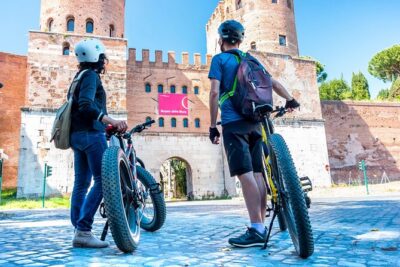
Appian Way Aqueducts Bike Tour (Catacombs & Lunch Option)
Read our review →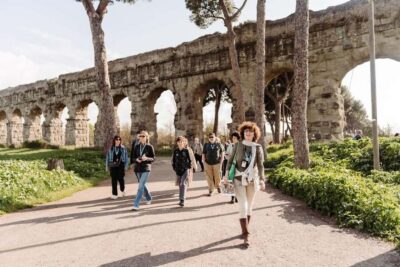
Appian Way, Catacombs and Aqueducts Park Tour with Top E-Bike
Read our review →
Appian Way E-Bike Tour Catacombs, Aqueducts & Picnic
Read our review →Browse the lists this tour appears in