
Reviewed · APPIAN WAY AND AQUEDUCTS TOURS
Appian Way Bike tour Underground with Catacombs & Lunch
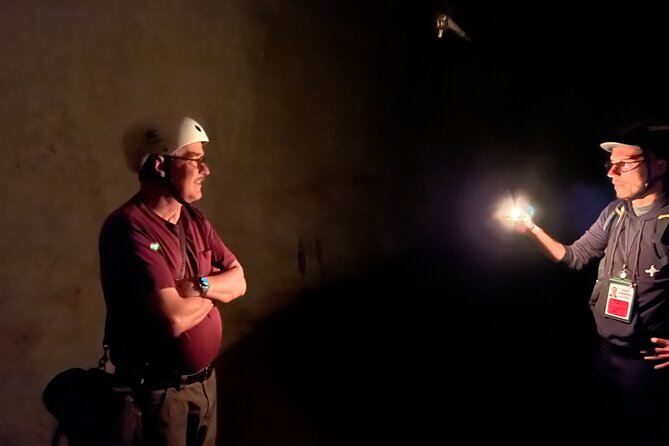
The most unusual part of this Rome tour comes underground. After riding the ancient Appian Way, you descend about 40 feet into old Roman quarry tunnels, spaces later used as air-raid shelters. You also visit the Catacombs of St. Callixtus, then pedal through ruins and open parkland far from the usual city-center circuit.
I like the small group, limited to 10 people, and the way an e-bike makes a long route possible without turning the day into a five-hour workout. I also like the mix of famous sights, such as Cecilia Metella’s tomb, and odd, lesser-known stops, such as the Ninfeo di Egeria.
The catch is the riding. You must know how to ride a bicycle well. Expect rough cobblestones, rocky paths, narrow tracks, and stretches of city traffic. The route can also change because of road closures or public events, and the advertised wine or aperitif may not always be offered.
Key points to know before you book
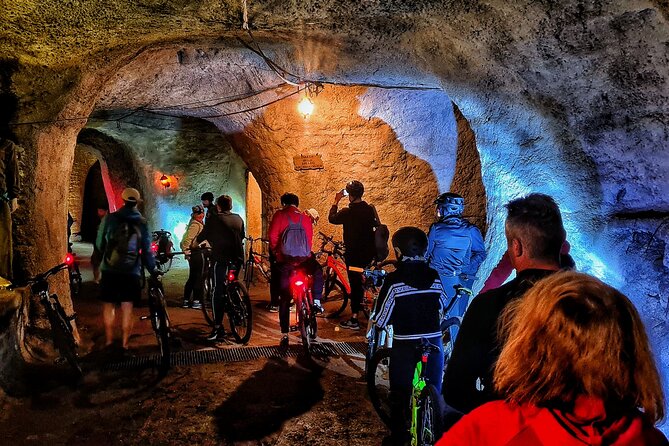
- The underground quarry is the tour’s most unusual feature: You ride or walk through tunnels about 40 feet below ground, with an intriguing link to ancient catacombs and wartime shelters.
- The route is active, not leisurely: Cobblestones and dirt paths can be hard going, even with electric assistance.
- The group stays small: A maximum of 10 people gives guides such as Veronica, Filippo, Lorenzo, and Flavio room to manage the pace and safety.
- Lunch is included: You stop at a local restaurant in the Appian Way area, though wine or an aperitif should not be treated as guaranteed.
- You leave central Rome behind: The ride reaches ancient roads, Roman ruins, meadows, aqueducts, and quiet stretches of the Appian Way Regional Park.
- The price reflects a full half-day: At $107.41 per person, you are paying for the bike, guide, catacomb entry, underground visit, lunch, and a five-hour route.
Why the Appian Way works so well by e-bike
Rome is easy to admire from a sidewalk, but the Appian Way asks you to move through it differently. This ancient road runs out from the city through archaeological parkland, where broken paving stones, tombs, churches, villas, and aqueducts appear among grass and trees.
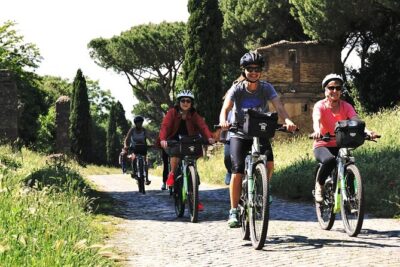
An e-bike is useful here because the route covers a lot of ground. You can reach several separate archaeological sites without spending the day waiting for buses or walking between them. The electric motor also helps on longer stretches, though it does not smooth out rough stones.
The bikes are described as easy to operate, and the shop allows time for fitting and practice. That matters if you have never used an e-bike. Still, electric assistance cannot replace basic bike control. You need to handle uneven surfaces, narrow paths, turns, and traffic.
The guides receive especially strong praise for safety and flexibility. Veronica is noted for keeping a steady pace and checking that everyone is comfortable. Filippo is described as careful and well informed, while Lorenzo encouraged riders to walk sections that felt too rough. Alessandro, Flavio, Elena, Ilenia, and others have also been praised for clear explanations and friendly direction.
More Appian Way and aqueduct tours:
- Rome EBike Tour: Appian Way, Catacombs & Roman Aqueducts
★ 5.0 · 1,766 reviews - Rome: Appian Way, Catacombs, & Roman Aqueducts E-bike Tour
★ 4.9 · 1,421 reviews - Rome:Appian Way E-bike Tour with Catacombs, Aqueducts & Food
★ 4.9 · 1,210 reviews
Porta San Sebastiano begins the story
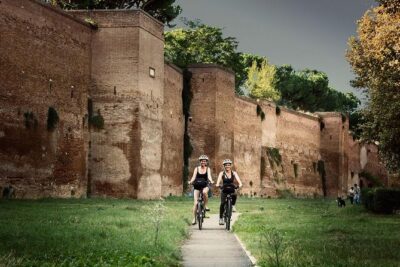
The meeting point is Roma STARBIKE on Via dei SS. Quattro, 58. From there, the tour heads toward Porta San Sebastiano, one of the great southern gates in Rome’s Aurelian Walls.
The gate dates from around AD 275 and marks the beginning of the historic Via Appia Antica. The short stop gives you a useful sense of transition. Modern Rome is behind you, and the old road is about to take over.
Look for medieval graffiti on the stonework. These marks help show how many pilgrims passed through over the centuries. The stop lasts about 20 minutes and costs nothing extra.
This is also where the guide’s role matters. The opening streets require attention, and the group may encounter traffic. Guides have adjusted the route when marathons or road closures affected the original plan, sometimes riding the route in reverse to keep the day moving.
St. Callixtus Catacombs and Rome’s underground dead
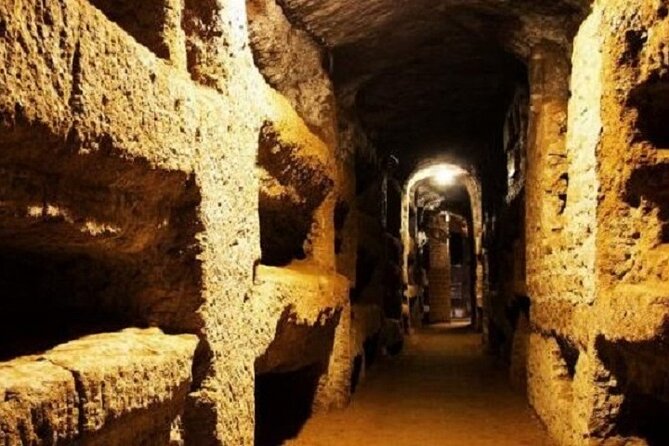
The Catacombs of St. Callixtus are the main formal underground visit. This large Christian cemetery has corridors extending for about 20 kilometers. It takes its name from Callixtus I and contains the burial places of more than 50 martyrs and 16 popes, along with hundreds of thousands of Christians.
The scheduled visit lasts about an hour, including the organized catacomb portion. You should expect a solemn place rather than a theatrical attraction. The value is in seeing how early Christians used the ground outside Rome’s walls for burial and worship.
The catacombs are one of the strongest reasons to choose this tour over a simple city bike ride. You get a place that is hard to fit into a standard Rome walking plan, then continue by bike into the wider archaeological park.
The underground areas can be especially memorable for families with older children, provided everyone is comfortable with enclosed historic spaces. Children from ages 6 to 10 can join only if they are under 143 centimeters tall, because they use a trailer bike rather than riding alone.
Cecilia Metella’s tomb and the Caetani complex
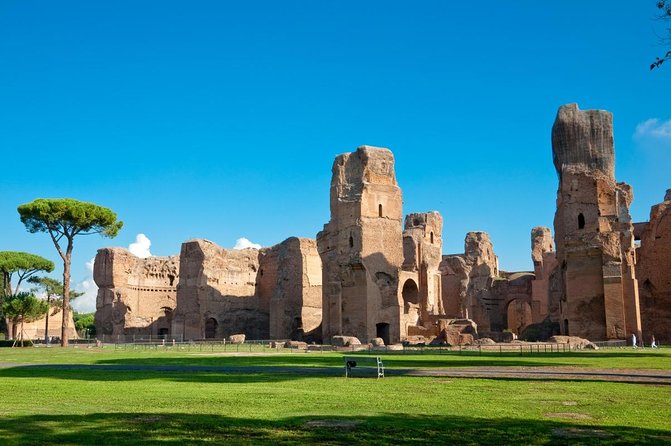
Back above ground, the route reaches the Mausoleum of Cecilia Metella. This large pagan tomb dates from the first century BC and is the best-preserved mausoleum on the Appian Way.
The tomb later became part of the Castrum Caetani, a medieval fortified complex. You can also see remains of the Caetani family’s house and the perimeter walls of the church of San Nicola.
The stop lasts about 20 minutes, which is enough for an explanation and a close look, but not a full archaeological visit. If you want to linger over every stone, this fast-moving tour may feel brisk. Its strength is the range of sites rather than long, museum-style time at one monument.
The contrast here is excellent. A pagan tomb, a medieval fortress, and a church ruin occupy one compact stretch of the ancient road. The Appian Way keeps layering periods on top of one another.
More catacombs tours in Rome:
- Rome: Crypts and Catacombs Underground Tour with Transfers
★ 4.6 · 5,341 reviews - The Original Roman Crypts and Catacombs Tour with Transfers
★ 4.5 · 4,896 reviews - Rome: Catacombs of St. Callixtus Entry Ticket & Guided Tour
★ 4.6 · 3,037 reviews - Rome: Guided Roman Catacombs Tour with Transfers
★ 4.6 · 1,830 reviews
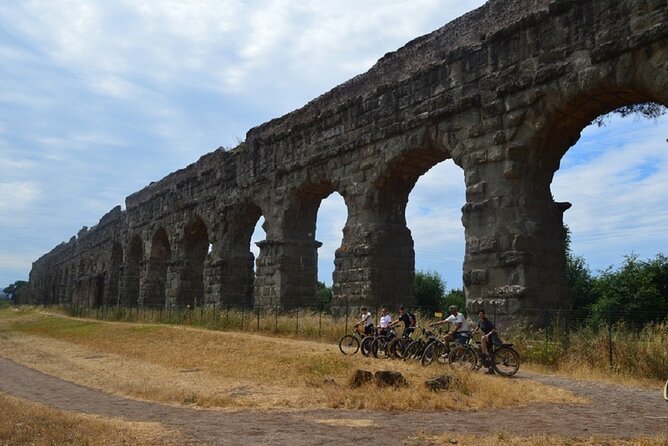
Riding the rough stones of the Appian Way
This is where you should take the practical warnings seriously. Some sections of the Appian Way are paved with uneven ancient cobbles, and other parts use dirt or rocky paths. Riders have described the going as difficult in places, with narrow tracks and brambles close to the route.
A guide may tell you to walk a section. That is sensible, not a failure. The electric bikes are helpful, but they do not make rough paving flat. Worn tires were a concern on one outing, so check your bike before setting off and mention any problem at once.
You also ride on busy Roman streets at points. The guides lead the group through traffic and set the pace, but you remain responsible for controlling your bike. A Saturday morning may bring lighter traffic than other times, though traffic conditions can change.
This is a good ride for an active family with confident cyclists. It is not a good choice if you want smooth paths, a gentle cruise, or a day spent mostly sitting and listening.
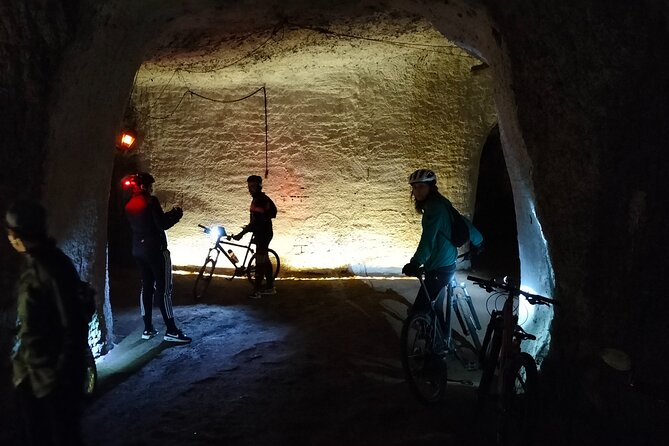
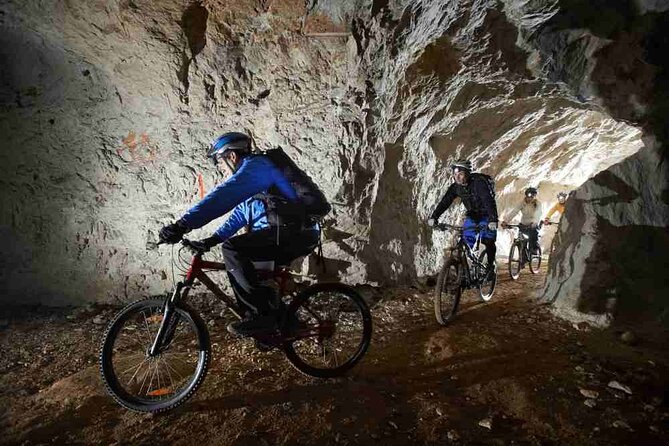
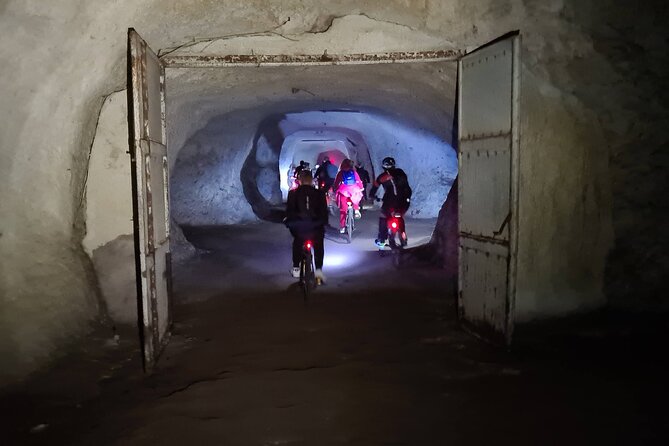
The underground quarry and wartime shelters
The quarry visit gives the tour its oddest turn. You descend about 40 feet into silent tunnels once connected with ancient Roman catacombs. During the Second World War, some of these underground spaces were used as air-raid shelters.
The tour describes this section as a story that has been overlooked for a long time. The setting is atmospheric without needing decoration: rough rock, narrow passages, and the sense that Rome keeps another layer below the one you already know.
Several riders have singled out the cave ride as the high point of the day. In some departures, the group rides through the underground section, while the precise experience can depend on access and conditions. One scheduled visit was affected by a door problem, with the group receiving extra lunch time instead. That is worth keeping in mind if the quarry is your main reason for booking.
The operator also offers a more private cave experience on some arrangements, but the exact format should be confirmed when booking. Do not assume that every departure will include the same depth or route inside the tunnels.
Lunch in the Appian Way park
After the morning’s riding and underground visits, you stop for a Roman lunch at a local restaurant in the Appian Way area. The meal is included, which helps explain the price and saves you from finding food while managing a bike and group schedule.
Lunch also gives you a needed pause. Five hours of riding, even with motor assistance, is not the same as a sightseeing bus tour. You will appreciate a proper sit-down break more than you might expect.
The published experience refers to lunch or an aperitif, and some descriptions mention a glass of wine. Several people were not offered wine, so I would treat the meal as guaranteed and the wine as uncertain. Bring water. Bottles are not consistently supplied, and a few riders were glad they had brought their own.
Villa dei Quintili and Santa Maria Nova
The route continues toward the Villa dei Quintili, at about the fifth mile of the ancient road. The villa belonged to brothers Sesto Quintilio Condiano and Massimo Valerio, Roman consuls in the second century AD.
Their property was confiscated by Emperor Commodus after their deaths and became imperial property. Even from a short stop, the size of the site helps you understand the wealth and power attached to the Appian Way.
The visit lasts about 20 minutes and is mainly an outdoor look at the remains. You will not receive an exhaustive tour of the villa in that time. Instead, the guide adds another piece to the day’s larger picture: the road served soldiers, pilgrims, merchants, aristocrats, and emperors.
The spring of Egeria
The Ninfeo di Egeria offers a quieter story. According to Roman legend, the nymph Egeria loved Numa Pompilius, Rome’s second king. After learning of his death, she wept so intensely that her tears became a spring.
The stop is only about 20 minutes, but it breaks up the ruins with a mythic place tied to water and woodland. It also shows why this route feels different from central Rome. You are not moving from one grand building to the next. You are passing through a wide archaeological area where stories attach to springs, roads, tombs, and fragments of walls.
Aqueducts and open parkland
The final major section reaches the Park of the Aqueducts. Here, nature, art, and Roman engineering share the same space. The group rides through meadows and archaeological remains beneath or near the old water channels.
The aqueducts give you some of the broadest views of the tour. After narrow tunnels and bumpy paving, the open park feels like a release. It is also a good place for photographs, though the tour’s 40-minute schedule means you will keep moving.
This part makes the e-bike especially useful. You see a large section of the Appian Way Regional Park rather than only one monument. The tradeoff is that the day does not allow long, unhurried exploration at every stop.
What the $107.41 price really covers
At $107.41 per person, this is not the cheapest way to see Roman ruins. It is also more than a basic bike rental. The fee covers a guide, e-bike, small-group organization, St. Callixtus Catacombs entry, the underground quarry experience, and lunch.
That is reasonable value if you want several separate sights tied together without arranging transport between them. The route reaches places that are awkward to connect on foot, and a good guide adds context while handling street crossings and route changes.
The value drops if you are not comfortable on rough ground or if you mainly want the catacombs. In that case, a simpler catacomb visit may suit you better. You are paying for movement, scenery, and variety here, not just admission to one underground site.
The tour is usually booked well ahead, with an average booking lead of about 48 days. That suggests planning early, especially if your Rome dates are fixed.
Who should book this ride
I would choose this tour if you want an active half-day outside the standard Rome center and can ride confidently. It suits couples, families with older children, and anyone who enjoys mixing history with a bit of physical effort.
You should be comfortable with city traffic, cobbles, dirt paths, narrow tracks, and the possibility of walking your bike. The maximum weight is 120 kilograms, or 265 pounds. Most people can participate, but the bike requirement is firm.
You may want a different tour if you have balance problems, dislike uneven surfaces, or expect a polished cycling path. Weather can also affect comfort, since wet cobbles and dirt are harder to manage. The tour operates in English, and the guides may adjust the route when public events or road closures interfere.
Free cancellation is available up to 24 hours before the start time. Changes or cancellations inside that window are not accepted for a refund.
Should you book the Appian Way e-bike tour?
Book it if the thought of riding over an ancient Roman road, entering catacombs, and exploring quarry tunnels sounds better than another morning in a museum. The strongest parts are the underground sections, the small group, the mix of ruins and open parkland, and the guides’ careful handling of traffic and changing conditions.
Skip it if you want smooth cycling, guaranteed wine, or long visits at each monument. The route can be rough, the day can change, and the caves are not an absolute certainty if access problems arise.
For a confident cyclist, this is one of the more distinctive ways to see Rome. You get history under your tires, below your feet, and all around you.
FAQ
How long does the Appian Way bike tour last?
The tour lasts approximately five hours and ends back at the Roma STARBIKE meeting point.
Where does the tour begin?
It begins at Roma STARBIKE, Via dei SS. Quattro, 58, 00184 Rome, Italy.
What sights are included?
The route includes Porta San Sebastiano, the Catacombs of St. Callixtus, Cecilia Metella’s mausoleum, the Appian Way, an underground quarry, Villa dei Quintili, the Ninfeo di Egeria, and the Park of the Aqueducts.
Is lunch included?
Yes. A Roman lunch at a local restaurant in the Appian Way area is included.
Is wine included with the meal?
Wine or an aperitif is mentioned in the tour details, but it is not consistently offered. Bring your own water, since bottles are not always provided.
How difficult is the cycling?
You must know how to ride a bike well. The route includes city traffic, uneven cobblestones, rocky dirt paths, and narrow tracks. Guides may suggest walking sections that feel too difficult.
What is the group size?
The tour has a maximum of 10 people.
Can children join the tour?
Children ages 6 to 10 can receive the child reduction only if they are under 143 centimeters tall, because they use a trailer bike rather than riding a bike alone.
More e-bike tours in Rome
- Rome: Top Highlights & Hidden Gems Tour by Cannondale E-Bike
★ 4.9 · 1,760 reviews - Rome City Small Group Bike Tour with quality Cannondale EBike
★ 5.0 · 1,380 reviews - Rome by Night – Ebike Small Group Tour – Food and Wine (Option)
★ 5.0 · 1,275 reviews - Rome: E-Bike Night Tour with Food and Wine Tasting
★ 4.9 · 1,131 reviews
More underground Rome tours
- Colosseum: Underground and Ancient Rome Tour
★ 4.7 · 12,691 reviews - Expert Guided Tour of Colosseum Arena OR Underground, and Forum
★ 4.5 · 5,041 reviews - Rome: Colosseum Underground Small Group Guided Tour
★ 4.7 · 4,844 reviews - Rome: St. Peter’s Basilica, Dome Climb, and Underground Tour
★ 4.8 · 3,404 reviews
Newest Rome tours we have reviewed
- Private TikTok Video Making in Rome★ 5.0 · 7 reviews
- Assisi, Orvieto and Civita di Bagnoregio Full Day Tour from Rome★ 4.5 · 45 reviews
- Assisi & Saint Francis Path Tour from Rome★ 5.0 · 45 reviews
- Assisi and Cascia Private Day Tour from Rome with Lunch★ 5.0 · 10 reviews
- Art Class in the center of Rome!★ 4.0 · 4 reviews
- Art & Craft: Beer Tour with Street Art in Rome★ 4.5 · 6 reviews
- Arrival in Rome: Airport Transfer & Exclusive City Introduction★ 5.0 · 3 reviews
- From Rome: Private Day-Tour of Tuscany★ 5.0 · 16 reviews
Appian Way and Aqueducts Tours, compared.
Rome EBike Tour: Appian Way, Catacombs & Roman Aqueducts
Read our review →
Appian Way, Catacombs, & Roman Aqueducts E-bike Tour
Read our review →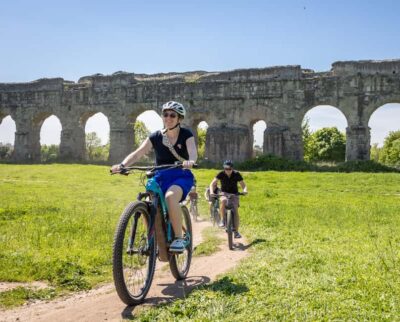
Appian Way E-bike Tour with Catacombs, Aqueducts & Food
Read our review →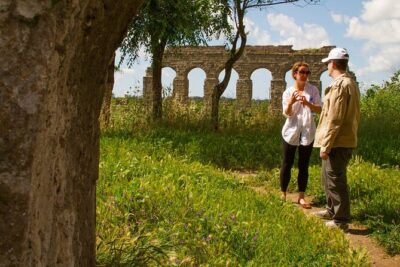
Rome Underground: Catacombs Tour, Aqueducts and Appian Way
Read our review →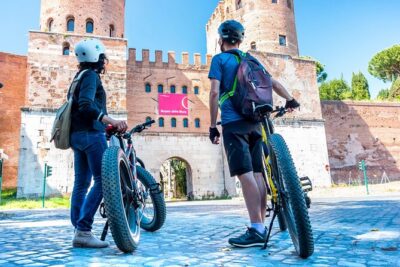
Appian Way Aqueducts Bike Tour (Catacombs & Lunch Option)
Read our review →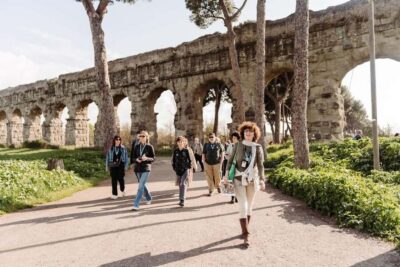
Appian Way, Catacombs and Aqueducts Park Tour with Top E-Bike
Read our review →
Appian Way E-Bike Tour Catacombs, Aqueducts & Picnic
Read our review →Browse the lists this tour appears in