
Reviewed · ROME
Rome: Ancient Mosaic Making Workshop
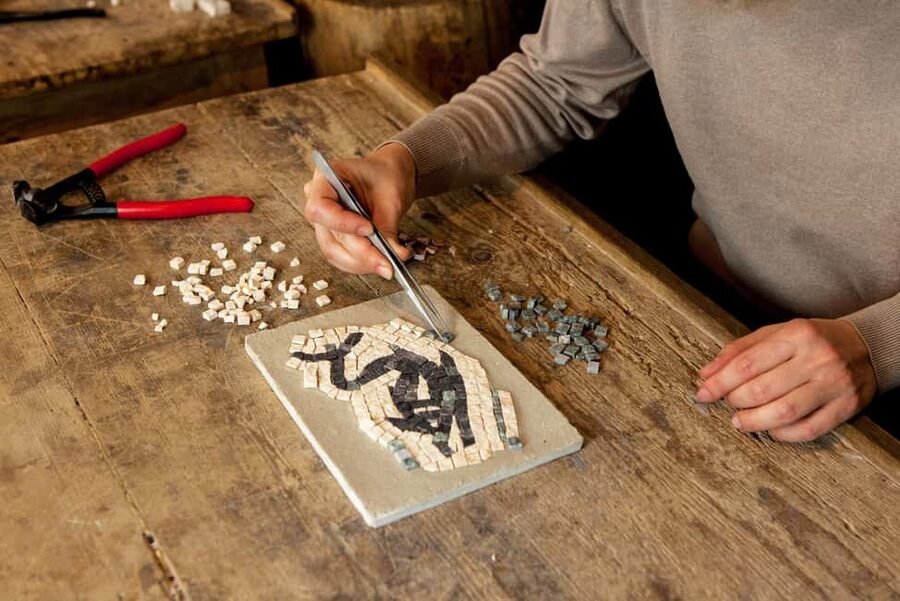
Roman mosaics are more than pretty floors in the Colosseum or Vatican Museums. At Studio Cassio, you get to handle the marble, shape the tiles, and build a small artwork with your own hands. The workshop takes place in a working family studio near the Colosseum, not in a classroom stripped of its craft.
I especially like the small-group format, limited to nine people, and the fact that you use natural local marble and real mosaic tools. I also like the useful souvenir: a personal artwork about 7 by 5 inches, packed in a sturdy box for the trip home. The main drawback is that the class lasts 2.5 hours, so you should expect a focused craft session rather than a quick, drop-in activity. Children under 12 cannot take part.
Key details before you book
- You cut real marble tiles: The lesson covers texture, composition, and the basic work of shaping stone.
- You work near the Colosseum: Studio Cassio is about a two-minute walk from the Cavour Metro stop on Line B.
- You learn from working mosaic artists: Alex, Julia, Hope, and other studio staff may lead or assist with the class.
- You take home a handmade piece: Your mosaic is framed and packed in a sturdy box, and weighs about 14 ounces.
- The group stays small: No more than nine people can join, which leaves room for help at the worktable.
- The class suits older children and adults: The minimum age is 12 because of the tools and stone-cutting work.
Why this workshop adds something different to Rome
Rome gives you grand monuments at every turn. You can see mosaics at the Vatican, in ancient churches, and around the archaeological sites. But looking at finished work only tells part of the story. This class lets you feel how much patience and control go into a mosaic made from small pieces of stone.
I like the contrast with a typical sightseeing day. After hours of walking around the Colosseum, you can sit down in an air-conditioned or shaded studio setting, work at a slower pace, and make something that is tied to Rome without being a mass-produced souvenir.
The lesson also gives you a better eye for mosaics later in your trip. You begin to notice how color, texture, spacing, and the direction of each tile affect the whole picture. That practical understanding is worth more than a short lecture alone.
The workshop is held in a historical family-owned studio, and you may see artists working on a real piece while you make your own. That matters. You are not simply copying a craft in a tourist shop. You are working beside people who still practice the skill.
More cooking classes in Rome:
- 3 in 1 Cooking Class near Navona: Fettuccine, Ravioli & Tiramisu
★ 5.0 · 7,376 reviews - Rome: Pasta & Tiramisu Class with Fine Wine by the Vatican
★ 4.9 · 4,852 reviews - Rome: Pasta Making Class with Wine, Limoncello, and Dessert
★ 4.9 · 3,177 reviews
Arriving near the Colosseum and Cavour
Studio Cassio is near the Colosseum in Rome’s Monti neighborhood. From the Cavour stop on Metro Line B, the studio is about a two-minute walk. That makes it easy to pair with a visit to the Colosseum, the Roman Forum, or another nearby sight.
You will need to arrange your own transportation to the studio. The workshop does not include pickup or return transport, but the metro location keeps the arrival simple if you are already using Line B.
The Monti setting is useful for another reason. It gives you a break from the wide-open archaeological sites and crowded walking routes around the Colosseum. You move from ancient ruins to a modern working studio that continues an old Roman art form.
Check the starting time when booking, since the class schedule varies. I would avoid placing the workshop too close to a timed Colosseum entry. Rome delays happen, and arriving late could mean missing the introduction or part of the hands-on lesson.
The opening lesson: mosaic history and technique
The first part of the session introduces Roman mosaics and explains the basic methods you will use. The instructors speak English and Italian, and the class has been praised for making the history easy to follow rather than turning it into a long academic talk.
This opening matters because the craft can look deceptively simple. A finished mosaic may seem like a neat arrangement of colored squares, but the effect comes from many choices: the shape of each piece, the direction of the cuts, the gaps between tiles, and the way colors meet.
The teaching focuses on authentic Roman mosaic techniques. The goal is not to rush you toward a perfect souvenir. Your work follows traditional requirements, so you get a small lesson in the discipline behind the finished image.
Alex has led sessions described as both skilled and good-humored, while Julia and Hope have also helped participants at the studio. The exact instructor can vary, but the teaching team works directly with you rather than leaving you to figure out the tools alone.
Choosing a design and working with local marble
You create your own design within the size of the provided frame. One parent and daughter chose to work from a design the daughter sketched herself, which shows the class allows some personal direction rather than giving everyone an identical project.
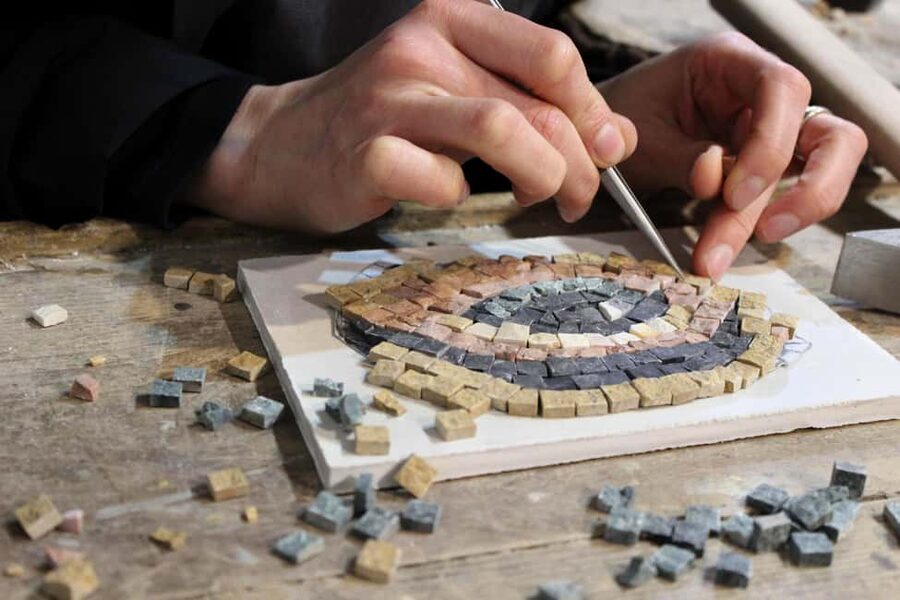
You should expect a small artwork, not a large floor panel. The finished piece measures about 7 by 5 inches and weighs roughly 14 ounces. That size keeps the project realistic within a 2.5-hour session and makes it easy to carry in your luggage.
The material is one of the best parts of the class. You work with high-quality, natural, local marble. Stone has variation in color and texture, so your final design will have a more genuine look than one made from uniform craft-store tiles.
The instructors help you think through composition before and during the cutting process. If you are not confident with design, do not worry too much. The class is built around guidance and encouragement, and the staff can help you make sensible choices without taking over your project.
Same city, a completely different half-day:
- Vatican Museums & Sistine Chapel Tour with Optional Basilica
★ 4.3 · 67,413 reviews - Vatican Museums, Sistine Chapel & St Peter’s Basilica Guided Tour
★ 4.5 · 39,149 reviews - Rome: Colosseum, Palatine Hill and Roman Forum Guided Tour
★ 4.8 · 32,814 reviews - Rome: Guided Tour of Colosseum, Roman Forum & Palatine Hill
★ 4.7 · 27,897 reviews
Cutting marble and handling the tools
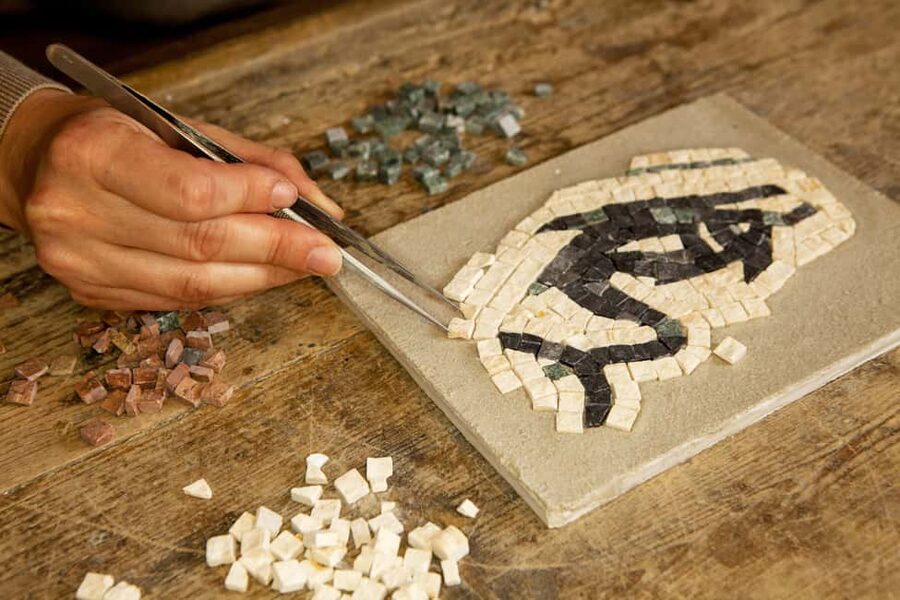
The hands-on work is the heart of the session. You practice cutting marble tiles with the specific tools used in mosaic craft, then fit the pieces into your framed design.
This is not a completely effortless craft project. Stone cutting takes care, and the work requires attention to your fingers, the tools, and the direction of each piece. That is why the minimum age is 12. Adults should also expect to slow down and listen closely during the demonstration.
You learn how texture affects the appearance of the mosaic. A smooth, regular arrangement gives one effect, while different tile shapes and surfaces create another. The same applies to composition. A tiny shift in angle can change the way a shape reads.
The instructors are there to help you refine the work, not simply hand you pre-cut pieces. That makes the finished item more meaningful, but it also means your result may look handmade. If you want a flawless, factory-like object, buy one in a shop. If you want proof of your own effort, this format is much better.
A working studio instead of a staged attraction
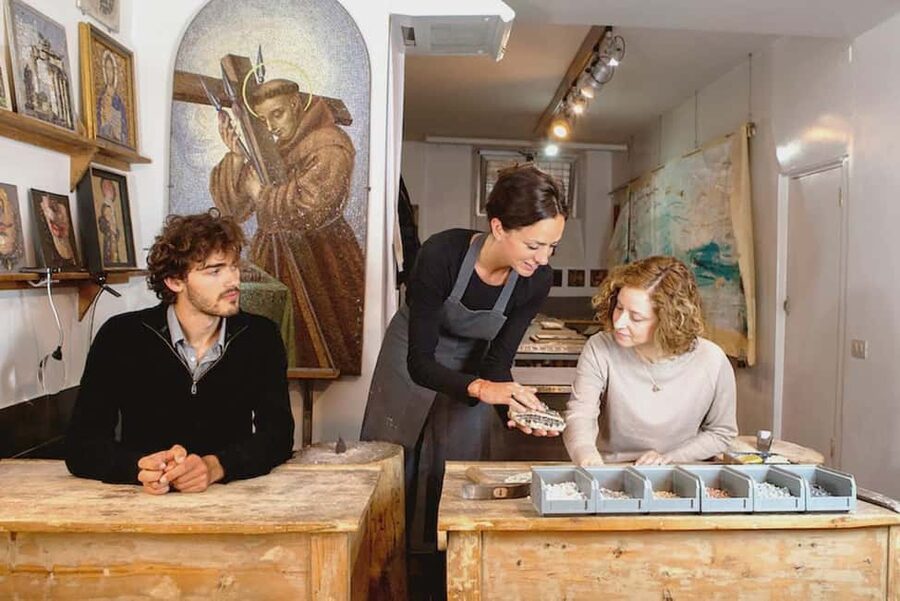
One of the strongest reasons to book this class is the setting. Studio Cassio is a family-owned mosaic workshop where artists continue to work on real projects. You may watch them at their tables while you work on your own piece.
That detail adds context without requiring a separate museum visit. You see the tools, materials, and pace of the craft up close. The studio staff also share stories about the studio’s past and their lives as mosaic artists, giving the session a human side.
The atmosphere appears relaxed and friendly, but the work remains serious. You are learning a traditional process, not just decorating a souvenir. That balance suits people who want a cultural activity with plenty of hands-on time.
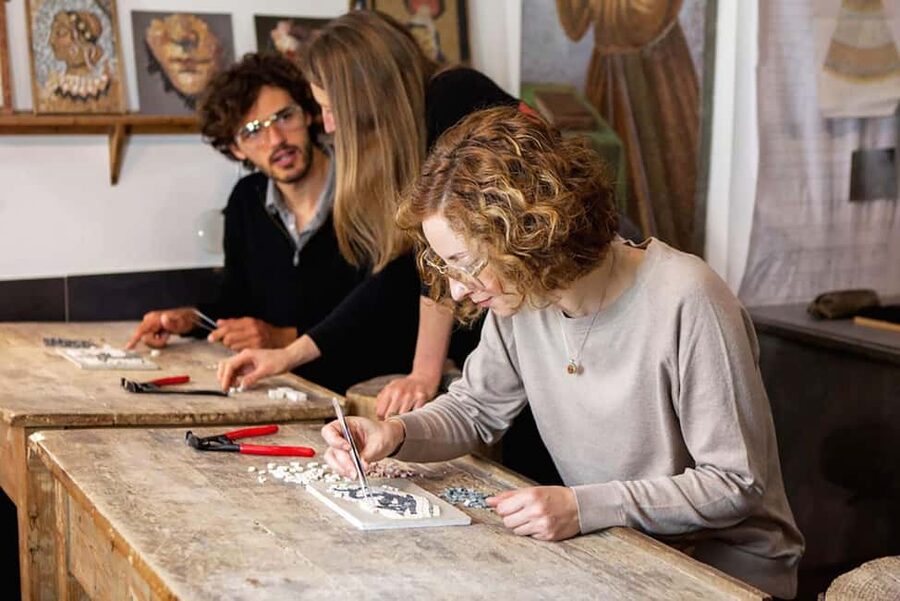
The small group helps here. With a maximum of nine participants, the instructor can check your cutting technique and suggest adjustments. Some sessions may be smaller, even just two people, though the group size can vary by date.
What you take home
At the end, you have your own mosaic in its frame. The staff wrap it securely and place it in a sturdy box to protect it during the journey home.
That packaging is important. A fragile artwork made from marble is not ideal as a loose item in a suitcase. The box gives you a practical way to carry it, although you should still place it where heavy luggage will not crush it.
The finished mosaic is small enough to fit into most luggage, but it has enough weight and substance to feel like a real object. At about 14 ounces, it is heavier than a paper print or a small magnet, but it should not be difficult to carry.
I also like the personal value. You choose or shape the design, cut the pieces, and assemble the work. Years later, the mosaic can remind you of the time spent making it, not just the place where you bought it.
Is $106 a fair price?
At $106 per person, this is not a cheap filler activity. The value depends on what you want from your Rome sightseeing.
You are paying for 2.5 hours of instruction, access to natural local marble, use of specialist tools, a frame, packing materials, drinks, and direct help from mosaic artists. You also leave with an artwork that you made yourself.
Compared with a short demonstration, the workshop offers much more participation. Compared with a private art lesson, the small group keeps the price more moderate, though it is still a considered purchase for a family or couple.
I think the price makes the most sense for someone who values craft and personal souvenirs. It is less compelling if you want a low-cost activity or if your Rome schedule is already packed with major sights.
Coffee, tea, and bottled water are included. Those are small extras, but they help during a work session that requires concentration.
Who will enjoy this most?
This workshop fits adults, couples, families with teenagers, and anyone who wants a quieter activity between major sights. It is also a good choice for people who have already seen several churches, museums, and archaeological sites and want to do something with their hands.
A parent and teenager can work side by side, and the minimum age of 12 makes it suitable for older children who can follow tool-safety instructions. Younger children cannot join.
You do not need to be an artist. The instructors guide the process, and the finished item does not need to look like a museum piece. Patience matters more than drawing skill.
The class also works well on a hot day. One participant used it as a break from the heat, and the indoor setting gives you time away from Rome’s bright streets and stone pavements.
Who may want to skip it?
Skip this activity if you dislike slow, careful handwork. You will spend a good part of the session cutting, placing, and adjusting small pieces. It is not a fast entertainment stop.
You may also want to skip it if your main goal is to see as many landmarks as possible. Two and a half hours is a meaningful block of time, especially when you add transport and arrival time.
People with very young children will need another activity because children under 12 are not permitted. The class is also less suitable if you want a completely polished final object made by a professional. Your mosaic is your work, with the unevenness that comes with handmade craft.
Booking and practical planning
You can cancel up to 24 hours before the activity for a full refund, and the reserve-now, pay-later option gives you some flexibility when planning a Rome itinerary. Starting times vary, so check the available slot before building your sightseeing day around it.
Use the Cavour Metro stop as your main arrival reference. Since the workshop is close to the Colosseum, plan extra time if you are coming from another part of Rome.
Wear something that lets you sit and work comfortably. The supplied information does not specify a dress code, but the session involves marble cutting and hands-on tools, so practical clothing makes more sense than delicate outfits.
The studio provides the tools, marble, frame, box, and drinks. You do not need to bring craft supplies.
Should you book the Studio Cassio mosaic workshop?
Book it if you want a genuine craft experience, a small group, and a souvenir that carries your own effort. The combination of local marble, traditional technique, working artists, and a central Monti location gives the class real substance.
I would especially recommend it after a morning at the Colosseum or Vatican Museums, when you are ready to stop looking and start making. The class adds a new layer to Rome’s mosaics by showing you how much skill goes into each finished surface.
Skip it if $106 feels too high for a hands-on souvenir, if you have no room for a 2.5-hour class, or if you are traveling with children under 12. For everyone else, Studio Cassio offers a thoughtful change of pace and one of the more personal keepsakes you can bring home from Rome.
FAQ
Where does the Roman mosaic workshop take place?
The workshop takes place at Studio Cassio in Rome’s historic Monti neighborhood, near the Colosseum.
How close is the studio to public transportation?
The studio is about a two-minute walk from the Cavour stop on Metro Line B.
How long does the workshop last?
The workshop lasts 2.5 hours.
How much does the experience cost?
The listed price is $106 per person.
What languages are spoken during the workshop?
The instructors speak English and Italian.
How many people can join the class?
The workshop is limited to nine participants.
What will I make during the class?
You will make your own Roman mosaic using natural local marble, then take it home in a frame and sturdy protective box.
How large and heavy is the finished mosaic?
The finished piece is approximately 7 by 5 inches and weighs about 14 ounces.
Can children join the workshop?
The activity is recommended for ages 12 and up. Children under 12 are not permitted for safety reasons.
Newest Rome tours we have reviewed
- Private TikTok Video Making in Rome★ 5.0 · 7 reviews
- Assisi, Orvieto and Civita di Bagnoregio Full Day Tour from Rome★ 4.5 · 45 reviews
- Assisi & Saint Francis Path Tour from Rome★ 5.0 · 45 reviews
- Assisi and Cascia Private Day Tour from Rome with Lunch★ 5.0 · 10 reviews
- Art Class in the center of Rome!★ 4.0 · 4 reviews
- Art & Craft: Beer Tour with Street Art in Rome★ 4.5 · 6 reviews
- Arrival in Rome: Airport Transfer & Exclusive City Introduction★ 5.0 · 3 reviews
- From Rome: Private Day-Tour of Tuscany★ 5.0 · 16 reviews