
Reviewed · ANCIENT ROME TOURS
Rome: Ancient Rome Nighttime Sightseeing Tour
Rome’s ancient center takes on a different mood after dark. This three-hour walking tour links imperial ruins, Renaissance design, medieval power, and modern Italy without trying to cover every corner of the city. I like the route’s clear story, from Rione Monti and the Roman elite to the government district around Piazza Colonna. I also like the small-group format and the final drink at the Highlander Pub. The main drawback is simple: this is a walking tour over historic streets, so it is not suitable for people with mobility impairments and it runs rain or shine.
The guide can make a big difference here. Dimitri, one guide associated with this experience, used questions, humor, and extra time to turn the walk into a conversation rather than a lecture. You should still expect a tour focused on outdoor sights, not monument entry, so choose it for atmosphere, context, and evening views rather than inside access.
Key points to know before booking
- Rione Monti begins the story: Start in Rome’s oldest residential area and see how the city’s center has changed over time.
- Trajan’s Forum brings imperial Rome to life: Explore the last and largest Imperial Forum, including the site described as the world’s first shopping mall.
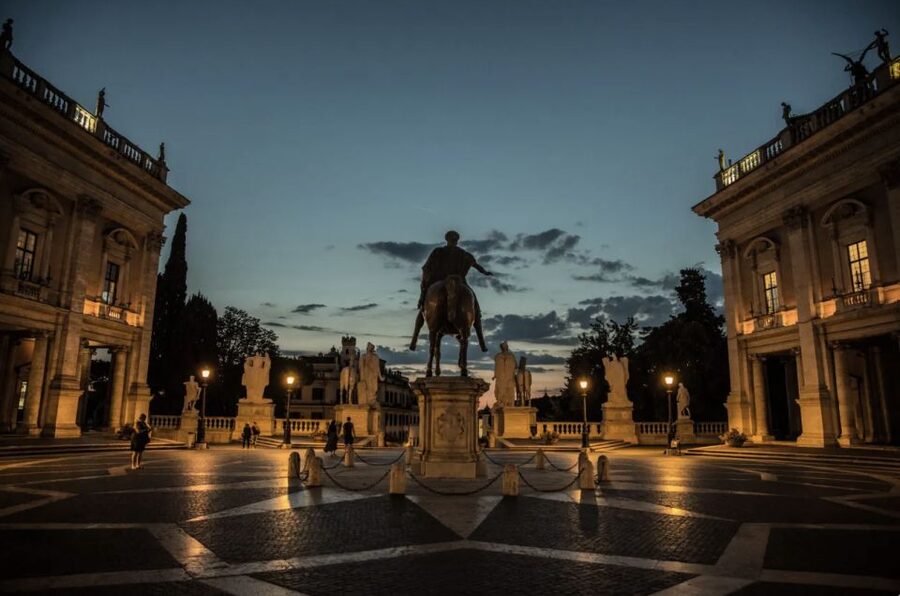
- Michelangelo shapes the Campidoglio stop: See one of Rome’s most famous Renaissance squares and its carefully planned design.
- The route ends near Italian government: Piazza Colonna remains a political center, making a useful bridge from ancient Rome to the present.
- A drink closes the evening: The Highlander Pub stop includes a glass of wine or a cocktail.
- Bring good walking shoes: The tour takes place outdoors, in all weather, and is not suitable for people with mobility impairments.
Why Rome after dark works so well
Rome can feel crowded and bright during the day. At night, the city’s monuments often read more clearly. Artificial light picks out columns, stairways, domes, and carved stone, while the quieter streets make it easier to listen and look around.
This tour is not a fast checklist of famous sights. It follows a compact route through the historic center, using each stop to show a different period of Rome. You move from the ancient residential quarter to Renaissance planning, then to the medieval and modern political heart of the city.
I like that structure. Rome is not one single historical period layered neatly on top of another. It is a working city built around old foundations. You see that idea repeatedly on this walk, especially when imperial ruins sit beside government buildings and busy central streets.
The group format also matters. A small group makes it easier to hear the guide and ask questions. Dimitri is specifically associated with an interactive style, adding humor and allowing extra time for questions about Rome. That kind of exchange can help you remember the facts instead of simply hearing a long string of dates.
More ancient Rome tours:
- Colosseum: Underground and Ancient Rome Tour
★ 4.7 · 12,691 reviews - Colosseum & Ancient Rome with Arena Floor Option I Max 6 People
★ 5.0 · 3,306 reviews - Rome: Colosseum, Ancient Rome Tour or Self AudioGuided Tour
★ 4.4 · 2,866 reviews
Rione Monti, Rome’s oldest residential quarter
The walk begins in Rione Monti, described as the oldest residential area in Rome. This is a useful starting point because it gives you a feel for the city as a lived-in place before the grand monuments take over.
The neighborhood provides an introduction to the changing character of Rome’s center. You are not only looking at ruins. You are also considering how people have lived, worked, and moved through this part of the city across different eras.
That opening makes the tour feel less like a museum visit and more like a walk through an old capital. Your guide sets up the idea of an ever-changing Rome center, where historical pieces remain part of daily urban life.
The exact meeting point is not specified in the supplied details, so check the booking information carefully before setting out. Arrive ready to walk, and wear comfortable shoes. Since the tour runs rain or shine, a light rain layer can be a sensible choice, though the activity information only specifically requires comfortable footwear.
Piazza Quirinale and the Roman elite
From Rione Monti, the route continues to Piazza Quirinale, one of the grand settings on the walk. The square is presented as the seat of the Roman elite throughout the ages, giving the guide a natural place to explain status, power, and Rome’s long political story.
Piazza Quirinale is valuable in this itinerary because it shifts your attention from ordinary neighborhood life to the city’s ruling class. Rome’s historic center is full of places where power was displayed through architecture, position, and scale. Here, you can consider how a public square can serve as a stage for authority.
Nighttime helps with this stop. Large civic spaces can be hard to absorb in the middle of a busy day. In the evening, you may find it easier to appreciate the proportions and mood of the square while the guide explains its role.
Do not expect an extended indoor visit here. The strength of the stop is the outdoor setting and the explanation that connects it to the wider route.
Trajan’s Forum and the ancient shopping district
The next major point is Trajan’s Forum, the largest and last Imperial Forum built in Rome. This is one of the tour’s most important ancient Roman stops, and it gives you a strong sense of how ambitious imperial Rome could be.
The forum was more than a ceremonial space. The experience describes it as the site of the world’s first shopping mall, a detail that helps make the ruins easier to picture. Instead of treating the forum as a pile of old stones, the guide can help you think about it as a planned public and commercial center.
That practical angle is useful. Ancient Rome was not only about emperors, temples, and military power. It was also about trade, movement, business, and public life. Trajan’s Forum lets you connect those everyday activities with the grand scale of imperial construction.
The nighttime setting changes the way you read the remains. Shadows can sharpen the outlines of the surviving structures, although darkness can also make some details harder to see. If you enjoy close study of inscriptions or small architectural fragments, a daytime visit may offer better visibility. If you want mood and a broad understanding of the site, the evening timing has real appeal.
More city highlights tours in Rome:
- Rome: Big Bus Hop-on, Hop-off Open-Top Sightseeing Tour
★ 3.5 · 2,580 reviews - Rome in a Day Group Tour with Vatican Museums and Colosseum
★ 4.5 · 2,450 reviews - Rome Highlights by Golf Cart Private Tour
★ 5.0 · 2,379 reviews - Rome: City Highlights Open-Top Bus Night Tour
★ 4.1 · 2,038 reviews
Piazza Campidoglio and Michelangelo’s design
The route then reaches Piazza Campidoglio, where Michelangelo’s design becomes the focus. This is the Renaissance section of the evening and a good reminder that Rome’s story did not stop with the fall of the ancient empire.
Michelangelo’s work here is not simply about decoration. The design of the square creates a controlled sense of arrival, with buildings, stairs, and patterns working together. Your guide can help you notice how the space directs your eye and shapes your movement.
This stop is especially useful if you have seen Roman ruins but have not yet learned to read Renaissance urban design. The square shows how later architects and city leaders gave old Rome new meaning. Ancient materials and locations could be reused, but the visual language changed.
I like this part of the itinerary because it gives the tour a pause from ruins. You get to compare imperial engineering with Renaissance planning. Both periods used architecture to express power, but they did so in different ways.
Again, the experience is an outdoor visit. The tour does not indicate entry into museums or buildings, so book this for the square itself and the guide’s interpretation.
Palazzo Venezia and the modern center
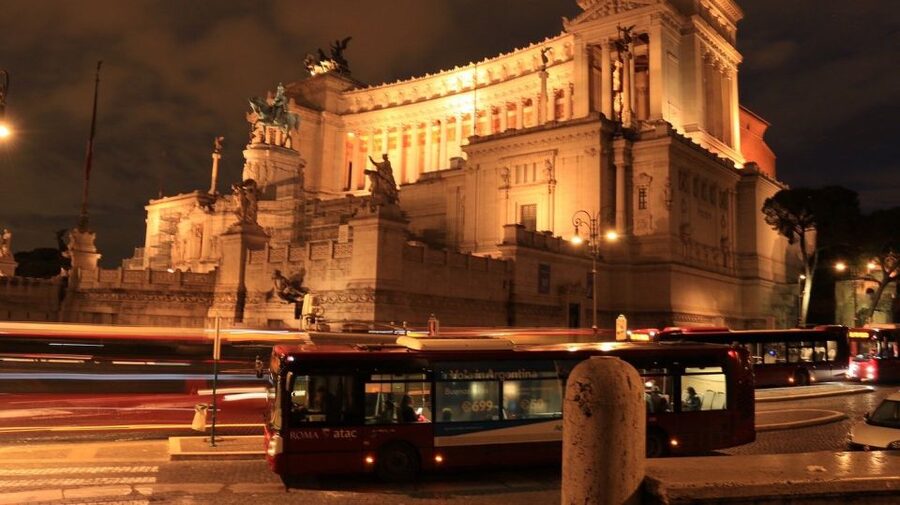
Nearby, the route reaches Palazzo Venezia, described as a medieval building and a central hub of Rome. This stop adds another layer to the city’s changing identity.
Palazzo Venezia helps show how Rome’s political importance continued long after the imperial period. The buildings around the historic center were repeatedly adapted to new rulers, institutions, and public purposes. That makes this part of the walk a useful link between medieval Rome and the modern state.
Facing the palace is the monument to Vittorio Emanuele II, connected with the unification of Italy. The contrast is striking: a medieval palazzo on one side, and a monumental symbol of modern Italian unity on the other.
You get a visual lesson in how different eras compete for space in central Rome. The route does not isolate each period behind a museum door. Instead, it puts them across from one another in the street.
For me, this is where the tour’s larger idea becomes clearest. The evening is not only about ancient Rome. It is about how each generation altered the center while leaving earlier layers visible.
Piazza Colonna and Italy’s seat of government
The final sightseeing stop is Piazza Colonna, the seat of the government of Italy. Ending here gives the walk a modern political finish rather than returning to the ancient world.
The square’s role provides a useful contrast with Trajan’s Forum. At Trajan’s site, power was expressed through an imperial complex. At Piazza Colonna, the surrounding government buildings show how Rome remains a center of national authority today.
This is also a fitting place to review the route. You have moved through residential Rome, elite Rome, imperial Rome, Renaissance Rome, medieval Rome, and unified Italy. The stops are not random. They create a simple timeline that you can carry with you as you explore the city on your own.
The tour finishes at the nearby Highlander Pub with a complimentary drink. You can choose a glass of wine or a cocktail, giving the evening a relaxed close. A pub stop may not appeal to everyone, especially if you prefer to end at a restaurant or return straight to your hotel. For many people, though, it is a pleasant chance to ask final questions and continue the conversation after the formal walk ends.
What the $82 price includes
At $82 per person, this is not the cheapest way to see Rome’s historic center. The value depends on what you want from an evening out.
The price includes a live guide, a small-group experience, and a glass of wine or cocktail at the end. You are paying mainly for the route and the explanation, not for admission to an interior monument. No attraction entry is listed, and no transportation is included, so think of this as a guided city walk.
I see the price as reasonable if you want a clear introduction to central Rome and prefer company over wandering alone. The guide’s role is important here. A good explanation can help you notice why a square was designed a certain way or why a forum mattered beyond its surviving stones.
The value is weaker if you already know these monuments well or want extensive time at each site. Three hours sounds generous, but the route includes several major locations. The tour has to keep moving, and most stops will be for orientation and explanation rather than detailed architectural study.
The included drink adds a social finish, though you should not book the tour solely for the cocktail or wine. The main product is the guided walk.
Who should book this nighttime walk?
I would recommend this experience to first-time Rome visitors who want a broad introduction to the city’s historic center. It also suits you if you enjoy architecture, public squares, and stories about how Rome changed from one era to the next.
It is a good choice for an arrival evening, when you want to get your bearings without committing to a formal museum visit. It can also work later in a trip, especially if you have seen the Colosseum and Vatican Museums but want more context for the streets and piazzas between them.
The tour may suit families and mixed-age groups if everyone can manage three hours of walking. Dimitri’s interactive approach, including humor and questions, suggests that the experience is not built around a dry lecture. Still, the activity is not suitable for people with mobility impairments, and the rain-or-shine policy means you need to be prepared for changing weather.
Choose English or Spanish when booking. The tour has live guides in both languages.
Should you book it?
Book this tour if you want Rome’s major historic layers explained in one evening, with a small group and a drink at the end. The route is especially useful for understanding how ancient ruins, Renaissance planning, medieval buildings, and modern government fit together.
Skip it if you need step-free access, dislike walking in poor weather, or want to enter major monuments. At $82, the tour makes the most sense for the guide’s storytelling and the carefully arranged route. If that is what you are after, this is a practical and enjoyable way to meet Rome after dark.
FAQ
How long does the tour last?
The tour lasts three hours. Starting times vary, so check availability for the date you want.
Which languages are available?
A live tour guide is available in English or Spanish.
What is included in the price?
The experience includes a tour guide, a small-group tour, and a nightcap consisting of a glass of wine or a cocktail at the nearby Highlander Pub.
Where does the tour begin?
The walk departs from Rione Monti, Rome’s oldest residential area. The supplied details do not provide a more specific meeting-point address, so check the booking information before going.
Can I cancel the booking for a full refund?
Yes. You can cancel up to 24 hours in advance for a full refund.
Is the tour suitable for people with mobility impairments?
No. The activity is not suitable for people with mobility impairments. Comfortable shoes are recommended, and the tour takes place rain or shine.
More evening tours in Rome
- Vespa Sidecar Tour By Night with Pickup
★ 5.0 · 1,803 reviews - Rome by Night – Ebike Small Group Tour – Food and Wine (Option)
★ 5.0 · 1,275 reviews - Colosseum Sunset Tour with Entry
★ 4.5 · 1,230 reviews - Rome: E-Bike Night Tour with Food and Wine Tasting
★ 4.9 · 1,131 reviews
Newest Rome tours we have reviewed
- Private TikTok Video Making in Rome★ 5.0 · 7 reviews
- Assisi, Orvieto and Civita di Bagnoregio Full Day Tour from Rome★ 4.5 · 45 reviews
- Assisi & Saint Francis Path Tour from Rome★ 5.0 · 45 reviews
- Assisi and Cascia Private Day Tour from Rome with Lunch★ 5.0 · 10 reviews
- Art Class in the center of Rome!★ 4.0 · 4 reviews
- Art & Craft: Beer Tour with Street Art in Rome★ 4.5 · 6 reviews
- Arrival in Rome: Airport Transfer & Exclusive City Introduction★ 5.0 · 3 reviews
- From Rome: Private Day-Tour of Tuscany★ 5.0 · 16 reviews
Ancient Rome Tours, compared.
Colosseum: Underground and Ancient Rome Tour
Read our review →
Colosseum & Ancient Rome with Arena Floor Option I Max 6 People
Read our review →
Colosseum, Ancient Rome Tour or Self AudioGuided Tour
Read our review →
Colosseum Underground & Ancient Rome Guided Tour
Read our review →
Ancient Rome: Colosseum Underground Group Tour
Read our review →
Colosseum Express Guided Tour and Ancient Rome Admission Included
Read our review →
Colosseum Arena Access and Ancient Rome Guided Tour
Read our review →
Ancient Rome Discovery: Colosseum, Forum, Palatine Guided Tour
Read our review →Browse the lists this tour appears in