

Reviewed · APPIAN WAY AND AQUEDUCTS TOURS
Rome: Appian Way, Catacombs, & Roman Aqueducts E-bike Tour
Rome’s best bike ride takes you far beyond the Colosseum, into a quieter Rome of broken tombs, country lanes, towering aqueducts, and open fields. You leave through St. Sebastian’s Gate and follow the 2,300-year-old Appian Way, then ride beneath the great arches of the Park of the Aqueducts.
I like the mix of ancient engineering and countryside. I also like the careful guiding, especially on the city sections, where guides such as Arina, Oscar, Anna, and Bita have helped riders stay together and cross busy roads safely. The catch is simple: this is a 27-kilometer ride with rough tracks and city traffic, so you should feel comfortable handling a bike before you book.
Key points to know before you book
- The six-hour tour includes the Catacombs: You get a guided underground visit at St. Callixtus or St. Sebastian, while the four-hour version only stops at the entrance.
- Most of the ride is away from traffic: About 60 percent of the route runs off-road through parks and along the Appian Way.
- The distance is real, but the e-bike helps: You cover about 17 miles, including hills, gravel, and uneven ground.
- The aqueducts are the visual high point: Huge Roman arches stretch across the Park of the Aqueducts before the route returns toward the city.
- Groups are kept small: The limit is 10 people, which matters when the ride reaches city streets.
- You need basic bike confidence: The tour is classed as intermediate, and the rough sections can be awkward for an inexperienced rider or a child using an attachment.
Why this is one of Rome’s best ways to reach the ancient countryside
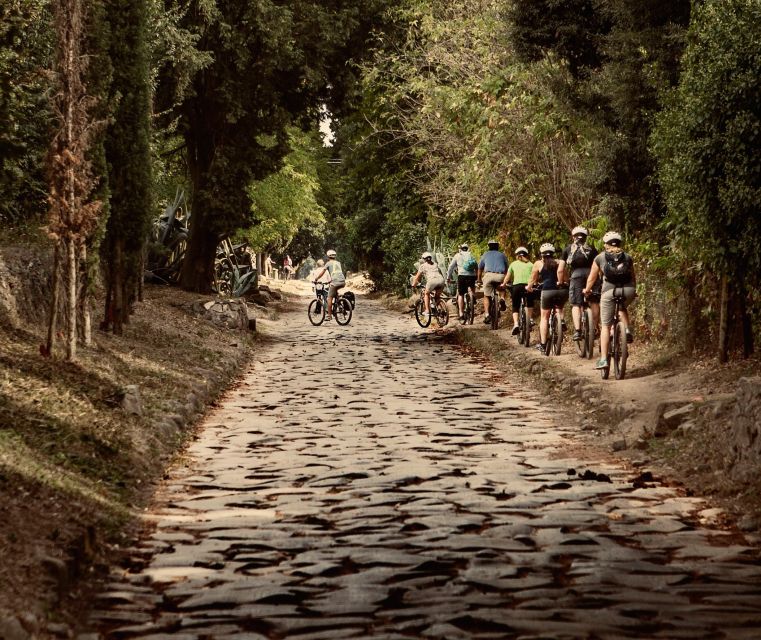
Rome’s central sights can feel tightly packed. The Appian Way gives you room to breathe. Instead of moving from one crowded monument to the next, you pedal past ancient stones, umbrella pines, old villas, and grazing countryside. The city slowly falls behind.
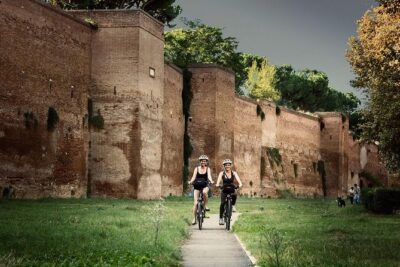
This is not just a recreational ride with a few ruins sprinkled in. The route connects several major pieces of Roman history. You see the defensive Aurelian Walls, the road that carried armies and trade across the Roman world, early Christian burial tunnels, aristocratic tombs, imperial villas, and the water system that supplied ancient Rome.
I especially like the way the tour links these sights. The Appian Way explains how Rome moved people and goods. The catacombs show what happened below ground in the early Christian era. The aqueducts reveal how Rome supported a huge population. Taken together, the stops tell a coherent story.
The e-bike makes the full route manageable for a reasonably active rider. You still pedal, but the electric assistance takes the sting out of climbs and helps over the long distance. A six-hour ride sounds demanding on paper. In practice, the frequent stops and motor assistance make it far less punishing than a standard bicycle tour.
More Appian Way and aqueduct tours:
- Rome EBike Tour: Appian Way, Catacombs & Roman Aqueducts
★ 5.0 · 1,766 reviews - Rome:Appian Way E-bike Tour with Catacombs, Aqueducts & Food
★ 4.9 · 1,210 reviews - Rome Underground: Catacombs Tour, Aqueducts and Appian Way
★ 5.0 · 1,007 reviews
From Via Labicana to the Aurelian Walls
The meeting point is at Via Labicana 49, within walking distance of both the Colosseum and Manzoni Metro stations. From the Colosseum, allow about 10 to 15 minutes on foot. From Manzoni, the walk takes about 10 minutes.
After fitting your helmet and getting used to the Cannondale e-mountain bike, you head toward the Aurelian Walls. The bikes have anti-puncture tires, a five-liter handlebar bag, and a water bottle. Helmet use is mandatory, which is sensible once the route leaves smooth city pavement.
The first city riding requires attention. Around 40 percent of the whole route takes place in urban areas, mainly to connect the starting point with the Appian Way and the aqueduct park. Your guide leads the group through carefully selected streets, but Rome traffic is still Rome traffic.
This is where a small group earns its keep. With no more than 10 riders, the guide can keep an eye on everyone and give clearer instructions. Guides including Arina, Anna, Oscar, and Bita have been praised for calm road handling and good pacing. Still, you should not treat the city section as a lesson for someone who has never ridden in traffic.
The Appian Way, where Rome opens up

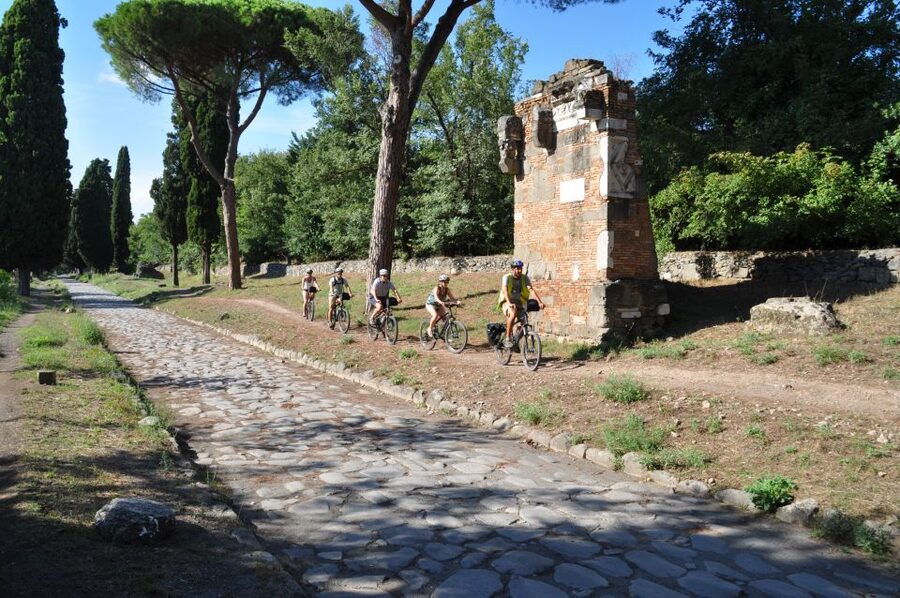
You enter the ancient road through St. Sebastian’s Gate in the Aurelian Walls. The Appian Way, or Via Appia Antica, began in 312 BC and became one of Rome’s most important roads. Its surviving stones and raised edges give you a direct sense of how Roman builders made long-distance travel possible.
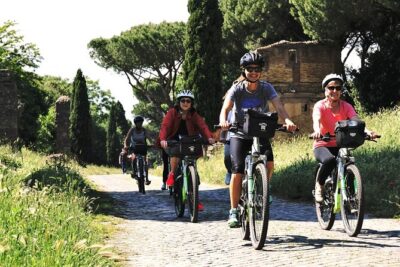
The ride is not a smooth cycle path. Parts of the old road are uneven, and sections beyond it include gravel and dirt tracks. That texture is part of the appeal, but it also explains the intermediate rating. I would choose comfortable shoes with a firm sole and avoid bringing anything you need to carry by hand.
The pace is designed around stops. You can look at tombs, mausoleums, villas, and fragments of ancient road rather than simply pedaling past them. Guides pause to explain what you are seeing and allow time for photographs.
The setting is one of the tour’s biggest rewards. You are still close to Rome, yet the road feels separated from the city. Several people who booked with children or older family members found the electric assistance helpful, but the ride remains more demanding than a flat urban cycle route.
The catacombs: choose the six-hour version for the full story
The six-hour option includes a guided underground visit to the Catacombs of St. Callixtus or St. Sebastian. You descend into crypts and corridors linked with early Christian burial practices. This adds a different mood to the day: the open Roman countryside gives way to narrow, enclosed spaces below ground.
The visit is important because it adds early Christian history to a route otherwise dominated by roads, monuments, and engineering. It also gives the longer tour a stronger sense of variety. You are not spending six hours simply riding from one outdoor site to another.
The four-hour version makes only a short stop at the entrance, with an explanation of the catacombs’ purpose and importance. That shorter format may suit you if you want the cycling and aqueducts but prefer not to spend extra time underground.
I would pick the six-hour tour if the catacombs are a major reason for your interest. Pick the four-hour version if you want a lighter outing, especially in hot weather or when your Rome schedule is tight. On Wednesdays, the tour can last about 30 minutes longer, so leave extra time in your day.
More catacombs tours in Rome:
- Rome: Crypts and Catacombs Underground Tour with Transfers
★ 4.6 · 5,341 reviews - The Original Roman Crypts and Catacombs Tour with Transfers
★ 4.5 · 4,896 reviews - Rome: Catacombs of St. Callixtus Entry Ticket & Guided Tour
★ 4.6 · 3,037 reviews - Rome: Guided Roman Catacombs Tour with Transfers
★ 4.6 · 1,830 reviews
Maxentius, Cecilia Metella, and the old aristocratic road
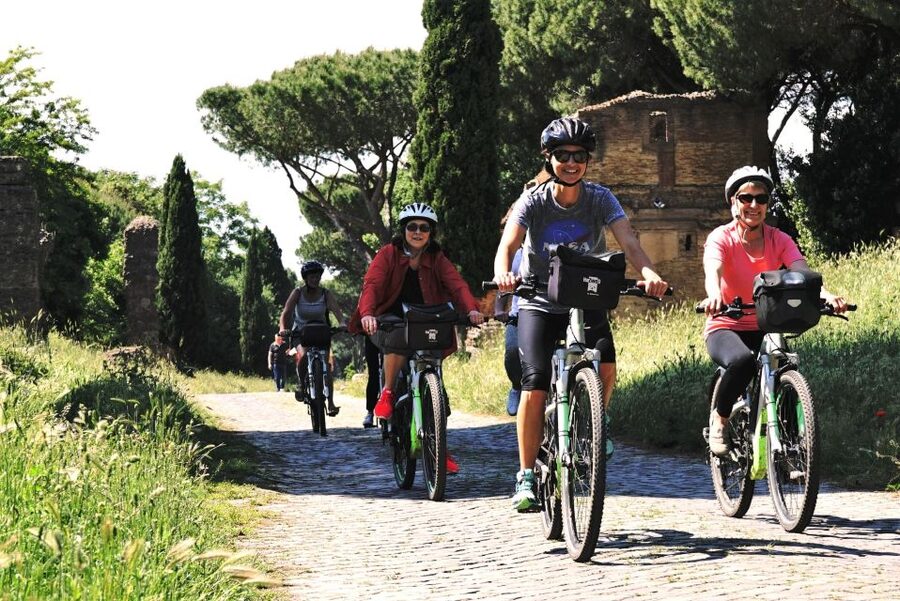
The route continues past the Circus of Maxentius, a large imperial complex built in the early fourth century. Its remains help show the scale of Roman public buildings outside the city center.
You also pass the Tomb of Cecilia Metella, one of the most recognizable monuments along the Appian Way. The tomb’s massive form reflects the wealth and status of the Roman families who built memorials beside this major road.
Further along, the Villa dei Quintili gives you another look at Roman privilege. This was a sprawling suburban estate associated with an influential family before Emperor Commodus took it over. You do not need to be an ancient-history expert to appreciate the point: this road was not only a military route. It was also lined with grand residences and expensive monuments.
The guide makes these stops more useful than a silent ride past ruins. Names, dates, and political stories give meaning to what can otherwise look like scattered stone. The best guides keep the explanations focused, then let you enjoy the ride.
The Park of the Aqueducts is the visual payoff
The route eventually reaches the Park of the Aqueducts, where long rows of Roman arches cross wide open ground. This is the moment many riders remember most. The scale is hard to grasp from a photograph, especially when you stand or cycle beneath the arches and see them continue into the distance.
The aqueducts carried water toward Rome from sources many miles away. Their height and repeated arches were practical engineering, but they also create one of the city’s most striking outdoor views.
Here the ride feels less like sightseeing in a city and more like a country excursion. The park offers space, sunlight, and broad views, with far fewer crowds than the central monuments. You can stop for photographs and listen to the guide explain how the water system worked.
The route follows the aqueducts back toward modern Rome. This is a clever choice because the arches remain a reference point as you ride. You are not simply told how Roman water reached the city. You follow part of the route yourself.
Caffarella Valley and the ride back
After the aqueduct park, you cross the green Caffarella Valley. This section adds another stretch of open countryside before the final return to Via Labicana.
Caffarella is valuable as a change of pace. After the ancient road and huge aqueducts, you get a softer setting with fields and quieter paths. It also gives you one more chance to enjoy the contrast between Rome’s busy center and its outer parks.
The final ride includes city streets again, so do not assume the last hour will be entirely relaxed. Your guide will direct the group, but you still need to watch road conditions, traffic, and the riders around you.
The return route also brings you near the Baths of Caracalla, another major Roman sight. The bath complex is not treated as a long independent visit on this tour, but its inclusion helps connect the outer route with the imperial city you know from central Rome.
Bike quality, comfort, and the real effort involved
The tour uses Cannondale e-mountain bikes with electric assistance and anti-puncture tires. That is a useful match for the route. You need a bike built for gravel, uneven stones, and park tracks, not a delicate city cruiser.
Electric power does not eliminate the need to ride. You still steer, brake, balance, and pedal. Riders who had little e-bike experience generally found the controls easy to learn, but several practical points matter:
- Expect bumps on parts of the Appian Way and park tracks.
- The bikes do not turn the route into a completely effortless outing.
- Some bike-handling experience helps on gravel and uneven surfaces.
- The equipment has a total weight limit of 300 pounds, or 136 kilograms.
- Children aged 9 and older may ride an e-bike independently.
- Children aged 5 to 8 use a child extension, while children aged 1 to 4 can use a child seat up to 49 pounds, or 22 kilograms.
A child seat or extension makes the ride harder to manage, so families should be honest about their cycling ability. One family with children aged 9, 11, and 14 had a great time, but the route is not suitable for babies under 1 year.
Guides, group size, and safety
The guide can make or break a ride that includes traffic, rough ground, and a long distance. This experience has multilingual guides in English, Italian, French, Spanish, German, and Dutch. Names that have received especially strong praise include Oscar, Arina, Bita, Agnese, Cas, Sina, Ali, Pablo, and Zak.
The common thread is not a scripted lecture. You get history at the stops, help with the bike, and direction through the city. Several guides have been singled out for adjusting the pace, checking on less experienced riders, and stopping often enough for water and pictures.
The maximum group size is 10. That is small enough for the guide to respond when somebody has trouble with an e-bike or needs a slower pace. The minimum is four participants. If that number is not reached, you are offered an alternative or a full refund.
The tour is available in four-hour and six-hour formats. Both include the bike, helmet, guide, handlebar bag, and biodegradable water bottle. Food is not included, but you can buy something along the way. Some groups have stopped at a pizzeria for lunch, so you may want to carry a little cash and keep room in your schedule.
Is $85 a fair price?
At $85 per person, this is not the cheapest way to see ruins in Rome. It is a fair price if you value the bike, the guide, the long route, and the access to places that are awkward to reach independently.
You are covering about 27 kilometers and visiting several separate areas: the Appian Way, catacombs, Circus of Maxentius, Cecilia Metella, Villa dei Quintili, Aqueducts Park, Caffarella Valley, and the Baths of Caracalla area. Renting a suitable e-bike, planning the route, and navigating city connections on your own would take time and still leave you without the historical context.
The value is strongest on the six-hour version, since the catacomb visit adds a major site and gives the day more variety. The four-hour option remains useful if you mainly want the road, parks, and aqueducts.
Free cancellation is available up to 24 hours before departure, and you can reserve now and pay later. Starting times vary, so check the available schedule before building the rest of your day around it.
Who should book this ride?
I would recommend it to you if you want a break from Rome’s central crowds and enjoy seeing history while moving through the setting where it happened. It works particularly well for active couples, families with confident young riders, and anyone who has already seen the Colosseum and wants a different side of the city.
It is also a strong choice for people who like a full day with several kinds of scenery. You get city walls, ancient roads, underground corridors, imperial remains, open parks, and aqueducts in one outing.
I would hesitate if you rarely ride a bike, dislike uneven surfaces, or feel nervous around city traffic. A few riders managed the route despite limited off-road experience, but even positive reports describe bumpy sections. If you are unsure, practice on an e-bike before arriving in Rome.
Should you book the Appian Way e-bike tour?
Book it if you want Rome’s ancient world with more space, fresh air, and movement. The aqueducts are spectacular, the Appian Way feels genuinely old, and the route shows how much Roman history sits beyond the famous center.
Choose the six-hour option if you want the catacombs and have the time. Choose four hours if you want the main outdoor sights with less commitment. Either way, bring comfortable shoes, expect some traffic and rough ground, and treat this as a real bike tour rather than a motor-assisted sightseeing ride. For the right rider, $85 buys one of Rome’s most memorable history days.
FAQ
How long is the Appian Way e-bike tour?
You can choose a four-hour or six-hour version. The six-hour tour includes a guided catacomb visit, while the four-hour tour stops at the catacomb entrance for a short explanation.
How far do you ride?
The route is about 27 kilometers, or 17 miles. Around 60 percent takes place off-road, mainly in parks and along the Appian Way.
Is the tour suitable for beginners?
The tour is rated intermediate. You do not need advanced cycling skills, but you should be comfortable steering and braking on gravel, uneven ground, and city streets.
Is there traffic during the ride?
Yes. About 40 percent of the route is in the city, connecting the Appian Way with the Aqueducts Park. The guide chooses specific streets, but some traffic is unavoidable.
What is included in the price?
The tour includes a Cannondale e-mountain bike with anti-puncture tires, a professional guide, a helmet, a five-liter handlebar bag, and a biodegradable bottle of water. The six-hour option also includes the guided catacomb visit.
Is food included?
No. Food and drinks are not included, though you can buy refreshments along the way.
Can children join the tour?
Children aged 1 to 4 can use a child seat up to 49 pounds, or 22 kilograms. Children aged 5 to 8 use a child extension, and children aged 9 or older can ride an e-bike independently. Babies under 1 year are not permitted.
Where does the tour meet?
The meeting point is Via Labicana 49. It is about a 10 to 15-minute walk from the Colosseum Metro station and about 10 minutes from Manzoni Metro station.
More e-bike tours in Rome
- Rome: Top Highlights & Hidden Gems Tour by Cannondale E-Bike
★ 4.9 · 1,760 reviews - Rome City Small Group Bike Tour with quality Cannondale EBike
★ 5.0 · 1,380 reviews - Rome by Night – Ebike Small Group Tour – Food and Wine (Option)
★ 5.0 · 1,275 reviews - Rome: E-Bike Night Tour with Food and Wine Tasting
★ 4.9 · 1,131 reviews
Newest Rome tours we have reviewed
- Private TikTok Video Making in Rome★ 5.0 · 7 reviews
- Assisi, Orvieto and Civita di Bagnoregio Full Day Tour from Rome★ 4.5 · 45 reviews
- Assisi & Saint Francis Path Tour from Rome★ 5.0 · 45 reviews
- Assisi and Cascia Private Day Tour from Rome with Lunch★ 5.0 · 10 reviews
- Art Class in the center of Rome!★ 4.0 · 4 reviews
- Art & Craft: Beer Tour with Street Art in Rome★ 4.5 · 6 reviews
- Arrival in Rome: Airport Transfer & Exclusive City Introduction★ 5.0 · 3 reviews
- From Rome: Private Day-Tour of Tuscany★ 5.0 · 16 reviews
Appian Way and Aqueducts Tours, compared.
Rome EBike Tour: Appian Way, Catacombs & Roman Aqueducts
Read our review →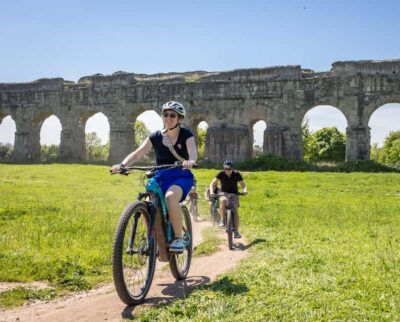
Appian Way E-bike Tour with Catacombs, Aqueducts & Food
Read our review →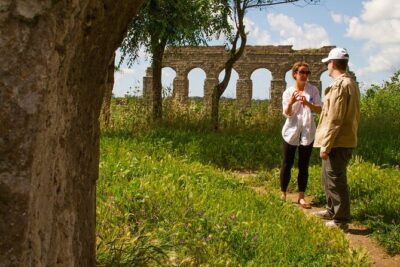
Rome Underground: Catacombs Tour, Aqueducts and Appian Way
Read our review →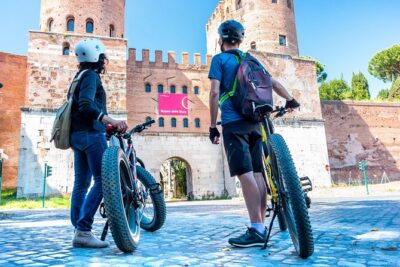
Appian Way Aqueducts Bike Tour (Catacombs & Lunch Option)
Read our review →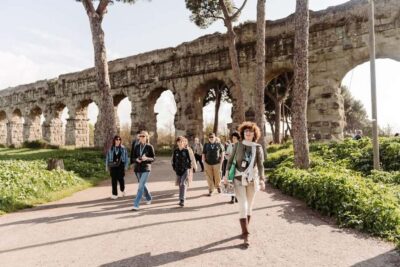
Appian Way, Catacombs and Aqueducts Park Tour with Top E-Bike
Read our review →
Appian Way E-Bike Tour Catacombs, Aqueducts & Picnic
Read our review →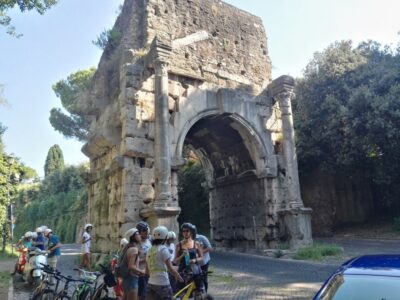
Appian Way Aqueducts Bike Tour (UPG Catacombs & Lunch)
Read our review →Browse the lists this tour appears in