
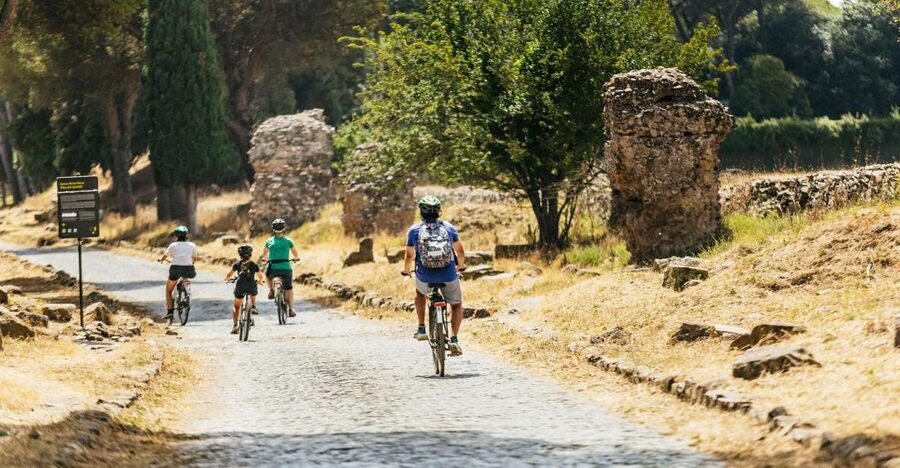
Reviewed · APPIAN WAY AND AQUEDUCTS TOURS
Appia Antica & Aqueducts e-Bike Tour – Official Provider
Rome’s best ancient-road experience is not in the city center. It is out along the Appian Way, where your e-bike rolls over stones worn by wagon wheels, past tombs, churches, catacombs, and broad Roman ruins. The route continues to the giant arches of the Aqueducts Park, giving you a far better sense of Rome’s reach than another hour in a museum.
I especially like the mix of archaeology and open countryside, plus the electric assistance that makes this long route manageable. Guides such as Federico, Sara, and Alex bring strong storytelling and keep an eye on riders at road crossings. The main caution is that this is not a gentle city-bike spin: about 70 percent is off-road, some streets carry traffic, and inexperienced riders can slow the whole group.
Key points to know
- Ancient road surface: Ride on the original Appian Way, including stones marked by centuries of wagon traffic.
- Big Roman set pieces: Visit Maxentius’ Circus and the Aqueducts Park, while passing Cecilia Metella’s tomb and Villa dei Quintili.
- E-bike only: Electric assistance matters on the uneven route and longer stretches between ruins.
- Optional catacombs: Add Saint Sebastian or Saint Callixtus for €10 per person, paid locally.
- Three and a half hours: The route packs in a great deal, but it leaves no time for a leisurely lunch.
- Rain or shine: Bring suitable clothing and expect real cycling, not just sightseeing from a saddle.
Why the Appian Way feels different from central Rome
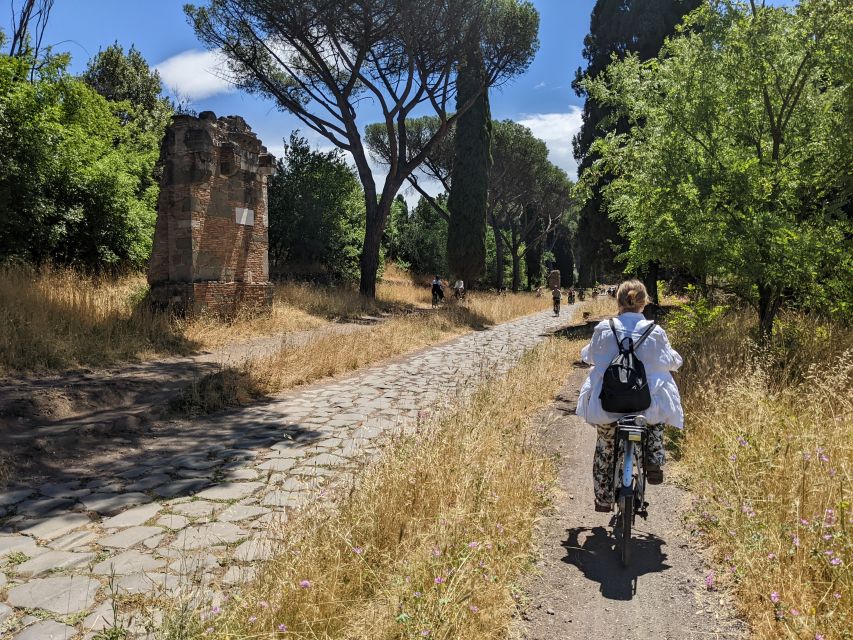
Rome’s famous sights show you the empire in polished fragments. The Appian Way gives you the setting. You ride through a protected regional park covering about 4,500 hectares, only around 2 kilometers from Circus Maximus, yet the city quickly feels far away.
The ancient road was first built for military use and later carried merchants, pilgrims, writers, and other long-distance visitors. Today, the route still links churches, burial sites, villas, thermal remains, and Roman engineering. An e-bike lets you cover the wide stretch from the Domine Quo Vadis Church to the Aqueducts Park without spending the whole day pedaling.
The tour begins at EcoBike, at Via Appia Antica 60. Before setting off, the guide explains how to use the e-bike and gives you a short introduction to the area. That briefing matters because the route includes uneven ancient stones, dirt paths, and sections shared with vehicles.
More Appian Way and aqueduct tours:
- Rome EBike Tour: Appian Way, Catacombs & Roman Aqueducts
★ 5.0 · 1,766 reviews - Rome: Appian Way, Catacombs, & Roman Aqueducts E-bike Tour
★ 4.9 · 1,421 reviews - Rome:Appian Way E-bike Tour with Catacombs, Aqueducts & Food
★ 4.9 · 1,210 reviews
Riding from Domine Quo Vadis to the ancient stones
The first important stop is the Church of Domine Quo Vadis. Christian tradition says Saint Peter met Jesus here while fleeing Nero’s persecution. The story tells you something about the Appian Way itself: this was not merely a road between two Roman towns. It was a place of military movement, religious travel, exile, and pilgrimage.
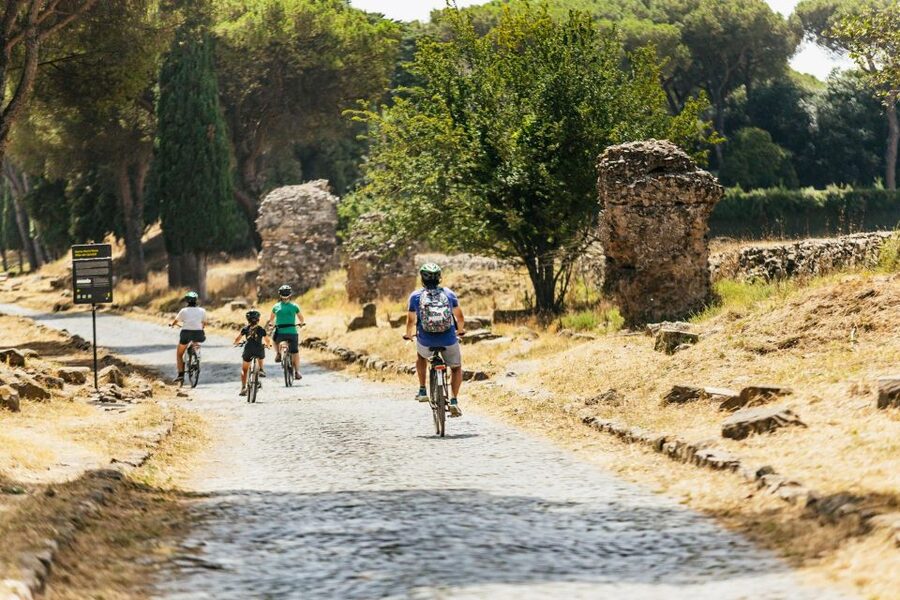
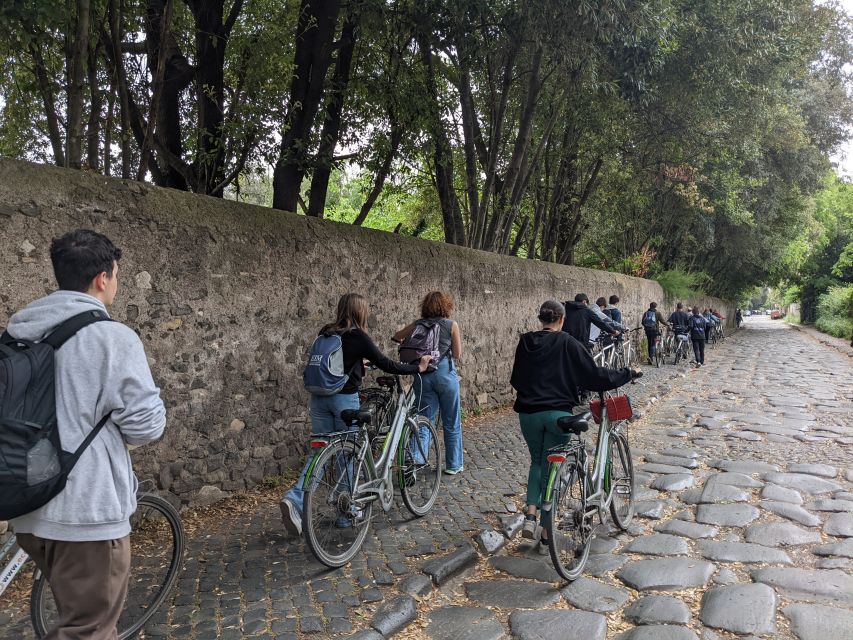
From here, the road begins to show its age in a very physical way. You can see and feel the large paving stones worn down by wagon wheels and countless footsteps. This is one of the tour’s best moments because the past is not behind glass. You are riding directly over the route used nearly 2,000 years ago.
The surface also explains why a standard bicycle could be tiring. The e-bike does not remove every bump, but it takes the strain out of the distance and helps on rises. You still need to steer carefully and stay comfortable on rough ground.
Catacombs of Saint Sebastian or Saint Callixtus
You can add a visit to one of two catacomb complexes, Saint Sebastian or Saint Callixtus. Entry is optional and costs €10 per person, paid on site. The underground portion is added toward the end of the route, so you can decide whether it fits your interests and energy on the day.
The catacombs give the Appian Way another layer. Above ground, you see tombs and monuments built to be noticed. Below ground, the early Christian burial world is quieter and less obvious. If underground cemeteries interest you, this is a worthwhile addition.
There is a practical tradeoff. The full bike route already lasts three and a half hours, and the catacomb visit adds another stop rather than replacing one. If your priority is open-air Roman scenery and the Aqueducts Park, you may prefer to keep the tour moving. If you want the clearest look at early Christian Rome, bring the extra €10 and choose one.
Maxentius’ Circus and the Ben-Hur connection
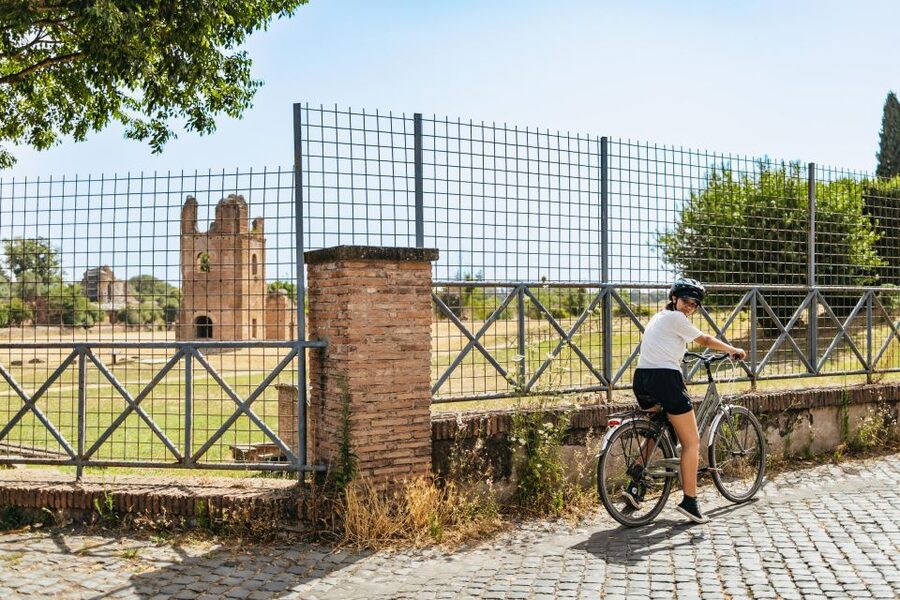
The complex of Maxentius is one of the strongest stops on the route. It includes the emperor’s private circus, a villa, and the mausoleum of his son, Valerius Romulus. Entry to this complex is included at no extra charge.
The circus is especially striking because it remains one of the best-preserved Roman circuses. This is the kind of place where scale becomes easy to understand. Rather than looking at a small surviving wall, you can picture the long racing track and the large crowds once gathered around it.
The site also has a cinema connection. The chariot-race scene in William Wyler’s Ben-Hur, starring Charlton Heston, was filmed here. That detail is useful even if you are not a film fan. It helps explain why the site can feel instantly familiar once the guide points out its role in the movie.
Allow yourself time to listen here. The ancient stones are impressive, but the guide’s explanation turns a large ruin into a place with a purpose, a political owner, and a clear connection to Roman entertainment.
More e-bike tours in Rome:
- Rome: Top Highlights & Hidden Gems Tour by Cannondale E-Bike
★ 4.9 · 1,760 reviews - Rome City Small Group Bike Tour with quality Cannondale EBike
★ 5.0 · 1,380 reviews - Rome by Night – Ebike Small Group Tour – Food and Wine (Option)
★ 5.0 · 1,275 reviews - Rome: E-Bike Night Tour with Food and Wine Tasting
★ 4.9 · 1,131 reviews
Cecilia Metella and the road’s medieval chapter
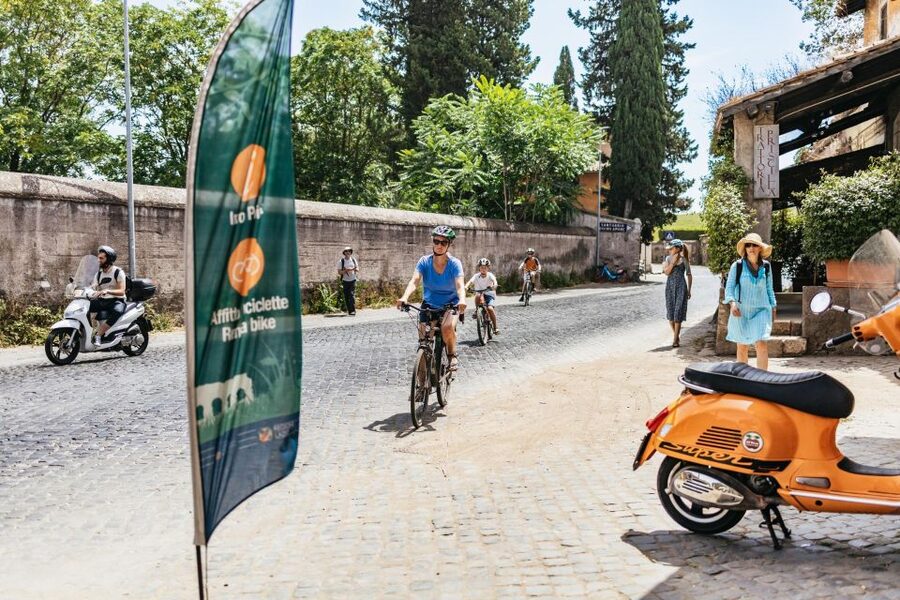
You pass the Tomb of Cecilia Metella rather than making it a full guided stop. Its huge cylindrical form rises above the Appian Way, making it one of the road’s easiest landmarks to recognize.
Cecilia Metella was a noblewoman, but little is known about her beyond her family background. That lack of personal detail is part of the story. The monument tells you more about Roman social rank, wealth, and public display than it does about the woman herself.
The tomb later became part of a medieval fortress controlled by several families, including the Caetani. Its position allowed them to watch the surrounding area and control movement along the road. They built a fenced settlement and charged a duty to pass through. In other words, this was not only a Roman cemetery. It became a strategic checkpoint many centuries later.
You pass through this stretch on the bike, so do not expect a long independent visit inside every monument. The benefit is range: in one morning, you see several major sites instead of spending the entire tour at a single complex.
Villa dei Quintili and the route toward the aqueducts
The route passes Villa dei Quintili, an aristocratic Roman residence known for its size and position along the Appian Way. You do not receive the same extended stop here as at Maxentius’ Circus, but the villa helps fill in the social picture of the road.
The Appian Way was not lined only with military structures and tombs. Wealthy Romans placed villas, baths, and country residences along it. Riding past these remains makes the road feel like a complete Roman corridor, with transport, burial, leisure, and political power sharing the same route.
You also pass the Quintili Nymphaeum before continuing toward the Aqueducts Park. The changing sights keep the ride from becoming a simple straight run over old paving stones.
Aqueducts Park: the tour’s grand finish
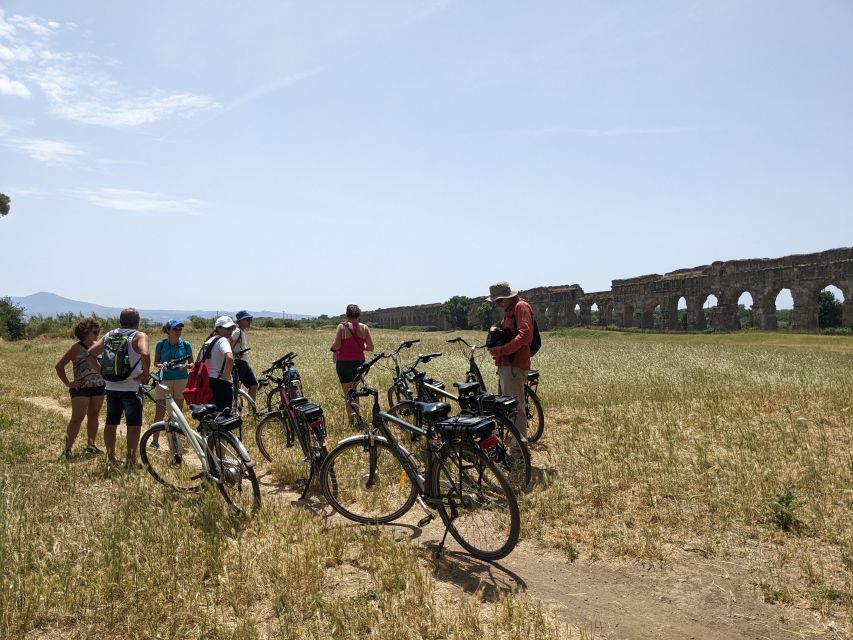
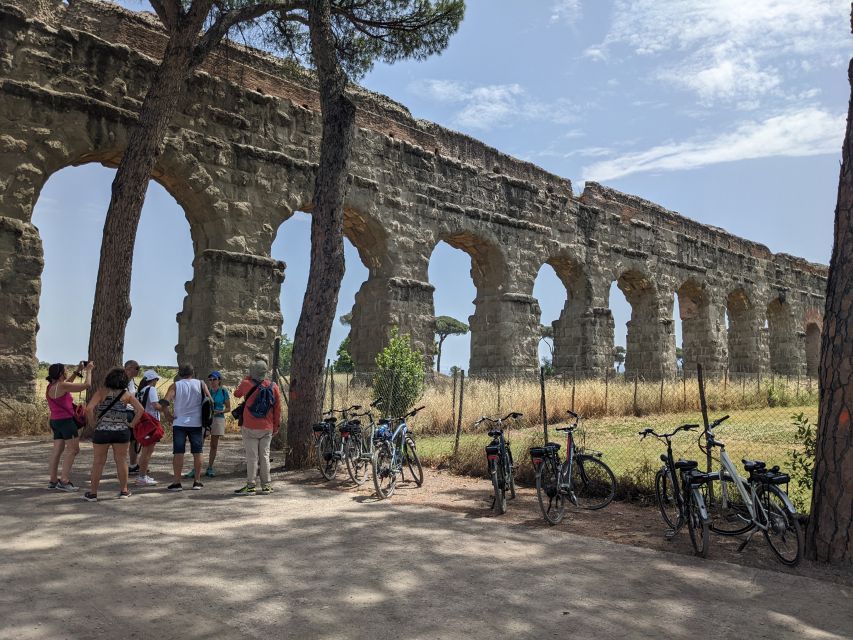
The Aqueducts Park is the visual payoff. Here, long rows of Roman arches cross open ground, showing how engineers carried water over great distances to supply the city.
The arches are more than photogenic ruins. They show the scale and planning behind Roman public works. In central Rome, you often see aqueduct fragments squeezed between modern buildings. In this park, the structures have room around them, so you can read their length and height.
The guide leads you through the park and explains the aqueduct remains. This is a good place to stop, look back along the arches, and understand how the route has shifted from a single ancient road to a larger view of Roman infrastructure.
The park also gives the tour a welcome change of pace. After tombs and archaeological compounds, the broad open setting makes the engineering easier to grasp. You are not just ticking off another ruin. You are seeing how water, roads, estates, and the city all fitted together.
Caffarella Valley adds space and quiet
The ride also passes through Caffarella Valley, another protected area tied to the Appian Way. This section adds open green space and a quieter contrast to Rome’s dense center.
For me, this is an important part of the experience. The Appian Way makes more sense when you see the fields and open ground around it. You get a better idea of why Romans built villas and tombs here, and why the route still feels removed from the city despite being close to major attractions.
Do not expect a fully silent country ride. The complete route includes stretches with traffic, and the guide will manage crossings and help keep the group together. One recent departure was described as roughly 70 percent off-road and 30 percent on streets, which is a useful guide to the balance.
What the e-bike changes
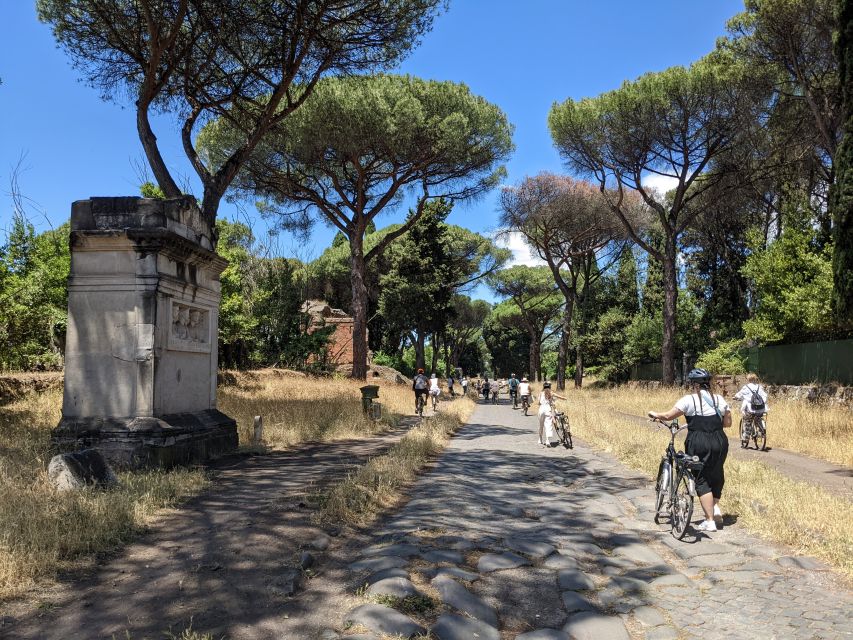
The e-bike is not a minor extra on this excursion. It is the reason the tour can cover the Domine Quo Vadis Church, Maxentius’ Circus, the Appian Way, Caffarella Valley, Villa dei Quintili, and the Aqueducts Park in three and a half hours.
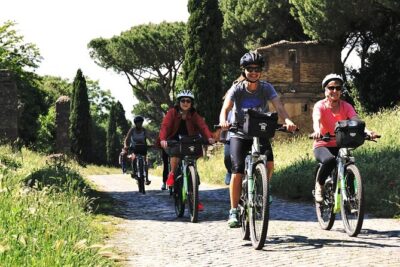
You still pedal, but the motor helps on inclines and reduces fatigue over rough or extended stretches. The equipment includes a helmet, lock, map, and half a liter of mineral water. Child seats for children up to 20 kilograms are available on request, though the activity is not considered suitable for children under 13.
The stated e-bike minimum is age nine and height 135 centimeters, or about 4 feet 5 inches. That does not override the broader suitability rule, so families should check carefully before booking. Adult e-bikes are homologated for riders up to 90 kilograms.
This is not the right choice if you want a relaxed ride with no road awareness. You need to handle the bike, watch the surface, and follow the guide’s directions at crossings. Pregnant people and those with back problems should choose another way to see the park.
Guides, pace, and group experience
The guide can make a major difference here because the route contains long stretches between headline ruins. Recent tours have been led by Federico, Sara, and Alex, with strong praise for their stories, route knowledge, and attention to safety.
Federico has been singled out for his grasp of the area and his ability to keep a family group engaged. Sara has been described as an excellent fit for a well-paced outing, while Alex is noted for making the history entertaining rather than dry. These names may not be the guide on your departure, but they give you a sense of the standard to expect from EcoBike Roma.
The group pace deserves attention. A rider with little cycling experience can slow everyone down, especially on uneven ground and at crossings. If you are a confident cyclist, this may not bother you. If you prefer to stop often and move at your own speed, renting an e-bike for a self-guided ride could be a better match.
The guide-led format still has a clear advantage: you do not need to navigate the park alone, and you get context at sites that can otherwise look like scattered stones.
Is $59 a fair price?
At $59 per person, the tour offers good value if you want the full route and do not already have an e-bike. The price includes the professional English-speaking guide, bike, helmet, lock, map, and water. It also includes entry to the Maxentius complex.
The catacombs are separate at €10 each, so budget for that only if you choose to go underground. Lunch is not included, and the three-and-a-half-hour schedule does not build in a meal stop.
The main value comes from distance and access. You cover several sites spread across a large park without arranging transport between them. You also avoid the effort of organizing an unfamiliar route over rough surfaces and streets.
For a visitor who has already seen the Colosseum, Roman Forum, and other central sights, this is a strong way to add a different side of Rome. For a first-time visitor with only a day or two in the city, I would place the classic center first.
Practical details before you book
Wear shoes that stay secure on the pedals and clothing suited to the weather. The tour runs rain or shine, so a light rain layer can make a wet departure more manageable.
Bring a passport or ID card. A copy is accepted. Alcoholic drinks are not allowed in the vehicle, and bare feet are not permitted.
The activity is offered in English and lasts three and a half hours. You can cancel up to 24 hours before departure for a full refund, and the reserve-now, pay-later option gives you some flexibility when your Rome plans are still changing.
Should you book this Appian Way tour?
Book it if you want ancient Rome beyond the famous center, enjoy active sightseeing, and like the idea of combining Roman roads, tombs, catacombs, villas, countryside, and aqueducts in one outing. The included e-bike makes the distance practical, while the guide adds the context that the scattered ruins need.
Think twice if you are uncomfortable cycling near traffic, have back problems, or want to stop for long periods at each site. This is a full route with a group pace, not a private archaeological tour.
For most reasonably confident riders, the balance is excellent. You get the Appian Way’s worn stones, Maxentius’ remarkable circus, the open Caffarella Valley, and the giant aqueduct arches for less than the cost of many central Rome attractions. Add the catacombs if underground history matters to you, and bring enough energy for a route that earns its final view.
FAQ
How long does the Appian Way e-bike tour last?
The tour lasts three and a half hours, including the ride through the Appian Way, Maxentius’ Circus, Caffarella Valley, and the Aqueducts Park.
Where does the tour start?
It starts at Centro Servizi Appia Antica, EcoBike Bike Rental, at Via Appia Antica 60.
What language is the tour offered in?
The live guided tour is offered in English.
Are the catacombs included?
The catacomb visit is optional and is not included in the listed tour price. You can visit Saint Sebastian or Saint Callixtus by paying €10 per person on site.
Is the e-bike suitable for children?
E-bikes are available from age nine and for riders at least 135 centimeters tall. However, the activity is listed as unsuitable for children under 13, so families should follow the stricter age guidance.
What is included in the price?
The price includes a professional guide, a high-quality e-bike, helmet, lock, map, and half a liter of mineral water. Child seats for children up to 20 kilograms are available on request.
Does the tour run in bad weather?
Yes. The tour takes place rain or shine.
What should I bring?
Bring a passport or ID card, although a copy is accepted. You should also bring clothing suitable for the weather and wear proper footwear, since the route includes cycling over uneven surfaces.
Newest Rome tours we have reviewed
- Private TikTok Video Making in Rome★ 5.0 · 7 reviews
- Assisi, Orvieto and Civita di Bagnoregio Full Day Tour from Rome★ 4.5 · 45 reviews
- Assisi & Saint Francis Path Tour from Rome★ 5.0 · 45 reviews
- Assisi and Cascia Private Day Tour from Rome with Lunch★ 5.0 · 10 reviews
- Art Class in the center of Rome!★ 4.0 · 4 reviews
- Art & Craft: Beer Tour with Street Art in Rome★ 4.5 · 6 reviews
- Arrival in Rome: Airport Transfer & Exclusive City Introduction★ 5.0 · 3 reviews
- From Rome: Private Day-Tour of Tuscany★ 5.0 · 16 reviews
Appian Way and Aqueducts Tours, compared.
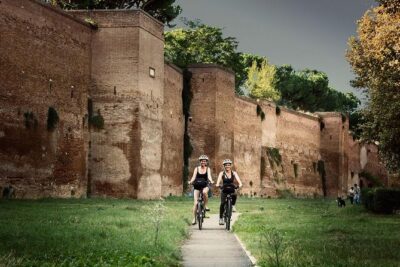
Rome EBike Tour: Appian Way, Catacombs & Roman Aqueducts
Read our review →
Appian Way, Catacombs, & Roman Aqueducts E-bike Tour
Read our review →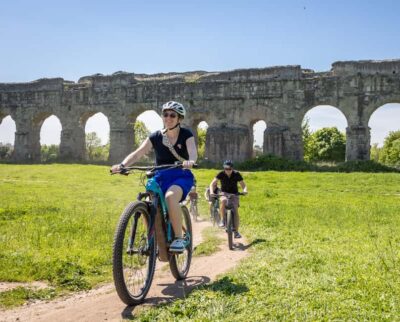
Appian Way E-bike Tour with Catacombs, Aqueducts & Food
Read our review →
Rome Underground: Catacombs Tour, Aqueducts and Appian Way
Read our review →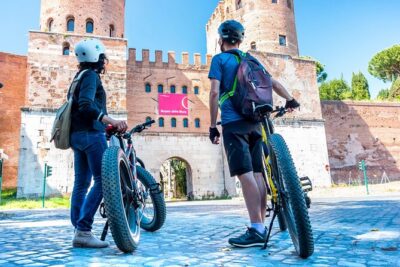
Appian Way Aqueducts Bike Tour (Catacombs & Lunch Option)
Read our review →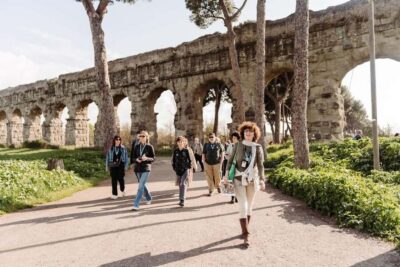
Appian Way, Catacombs and Aqueducts Park Tour with Top E-Bike
Read our review →
Appian Way E-Bike Tour Catacombs, Aqueducts & Picnic
Read our review →Browse the lists this tour appears in