
Reviewed · APPIAN WAY AND AQUEDUCTS TOURS
Rome: Appian Way & Catacombs Golf Cart Shared Tour
The most surprising thing about this tour is how quickly Rome’s crowds give way to open countryside and ancient stone. Just a short distance from the Colosseum, you’re riding the Appian Way, a road tied to Spartacus, Roman emperors, early Christians, and some of the city’s most striking ruins. I like the small group, limited to five, and the chance to cover a large archaeological park without wearing out your feet.
I also like that the catacombs entrance is included, along with a local English-speaking guide and half a liter of water. The main consideration is that the aqueducts are not part of this route, and the catacombs require about 50 uneven steps down and 50 back up, with no lift or place to sit.
Key points to know before booking
- Three hours on the ancient Appian Way: You see several major sites without spending the day on foot.
- A small group of up to five: The format should make it easier to hear your guide and ask questions.
- Catacombs included: Expect a guided underground visit lasting about 50 minutes.
- Strong local guiding: Federico, Frederico, and Shannon are specifically praised for clear English, historical detail, and engaging stories.
- No aqueducts on this route: You’ll need a different tour if the Roman aqueducts are your main goal.
- Not suitable for wheelchair users: The catacombs have irregular stairs, architectural barriers, and no lift.
Why the Appian Way feels different from central Rome
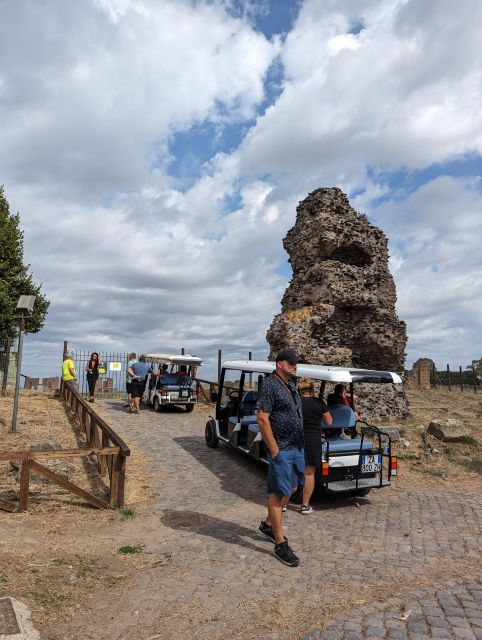
Rome’s famous center is crowded, noisy, and packed with grand monuments. The Appian Way gives you a very different view of the capital. Here, the ruins are spread across a protected area of about 4,580 hectares, with more than 2,000 years of history along an old Roman road.
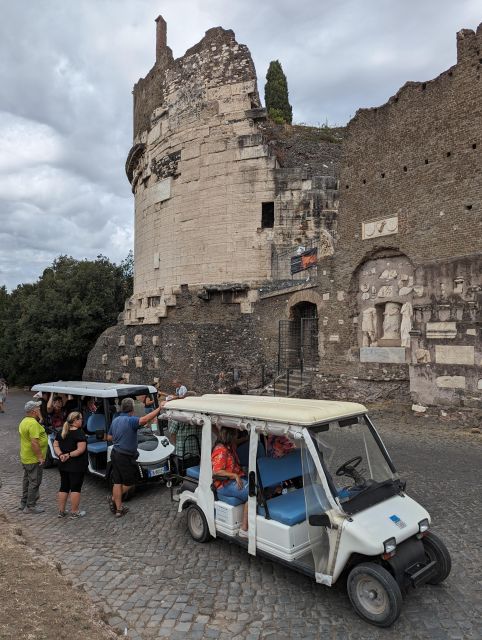
A golf cart is a sensible way to cover it. You can see more than you would on foot, yet you remain close enough to notice the road surface, tombs, fields, and scattered ruins. The pace also leaves room for your guide to explain what you’re seeing instead of rushing from one landmark to the next.
The road is linked with the defeat of Spartacus and his army of enslaved people. The story is not just a famous episode from ancient history. It helps explain the Appian Way’s role as a military and political route, and why this road has carried such a heavy memory for Rome.
I would choose this tour early in a Rome stay if you want context for the city beyond the Colosseum and Vatican. It is especially useful after a few crowded central sights, when a quieter stretch of ancient Rome sounds appealing.
More Appian Way and aqueduct tours:
- Rome EBike Tour: Appian Way, Catacombs & Roman Aqueducts
★ 5.0 · 1,766 reviews - Rome: Appian Way, Catacombs, & Roman Aqueducts E-bike Tour
★ 4.9 · 1,421 reviews - Rome:Appian Way E-bike Tour with Catacombs, Aqueducts & Food
★ 4.9 · 1,210 reviews
Domine Quo Vadis and the story of Saint Peter
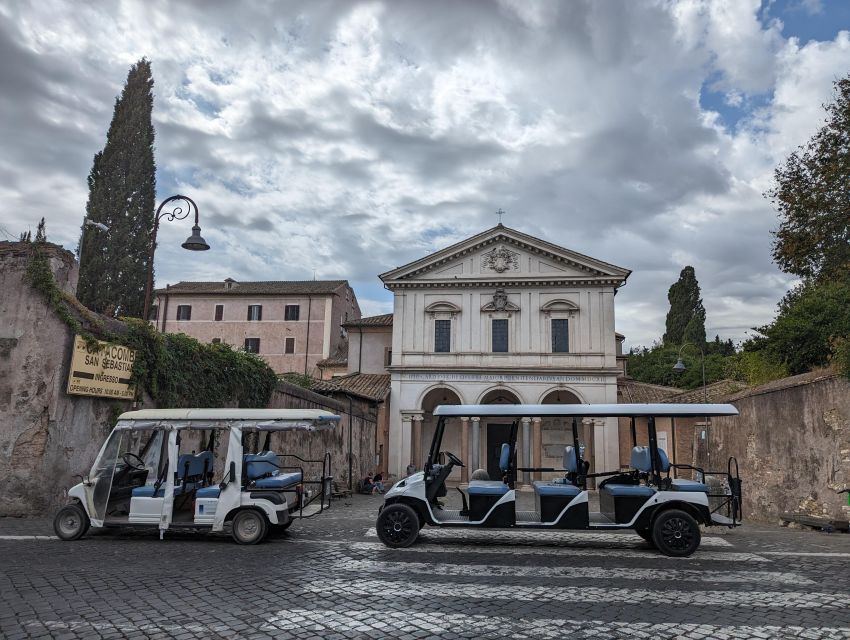
One of the early stops is the church of Domine Quo Vadis. Its name refers to the traditional encounter between Christ and Saint Peter, a story tied to Peter’s decision to turn back toward Rome.
You should not expect a lengthy church visit to dominate the tour. Instead, this stop gives the road a Christian layer before you reach the catacombs. Your guide can connect the church, the ancient road, and the underground burial sites in a way that makes the route feel like one story rather than a series of unrelated ruins.
This is also where the tour’s local storytelling matters. Federico and Frederico are praised for explaining both modern Italy and its past, while Shannon is noted for helping you picture how the area looked centuries ago. The guide’s ability to set the scene is important here, since the road itself does not always explain its own past.
Inside the catacombs, expect steps and cool air
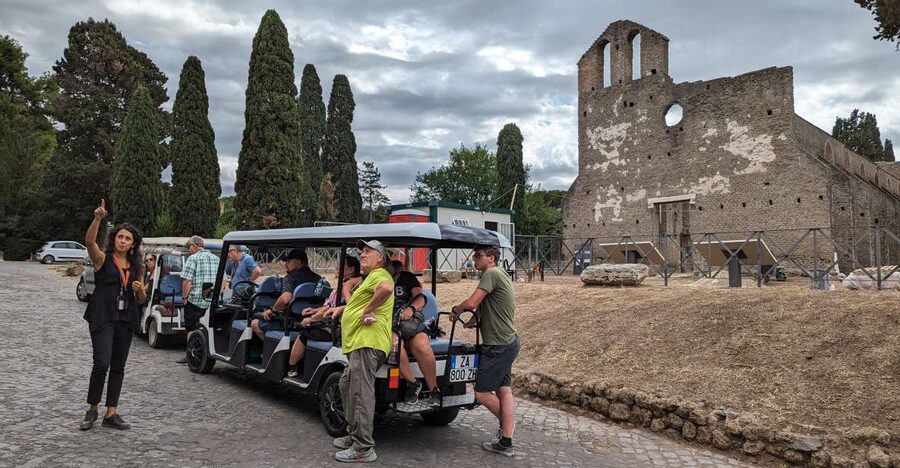
The catacombs are the tour’s most unusual stop. For about 50 minutes, you head underground to see a world shaped by early faith, burial customs, and life outside the official public face of Rome.
The temperature is about 16 degrees Celsius, so a light layer is useful even in warm weather. The practical warning matters more: there are roughly 50 irregular steps going down and the same number coming back up. There is no lift, and you cannot sit along the way.
You should wear secure shoes and be comfortable with uneven stairs. Wheelchairs are not permitted because of the architectural barriers. The experience is also not suitable for pregnant women or children under two.
The catacombs are included in the tour price, which adds real value. You are not simply passing a locked entrance or hearing a short explanation from outside. You get a guided visit below ground, where the physical setting helps you understand why early Christian communities used these spaces.
One point deserves a fair warning. The catacombs may have their own on-site guide in addition to the golf cart guide. The quality of that presentation can vary. One specific account praised the main guide but found the woman guiding the catacombs section too fast and emotionless. That does not erase the value of the site, but it is useful to know that the underground talk may feel more formal and less personal than the rest of your tour.
A small detail noted by a guest was the presence of trilobite fossils in the marble floor. That kind of feature is easy to miss if you hurry, so keep your eyes open and ask questions.
Circus of Maxentius and the memory of Ben-Hur
The Circus of Maxentius is one of the main outdoor highlights. Your guide explains how one of Rome’s large ancient circus complexes worked and places the ruins in the setting of imperial power.
The site is also associated with the film Ben-Hur, which gives you a modern visual reference for a place that can otherwise be difficult to imagine. Movies often simplify Roman spectacle, but they can help you picture the scale of chariot racing and public entertainment.
This is a good example of why a guided visit helps. Ruins can look like low walls and broken foundations when you walk past alone. With a guide, those remains become part of a functioning complex, tied to an emperor and to the public events that helped Roman rulers display authority.
You will have a guided visit here, not just a quick drive-by. The amount of time at each point can depend on the pace of the group and the guide, but the three-hour format gives the excursion a clear limit. You see a broad selection of sites rather than spending most of the morning at one monument.
More catacombs tours in Rome:
- Rome: Crypts and Catacombs Underground Tour with Transfers
★ 4.6 · 5,341 reviews - The Original Roman Crypts and Catacombs Tour with Transfers
★ 4.5 · 4,896 reviews - Rome: Catacombs of St. Callixtus Entry Ticket & Guided Tour
★ 4.6 · 3,037 reviews - Rome: Guided Roman Catacombs Tour with Transfers
★ 4.6 · 1,830 reviews
Cecilia Metella and the power behind a tomb
The Tomb of Cecilia Metella is one of the Appian Way’s best-known monuments. In this tour, you pass by it rather than entering for a full visit.
That distinction matters if you are especially interested in the tomb. The monument is linked to an unknown woman whose family connection points toward Rome’s wealthy elite. The guide uses it to discuss status, money, and the people who could afford to leave a major marker beside one of Rome’s most important roads.
You will get the historical explanation and an exterior view, but not the same experience as a ticketed interior visit. If Cecilia Metella is a personal priority, check the route details carefully and consider adding a separate visit if available during your stay.
Capo di Bove adds another layer to the road
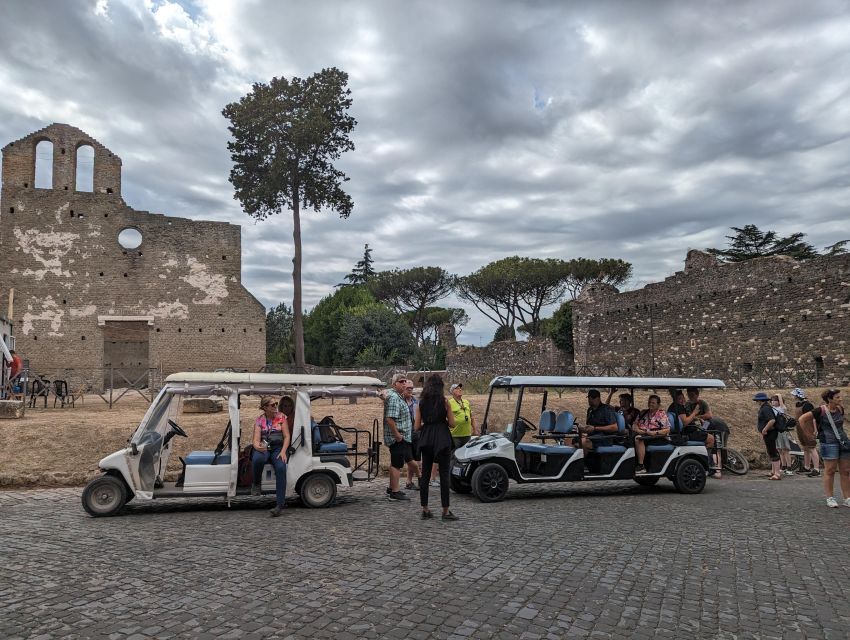
The stop at Capo di Bove gives the tour another archaeological point away from the better-known central monuments. You receive a guided explanation here, making it one of the places where your guide’s knowledge has the most impact.
This is the sort of stop that rewards patience. You may find fewer obvious visual cues than at a large circus or a monumental tomb, but the site helps show how much ancient Rome extends beyond its headline attractions.
I particularly like having this kind of place included because it keeps the tour from becoming only a greatest-hits circuit. The Appian Way is not just one famous road and one set of ruins. It is a long historical corridor, and Capo di Bove helps broaden the picture.
Villa dei Quintili and the darker side of Emperor Commodus
The route passes by Villa dei Quintili rather than offering a full guided entry. The villa is tied to the Quintili brothers and to the political plots surrounding Emperor Commodus.
That story adds a darker edge to the outing. Ancient Roman history is full of grand buildings, but also suspicion, rivalry, confiscation, and imperial power. The villa gives your guide a chance to explain how private wealth could become dangerous when it crossed paths with an emperor.
Because you pass by, you should treat this as an introduction rather than a complete visit. If the Villa dei Quintili is one of your main interests, you may want a separate ticket and more time there. For this golf cart tour, the benefit is seeing it as part of the larger Appian Way route.
What the $95 price includes
At $95 per person, this is not the cheapest way to see the Appian Way. The value comes from combining several pieces in one three-hour outing: transport by golf cart, an English-speaking local guide, a small group, water, and admission to the catacombs with its guided visit.
The small group is important. With a maximum of five people, you are not trying to hear an explanation over a large crowd. You can also ask about details that catch your eye, such as the road, the fossils in the marble, or the stories connected to Spartacus and Commodus.
The price makes less sense if you only want a quick ride along the road or if your main target is the aqueducts. Those are not included. It makes more sense if you want a compact overview of several Appian Way sites and do not want to arrange catacombs admission separately.
There is no hotel pickup, food, or other drink included. You meet at Via Appia Antica, 60, and should arrive about 10 minutes early to check in at the desk. The tour returns to the same location.
How the guiding shapes the experience
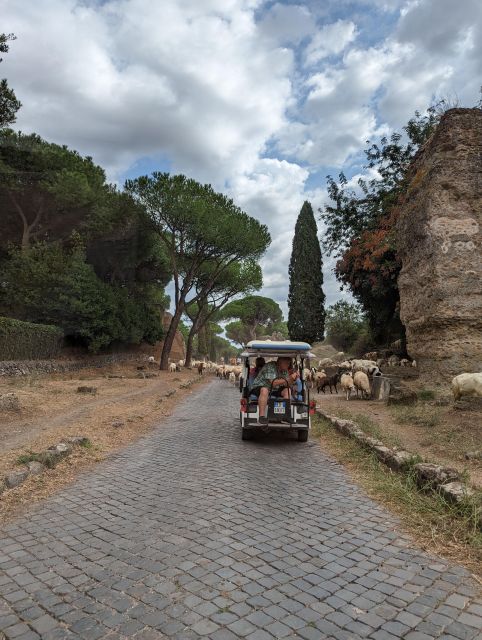
The strongest part of this outing is the human explanation. Federico is praised for being friendly, clear, and full of historical detail. Frederico is also described as an excellent English-speaking guide with interesting stories, and Shannon is praised for helping the group imagine the past.
The information is not limited to dates and names. The best guides connect places to people: Spartacus and the 6,000 enslaved followers defeated on the road, Saint Peter’s traditional encounter, Maxentius and the circus, Cecilia Metella’s tomb, and the political danger around Commodus.
You should still keep your expectations balanced. The tour is conducted in English, and the catacombs may use a separate local presenter. The quality of delivery may vary from one part of the route to another. The main guide appears to be the person who gives the trip its strongest personal character.
Who should book this tour
I would recommend it to you if you want ancient Rome without another packed city-center queue. It suits people who enjoy history but do not want to spend three hours walking between widely scattered sites.
It is also a good choice for first-time visitors who have already planned the Colosseum and Vatican Museums. The Appian Way shows a quieter side of Rome and gives you a sense of how large the ancient city’s world really was.
Families with very young children should choose another outing, since children under two are not accepted. The catacomb stairs also make this a poor fit for anyone with limited mobility, wheelchair users, and pregnant women.
If you want the aqueducts, this is not the right tour. If you want a full visit inside every monument, it is also not the right format. This is a broad, guided introduction to the road and its major points, with the catacombs as the one substantial included interior visit.
Practical details that affect your choice
The activity lasts three hours, but you should plan extra time for reaching Via Appia Antica, 60. The starting and ending point are the same, and hotel transportation is not included.
Bring comfortable shoes for the catacomb stairs and a light layer for the underground temperature. Pets are not allowed. The tour includes half a liter of water per person, but food and other drinks are your responsibility.
You can cancel up to 24 hours before the start for a full refund, and the reserve-now, pay-later option gives you some flexibility while planning your Rome schedule. Starting times vary, so check availability when booking.
Should you book the Appian Way golf cart tour?
Book it if you want a small, history-focused outing that combines the road, catacombs, circus, tombs, and imperial stories in one manageable morning or afternoon. The included catacombs visit and strong main guides such as Federico, Frederico, and Shannon make the $95 price easier to justify.
Skip it if the aqueducts are your top priority, if you need step-free access, or if you want extended interior visits at every archaeological site. For most visitors who want to get beyond central Rome without spending the whole day walking, this is a well-focused way to see the Appian Way and understand why it still matters.
FAQ
How long does the Appian Way golf cart tour last?
The tour lasts three hours.
Where does the tour start and finish?
It starts and ends at Via Appia Antica, 60.
Is the tour conducted in English?
Yes. The tour has a live English-speaking guide.
How many people are in the group?
The group is limited to five participants.
Is the catacombs entrance included?
Yes. Catacombs admission and the guided catacombs visit are included.
How many stairs are inside the catacombs?
You should expect about 50 irregular steps going down and about 50 steps coming back up.
Are the catacombs wheelchair accessible?
No. Wheelchairs are not permitted because of architectural barriers, irregular steps, and the lack of a lift.
Are the aqueducts included?
No. The aqueducts area is not included in this tour.
What is included besides the golf cart ride?
The tour includes an English-speaking local guide, the three-hour golf cart tour, catacombs admission with a guided visit, and half a liter of water per person. Food, drinks beyond the included water, and hotel pickup and drop-off are not included.
More golf cart tours in Rome
- Rome by Golf Cart Private Tour: Beyond the Landmarks
★ 5.0 · 4,361 reviews - Rome on a Golf Cart Semi-Private Tour Max 6 with Private Option
★ 5.0 · 2,502 reviews - Rome Highlights by Golf Cart Private Tour
★ 5.0 · 2,379 reviews - Rome Highlights City Tour by Golf Cart with Gelato
★ 5.0 · 1,088 reviews
Newest Rome tours we have reviewed
- Private TikTok Video Making in Rome★ 5.0 · 7 reviews
- Assisi, Orvieto and Civita di Bagnoregio Full Day Tour from Rome★ 4.5 · 45 reviews
- Assisi & Saint Francis Path Tour from Rome★ 5.0 · 45 reviews
- Assisi and Cascia Private Day Tour from Rome with Lunch★ 5.0 · 10 reviews
- Art Class in the center of Rome!★ 4.0 · 4 reviews
- Art & Craft: Beer Tour with Street Art in Rome★ 4.5 · 6 reviews
- Arrival in Rome: Airport Transfer & Exclusive City Introduction★ 5.0 · 3 reviews
- From Rome: Private Day-Tour of Tuscany★ 5.0 · 16 reviews
Appian Way and Aqueducts Tours, compared.
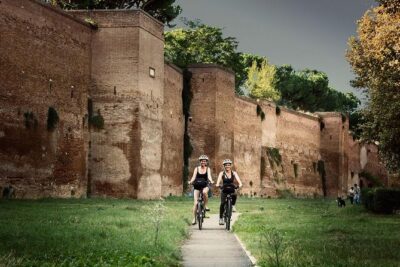
Rome EBike Tour: Appian Way, Catacombs & Roman Aqueducts
Read our review →
Appian Way, Catacombs, & Roman Aqueducts E-bike Tour
Read our review →
Appian Way E-bike Tour with Catacombs, Aqueducts & Food
Read our review →
Rome Underground: Catacombs Tour, Aqueducts and Appian Way
Read our review →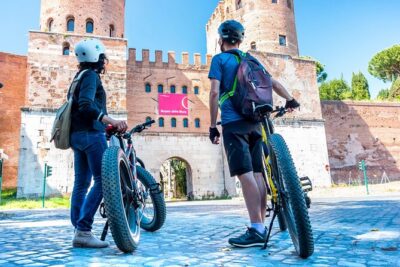
Appian Way Aqueducts Bike Tour (Catacombs & Lunch Option)
Read our review →
Appian Way, Catacombs and Aqueducts Park Tour with Top E-Bike
Read our review →
Appian Way E-Bike Tour Catacombs, Aqueducts & Picnic
Read our review →Browse the lists this tour appears in