
Reviewed · CARAVAGGIO AND BAROQUE ART TOURS
Rome: Caravaggio Guided Walking Tour
Caravaggio’s best Roman paintings are still in the churches they were made for, and this 2.5-hour walk links three of them in one compact route. I like the chance to see The Conversion of St. Paul, The Madonna of the Pilgrims, and The Calling of Saint Matthew in their original settings, rather than as isolated museum pieces. I also like the street-level view of Caravaggio’s Rome, including the palaces where he lived.
The guide adds real value when the art story is brought to life. Patricia, one guide named in the feedback, is praised for combining technical art knowledge with stories about Caravaggio’s difficult life. The main caution is practical: this is a steady walking tour, and one booking reported a serious problem locating the guide at the meeting point.
Key points to know before booking
- Three churches, six major works: See Caravaggio paintings in Santa Maria del Popolo, St. Augustine, and the Contarelli Chapel at St. Louis of France.
- A walk through Caravaggio’s neighborhood: Pass Palazzo Madama and Giustiniani Palace, both linked to the artist’s life in Rome.
- Strong guide-led interpretation: Patricia is specifically praised for making the paintings and the artist’s working methods easy to follow.
- Church clothing rules matter: Your shoulders and knees must be covered, so shorts, sleeveless tops, and short skirts are not allowed.
- Good value for art lovers: At $71 per person, the price pays for a live guide, headsets, and focused access to several major paintings.
- Allow for walking and meeting-point care: The tour is not suitable for people with mobility impairments, and you should look for The Voyager flag at Piazza del Popolo.
Why Caravaggio works best in Rome’s churches
Caravaggio’s art is about more than dramatic light and troubled faces. His paintings were made for real chapels, real worshippers, and specific walls. Seeing them in those settings helps you understand why they caused such a stir.
The churches also change the way you look at the paintings. You are not simply moving from one numbered gallery label to the next. You enter a working place of worship, locate a chapel, and look upward or across a dim interior until the scene appears. The setting is part of the experience.
I especially like that this tour connects the paintings to Caravaggio’s daily life. You pass places associated with his homes and working years, so the walk gives you more than a string of famous titles. It offers a sense of the streets he knew, the patrons who supported him, and the tense world in which he worked.
The format is best for someone who wants context without spending half a day in a museum. You get a concentrated introduction to the artist, with time spent looking closely at key works rather than racing through a large collection.
More Caravaggio and baroque art tours:
- Rome: Terrazza Borromini Open-Air Opera with Aperitif
★ 4.7 · 212 reviews - Borghese Gallery Max 6 People Tour: Baroque & Renaissance in Rome
★ 5.0 · 185 reviews - Guided Walking Tour of Rome: Top Sights & Baroque Treasures
★ 5.0 · 155 reviews
Starting at Piazza del Popolo and Santa Maria del Popolo
The tour begins at Piazza del Popolo, one of Rome’s major public squares. Look for the guide carrying a flag marked with The Voyager logo. Since one booking had trouble finding the guide, I would arrive early, stay near the stated meeting point, and actively look for the flag rather than assuming the group will be obvious.
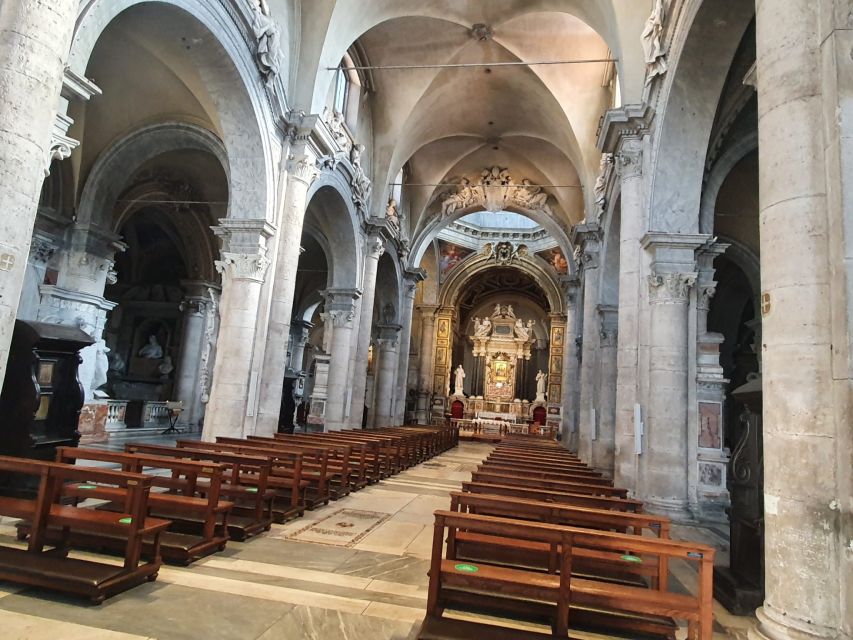
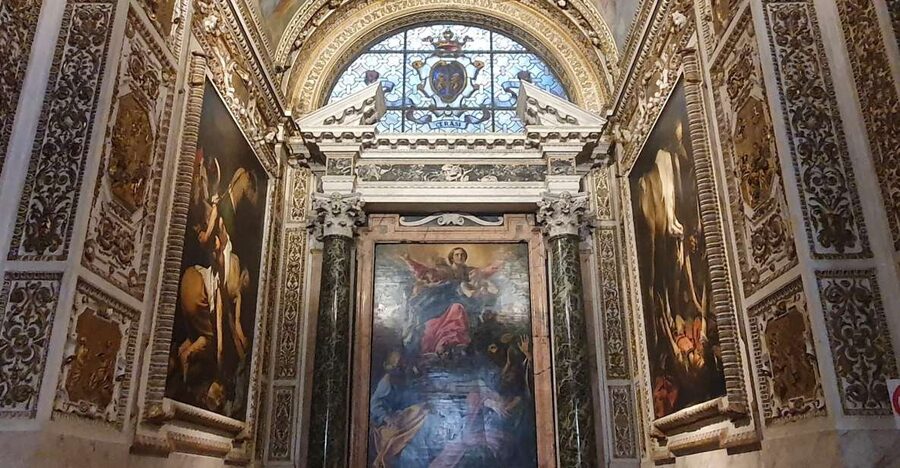
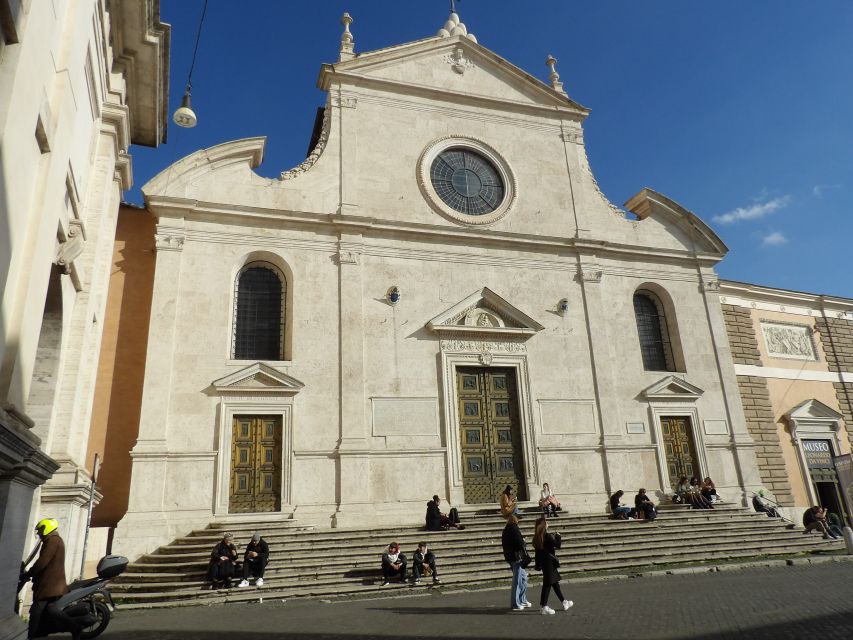
The first church is the Basilica of Santa Maria del Popolo. Here, Caravaggio’s The Crucifixion of St. Peter and The Conversion of St. Paul occupy the Cerasi Chapel. These are among the most important stops on the route.
The paintings show two very different moments. In The Crucifixion of St. Peter, the saint’s execution is presented with force and physical strain. The scene is not polished into a distant religious ideal. Caravaggio places the viewer close to the action, with the labor of the executioners and the weight of Peter’s body making the event feel immediate.
The Conversion of St. Paul is quieter but just as powerful. Paul lies on the ground after his encounter with Christ, while the large horse dominates much of the scene. The unusual composition directs your attention away from a grand heavenly display and toward a stunned human being.
This is where a live guide can help you notice details that are easy to miss. The church may be dark, visitors may gather around the chapel, and the paintings are not viewed from a museum-style distance. Headsets are included, which should make the explanation easier to hear while other people are moving through the space.
The first stop is also a good test of the tour’s pace. You are looking at two demanding works in a functioning church, not being given an unlimited private study period. If you want long periods of silent observation, a self-guided visit may suit you better. If you want someone to point out how Caravaggio uses light, scale, and ordinary human movement, the guide is the reason to book.
Walking past two Caravaggio residences
After Santa Maria del Popolo, the route continues through the historic center. You pass Palazzo Madama and Giustiniani Palace, identified as two of Caravaggio’s residences.
These stops are not presented as additional galleries filled with his paintings. Their value is biographical. They help connect the artist to actual addresses and make the walk feel like a passage through the world in which he lived and worked.
I like this part because it breaks up the church visits. You get a chance to walk, look at Rome’s alleys, and hear about Caravaggio away from the paintings themselves. The streets become part of the story, not just the space between attractions.
You should still expect a moderate amount of walking. Comfortable shoes are specifically recommended, and this is not a good choice if you need a tour with minimal time on your feet. People with mobility impairments are advised against booking it.
The tour does not include hotel pickup, transport, food, or drinks. That keeps the focus on the art, but you should plan your own route to Piazza del Popolo and carry only what you need. Large bags and luggage are not allowed, so this is not an easy activity to join immediately after arriving with suitcases.
The Madonna of the Pilgrims at St. Augustine
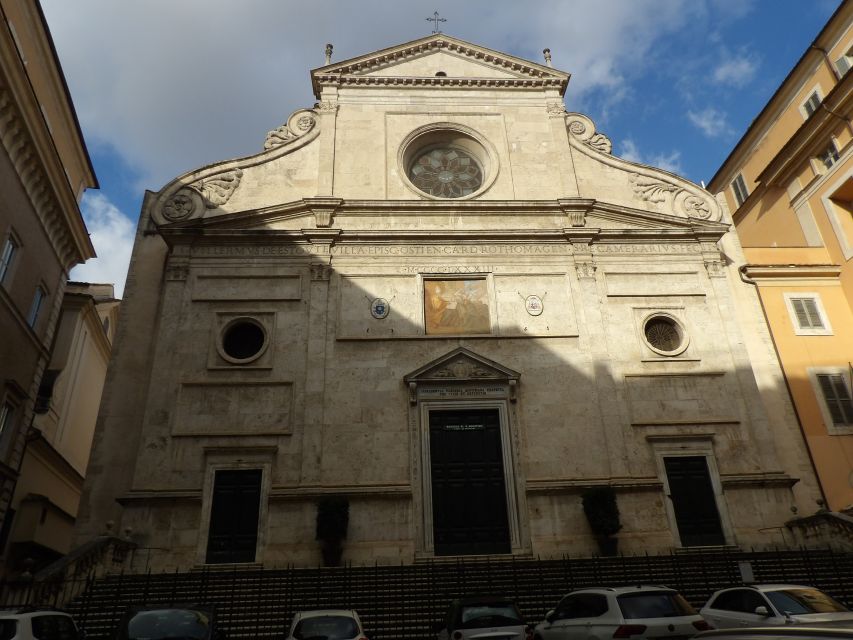
The next major stop is the Church of St. Augustine, home to The Madonna of the Pilgrims. The painting is sometimes known as Madonna of Loreto, and it is a clear example of Caravaggio’s habit of bringing sacred subjects close to everyday life.
The figures are not presented as distant, untouchable symbols. The pilgrims appear with the marks of ordinary travel, while the Madonna and child meet them at ground level. That directness is central to Caravaggio’s appeal, and a guide can explain how the painting’s realism served both an artistic and religious purpose.
This church stop also shows why the setting matters. The painting was made for a religious interior, where its visitors would encounter it as part of prayer and devotion. You can consider the contrast between the rough, human presence in the painting and the expectation of idealized religious art at the time.
The guide’s explanation is likely most useful here if you want to understand technique without needing an art degree. The tour is not described as an academic lecture. The strongest feedback points to an informal walk led by someone who enjoys the subject and can explain how Caravaggio worked.
That distinction matters. You will hear about his life, style, and methods, but the experience is built around walking and looking, not a classroom presentation. If you prefer a formal art-history seminar, this may feel light. If you want a clear story with visual examples in front of you, it is a sensible balance.
More walking tours in Rome:
- Rome: Trastevere & Campo de Fiori Street Food Walking Tour
★ 4.9 · 2,768 reviews - Rome: Paranormal Night Walking Tour & Secret Backstreets
★ 4.9 · 1,921 reviews - Rome by Night Walking Tour – Legends & Criminal Stories
★ 4.5 · 1,003 reviews - Rome: Guided City Center Evening Sightseeing Walking Tour
★ 4.4 · 953 reviews
The Contarelli Chapel and the life of Saint Matthew
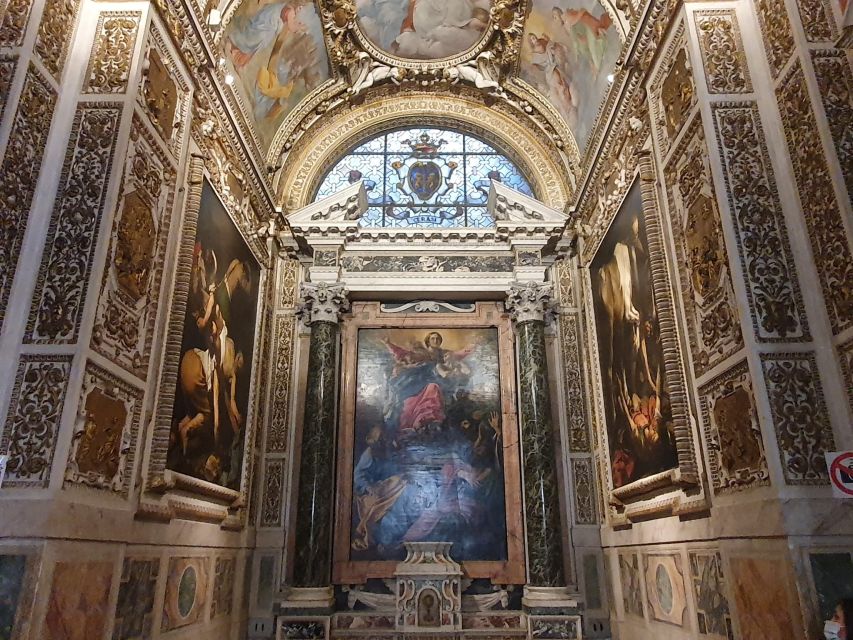
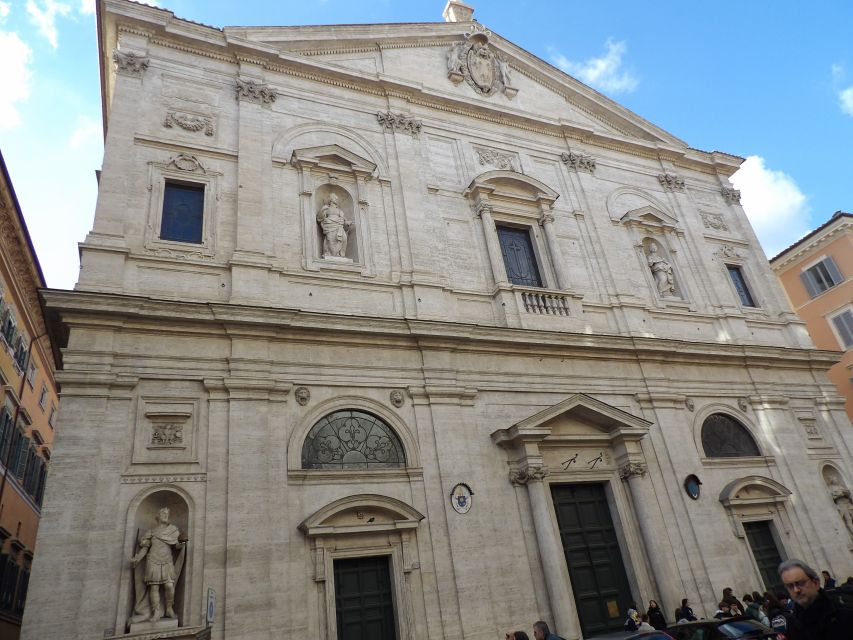
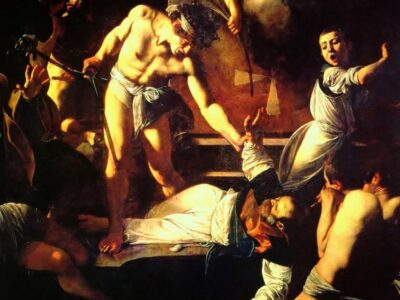
The final stop is St. Louis of France and its Contarelli Chapel. Here you see The Calling of Saint Matthew, The Inspiration of Saint Matthew, and The Martyrdom of Saint Matthew, grouped as Caravaggio’s Life of Saint Matthew.
This is the tour’s major finish. The three paintings allow you to follow a sequence rather than examine one isolated image. The Calling of Saint Matthew is especially famous for its beam of light and the sudden gesture that draws Matthew out of an ordinary group of men. The scene feels like a moment interrupted, which is one reason the painting remains so gripping.
The Inspiration of Saint Matthew offers a different mood, while The Martyrdom of Saint Matthew brings violence and movement into the chapel. Taken together, the works show how Caravaggio handled narrative, light, gesture, and physical presence across a complete commission.
I value this final group because it gives the tour a clear shape. You begin with two major chapel paintings, move through places linked to the artist, see The Madonna of the Pilgrims, and finish with a full cycle devoted to Saint Matthew. The route is short enough to remain focused, but the final chapel gives you a substantial amount to consider.
Church conditions can affect the visit. Religious buildings may close all or part of their interiors with little warning. If a sudden closure occurs beyond the operator’s control, an alternative may not be possible and no refund is promised. That is not a reason to avoid the tour, but it is worth remembering if you are booking it around a very tight schedule.
What the guide adds to the paintings
The guide is the central reason to choose this activity over visiting the churches alone. You receive a live guide in English or Italian, plus headsets and an audio guide option in those languages.
Patricia is the named guide receiving the clearest praise in the supplied feedback. She is described as passionate about Caravaggio and able to explain both the artist’s life and his working process. The useful detail here is that her style is not presented as stiff or overly academic. She makes room for stories and further questions.
That kind of delivery suits Caravaggio. His paintings are dramatic, but his life was also marked by conflict and instability. A guide who can connect the two without turning the visit into gossip gives you a better way to understand the work.
The headsets should help when you are standing in a busy church or moving with a group. They also let you keep your eyes on the painting instead of leaning toward the guide. I would still expect some variation based on the individual guide and the day’s conditions, since a tour is a live performance rather than a fixed audio program.
The overall score is 3.7 from 17 reviews, so the experience has not been flawless for everyone. The most serious complaint concerns a guide who could not be found at the meeting point, followed by a long wait and a missed tour. That appears to be an operational issue rather than a criticism of the art content, but it is important enough to plan around. Arrive early and confirm that the person with the The Voyager flag is your guide.
Is $71 a fair price?
At $71 per person, this is not the cheapest way to see paintings in Rome. The churches themselves are not being sold as a museum ticket package, and you are paying mainly for the guide, route, interpretation, and headsets.
I think the price can make sense if you are especially interested in Caravaggio or if you want help understanding what you are seeing. The tour places several major works into one organized visit and adds biographical stops between the churches. You also avoid the common problem of entering a church, finding a famous painting, and not quite knowing what makes it important.
The value is weaker if you already know Caravaggio well or prefer to move at your own pace. You may want more time with each painting than a group schedule allows. You also need to arrange your own food, drinks, transportation, and hotel transfer.
For a first visit to Rome, I would treat this as a specialist half-day activity rather than a general sightseeing tour. It will not cover the Colosseum, Vatican Museums, or other major sights. Its value comes from focus.
Clothing, timing, and practical preparation
Church dress rules are firm. Both men and women need to cover their shoulders and knees. Shorts, short skirts, sleeveless shirts, and similar clothing are not permitted.
Wear comfortable clothes and shoes. Bring a passport or ID card, as requested for the activity, but do not bring luggage or a large bag. Since food and drinks are not included, plan around the 2.5-hour duration and carry only what is allowed.
The tour is offered in English and Italian. Starting times vary, so you need to check availability for the date you want. Free cancellation is available up to 24 hours before the activity for a full refund, and you can reserve now and pay later.
The walk is not suitable for people with mobility impairments. Even without a mobility concern, Rome’s streets and churches can make a moderate walk feel tiring, so I would avoid placing this immediately after another long walking tour.
Who should book this Caravaggio walk?
I would choose this tour if you want to see major Caravaggio paintings in their intended church settings and want a guide to explain the details. It is especially useful for first-time visitors who recognize The Calling of Saint Matthew but want a clearer picture of the artist’s wider body of work.
It also suits art lovers who enjoy biography. The stops at Palazzo Madama and Giustiniani Palace give the tour a personal thread, while the three churches keep the focus on actual paintings.
I would think twice if you have limited walking ability, dislike group timing, or need a guaranteed schedule with no risk of church closures. I would also be careful about booking if you cannot comply with the clothing rules.
Should you book it?
Book this tour if Caravaggio is high on your Rome list and you want a lively guide-led explanation rather than a quick look at famous paintings. The route is focused, the works are first-rate, and the chance to see them in their original churches is the main reward.
At $71, it is a fair specialist tour, not a bargain attraction. Arrive early for the guide, look for The Voyager flag, wear church-appropriate clothing, and leave room for a moderate walk. If you take those precautions, this offers a strong way to connect Caravaggio’s art with the streets and chapels of Rome.
FAQ
How long does the Caravaggio walking tour last?
The tour lasts 2.5 hours.
Which Caravaggio paintings are included?
You see The Crucifixion of St. Peter and The Conversion of St. Paul at Santa Maria del Popolo, The Madonna of the Pilgrims at St. Augustine, and The Life of Saint Matthew in the Contarelli Chapel at St. Louis of France.
Where does the tour meet?
The tour starts at Piazza del Popolo. The guide carries a flag with The Voyager logo.
What languages are available?
The live tour is available in English and Italian. Audio guide support is also available in English and Italian.
What should I wear to enter the churches?
You must cover your shoulders and knees. Shorts, short skirts, and sleeveless shirts are not allowed for men or women.
Is the tour suitable for someone with mobility impairments?
No. The tour involves a moderate amount of walking and is not suitable for people with mobility impairments.
Newest Rome tours we have reviewed
- Private TikTok Video Making in Rome★ 5.0 · 7 reviews
- Assisi, Orvieto and Civita di Bagnoregio Full Day Tour from Rome★ 4.5 · 45 reviews
- Assisi & Saint Francis Path Tour from Rome★ 5.0 · 45 reviews
- Assisi and Cascia Private Day Tour from Rome with Lunch★ 5.0 · 10 reviews
- Art Class in the center of Rome!★ 4.0 · 4 reviews
- Art & Craft: Beer Tour with Street Art in Rome★ 4.5 · 6 reviews
- Arrival in Rome: Airport Transfer & Exclusive City Introduction★ 5.0 · 3 reviews
- From Rome: Private Day-Tour of Tuscany★ 5.0 · 16 reviews
Caravaggio and Baroque Art Tours, compared.
Terrazza Borromini Open-Air Opera with Aperitif
Read our review →
Borghese Gallery Max 6 People Tour: Baroque & Renaissance in Rome
Read our review →
Guided Walking Tour of Rome: Top Sights & Baroque Treasures
Read our review →
Renaissance Scarlet Ladies Tour: Caravaggio’s and Borgia’s Women
Read our review →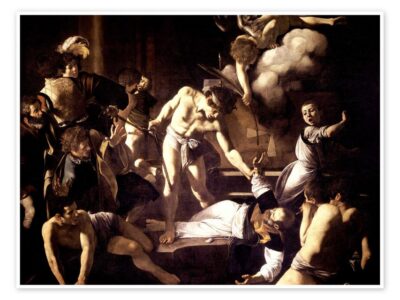
Rome’s Baroque Art Walking Tour: Who Killed Caravaggio?
Read our review →
Palazzo Barberini (Caravaggio Exhibition Is Not Included)
Read our review →
Browse the lists this tour appears in