

Reviewed · CASTEL SANT’ANGELO TOURS
Rome: Castel Sant’ Angelo Ticket and Audio Guide
Castel Sant’Angelo gives you several layers of Rome in one visit: Hadrian’s mausoleum, a fortified stronghold, grand papal rooms, and a rooftop lookout over the city. The building feels different from the Forum or Colosseum because you move through a tall, enclosed monument rather than across open ruins.
I like the skip-the-line entry, especially when the ticket queue stretches toward an hour. I also like the freedom to set your own pace with the audio tour, stopping longer in the Sala Paolina or at the upper viewpoints. The main catch is that the ticket instructions about all-day entry and timed admission can be unclear, so check the voucher carefully before you go.
Key points at a glance

- Hadrian’s mausoleum: See the enormous cylindrical tomb built for Emperor Hadrian, later reshaped into Castel Sant’Angelo.
- Sala Paolina frescoes: Take time with the well-kept painted rooms, one of the castle’s most rewarding interiors.
- Fast entry: Show the barcode at the entrance instead of waiting to buy a ticket on site.
- Self-guided freedom: The audio tour lets you pause, skip sections, and move at your own speed.
- Rooftop views: The upper levels offer wide views across Rome, with a café or bar where you can sit.
- Practical limits: You need your own compatible smartphone and headphones, and some areas require stairs.
What makes Castel Sant’Angelo worth your time

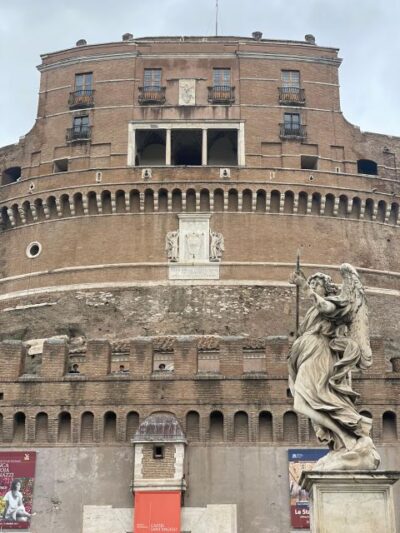
Castel Sant’Angelo is not simply an old castle. It began as the Mausoleum of Hadrian, built in the second century as the burial place for Emperor Hadrian and his family. Over time, Rome converted the massive tomb into a military fortress and later a papal residence.
That changing purpose gives the visit its shape. You start with the weight and scale of Roman imperial construction, then move through defensive spaces, decorated chambers, and elevated terraces. You are not looking at one period of history. You are walking through a building that kept being reused because its position and thick walls mattered.
I find this variety more interesting than a site that offers only one type of monument. One room may feel austere and defensive, while the next has polished decoration and painted walls. The audio guide helps explain those changes, especially if you do not already know why a mausoleum became a castle.
The site also makes a good companion to a walk along the Tiber or a visit to St. Peter’s Basilica. The main entrance is designed as the start and finish of the self-guided route, so you can plan it as a stand-alone stop rather than joining a larger group.
More Castel Sant’Angelo tours:
- Rome: Castel Sant’Angelo Skip-the-Line Ticket & Audio Guide
★ 4.4 · 3,500 reviews - Rome: Castel Sant’Angelo Skip-the-Line Ticket
★ 4.4 · 3,040 reviews - Rome: Castel Sant’Angelo Skip-the-Line Entry Ticket
★ 4.8 · 2,231 reviews
Getting through the entrance with the skip-the-line ticket
The strongest practical reason to book this experience is the admission process. You receive the ticket by email and show the barcode at Castel Sant’Angelo. Several visitors found that they could bypass the long ticket-buying queue and enter with little fuss.
That matters most on a busy day. Saving an hour at the entrance gives you more time for the castle itself, and it removes one of the least enjoyable parts of sightseeing in Rome. The ticket is not a private entrance or a personal escort. You still go through the normal site admission procedure, but you do not need to buy the basic ticket at the gate.
Pay close attention to the entry information printed on your voucher. The activity information describes the ticket as valid for one day, while the supplied experiences include conflicting expectations about whether visitors could arrive at any point or had to use a stated time slot. One person had to contact the provider to receive a ticket with the correct entry time.
My advice is simple: do not assume all-day access. If a time appears on your voucher, treat it as important. Arrive on time and keep the ticket email easy to open on your phone.
The audio guide and the freedom to set the pace

This is a self-guided tour, not a walking tour with a person leading you from room to room. You download the app and audio content before your visit, then explore with your own phone and headphones.
The audio guide is available in English, German, Italian, French, Spanish, and Chinese. It includes spoken commentary, text, and maps that can be used offline after downloading. You need 100 to 150 MB of free storage, a charged Android or iOS device, and your own headphones.
I like this format for Castel Sant’Angelo because the building rewards lingering. You may want to spend extra time in the decorated rooms, pause at a view, or move quickly through a section that interests you less. A live guide has a fixed rhythm. Here, you control the rhythm.
The tradeoff is that a phone audio guide can feel less personal. It will not answer a question, point out something you missed, or adjust its explanation to your interests. One person found the audio commentary helpful but later preferred a human guide. Another stopped using the app after a while.
Before you leave your hotel, download the tour and test the sound. Bring headphones rather than relying on the phone speaker. Also check your operating system. The guide does not work with Windows Phones, iPhone 5 or 5C and older models, older iPod Touch devices, or older iPads listed in the admission information.
The Mausoleum of Hadrian and the lower castle

Your first major subject is the original mausoleum. Hadrian’s tomb was built as a huge round structure, an imposing form that gave the future castle its core. The audio narration provides the Roman background and helps you understand the building before later military and papal changes take over the story.
This is where the audio guide earns its keep. Without context, the thick walls and curved passages can be hard to read. With it, the structure becomes a record of changing Roman power, from imperial burial monument to fortified residence.
The route is not a simple line through a museum. You move through different levels and spaces, and the building itself does much of the teaching. Look closely at the contrast between the heavy defensive character and the more polished rooms higher up.
You should allow enough time to stop and listen. One visitor felt the site needed a generous visit, even while preferring an audio guide to a fixed guided tour. That is good advice. Rushing through Castel Sant’Angelo means missing the way its spaces change as you climb.
More self-guided and audio tours in Rome:
- Rome: Colosseum & Forum with Audio Guide App -Optional Arena
★ 4.2 · 24,770 reviews - Rome: City Sightseeing Hop-on Hop-off Bus with Audioguide
★ 4.0 · 16,045 reviews - Rome: St. Peter’s Basilica & Dome Entry Ticket & Audio Tour
★ 4.2 · 7,537 reviews - Vatican & Sistine Chapel Ticket with Optional Audio Guide
★ 4.1 · 5,405 reviews
Sala Paolina and the decorated rooms

The Sala Paolina is one of the interior highlights. Its frescoes are described as well maintained, and they provide a sharp contrast to the bare strength of the original mausoleum.
I would not treat this room as a quick passage on the way to the roof. Stop, look at the painted surfaces, and listen to the relevant audio section if you want the room’s meaning rather than just its appearance. The decoration shows how the building served a refined papal court as well as an army.
The audio guide’s historical anecdotes are meant to add detail beyond dates and names. That is useful here, where the visual impression can be strong but the historical setting may not be obvious. You can pause the narration and examine the frescoes without holding up anyone else.
The limitation is that the app cannot replace a trained guide in front of the art. If you want detailed discussion of technique, symbolism, or restoration, a human-led tour may suit you better. For a flexible visit, though, the audio commentary gives you a useful foundation.
The upper terraces, rooftop café, and Rome views
The upper levels are the reward at the end of the climb. From the terraces and top areas, you get broad views across Rome. The view is one of the most praised parts of the experience, and it gives the visit a strong finish after the darker interior passages.
There is also a café or bar where you can sit and take in the scene. I would plan a short pause here rather than treating the rooftop as a quick photo stop. A drink or coffee can give you time to recover from the stairs and look out over the city.
The route upward is part of the attraction, but it also creates a practical issue. Even though the activity is marked wheelchair accessible, not every part of the castle is easy to reach. Several parts involve stairs, and one visit with an elderly wheelchair user could reach only some areas.
If you use a wheelchair or have limited mobility, contact the site or provider before booking and ask exactly which sections are open to you. The broad accessibility label should not be read as a promise that every room, terrace, or level is fully accessible.
How much time should you allow?
The ticket is valid for one day, but the supplied information does not set a fixed tour length. Your actual visit depends on how much of the audio guide you hear and how long you spend in the decorated rooms and viewpoints.
I would avoid squeezing Castel Sant’Angelo into a rushed gap between two timed attractions. The entrance shortcut saves time, but the building deserves enough space for the climb, the Sala Paolina, and the rooftop pause.
A self-guided route works well if you want to go slowly. You can listen to every section, stop for photographs, and return to a room that caught your attention. If you prefer a quick historical overview, you can shorten the visit by choosing only the main audio stops.
The lack of a live guide also makes timing easier in one sense. You are not tied to a group departure. But your ticket may still carry a specific entry time, so distinguish between the flexible touring pace and the actual admission window.
Is $31 a fair price?
At $31 per person, this is not the cheapest way to see a Roman monument. The value comes from combining admission, the audio content, offline maps and text, and the time saved at the entrance.
I think the price makes the most sense during busy periods, when the ticket queue can cost you a large part of the day. It also suits you if you want commentary but do not want to join a group or follow a guide on a fixed route.
The value is weaker if you already own a detailed guidebook, dislike listening on your phone, or can visit at a quiet time without a line. The audio guide is included, but your phone and headphones are not. You must also prepare the download yourself.
Free admission applies to visitors under 18 and to visitors with disabilities accompanied by someone from the health and social assistance service. EU citizens aged 18 to 25 may qualify for reduced admission, but this supplier does not provide the reduced or free tickets. If you qualify, check the official admission route before paying for this product.
Who should book this experience?

I would choose this ticket if you want three things: quick entry, independent touring, and a broad introduction to the building’s history. It suits first-time visitors who want more context than a bare admission ticket provides.
It also works for repeat visitors to Rome. Castel Sant’Angelo is easy to overlook beside larger attractions, yet the combination of ancient construction, military use, decorated papal rooms, and city views gives it a different feel.
Families with older children may like the freedom to move at different speeds, though each child needs access to a compatible phone if they are expected to use the audio guide. Couples and solo visitors can also benefit from the flexible route.
I would look for a live guided tour instead if you want questions answered as they arise or if you prefer a guide to point out details. I would also think carefully before booking if stairs are a major concern. Accessibility is available, but full access to every part is not assured.
Small details that make the visit easier
Bring a charged smartphone and headphones. Download the app and audio tour before reaching the entrance, since you do not want to spend your first minutes dealing with storage or mobile data.
Keep at least 100 to 150 MB free. Make sure your phone is a supported Android or iOS model, especially if it is older. The audio tour is not compatible with the older devices listed in the admission information.
Large bags and luggage are not allowed, and smoking and pets are prohibited. Plan to arrive with only what you need for the visit.
The self-guided route begins and ends at the main entrance. Keep the barcode ready, and confirm any printed entry time before you set out. Those simple checks prevent the most avoidable problems.
Should you book Castel Sant’Angelo with the audio guide?
Book it if you value fast admission and personal control more than a live guide. The ticket makes a strong case during crowded periods, and the audio commentary gives useful structure to a monument that can otherwise feel confusing.
I especially recommend it for visitors who want to study the Sala Paolina, enjoy the rooftop views, and take their time moving through Hadrian’s mausoleum. I would skip it in favor of a human-led tour if personal explanation matters most, or check accessibility carefully if stairs limit your mobility.
For many visitors, the biggest win is not a fancy tour format. It is the chance to get inside without wasting an hour in line, then explore one of Rome’s most layered monuments at your own speed.
FAQ
Where does the Castel Sant’Angelo audio tour start and finish?
The self-guided audio tour is designed to start and end at the main entrance of Castel Sant’Angelo.
What is included with the ticket?
You receive an adult skip-the-line admission ticket, audio tours for Android and iOS, offline text, audio narration, and maps.
Is a live guide included?
No. This is a self-guided audio tour, not a tour with a live person.
Which languages are available?
The audio guide is available in English, German, Italian, French, Spanish, and Chinese.
Do I need my own smartphone?
Yes. You need a compatible Android or iOS smartphone to download and use the audio tour.
Do I need to bring headphones?
Yes. Headphones are not included, so bring your own.
How much storage do I need?
You need approximately 100 to 150 MB of free space to download the audio tour and related content.
Can I use an older iPhone or iPad?
The audio guide is not compatible with iPhone 5 or 5C and older models, iPod Touch 5th generation or older, iPad 4th generation or older, iPad Mini 1st generation, or Windows Phones.
Is Castel Sant’Angelo wheelchair accessible?
The activity is listed as wheelchair accessible, but some areas require stairs and may not be reachable by wheelchair. Check access details before booking if full mobility access is important to you.
Are free or reduced tickets available through this supplier?
Visitors under 18 and some visitors with disabilities qualify for free admission, while EU citizens aged 18 to 25 may qualify for reduced admission. This supplier does not provide those free or reduced tickets.
Can I bring luggage or a large bag?
No. Luggage and large bags are not allowed. Pets and smoking are also prohibited.
Newest Rome tours we have reviewed
- Private TikTok Video Making in Rome★ 5.0 · 7 reviews
- Assisi, Orvieto and Civita di Bagnoregio Full Day Tour from Rome★ 4.5 · 45 reviews
- Assisi & Saint Francis Path Tour from Rome★ 5.0 · 45 reviews
- Assisi and Cascia Private Day Tour from Rome with Lunch★ 5.0 · 10 reviews
- Art Class in the center of Rome!★ 4.0 · 4 reviews
- Art & Craft: Beer Tour with Street Art in Rome★ 4.5 · 6 reviews
- Arrival in Rome: Airport Transfer & Exclusive City Introduction★ 5.0 · 3 reviews
- From Rome: Private Day-Tour of Tuscany★ 5.0 · 16 reviews
Castel Sant’Angelo Tours, compared.
Castel Sant’Angelo Skip-the-Line Ticket & Audio Guide
Read our review →

Castel Sant’Angelo Skip-the-Line Entry Ticket
Read our review →




Browse the lists this tour appears in