
Reviewed · ROME CITY HIGHLIGHTS TOURS
Rome:CityCenter Hidden Highlights Guided Walking Tour German
Rome’s best surprises are often below street level or hidden behind an ordinary church door. This German-language walking tour links famous sights with the underground Vicus Caprarius museum, the Stadium of Domitian, and Saint Ignazio’s remarkable illusion ceiling.
I like the mix of major landmarks and lesser-known stops, and I like the way the route keeps Rome’s ancient and Baroque sides in view. The main drawback is pace: three hours on foot, with stairs and outdoor walking, can feel long in rain or summer heat. The tour runs rain or shine.
- Underground Rome: See an old aqueduct and the water system beneath the Vicus Caprarius museum.
- Ancient sports venue: Walk through the Stadium of Domitian, once built for 15,000 to 20,000 spectators.
- Big sights included: Piazza Navona, the Pantheon, and Trevi Fountain all fit into one route.
- A visual surprise: Saint Ignazio’s painted ceiling uses perspective to create a three-dimensional effect.
- German-speaking guidance: The tour includes headsets, so you can follow explanations in busy streets.
- Useful planning note: Bring cash, wear suitable clothing for churches, and meet at Bernini’s fountain in Piazza Navona.
Why This Rome Walk Works So Well
This is not a tour built around one famous monument. It is a connected walk through the center of Rome, showing how the modern city sits on top of ancient structures and how Baroque artists used churches, fountains, and public squares as one grand stage.
You begin at Piazza Navona and finish at La Rinascente, a central department store. Along the way, the route moves between open-air squares, an ancient stadium, a functioning church, a famous fountain, and an underground archaeological site. That variety keeps the three hours from feeling like one long history lecture.
The tour is especially useful if you are in Rome for a short stay and want a strong first look at the historic center. You will not enter the Colosseum or Vatican Museums on this route, but you will cover several central landmarks without spending the whole morning at one attraction.
The tour is conducted in German. That matters more than it might seem. Rome’s monuments come with layers of names, dates, religious changes, and architectural terms. Listening in your first language makes it easier to follow the story while keeping an eye on traffic, fountains, ceilings, and ruins.
Meeting Bernini at Piazza Navona
Look for the Deutsche Römerin sign at Bernini’s fountain in Piazza Navona. The meeting point is at approximately 41.89900588989258, 12.473088264465332, so give yourself a little time to locate the guide in this busy square.
Piazza Navona is an excellent place to begin because it immediately shows you Rome’s ability to reuse the past. The long oval shape follows the outline of the ancient Stadium of Domitian, even though today the square is lined with Baroque churches, palaces, cafés, and fountains.
Your guide begins with an introduction to the square and points out the main details. Bernini’s fountain gives the group a natural landmark, but it can also be a crowded meeting spot. Look for the sign rather than relying only on a person in the crowd.
Headsets are provided, which is a practical benefit. Central Rome can be noisy, and guides often need to speak while the group is moving. The headset lets you hear the explanation without requiring everyone to gather tightly around the guide.
More city highlights tours in Rome:
- Rome: Big Bus Hop-on, Hop-off Open-Top Sightseeing Tour
★ 3.5 · 2,580 reviews - Rome in a Day Group Tour with Vatican Museums and Colosseum
★ 4.5 · 2,450 reviews - Rome Highlights by Golf Cart Private Tour
★ 5.0 · 2,379 reviews
Entering the Stadium of Domitian
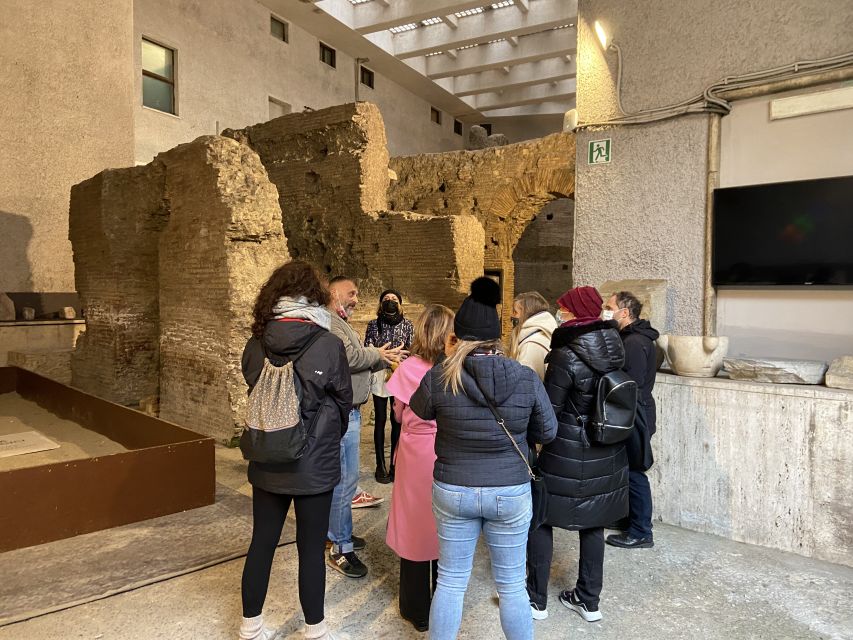
The first major ancient stop is the Stadium of Domitian. This athletic venue once held between 15,000 and 20,000 spectators, a useful reminder that ancient Rome was not only about emperors, temples, and military power. Public entertainment was part of daily city life too.
The remains sit below the present street level. That change in height helps you understand how much Rome has been built up over the centuries. Above ground, Piazza Navona looks like a grand Baroque square. Below it, the earlier stadium reveals the older shape of the site.
You will walk through the surviving remains rather than simply glance at them from a pavement. That makes this stop more meaningful than a quick photograph in the square. The scale of the venue also gives you a clearer idea of the crowds who once gathered here.
Do not expect a Colosseum-sized monument. The experience is more compact, and much of the value comes from understanding the site’s position beneath the modern city. If you want a large, open ancient arena, book the Colosseum separately. If you enjoy seeing how one Roman building became the foundation for another city space, this is a fine addition.
The Pantheon and Rome’s Changing Beliefs
The route continues to the Pantheon, one of central Rome’s most recognizable buildings. Your guide explains that it began as a Roman temple and was later converted into a Catholic church.
That change gives the building its special character. You are not looking at a frozen ancient monument. You are seeing a structure that survived because its use changed. Its continued religious role also explains why visitors need to treat the interior as a church, not simply as an archaeological attraction.
The Pantheon is one of the tour’s headline sights, but the guide’s explanation is what makes the stop useful. You learn to see the building as part of Rome’s long sequence of political and religious changes. The tour does not simply point and move on.
The supplied information does not specify how long the group remains inside, so plan on a guided visit rather than an extended independent exploration. If the Pantheon is high on your personal list, you may want to return later with extra time.
Saint Ignazio’s Painted Illusion
Saint Ignazio church offers one of the tour’s most memorable visual pauses. Its ceiling frescoes use perspective to create the appearance of a three-dimensional architectural space. From the floor, painted forms seem to rise above you, making the ceiling feel far deeper than it is.
This is a good example of why a guide can improve a Rome walk. Without an explanation, you might admire the ceiling and move on. With the right viewing point and a little context, you can understand how the illusion works and why Baroque artists cared so much about drama, movement, and optical tricks.
You may find yourself looking up for longer than expected. The church is not just another stop between the Pantheon and Trevi Fountain. It provides a quieter change of mood after the open squares and ancient ruins.
Dress for church visits. Short skirts and sleeveless shirts are not allowed, so choose clothing that meets the stated requirements from the start. That is simpler than trying to solve a dress problem halfway through a walking tour.
More walking tours in Rome:
- Rome: Trastevere & Campo de Fiori Street Food Walking Tour
★ 4.9 · 2,768 reviews - Rome: Paranormal Night Walking Tour & Secret Backstreets
★ 4.9 · 1,921 reviews - Rome by Night Walking Tour – Legends & Criminal Stories
★ 4.5 · 1,003 reviews - Rome: Guided City Center Evening Sightseeing Walking Tour
★ 4.4 · 953 reviews
Trevi Fountain and the Baroque City
The route then reaches the Trevi Fountain, Rome’s most famous Baroque fountain. It is an easy place to understand the city’s theatrical side: water, stone, movement, mythology, and architecture all combine in one crowded urban setting.
The fountain is usually busy, so your guide’s commentary and the provided headset are useful here. You may not get a quiet, private view, but you will get the story while standing in the middle of one of Rome’s most recognizable public spaces.
This stop also gives you a chance to compare different kinds of Rome. The Stadium of Domitian explains an ancient public venue. The Pantheon shows a building adapted across religious eras. Saint Ignazio turns painting into architecture. Trevi Fountain uses Baroque design to make water itself part of the city’s show.
That sequence is one of the tour’s strengths. You are not seeing disconnected sights. You are watching Rome change style and purpose from one stop to the next.
Below Street Level at Vicus Caprarius
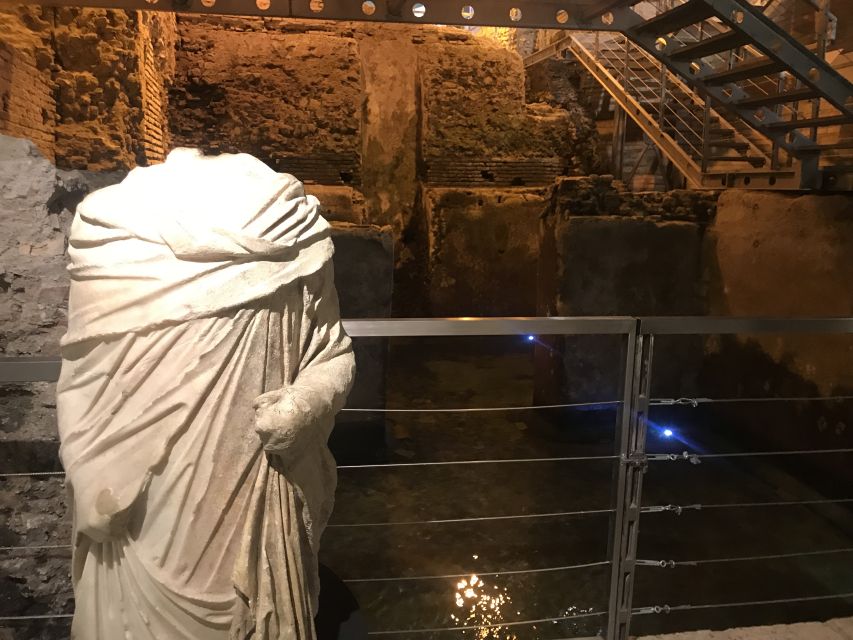
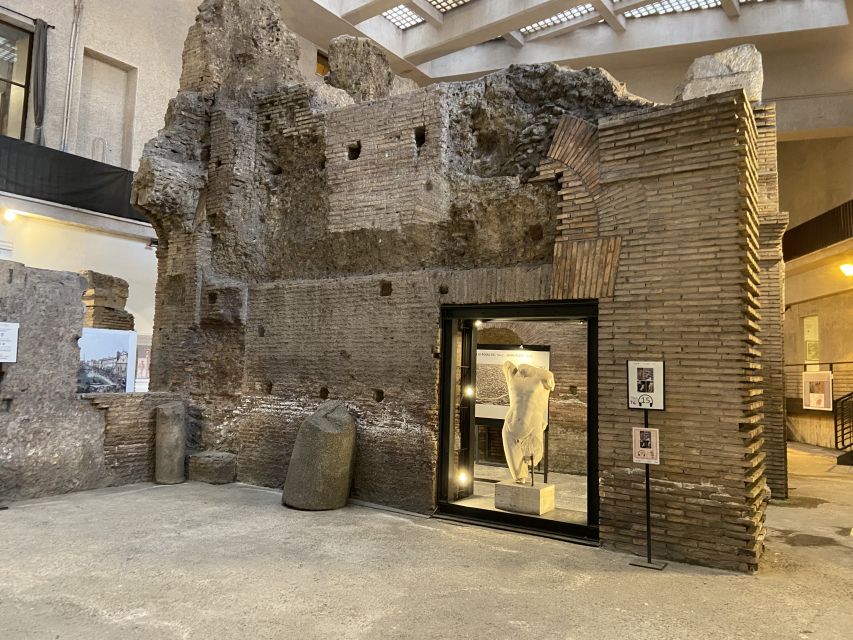
The Vicus Caprarius museum is the tour’s most unusual stop. Beneath the modern city, you see excavated remains connected with Rome’s ancient water system, including an old aqueduct.
The site is often described as the underground city of water, and it gives you a different way to understand Rome. Fountains and public water displays above ground depended on engineering below ground. Here, the infrastructure becomes the subject rather than a hidden support system.
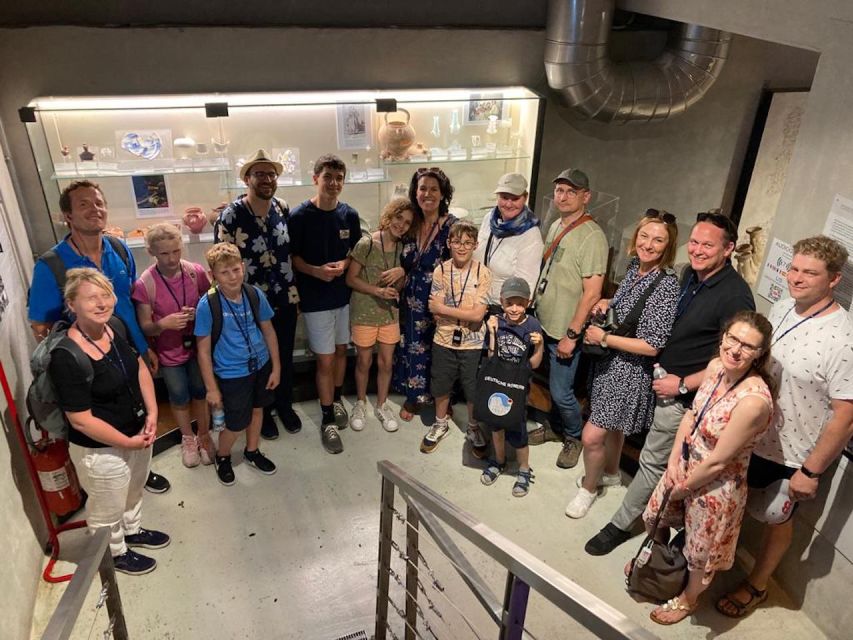
The underground setting is also a useful contrast with the open squares. You move from famous public monuments into a more enclosed archaeological space where the remains are closer to eye level. It feels less like checking off a landmark and more like discovering a layer under the pavement.
The tour information identifies this as a museum visit and notes skip-the-ticket-line access. It does not provide details about the exact amount of free time inside, so expect the stop to be part of a guided sequence rather than a long self-guided museum visit.
Bring cash as requested in the practical information. The tour does not state that cash is needed for a particular fee, but having it with you is the sensible choice.
Finishing at La Rinascente
The walk ends at La Rinascente, a large department store in central Rome. This is a practical finish because you remain in the city center rather than being left at an outlying site.
The end point also gives you flexibility. You can continue shopping, find a meal, walk onward to another central sight, or use the location as a reference point for the rest of your day. The tour is not a round trip, so remember that you finish somewhere different from where you met.
The three-hour duration is long enough to cover a lot, but short enough to fit into a morning or afternoon. Check the available starting times before booking, since the exact departure time is not fixed in the information provided.
The German Guides and Tour Style
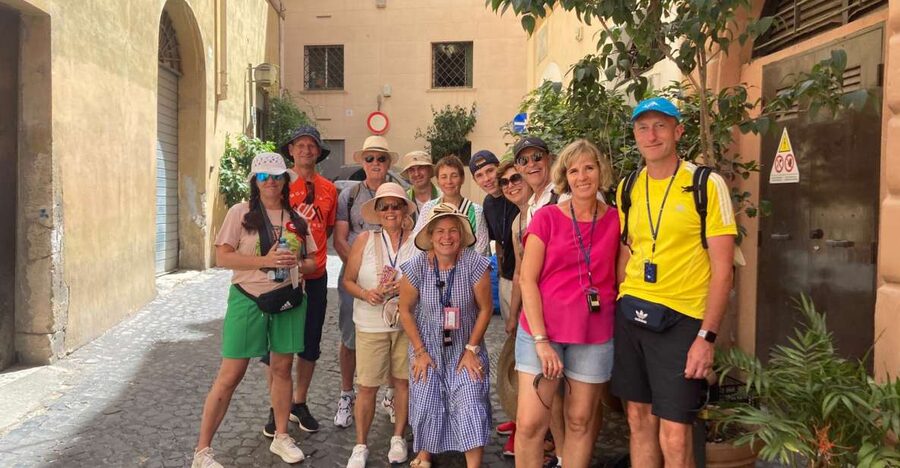
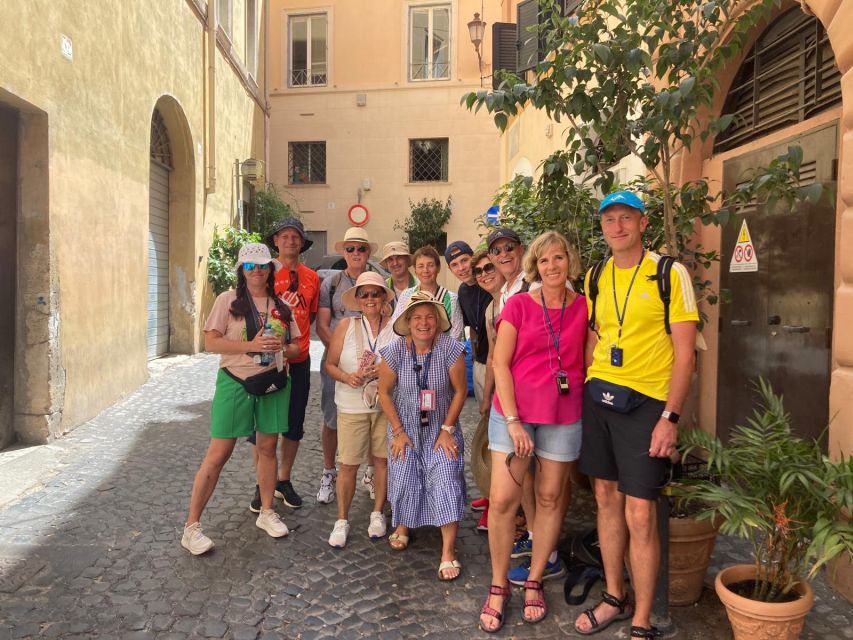
The guide makes a real difference on a walk like this. Gianluca is described as humorous and warm, while Janina is praised for giving excellent insight into the city. The comments about both guides point to a style that combines information with personality rather than delivering a dry recital of dates.
The published rating is 4.8 from 11 reviews, and the strongest pattern is clear: people praise the guides for being informative, entertaining, and personally engaged. Several comments describe the tour as interesting, very well done, and worthwhile. That is encouraging for anyone who wants more than a route between photo stops.
Still, guide-led experiences vary from one departure to another. Gianluca or Janina may not be the person leading your group, and the supplied information does not promise a particular guide. What is guaranteed is German-language guidance, headsets, and the stated itinerary.
Is Three Hours Good Value?
No price is provided here, so I cannot judge the tour by a fixed cost. I can judge what you receive for the time: several major landmarks, two less obvious archaeological or artistic stops, a German-speaking guide, headsets, and a route that crosses much of central Rome.
The value is strongest if you would otherwise visit these places without context. The Pantheon and Trevi Fountain are easy to locate, but the Stadium of Domitian and Vicus Caprarius are easier to miss or misunderstand. Saint Ignazio can also pass as just another church if nobody points out the ceiling’s visual trick.
The tour is less useful if you prefer to set your own pace. You will move with the group and follow the guide’s order. You may want longer at the Pantheon, more time for photographs at Trevi Fountain, or a slower look at the underground museum. A guided walk trades some freedom for structure and explanation.
The advertised skip-the-ticket-line benefit may also save time at included ticketed stops, though the information does not list every access condition. Treat it as a helpful feature, not a guarantee that every queue in Rome disappears.
Who Should Book This Walking Tour?
I would choose this tour if you want a broad introduction to central Rome in German and like the idea of combining famous sights with places you might not find on your own.
It suits:
- First-time Rome visitors who want orientation before exploring alone.
- German-speaking couples, families, or small groups.
- Anyone interested in ancient engineering, Roman public life, and Baroque design.
- People who enjoy walking between sights instead of riding from one monument to another.
- Short-stay visitors who need several central highlights in one three-hour block.
It may not suit you if mobility is limited, since the route includes substantial walking and an underground museum. The activity information does not provide accessibility details, so ask before booking if stairs or uneven surfaces are a concern.
It is also less suited to someone seeking a focused tour of the Colosseum, Vatican Museums, or Roman Forum. Those attractions are not part of this experience. This is a central-city sampler with a strong emphasis on Rome’s lesser-known layers.
Practical Details Before You Go
Meet at Bernini’s fountain in Piazza Navona and look for the Deutsche Römerin sign. Arrive with enough time to find the group, since Piazza Navona is large and busy.
Wear comfortable walking shoes. The activity lasts three hours, takes place outdoors as well as indoors, and runs rain or shine. A small umbrella or rain layer is sensible, but the supplied information does not specify any special equipment.
Dress appropriately for church entry. Short skirts and sleeveless shirts are not allowed. Bring cash, and remember that you finish at La Rinascente rather than returning to Piazza Navona.
Free cancellation is available up to 24 hours before the tour for a full refund. You can also reserve now and pay later, which helps if your Rome schedule is still changing.
Should You Book It?
Book this walk if you want Rome explained in German through a mix of major sights and unusual stops. The strongest reasons are the underground aqueduct at Vicus Caprarius, the Stadium of Domitian below Piazza Navona, and the ceiling illusion at Saint Ignazio. Those details give the tour more character than a standard fountain-and-square stroll.
Choose something else if you want an in-depth visit to one major monument or plenty of time for independent photographs. For everyone else, this is a useful three-hour introduction to the center of Rome, with enough ancient stone, Baroque spectacle, and underground archaeology to keep the route lively.
FAQ
What language is the tour conducted in?
The tour is conducted in German with a live German-speaking guide.
How long does the walking tour last?
The tour lasts three hours.
Where does the tour begin?
It begins at Bernini’s fountain in Piazza Navona. Look for the Deutsche Römerin sign.
Where does the tour finish?
The tour finishes at La Rinascente in central Rome.
Which major sights are included?
The route includes Piazza Navona, the Pantheon, and the Trevi Fountain.
Does the tour visit an underground site?
Yes. You visit the underground excavations at the Vicus Caprarius museum and see remains connected with an old aqueduct and Rome’s water system.
What should I bring and wear?
Bring cash. Short skirts and sleeveless shirts are not allowed, and the tour takes place rain or shine.
Newest Rome tours we have reviewed
- Private TikTok Video Making in Rome★ 5.0 · 7 reviews
- Assisi, Orvieto and Civita di Bagnoregio Full Day Tour from Rome★ 4.5 · 45 reviews
- Assisi & Saint Francis Path Tour from Rome★ 5.0 · 45 reviews
- Assisi and Cascia Private Day Tour from Rome with Lunch★ 5.0 · 10 reviews
- Art Class in the center of Rome!★ 4.0 · 4 reviews
- Art & Craft: Beer Tour with Street Art in Rome★ 4.5 · 6 reviews
- Arrival in Rome: Airport Transfer & Exclusive City Introduction★ 5.0 · 3 reviews
- From Rome: Private Day-Tour of Tuscany★ 5.0 · 16 reviews
Rome City Highlights Tours, compared.
Big Bus Hop-on, Hop-off Open-Top Sightseeing Tour
Read our review →
Rome in a Day Group Tour with Vatican Museums and Colosseum
Read our review →
Top Highlights & Hidden Gems Tour by Cannondale E-Bike
Read our review →
Rome Food Tour: Hidden Gems of Trastevere with Dinner & Wine
Read our review →
Rome Highlights City Tour by Golf Cart with Gelato
Read our review →
Rome in a Day Tour with Vatican, Colosseum and Historic Center
Read our review →Browse the lists this tour appears in