
Reviewed · OSTIA ANTICA TOURS
Rome: Ostia Antica Guided Tour in German with Tickets
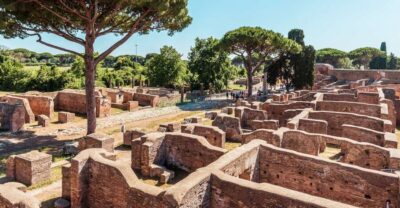
Ostia Antica gives you something Rome’s famous center often cannot: room to see how an entire Roman city worked. In three hours, you move past the theatre, Forum, public baths, latrines, and ordinary buildings that reveal daily life beyond emperors and monuments.
I like the German-speaking guidance, especially for travelers who want more than a quick look at weathered walls. I also like that entry tickets and headsets are included, so you can focus on the site rather than sorting out separate admission.
The main drawback is time. Ostia Antica is a large archaeological park, and three hours can feel short if you want to examine every street and building. The tour also takes place rain or shine, with no wheelchair access listed.
Key points to know before booking
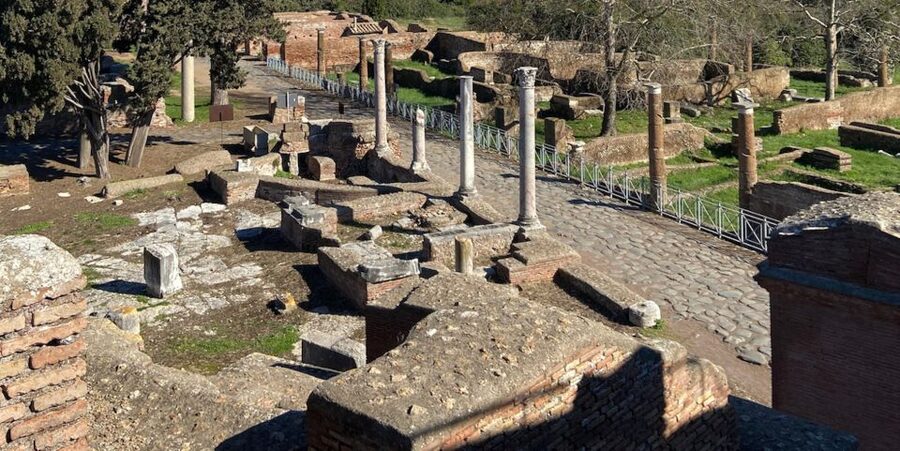
- A Roman city, not just one monument: See the theatre, Forum, public baths, latrines, and other buildings in one archaeological park.
- German guidance throughout: The live tour is conducted in German, with guides including Janina and Philipp associated with especially strong tours.
- Tickets and headsets included: You do not need to arrange separate admission, and headsets help you follow the guide.
- Three hours on site: This gives you a useful introduction, but not enough time for every corner of Ostia Antica.
- The tour ends in the park: From there, you can return toward Rome or continue one stop farther to Ostia Lido.
- Bring practical gear: Wear comfortable shoes, carry water in a non-glass bottle, and use sunscreen in summer.
Why Ostia Antica makes a good break from central Rome
Ostia Antica was once a prosperous Roman city connected with the sea. Its streets and buildings give you a broader picture of Roman life than a single arena or triumphal arch can provide.
At the Colosseum, you mainly see a place built for public spectacle. At Ostia Antica, you can consider where people worked, bathed, traded, worshipped, and handled ordinary bodily needs. That change in scale is the main reason I recommend this experience to anyone with an extra half-day in Rome.
The site is also useful for understanding Rome’s wider reach. Ostia was tied to the capital and had an important connection with the coast. The remains show a functioning city rather than an isolated ruin, even though much of what you see today is archaeological excavation.
I would not book this tour expecting a polished museum visit. You are walking through an open archaeological park, with uneven ground and exposed remains. The reward is a more direct encounter with the ancient city, but the setting asks for sensible shoes and a little patience.
More Ostia Antica tours:
- Ancient Ostia Antica Semi-Private Day Trip from Rome by Train with Guide
★ 4.5 · 579 reviews - From Rome: Ostia Antica Guided Half-Day Trip by Train
★ 4.8 · 486 reviews - Horse Sanctuary & Trail Ride in Ostia Antica
★ 4.5 · 276 reviews
Meeting the German guide at Ostia Antica
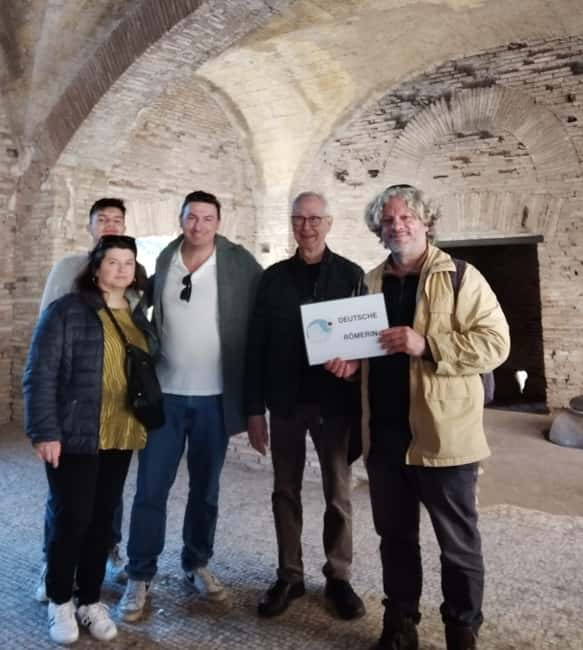
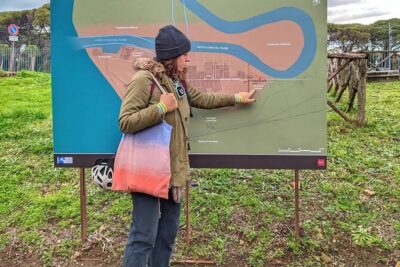
The meeting point is at 41.75925827026367, 12.300618171691895. Look for the guide holding the Deutsche Römerin sign.
That detail matters. Ostia Antica is not a place where you want to wander around hoping to spot the right group. Give yourself enough time to reach the stated meeting point and watch for the sign rather than relying only on a person’s appearance.
The tour is conducted in German. That makes it a clear choice for German-speaking visitors who want explanations in their own language. The guide uses a headset, which should make the commentary easier to follow while the group is moving through the ruins.
Several guides connected with this experience have made a strong impression. Janina has been praised for explaining the site in a lively way that also held the attention of teenagers. Philipp has been described as a professional guide with extensive knowledge of Ostia Antica and personal archaeological experience at the site. Those names are useful to know, but guide assignments can change, so do not book on the assumption that one particular person will lead your tour.
The theatre: Ostia’s public stage
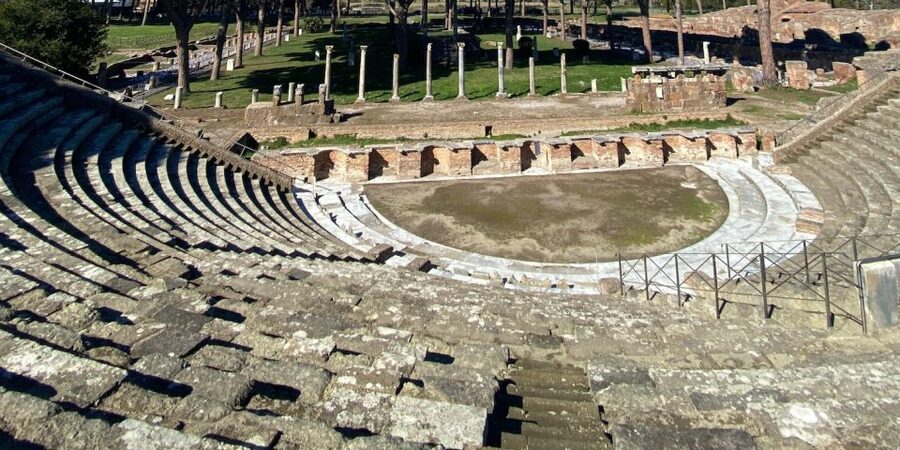
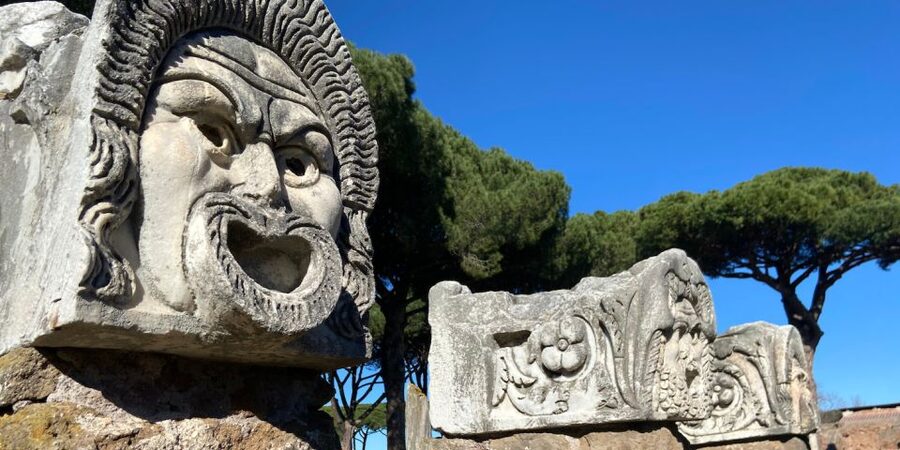
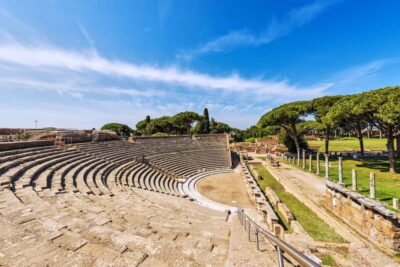
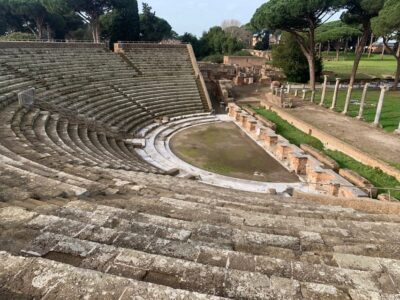
The theatre is one of the clearest reminders that Ostia was a working city with public entertainment. A theatre tells you more than the fact that Romans enjoyed performances. It also shows how a city organized shared experiences and gathered large numbers of people in one place.
Your guide can give the structure a human scale by explaining how it fitted into the town. Headsets are helpful here because the group may be standing in an open area rather than gathered in a quiet room.
I like this stop because it gives you an immediate visual anchor. Once you have seen the theatre, the rest of the site is easier to understand as part of a city plan rather than a collection of unrelated stones.
The limitation is that the theatre is only one part of the route. If you are especially interested in architecture or performance spaces, three hours may not give you as much time as you would like to linger.
The Forum and the shape of civic life
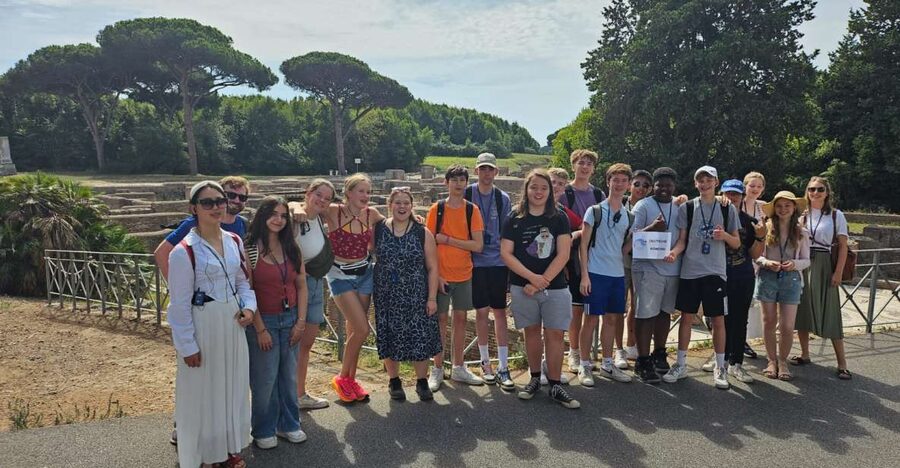
The Forum was the civic heart of an ancient Roman town. This is where the public side of Ostia becomes easier to picture. Instead of looking only at individual fragments, you can think about the spaces used for civic activity and public life.
The Forum also helps explain why a guided tour has value here. Without context, a broad paved area or partial foundation can be hard to read. A guide can point out what you are seeing and connect it with the rest of Ostia’s streets and buildings.
The site is not reconstructed into a perfect Roman town. That is part of its honesty, but it means you need to pay attention. Walls may survive at different heights, and the original purpose of a room may not be obvious at first glance.
I would encourage you to listen for the links between the stops. The theatre, Forum, baths, and other buildings make more sense when you see them as parts of one community.
More tickets and entry passes in Rome:
- Rome:Hop-On Hop-Off Panoramic Open Bus Ticket 3 Circuits x 1
★ 4.0 · 15,405 reviews - Vatican Museums & Sistine Chapel Skip-the-Line Entry Ticket
★ 4.4 · 13,838 reviews - Vatican Museums & Sistine Chapel Skip-the-Ticket-Line Tour
★ 4.3 · 10,486 reviews - Rome: St. Peter’s Basilica & Dome Entry Ticket & Audio Tour
★ 4.2 · 7,537 reviews
Neptune’s baths and the everyday Roman routine
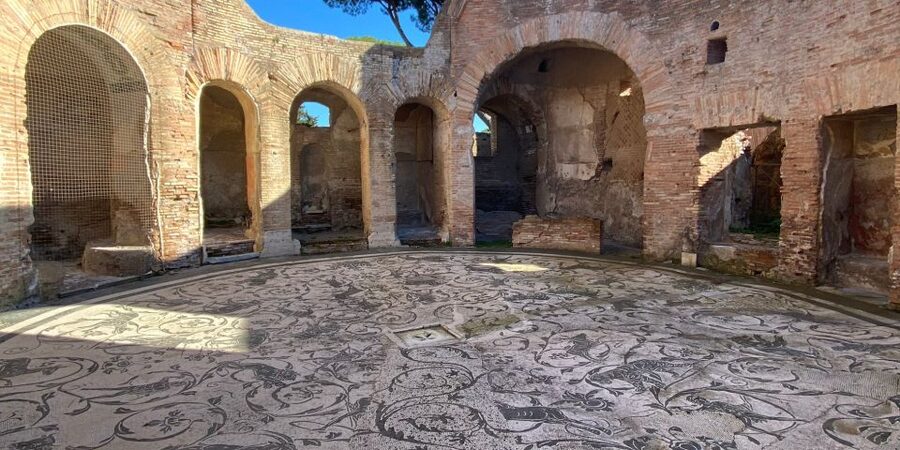
The baths connected to Neptune are among the tour’s most attractive stops because they show how Romans treated bathing as part of city life. This was not simply a private washroom. Public baths were social places and important features of Roman urban planning.
The name also points to decoration and the role of Neptune in Roman visual culture. You might find mosaics or decorative remains here, but the supplied tour information does not promise a particular condition or specific artwork, so keep your expectations flexible.
What I value about the baths is the change in subject. The theatre and Forum focus on public gathering and civic identity. The baths bring you closer to routine: washing, meeting other people, and spending time in a shared public setting.
The surfaces around archaeological remains can be uneven. Comfortable shoes are not a minor suggestion here. Wear footwear that you can manage for three hours without complaint.
Latrines and the less polished side of Roman life
The tour includes the ancient latrines, a stop that may raise a smile but has real value. Archaeological sites often focus on temples, statues, and wealthy homes. Latrines remind you that cities also depended on sanitation and practical infrastructure.
This is one of the details that can make the visit memorable for families and teenagers. It is concrete, easy to understand, and less formal than a discussion of imperial politics. A good guide can use it to show how ancient urban life included the same basic needs as modern life, even with very different systems.
I also like the balance it gives the itinerary. You are not being shown only grand buildings. You are seeing the city as a place where people worked, socialized, bathed, and dealt with ordinary necessities.
Ancient buildings and the feel of a working town
Between the headline stops, you will see the characteristic buildings of ancient city life. These remains are important because they make Ostia feel like a town with many functions rather than a monument built for one purpose.
The guide’s job here is to help you read the clues. A wall, doorway, room, street, or foundation may seem modest on its own. Together, such details show how Romans organized urban space.
This is also where the German commentary can make the biggest difference. You are not just hearing dates. You are being guided toward the meaning of the remains and how they relate to one another.
The strongest tours of this kind make room for questions and use the site itself as the lesson. Janina’s lively style and Philipp’s archaeological background have been singled out as examples of what this experience can offer. Still, the tour is not a private visit, and the pace will be set by the group.
Is three hours enough at Ostia Antica?
Three hours is enough for a structured introduction. You can see the main areas listed for the tour and leave with a clearer sense of Roman urban life.
It is not enough for a slow, independent examination of the entire archaeological park. Ostia Antica is the sort of place where you may want to stop often, look closely at walls, and compare one building with another. If you already have a strong interest in Roman archaeology, you may wish for more time after the guided portion.
The guide-led format helps prevent a common problem: spending too long at the first impressive ruin and then rushing through the rest. The tradeoff is that you must keep moving. One person who took the tour found the guided time too short and felt that organization before departure used too much of the available time. That is a fair concern, especially for anyone coming with a long list of specific buildings to see.
I would treat the experience as an orientation to Ostia Antica, not as the final word on the site. You will get the main story and the most important stops, then decide if you want to return independently.
What the price includes, and who gets the best value
The adult price is €95 for people aged 26 and over. Young adults aged 18 to 25 pay €79 with identification, children aged 13 to 17 pay €50, and children aged 5 to 12 pay €40. Children under four enter free.
That price includes the archaeological site ticket, the live German guide, and headsets. The value depends on how much you want interpretation in German. If you prefer to explore alone and do not need a guide, a ticket and audio option may suit you better. If you want the site explained as you go, the included guide and headset make the cost easier to justify.
Families should pay close attention to the age bands. A family with younger children may find the total more manageable because children under four are free and the reduced rates apply through age 17.
The strongest value is for people who want context without planning the visit alone. The tour turns a large ruin field into a readable story. The weaker value is for visitors who like to set their own pace and spend long periods at one building.
The tour has a 4.8 rating from 10 reviews, with repeated praise for the guides’ explanations and the small-group feel reported on one booking. A high rating is encouraging, but ten reviews is still a small sample. I would focus less on the number and more on the clear pattern: guide quality appears to be the central strength, while the short format is the main possible weakness.
Practical details that can make the visit easier
Bring a passport or identity card. Identification is especially important for anyone using the 18 to 25 price.
Wear comfortable shoes and bring sunscreen. The tour takes place rain or shine, and summer sun can make an open archaeological park tiring.
Carry water in a reusable bottle, but do not bring a glass bottle. Glass objects are not allowed, and everyone must pass through airport-style security before entering.
The experience is not suitable for wheelchair users. If step-free access is essential for you, this is a reason to choose another way to see Ostia Antica.
Free cancellation is available up to 24 hours before the tour for a full refund. You can also reserve now and pay later, which helps if your Rome plans are still shifting. Check the available starting times before booking because the activity lasts three hours.
Ending in the park, with a choice after the tour
The guided experience ends inside the archaeological park. You can then return toward Rome or continue one stop farther to Ostia Lido, the beach area.
That gives the outing a useful bit of flexibility. You can treat Ostia Antica as a focused archaeological visit and head back, or add the coast if your schedule and energy allow. The tour does not promise transport back to Rome, so plan your onward journey separately.
I like this ending because it does not force you into a fixed return arrangement. You can decide after the ruins whether you want more city time or a change of scene by the water.
Who should book this German Ostia Antica tour?
I would choose this experience if you want a German-speaking guide, prefer a clear three-hour structure, and enjoy Roman sites that show daily life as well as grand public monuments.
It also suits families with older children and teenagers. The theatre, baths, and latrines provide different kinds of stories, while the lively approach associated with Janina has worked well for younger minds.
I would hesitate if you need wheelchair access, dislike walking on uneven archaeological ground, or want a full day to explore every part of Ostia Antica. I would also think twice if you prefer complete independence and do not need a guide.
FAQ
What language is the tour conducted in?
The live tour guide speaks German.
How long does the Ostia Antica tour last?
The tour lasts three hours.
Are entrance tickets included?
Yes. Entrance tickets to the archaeological site are included in the price.
Are headsets provided?
Yes. Headsets are included so you can follow the guide’s explanations.
What buildings and areas are included?
The tour includes the theatre, Forum, ancient buildings, Neptune thermal baths, and ancient latrines.
Where is the meeting point?
Meet at the coordinates 41.75925827026367, 12.300618171691895 and look for the guide holding the Deutsche Römerin sign.
What should I bring?
Bring a passport or identity card, comfortable shoes, sunscreen, and water in a reusable non-glass bottle.
Can I join if I use a wheelchair?
No. The experience is listed as unsuitable for wheelchair users.
Does the tour run in bad weather?
Yes. The tour takes place rain or shine.
What happens after the tour ends?
The tour ends in the archaeological park. From there, you can return toward Rome or continue one stop farther to Ostia Lido.
Should you book it?
Book it if you want Ostia Antica explained in German and prefer a guide to connect the theatre, Forum, baths, latrines, and other buildings into one clear story. The included ticket and headset remove two common hassles, and guides such as Janina and Philipp have brought strong subject knowledge and energy to the experience.
Skip it if three hours feels too short or you want to explore at your own pace. For most German-speaking visitors who want an organized introduction to ancient Ostia, though, this is a practical and worthwhile choice.
Newest Rome tours we have reviewed
- Private TikTok Video Making in Rome★ 5.0 · 7 reviews
- Assisi, Orvieto and Civita di Bagnoregio Full Day Tour from Rome★ 4.5 · 45 reviews
- Assisi & Saint Francis Path Tour from Rome★ 5.0 · 45 reviews
- Assisi and Cascia Private Day Tour from Rome with Lunch★ 5.0 · 10 reviews
- Art Class in the center of Rome!★ 4.0 · 4 reviews
- Art & Craft: Beer Tour with Street Art in Rome★ 4.5 · 6 reviews
- Arrival in Rome: Airport Transfer & Exclusive City Introduction★ 5.0 · 3 reviews
- From Rome: Private Day-Tour of Tuscany★ 5.0 · 16 reviews
Ostia Antica Tours, compared.
Ancient Ostia Antica Semi-Private Day Trip from Rome by Train with Guide
Read our review →
Ostia Antica Archaeological Park Ticket & Audio App
Read our review →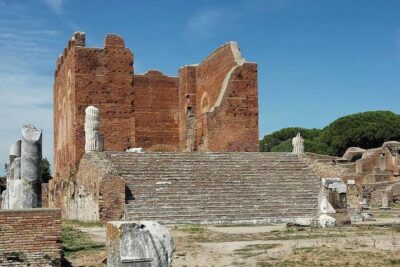
Browse the lists this tour appears in