
Reviewed · OSTIA ANTICA TOURS
Ancient Ostia Private Tour Led By An Archaeologist
Ostia Antica gives you something Rome often cannot: room to walk through an ancient city without the crush of modern crowds. In four hours, you follow old streets, enter baths and temples, sit in a theater, and see how an ordinary Roman town worked. Archaeologist Francesca leads the visit and explains what you are seeing in clear, lively terms.
I like the private format, since your group can move at its own pace and ask questions freely. I also like Francesca’s archaeological background and her habit of bringing extra books to help explain the site. The main drawback is simple: this is a walking tour across a large ruin, so four hours can feel demanding in warm weather or if you prefer short sightseeing stops.
Key points to know
- A private archaeological visit: Only your group takes part, with Francesca as your guide.
- A short trip from Rome: Ostia Antica is reached from the Porta San Paolo area, with the site described as about 35 minutes by train from Rome.
- Four hours at one large site: The visit covers the main streets, theater, baths, forum, temples, guild square, and food shop.
- A strong guide for history fans: Francesca is a practicing tour guide with an archaeology background and brings extra books for visual context.
- Admission is included: You do not need to arrange a separate entrance ticket for the archaeological park.
- Good for small groups: Group discounts may make the per-person cost easier to justify for families or friends traveling together.
Why Ostia Antica makes a smart break from central Rome
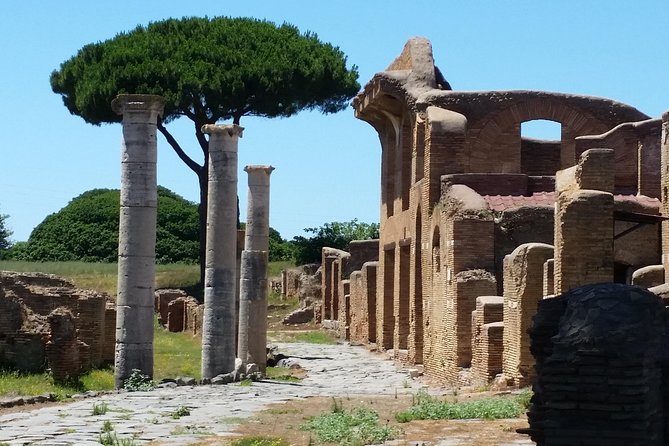
Rome gives you famous monuments at nearly every turn, but its popularity can work against the experience. At Ostia Antica, you get a clearer sense of an ancient town as a place where people lived, worked, worshipped, shopped, and relaxed.
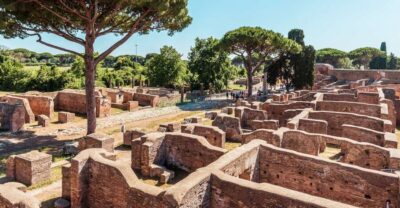
The site is often compared with Pompeii and Herculaneum because so much of the Roman town remains visible. That comparison is useful, though Ostia has its own character. You are not simply viewing isolated buildings. You are walking along the Decumanus Maximus, the main street, and moving between public spaces, business areas, religious buildings, and homes.
I find that this kind of visit helps connect the grand monuments of central Rome with daily life. The Forum mattered, but so did the bathhouse, the market, the theater, and the small food counter. Ostia lets you look at the Roman city from ground level.
The site is also a good choice if you have already spent several days among Rome’s busiest attractions. It offers a change of pace without requiring a full day away from the capital. The advertised train ride takes about 35 minutes, and the tour begins and ends at Porta San Paolo.
More Ostia Antica tours:
- Ancient Ostia Antica Semi-Private Day Trip from Rome by Train with Guide
★ 4.5 · 579 reviews - From Rome: Ostia Antica Guided Half-Day Trip by Train
★ 4.8 · 486 reviews - Horse Sanctuary & Trail Ride in Ostia Antica
★ 4.5 · 276 reviews
Meeting at Porta San Paolo and getting to the ruins
The meeting point is Porta San Paolo, at 00153 Rome. This is important to note before booking because the tour does not begin at Ostia Antica itself. You need to reach the starting point in Rome, then continue to the archaeological park.
The train journey is part of the practical appeal. A trip of roughly 35 minutes makes Ostia manageable as a half-day outing rather than a major expedition. You also avoid arranging a separate private transfer, though you should still allow enough time to reach Porta San Paolo before the scheduled start.
The information provided does not specify the exact train departure time, the platform, or the precise instructions for meeting Francesca. I would confirm those details after booking, since confirmation is sent within 48 hours and remains subject to availability.
At the end, the activity returns to the same meeting point. That makes planning easier if you have dinner, a museum visit, or another appointment in central Rome later in the day. Still, I would avoid scheduling anything tight. Public transport and a large archaeological site both leave room for delay.
The Decumanus Maximus gives you the city’s main line
The tour begins its real work on the Decumanus Maximus, the main road through Ostia. This is where the site starts to feel like a town rather than a collection of ruins.
A major street gives you scale. You can see how buildings were arranged around a route used by residents, workers, merchants, and officials. Instead of looking at one famous monument and moving on, you start to understand how the settlement was organized.
This is also a good place to listen closely to Francesca. Her archaeology training should help you notice practical features that are easy to miss on your own, such as the relationship between the road and the buildings beside it. The private setting means you can stop to ask why a structure was built in a certain place or how it may have served the town.
The drawback is that an ancient street is not a single dramatic sight. If you want nonstop spectacle, the early part of the visit may feel more measured. Give it time. The value comes from building a picture of the whole city.
Baths of Neptune and the public side of Roman life
The Baths of Neptune are one of the major stops. Roman baths were not just places to wash. They were social and public buildings, and they help show how much effort Roman towns put into shared spaces.
At Ostia, the baths are part of a larger pattern. You see them alongside the theater, forum, temples, and commercial areas. That combination makes the stop useful because you can think about recreation and public life together.
The information does not specify exactly which mosaics, rooms, or decorative details Francesca emphasizes on the day. That is worth remembering. The tour promises the Baths of Neptune as a stop, but the exact route and depth of discussion can vary with site conditions and the interests of your group.
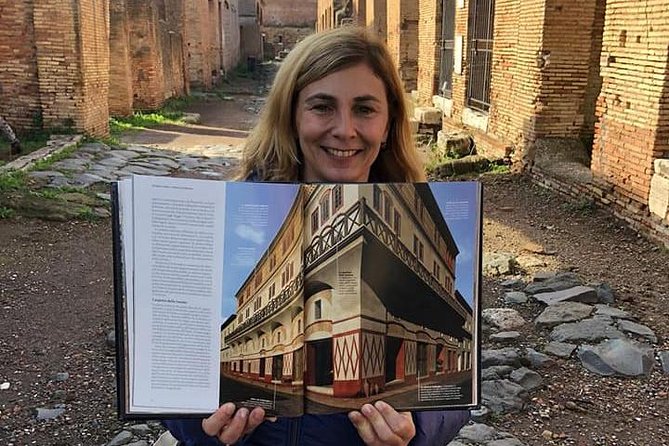
I would expect the guide to help you read the remains rather than simply point at walls. Francesca’s archaeological background and use of extra books should be especially useful here, where a little visual explanation can make worn structures easier to understand.
More private tours in Rome:
- Rome by Golf Cart Private Tour: Beyond the Landmarks
★ 5.0 · 4,361 reviews - Early Morning Vatican, Sistine, St. Peter’s Semi or Private Tour
★ 5.0 · 3,779 reviews - Rome on a Golf Cart Semi-Private Tour Max 6 with Private Option
★ 5.0 · 2,502 reviews - Rome Private Arrival Transfer: Fiumicino Airport to Hotel in Rome
★ 4.5 · 2,492 reviews
The theater and Square of the Guilds
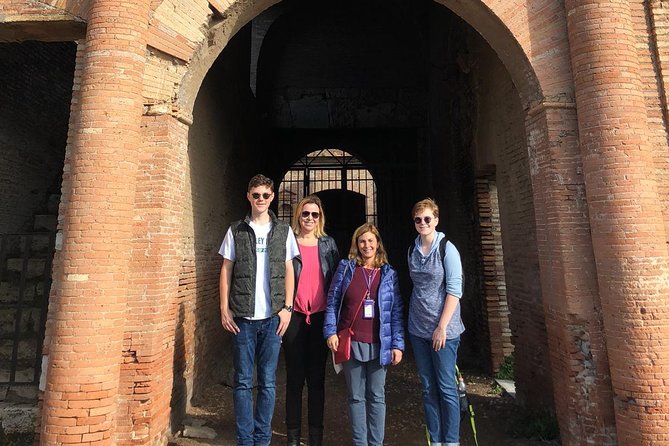
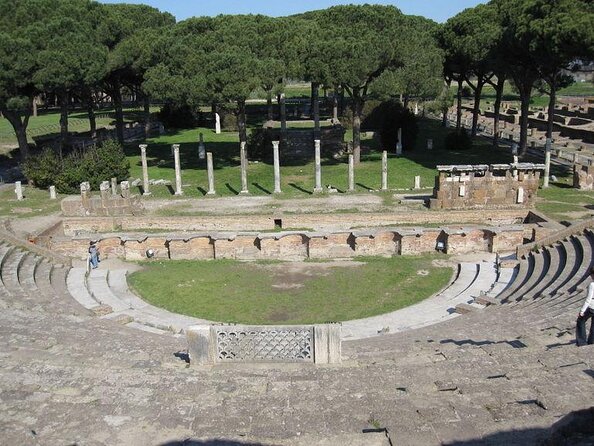
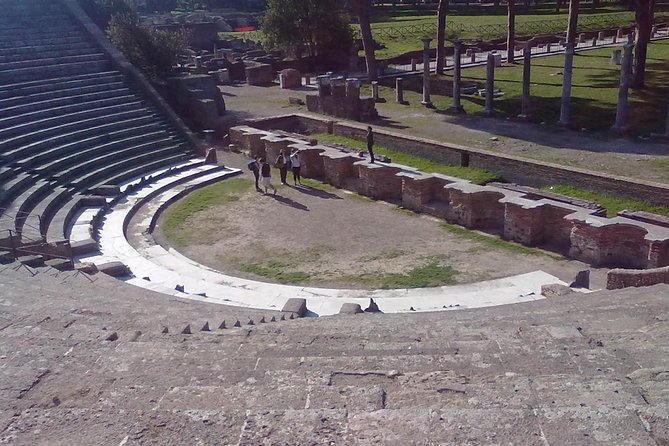
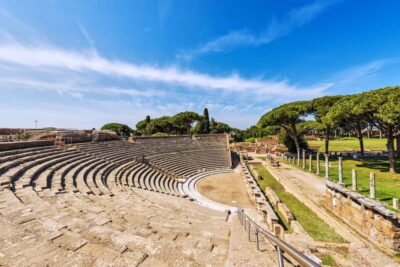
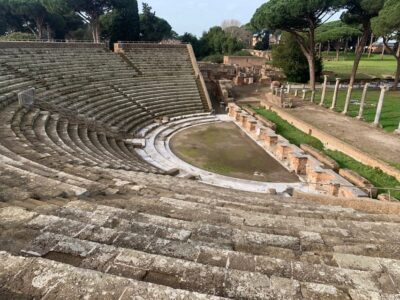
Ostia’s theater gives the tour one of its most memorable settings. You can sit in the theater, look across the surviving structure, and consider how public entertainment fit into the rhythm of Roman life.
That chance to sit matters. A theater is easier to picture when you are not hurried past it. You can pause, take in the shape of the space, and ask questions about how it was used.
Nearby, the Square of the Guilds adds an economic angle. The name points to the organized business groups connected with Ostia’s role as a port town. The supplied information does not list each guild or explain the individual decorations you will see, so I would not book this tour expecting a detailed catalog of every symbol.
What you do get is a useful shift in subject. The theater shows public entertainment. The guild square points toward trade, work, and commercial organization. Together, they make Ostia feel like an active town with many kinds of residents and occupations.
The Forum and Capitolium show Ostia’s civic center
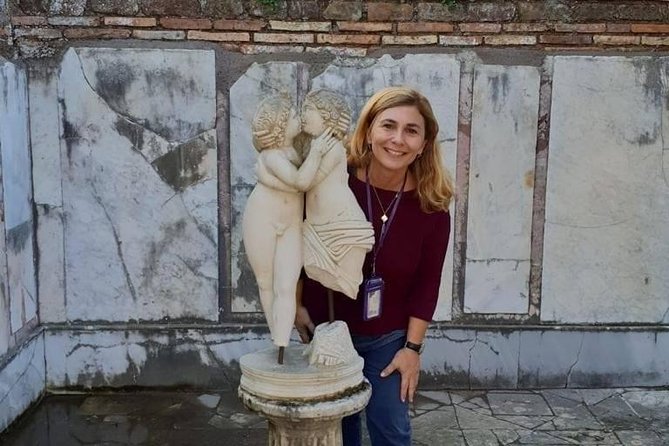
The Forum and Capitolium bring the tour to Ostia’s civic and religious heart. These buildings help explain how authority, ceremony, and public identity were presented in a Roman town.
The Forum is not simply another open area to cross. It gives you a reference point for understanding the buildings around it. The Capitolium adds a strong religious and official focus, and Francesca can help place those structures within the broader plan of Ostia.
A private guide is particularly useful in a civic center. Without help, a visitor may see broken columns and foundations but struggle to understand which buildings mattered most. With a guide, you can ask direct questions and spend more time on the parts that interest you.
Do not expect the same intact, polished look you get from a museum reconstruction. Ostia is an archaeological site, and some remains take patience to read. That is part of the point, but it means this tour suits people who enjoy interpretation more than quick photo stops.
Baths of the Forum and the Thermopolium
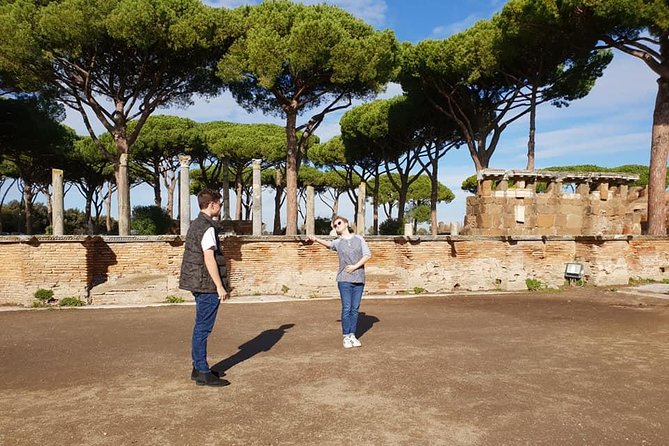
The Baths of the Forum continue the look at public facilities, this time close to the town’s central civic area. The stop helps show that bathing was woven into city life rather than pushed to the edge of town.
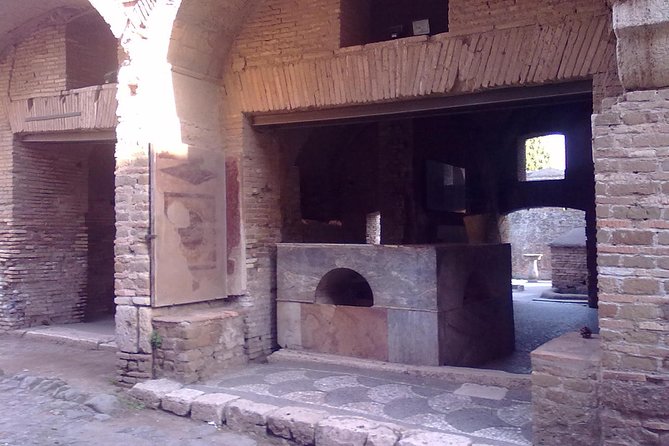
The Thermopolium offers a smaller but very human detail. This was a Roman food and drink shop, and it helps turn the ancient settlement from a set of public monuments into a place where people bought meals and stopped during the day.
I especially like having a commercial stop near grander sites. Temples and forums tell you about power and public ceremony. A food shop makes you think about ordinary routines. That contrast is one of Ostia’s strengths.
The supplied details do not promise a meal or tasting at the Thermopolium. You are visiting the archaeological remains, not taking part in a food experience. Keep that distinction in mind when comparing this tour with culinary activities in Rome.
What Francesca adds to the four-hour visit
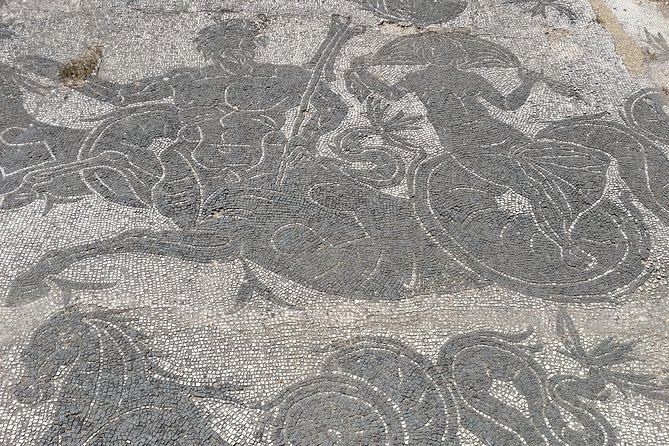
Francesca is the guide named for this experience. She is described as an archaeologist who now works as a tour guide, and that background shapes the appeal of the visit.
You can expect a guide who is comfortable explaining the site beyond surface facts. Her passion for Ostia comes through in the way she presents the ruins, and she brings extra informational books to show during the tour. Those visual aids can be valuable when the remains themselves are incomplete or hard to picture.
The private structure gives Francesca room to adjust. If your group wants more time on baths, religious buildings, or the theater, you can ask. If someone in your group has a strong interest in Roman urban planning, trade, or archaeology, the format should make it easier to follow that interest.
No guide can remove every challenge at a large ruin. Four hours is a substantial period for walking and listening, and the tour may feel intense if you are already tired from a full day in Rome. Wear practical shoes and bring what you need for time outdoors, though the provided information does not list specific equipment requirements.
Is $297.93 per person a fair price?
At $297.93 per person, this is not a budget outing. The value depends heavily on your group size and how much you want expert interpretation.
The fee covers a private four-hour activity with admission included. You are paying for Francesca’s time, the private setting, and a guided visit to one of the most important ancient sites near Rome. For a couple or a small group with a serious interest in Roman archaeology, that can be worthwhile. You do not have to share questions with a large tour or wait for a guide to address unrelated interests.
Group discounts may improve the price for families or friends booking together. Check how the discount applies before committing, since the listed rate is given per person and the exact savings are not provided.
For a quick look at Ostia, the cost may feel high. You could prefer a less expensive group visit or independent entry if you are comfortable reading the site on your own. The private tour earns its price only if you value the guide’s archaeological knowledge and the freedom to shape the conversation.
The experience is commonly booked well ahead, with an average lead time of 95 days. That suggests you should plan early if Francesca’s availability and a particular date matter to you.
Who should book this Ostia Antica experience?
I would recommend this tour to anyone who wants Roman history explained through streets and buildings rather than only through famous monuments. It suits couples, families, and small groups who like to ask questions and move at a personal pace.
It is also a good match for repeat visitors to Rome. If you have already seen the Colosseum, Forum, and Pantheon, Ostia gives you a different view of Roman life. The site offers a town plan, commercial spaces, bathhouses, a theater, temples, and civic buildings in one visit.
Families can benefit from the variety of stops, though four hours may be long for very young children. The theater and Thermopolium can provide memorable anchors, while the longer stretches of streets and foundations may test short attention spans.
I would hesitate if you dislike walking, prefer tightly timed indoor sightseeing, or want a tour with food included. I would also think twice if the price is difficult for your budget and you are happy exploring ruins without a guide.
Free cancellation is available if you cancel at least 24 hours before the start time. Changes or cancellations made within 24 hours are not accepted for a refund, and the cut-off follows local time.
The final call on booking Francesca’s private tour
Book this experience if you want to understand Ostia Antica as a real Roman town, not just photograph scattered ruins. The combination of a private group, an archaeologist guide, included admission, and a four-hour route gives you time to connect the main streets with public, religious, commercial, and social life.
The cost is the serious consideration. At $297.93 per person, this is best for people who will use the private format and ask questions. If that sounds like your kind of sightseeing, Francesca’s archaeological background and extra books make the tour a strong choice. If you only want a brief visit, a lower-cost option may serve you better.
FAQ
Where does the tour begin?
The tour begins at Porta San Paolo, 00153 Rome, in the Metropolitan City of Rome Capital.
Where does the tour end?
The activity ends back at the meeting point at Porta San Paolo.
How long does the tour last?
The tour lasts approximately four hours.
How far is Ostia Antica from Rome?
Ostia Antica is described as about a 35-minute train ride from Rome.
Is admission to Ostia Antica included?
Yes. The admission ticket for the archaeological park is included.
Is this a private tour?
Yes. Only your group participates in the activity.
Who leads the tour?
The tour is led by Francesca, an archaeologist who now works as a tour guide.
What places are visited at Ostia Antica?
The route includes the Decumanus Maximus, Baths of Neptune, theater, Square of the Guilds, Forum, Capitolium, Baths of the Forum, and Thermopolium.
Are group discounts available?
Yes. Group discounts are listed as a feature of the experience.
Can I cancel for a full refund?
Yes, if you cancel at least 24 hours before the experience begins. Cancellations made less than 24 hours before the start time are not refunded.
Newest Rome tours we have reviewed
- Private TikTok Video Making in Rome★ 5.0 · 7 reviews
- Assisi, Orvieto and Civita di Bagnoregio Full Day Tour from Rome★ 4.5 · 45 reviews
- Assisi & Saint Francis Path Tour from Rome★ 5.0 · 45 reviews
- Assisi and Cascia Private Day Tour from Rome with Lunch★ 5.0 · 10 reviews
- Art Class in the center of Rome!★ 4.0 · 4 reviews
- Art & Craft: Beer Tour with Street Art in Rome★ 4.5 · 6 reviews
- From Rome: Private Day-Tour of Tuscany★ 5.0 · 16 reviews
- Arrival in Rome: Airport Transfer & Exclusive City Introduction★ 5.0 · 3 reviews
Ostia Antica Tours, compared.
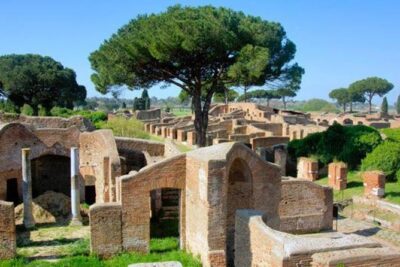
Ancient Ostia Antica Semi-Private Day Trip from Rome by Train with Guide
Read our review →
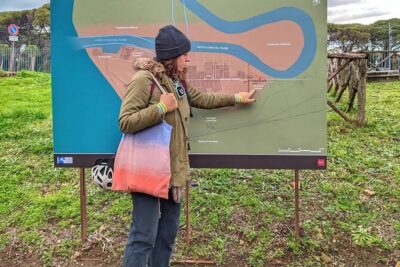
Ostia Antica Archaeological Park Ticket & Audio App
Read our review →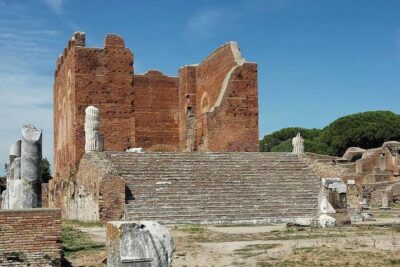
Browse the lists this tour appears in