
Reviewed · CASTEL SANT’ANGELO TOURS
Castel Sant’Angelo | The Tomb of Hadrian Private Guided Tour
Castel Sant’Angelo is one of Rome’s most unusual time capsules: an emperor’s tomb turned fortress, papal refuge, prison, execution site, and museum. In two hours, you’ll move through those changing chapters with a private art historian, then finish above the Tiber with sweeping views from the rooftop terrace.
I like the private format, which gives you room to ask questions and keeps the story focused on your interests. I also like the bridge opening, since Ponte Sant’Angelo’s statues provide a fitting introduction before you enter the castle. The main drawback is the price, $225.44 per person, which is a serious outlay for a two-hour visit and makes the tour best for couples, families, or small groups who value personal guiding.
Key points to know before booking
- Hadrian’s tomb became a fortress: You’ll see how one building served emperors, popes, soldiers, prisoners, and museum visitors.
- The bridge is part of the tour: Your guide explains the statues on Ponte Sant’Angelo before taking you inside.
- Private groups stay small: The tour accepts between 2 and 10 people, so you can ask questions without competing with a large crowd.
- The rooftop view is the payoff: The terrace looks across central Rome and gives you excellent photo opportunities.
- The castle has a dark side: Papal apartments and frescoed rooms sit alongside cramped cells and execution spaces.
- Comfortable shoes matter: The visit involves a moderate amount of walking and is not wheelchair accessible.
Why Castel Sant’Angelo is more than a castle

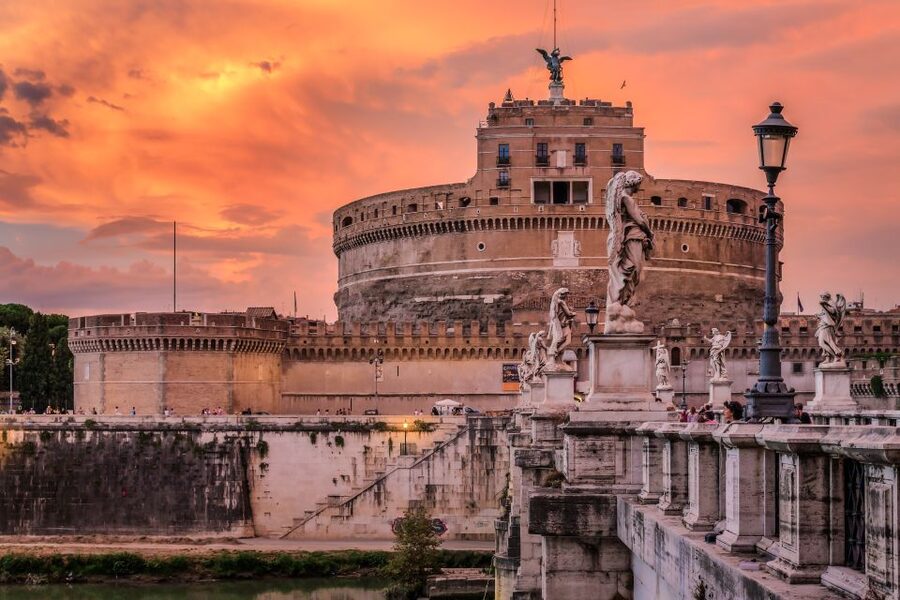
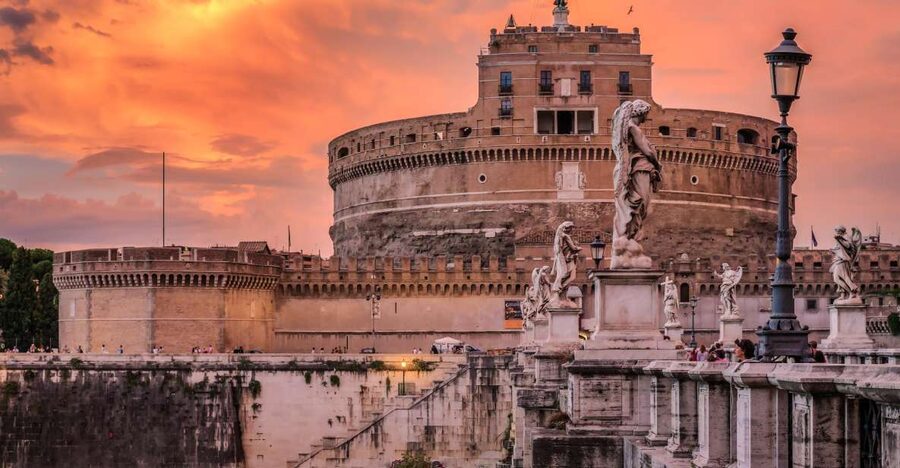
Many visitors first notice Castel Sant’Angelo as a big, round mass beside the Tiber. Its shape comes from its first purpose. Emperor Hadrian built the structure as a mausoleum, or imperial tomb, and the original form still gives the building its powerful, drum-like profile.
That is only the beginning. Over the centuries, the building was reshaped into a fortified refuge for popes, a residence with decorated rooms, a prison, an execution ground, and finally a museum. I like this layered story because the architecture does not belong to a single period. You are not simply looking at an ancient monument or a Renaissance palace. You are seeing Rome’s changing priorities pressed into one building.
A private guide helps connect those changes. Instead of walking through rooms as isolated sights, you can ask why a tomb needed heavy defenses, how papal power changed the building, and where the castle’s polished rooms sit beside its harsher spaces. The tour is especially useful if you enjoy political and religious history as much as art.
More Castel Sant’Angelo tours:
- Rome: Castel Sant’Angelo Skip-the-Line Ticket & Audio Guide
★ 4.4 · 3,500 reviews - Rome: Castel Sant’Angelo Skip-the-Line Ticket
★ 4.4 · 3,040 reviews - Rome: Castel Sant’Angelo Skip-the-Line Entry Ticket
★ 4.8 · 2,231 reviews
Meeting your guide beside Ponte Sant’Angelo
Your guide waits outside the main entrance at Lungotevere Castello number 50, holding a Tour in the City sign. This is a practical meeting point, since the entrance is beside the famous bridge and easy to identify from the surrounding riverfront.
Plan to arrive with your passport or identity document. Every person must show valid identification matching the booking name for entry. Bring comfortable shoes, since the route includes walking through the castle and climbing toward the upper levels.
The tour is offered in English, Spanish, French, and Italian. The supplied information specifically lists English and Spanish in one section, so check your selected language and starting time when booking. The exact start time depends on availability.
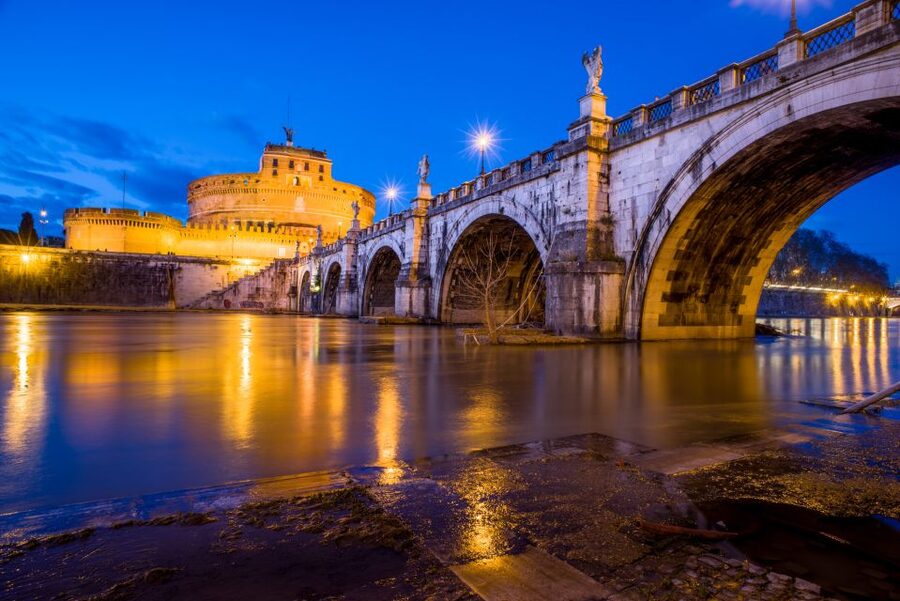
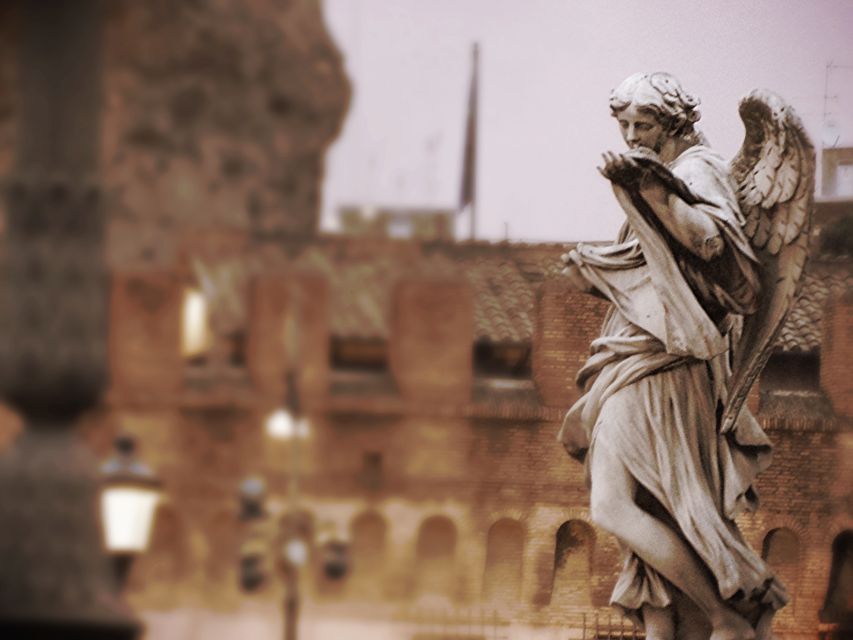
Before entering, you begin with Ponte Sant’Angelo. The bridge crosses the Tiber and is lined with striking sculptures. Your guide explains the bridge and its statues during a short visit of about 15 minutes, giving you a useful view of Castel Sant’Angelo from outside.
This opening is more valuable than it may sound. The bridge frames the castle and shows how closely the monument is tied to the river and the city around it. It also lets you start with Rome’s public face before moving into the building’s private rooms, corridors, and cells.
Inside the former mausoleum of Hadrian
After the bridge, your guide takes you into Castel Sant’Angelo with entrance admission and skip-the-ticket-line access included. Skip-the-line access does not mean you should ignore the meeting time. You still need to arrive at the correct entrance with the right identification.
Inside, the tour follows the building’s long transformation. Hadrian’s original mausoleum is the foundation of the story, but the site later became a military stronghold. Its thick walls and defensive design make more sense once you understand that Rome’s rulers needed a place that could protect both people and power.
The guide helps you read the building as you walk. Look for the contrast between monumental Roman construction, fortress passages, papal rooms, and later museum areas. The attraction is not arranged like a single elegant palace. Its appeal comes from the way grand spaces and severe working areas appear in the same complex.
Headsets are included, which matters in a large stone building where sound can carry poorly. With a private group, you should be able to hear the guide clearly and stop for questions without losing the thread of the explanation.
The two-hour length gives you a focused visit rather than an exhausting day inside the museum. Still, the route is not a quick photo stop. You will walk a moderate amount, and the building’s circulation can be demanding for anyone with limited mobility. Castel Sant’Angelo is not wheelchair accessible, and walking frames are not allowed.
Papal rooms, frescoes, and Michelangelo’s courtyard
The castle’s papal period adds an entirely different mood. Popes used Castel Sant’Angelo as a residence and refuge, and some rooms were decorated with the luxury expected of powerful church leaders.
One notable stop is Pope Clement VII’s bathroom, decorated with frescoes associated with Raphael’s school. The room shows how even a practical space could carry artistic ambition. It also gives you a more human view of papal life than a grand ceremonial hall alone would provide.
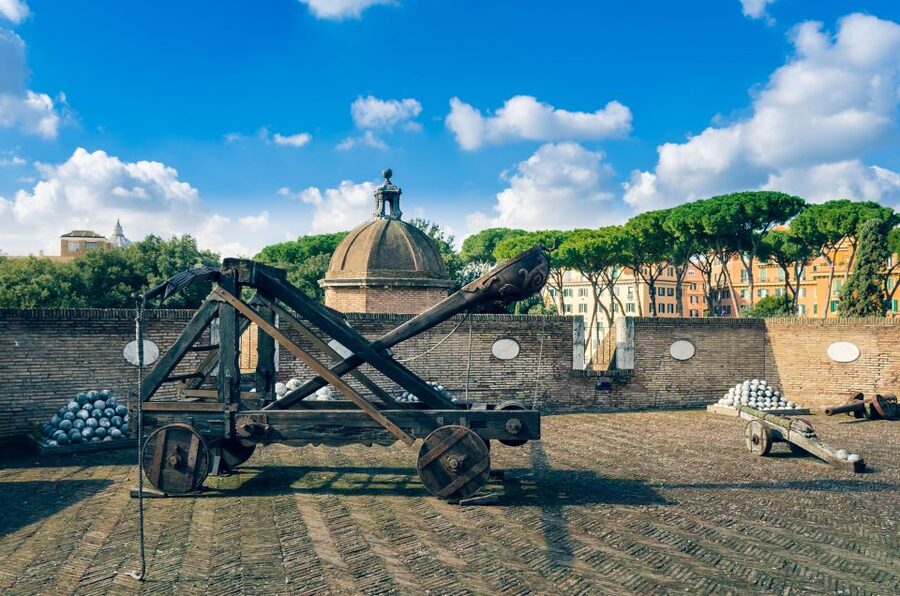
You will also see gilded stucco, marble floors, and other decorative details. These polished interiors can seem surprising inside a building better known for cannons, prison cells, and defensive walls. I enjoy this contrast because it prevents the castle from becoming a simple military-history visit.
The tour also highlights Michelangelo’s courtyard. The experience description does not promise a full Michelangelo-designed complex, so keep expectations measured, but the courtyard is an important artistic detail within the visit. Your guide can place it alongside the frescoes, papal rooms, and changing architecture.
If you care about art, ask questions here. A private tour is most useful when you make it personal. You can focus on decoration, the role of the papacy, the building’s architects, or how art was used to express authority.
More private tours in Rome:
- Rome by Golf Cart Private Tour: Beyond the Landmarks
★ 5.0 · 4,361 reviews - Early Morning Vatican, Sistine, St. Peter’s Semi or Private Tour
★ 5.0 · 3,779 reviews - Rome on a Golf Cart Semi-Private Tour Max 6 with Private Option
★ 5.0 · 2,502 reviews - Rome Private Arrival Transfer: Fiumicino Airport to Hotel in Rome
★ 4.5 · 2,492 reviews
The prison cells and darker stories
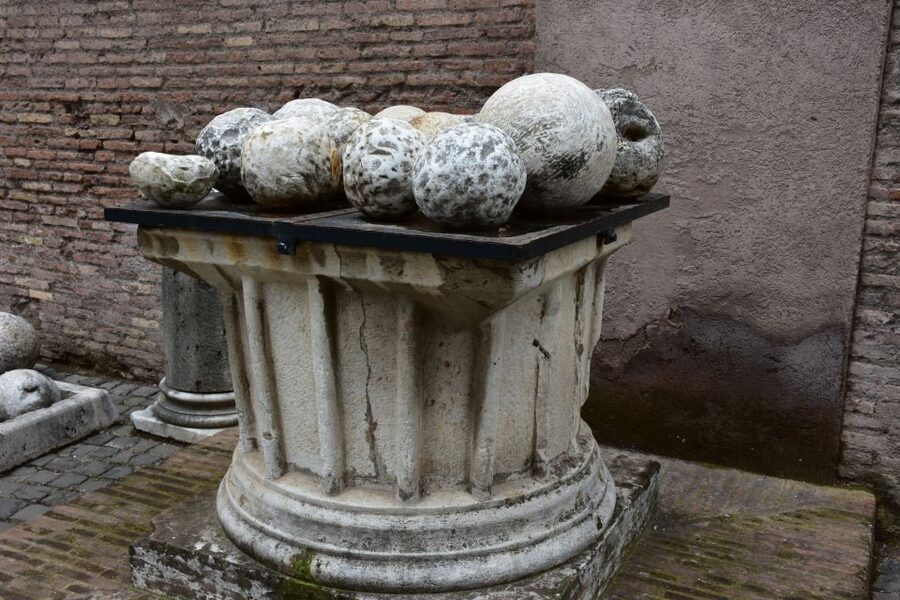
Castel Sant’Angelo’s attractive rooms are only half the story. The fortress also held prisoners and served as a site of execution. The darker spaces explain why the castle has such a strong place in Rome’s popular imagination.
One of the most feared cells was a cramped space above the spiral ramp of Hadrian’s mausoleum. It could be reached only through a trapdoor, making it difficult to access and almost impossible to escape. Another concealed space in the floor was used for disposing of bodies.
These details are grim, but they matter. They show how the same structure could offer safety to rulers while creating fear for those held inside. A guide can give these areas their proper context without turning the visit into a horror show.
The castle’s prison stories also connect it to wider art and popular culture. Castel Sant’Angelo features in Dan Brown’s Angels and Demons, which has brought new attention to the monument. The fictional use is not the reason to visit, but it can help you recognize how the castle’s tunnels, secret spaces, and imposing exterior have shaped modern ideas about Rome.
I would not choose this tour only for the novel connection. The real attraction is the building itself, where the prison history is part of a much larger story involving imperial Rome, the papacy, military power, and art.
The rooftop terrace and Rome from above
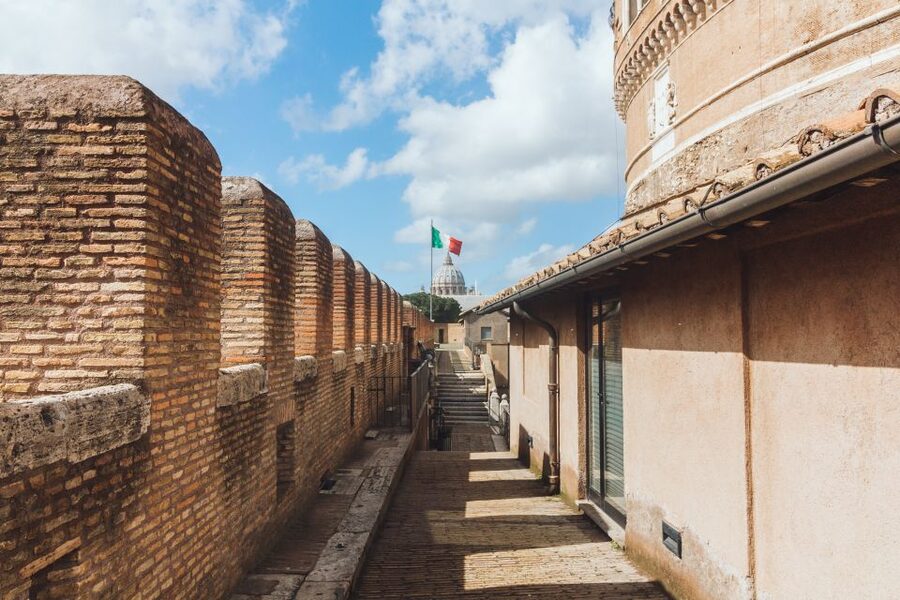
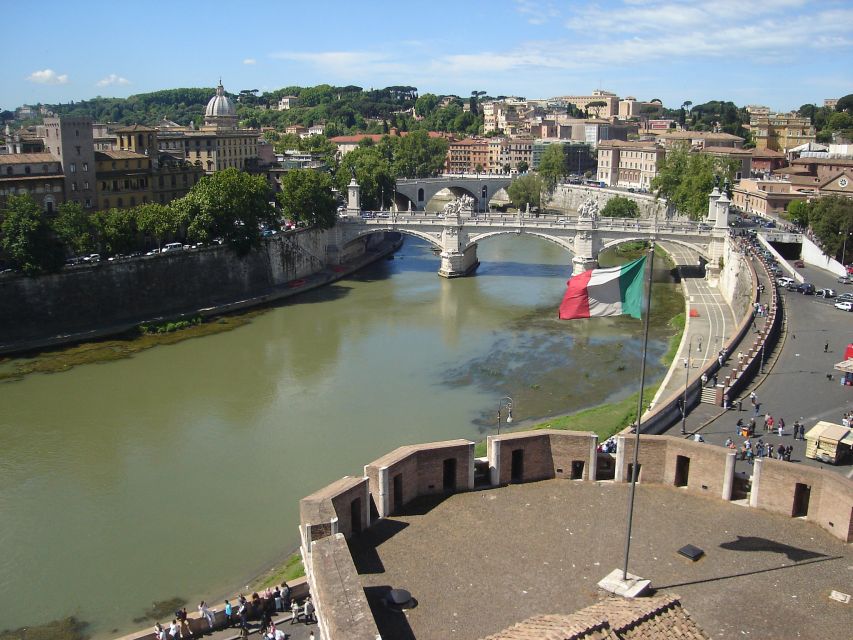
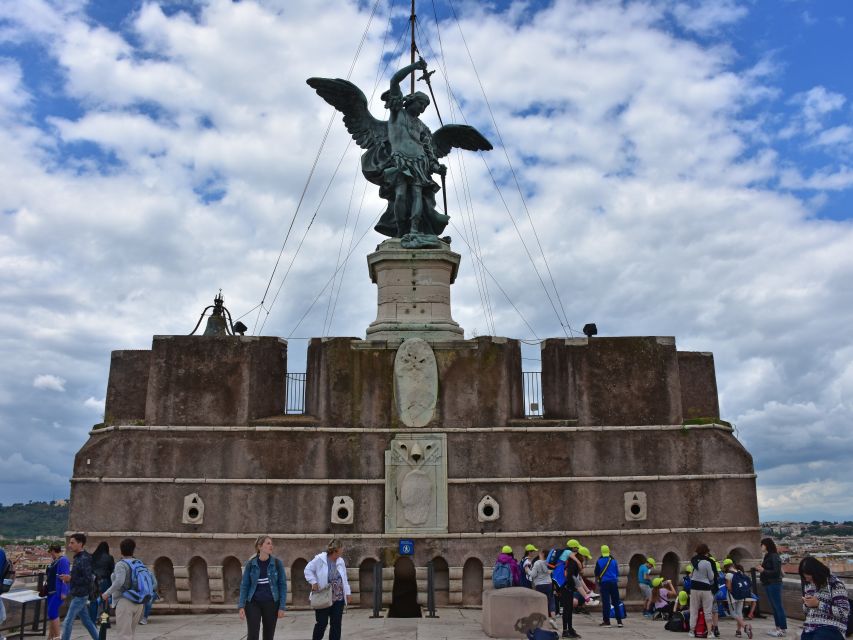
The visit ends at the rooftop terrace, one of the clearest reasons to include Castel Sant’Angelo in your Rome plans. From above, you get broad views across the city and the Tiber, with the castle and bridge below helping you understand the setting.
This is a good place for photographs, but do not rush through it. The terrace also helps you make sense of the route you have just walked. From ground level, Castel Sant’Angelo can feel like a maze of rooms and passages. From the top, its position beside the river and its relationship to the surrounding city become much clearer.
The view is especially useful for orientation. You can look back toward Ponte Sant’Angelo and see how the bridge leads visitors toward the fortress. The panoramic outlook also gives the tour a change of pace after the enclosed rooms and prison spaces.
The final rooftop stop is one reason a private guide adds value. You can ask for help identifying parts of the view or spend a little time taking pictures without being hurried through a large group. The experience returns to the Museo Nazionale di Castel Sant’Angelo meeting point after the castle visit.
What the private format adds
This is not a general group tour with a fixed speech delivered to dozens of people. The group size ranges from two to ten, and the guide is dedicated to your party. That makes the experience a good match for people who ask questions, enjoy historical explanation, or want to set the pace around art and architecture.
Two guides singled out in the supplied comments were Sabrina and Martin. Sabrina was praised for her energy, broad explanations, and willingness to answer questions, while Martin was remembered for his wide-ranging information and help taking photographs. Those details suggest the guide can be a major part of the experience, though the specific guide assigned to your booking is not guaranteed.
A private guide also helps if your group has mixed interests. One person might want papal history, another may care about Roman engineering, and another may be waiting for the rooftop view. You can ask the guide to connect those subjects instead of listening to a standard presentation that gives each one equal time.
The limitation is cost. At $225.44 per person, this is not the economical way to see Castel Sant’Angelo. The value improves if you are traveling with a small group, want a specialist guide, or would otherwise pay for several separate explanations. If you prefer to wander quietly and read at your own speed, the private format may offer more structure than you need.
Price, timing, and practical comfort
The tour lasts two hours. That is enough time for the bridge, major castle areas, papal rooms, prison history, artistic details, and terrace, but it is not enough for a slow examination of every museum display.
Entrance fees, headsets, skip-the-line access, and a professional private guide are included. Food, drinks, hotel pickup, drop-off, and transport to the attraction are not included. You will need to reach Lungotevere Castello 50 on your own.
The tour requires a moderate amount of walking. Wear shoes you can manage on hard surfaces and through an old fortress. Smart casual clothing is requested, and shoulders and knees must be covered to enter the small chapel inside the castle.
The site is not wheelchair accessible, and it is not suitable for wheelchair users. Pets, oversize luggage, smoking, and walking frames are not allowed. These restrictions are worth checking before you pay, particularly if anyone in your party needs mobility equipment.
You can cancel up to 24 hours before the tour for a full refund. Reserve now and pay later is available, which can help if your Rome schedule is still changing. Confirmation is normally received at booking, although bookings made within seven days of travel may be confirmed within 48 hours, subject to availability.
Who should book this Castel Sant’Angelo tour?
I would choose this experience if you want the building’s full story rather than a quick look at the exterior. It suits history fans, art lovers, first-time Rome visitors who want context, and anyone who prefers asking a guide direct questions.
It is also a strong choice for a small family or group of friends. The private setting lets you keep children or less experienced museum-goers engaged with stories about emperors, popes, prisons, and secret passages instead of relying only on labels.
I would think twice if your budget is tight, if you want a longer museum visit, or if mobility limitations make stairs and moderate walking difficult. The two-hour visit is focused and convenient, but the price is high compared with entering independently.
Should you book it?
Book this tour if you want a guided explanation of Castel Sant’Angelo’s many identities and value a private experience over the lowest price. The bridge, papal rooms, Michelangelo’s courtyard, prison spaces, and rooftop terrace give you a varied visit, while a strong guide can tie those pieces together.
Skip it if you are satisfied with a self-guided visit, have already studied the castle, or need step-free access. For everyone else, the tour offers a clear way to understand one of Rome’s strangest monuments, with the rooftop view providing a memorable finish.
FAQ
How long does the Castel Sant’Angelo private tour last?
The tour lasts two hours. It includes the visit to Castel Sant’Angelo and a roughly 15-minute guided visit to Ponte Sant’Angelo.
Where does the tour meet?
Your guide waits outside the main entrance of Castel Sant’Angelo at Lungotevere Castello number 50, holding a Tour in the City sign.
Where does the tour end?
The activity ends back at the Museo Nazionale di Castel Sant’Angelo meeting point.
Is skip-the-line access included?
Yes. The tour includes entrance fees and skip-the-ticket-line access.
What languages are available?
The tour is offered in English, Spanish, French, and Italian. Check the selected language when booking, since the listed language options may vary by departure.
How many people can join the private group?
The group must include at least two people and can have up to ten participants.
Is the tour wheelchair accessible?
No. The tour is not wheelchair accessible and is not suitable for wheelchair users. Walking frames are also not allowed.
What should I bring?
Bring a valid passport or identity document that matches the name on the booking, along with comfortable shoes.
What clothing is required inside the castle?
Smart casual clothing is requested. Shoulders and knees must be covered to enter the small chapel inside Castel Sant’Angelo.
Newest Rome tours we have reviewed
- Private TikTok Video Making in Rome★ 5.0 · 7 reviews
- Assisi, Orvieto and Civita di Bagnoregio Full Day Tour from Rome★ 4.5 · 45 reviews
- Assisi & Saint Francis Path Tour from Rome★ 5.0 · 45 reviews
- Assisi and Cascia Private Day Tour from Rome with Lunch★ 5.0 · 10 reviews
- Art Class in the center of Rome!★ 4.0 · 4 reviews
- Art & Craft: Beer Tour with Street Art in Rome★ 4.5 · 6 reviews
- Arrival in Rome: Airport Transfer & Exclusive City Introduction★ 5.0 · 3 reviews
- From Rome: Private Day-Tour of Tuscany★ 5.0 · 16 reviews
Castel Sant’Angelo Tours, compared.
Castel Sant’Angelo Skip-the-Line Ticket & Audio Guide
Read our review →

Castel Sant’Angelo Skip-the-Line Entry Ticket
Read our review →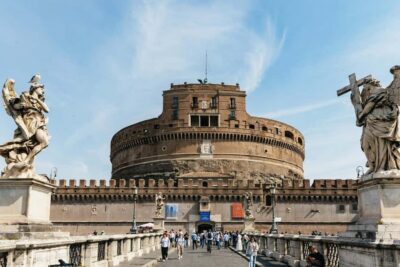




Browse the lists this tour appears in