
Reviewed · ROME COLOSSEUM TOURS
Rome: Colosseum, Circus Maximus, Forum & Ancient Rome Tour
Ancient Rome makes more sense when you connect the ruins on foot, and this tour does exactly that. You move from the Jewish Ghetto and Tiber Island to the Theatre of Marcellus, Capitoline Hill, the Roman Forums, Circus Maximus, and the outside of the Colosseum.
I like the route’s mix of famous sights and less familiar stops, especially the Portico of Octavia, Ponte Fabricius, and Temple of Apollo. I also like that guides such as Bruno, Gabriel, Francesco, and Sam bring a human touch to the history with humor, clear answers, and an easy manner. The catch is important: this costs $243.56 per person, lasts only two hours, and includes no interior visit or entrance ticket.
Key points to know before booking
- A walking route through several eras: Begin in the Jewish Ghetto, cross ancient Ponte Fabricius, then continue toward the Roman Forums and Colosseum.
- The Colosseum is exterior only: You’ll hear about the amphitheater and see it from outside, but admission is not part of the tour.
- Theatre of Marcellus adds a useful comparison: Its curved stone structure is often mistaken for the Colosseum, making it an especially interesting stop.
- The guide shapes the experience: Bruno, Gabriel, Francesco, and Sam are praised for clear explanations, warmth, humor, and answering questions.
- Expect outdoor walking: Wear comfortable shoes, arrive 15 minutes early, and plan for the tour to run in rain or sun.
- High price for a short visit: At $243.56, the value depends on how much you want guided context rather than entry inside a monument.
Why this route works for Ancient Rome
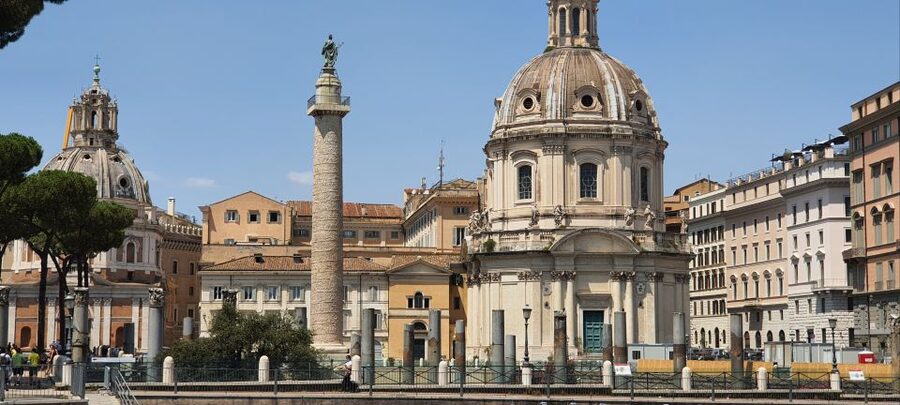
Many Rome tours rush straight to the Colosseum. This one takes a wider view. You start among the streets and monuments of central Rome, then follow the city’s old political, religious, and entertainment districts toward the great amphitheater.
That order gives you a useful sense of how Rome was put together. The route moves through the Jewish Ghetto, across the Tiber, past ancient theaters and temples, up Capitoline Hill, along the Imperial Forums, and finally to the Circus Maximus and Colosseum.
I like this approach because the ancient remains are not isolated museum pieces. They appear beside modern streets, churches, apartments, and busy city routes. Your guide’s job is to point out what is easy to miss and explain how each site fits into the larger story.
The tour lasts two hours, so it is a brisk introduction rather than a slow archaeological study. You will stop often for explanations, but you should expect to keep walking. This is best for someone who wants orientation and context before exploring Rome on their own.
More ancient Rome tours:
- Colosseum: Underground and Ancient Rome Tour
★ 4.7 · 12,691 reviews - Colosseum & Ancient Rome with Arena Floor Option I Max 6 People
★ 5.0 · 3,306 reviews - Rome: Colosseum, Ancient Rome Tour or Self AudioGuided Tour
★ 4.4 · 2,866 reviews
Starting at Piazza Cinque Scole and the Jewish Ghetto
The meeting point is in front of the Basilica of Sant’Anastasia al Palatino, but the route description begins at Piazza Cinque Scole in the Jewish Ghetto. Be certain to check the exact meeting instructions on your booking confirmation and arrive at least 15 minutes early.
Piazza Cinque Scole gives the tour a strong opening. This part of Rome carries layers of Jewish and Roman history, and it feels different from the grand ceremonial spaces farther south. Your guide introduces the district before leading you toward the ancient structures nearby.
The first section is especially useful if you prefer a city tour that includes daily life and neighborhoods, not only famous ruins. You are not simply walking from one postcard view to another. You are seeing how historic Rome still sits within the modern city.
The meeting rule is strict. Guides wait no more than 10 minutes after the start time, and late arrivals do not receive a refund. Rome’s streets can be confusing, so allow extra time rather than cutting it close.
Portico of Octavia and the old market district
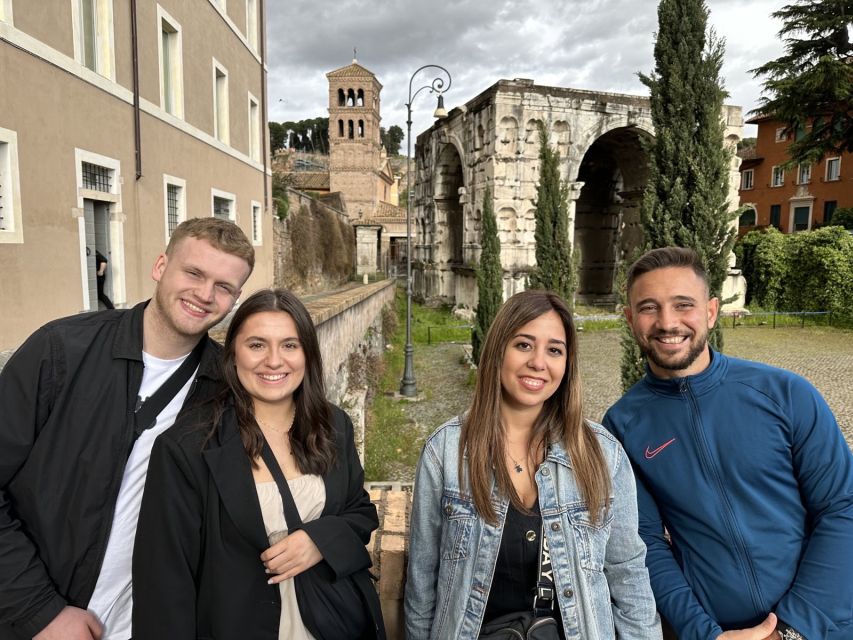
The Portico of Octavia is one of the early highlights. This large ancient structure once marked the entrance to a market area. The remains help you picture Rome as a working city filled with trade, movement, and public activity, not just temples and triumphal arches.
This is also the sort of stop that benefits from a guide. Ruins can look like scattered walls when you first see them. A good explanation gives the stones a purpose and helps you imagine the original arrangement.
The surrounding area links the ancient Roman world with the Jewish Ghetto, so the transition between sites is part of the experience. You get a sense of how Rome’s districts overlap instead of treating each monument as a separate stop.
Do not expect extended time at every monument. The tour has many sites to cover, and the guide must keep the group moving toward Capitoline Hill and the Forums.
Ponte Fabricius and Tiber Island
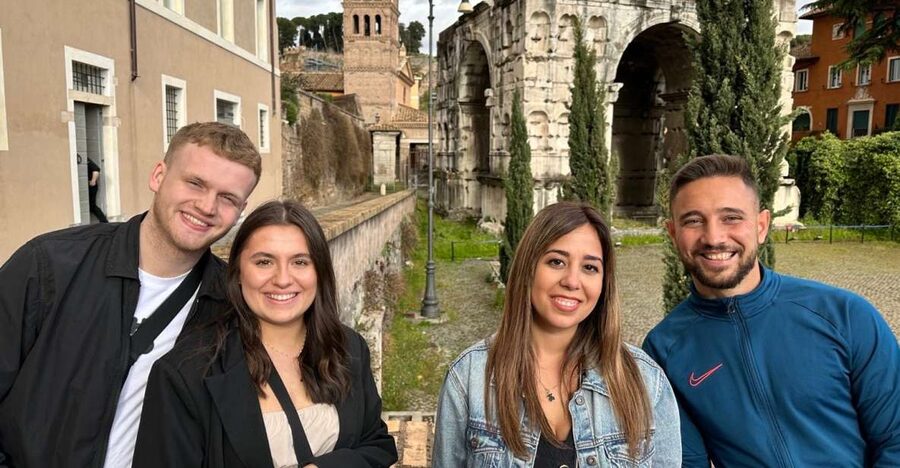
The walk continues across Ponte Fabricius, described as the oldest bridge in Rome. It connects the city to Tiber Island, giving you a short but memorable change of setting.
A bridge crossing might sound like a small part of the itinerary, but it matters here. The Tiber was central to Rome’s growth, movement, and defense. Crossing it on foot makes the geography easier to understand than seeing the river from a bus.
The route also gives your guide a natural place to explain how the city’s districts relate to one another. You move from the Jewish Ghetto toward the ancient center, following a path that ties together civic life, religion, trade, and public entertainment.
You should wear shoes with good support. This is an outdoor walk with several stops and changing surfaces, and the tour is not suitable for wheelchair users or people with mobility impairments.
More Circus Maximus tours:
- Rome: Caracalla Baths & Circus Maximus — Private or Shared
★ 4.7 · 835 reviews - Rome: Small-Group Tour of Caracalla Baths and Circus Maximus
★ 5.0 · 140 reviews - Rome: Roman Forum, Palatine, and Circus Maximus Tour
★ 4.7 · 117 reviews - Rome: E-bike Tour From The Circus Maximus To The Catacombs
★ 5.0 · 3 reviews
Theatre of Marcellus and the Temple of Apollo
The Theatre of Marcellus is one of the most interesting stops because its shape can remind you of the Colosseum. It is an ancient theater, not an amphitheater, and seeing it before the final Colosseum stop makes the comparison more useful.
This is where a guide can add real value. You can look at the curved exterior and understand how different Roman public buildings served different purposes. The tour description notes that the theater is often mistaken for the Colosseum, so your guide will likely use that resemblance to clarify the difference.
Nearby, the Temple of Apollo adds another layer to the route. Its ruins echo Rome’s religious past and show how close theaters, temples, markets, and civic spaces once stood to one another.
I particularly like this part of the itinerary because it avoids the usual all-Colosseum focus. You still see the great amphitheater later, but these earlier monuments give you more points of comparison.
Climbing Capitoline Hill and Michelangelo’s square
The route then climbs Capitoline Hill. This is one of the key moments of the walk, both for the history and for the change in viewpoint.
At the top, you see the beautiful square designed by Michelangelo. The space offers a striking contrast to the rough stone ruins below. Ancient Rome, Renaissance Rome, and modern Rome meet in one compact area.
The hill was central to Roman political and religious life, and it remains one of the best places to understand the city’s power center. Your guide explains the setting while you look across the surrounding historic district.
The climb is not described as difficult, but it is still a climb. If you have trouble with stairs, slopes, or extended walking, consider the mobility warning seriously. This tour is not designed for wheelchair users or people with mobility impairments.
The Roman Forum from Via dei Fori Imperiali
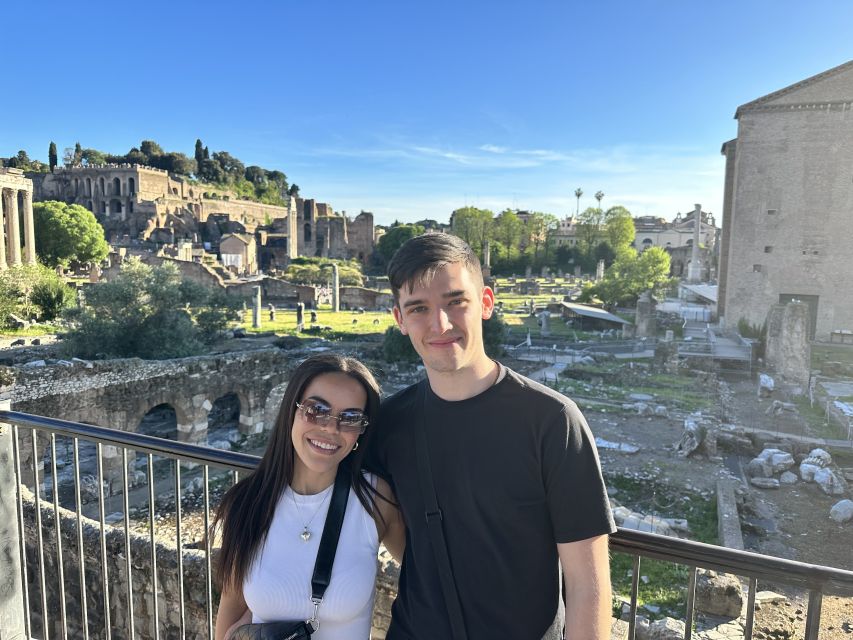
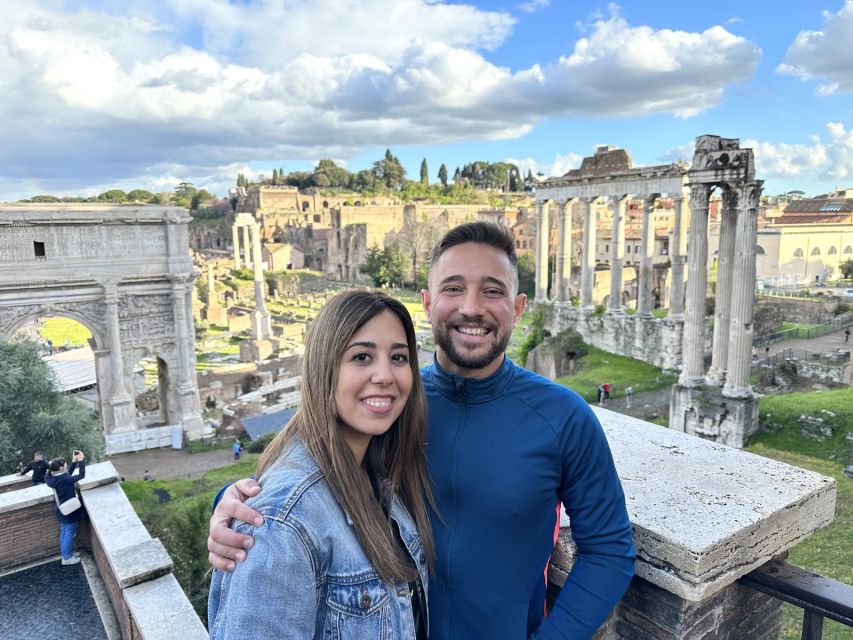
From Capitoline Hill, the tour reaches Via dei Fori Imperiali. Here you look across the Roman Forum along with the Forum of Augustus, Forum of Caesar, and Forum of Nerva.
This section is the historical heart of the experience. Your guide discusses the social and political life of Roman citizens while you view the remains from outside. That context matters because the Forums can be hard to read without help. Columns, foundations, arches, and fragments do not explain themselves.
The Forum was not just a collection of temples. It was a center of public business, politics, ceremony, law, and social life. The Imperial Forums show how later rulers built new public spaces to honor themselves and shape the city’s image.
You should keep your expectations clear. The tour looks at the Forums from the route rather than offering an interior archaeological visit with an entry ticket. If you want to walk among the excavated ruins, you will need to arrange that separately.
Still, the outside views can be effective for a first look. You gain a broad picture of the ancient center without spending your entire day inside one archaeological site.
Circus Maximus and the final Colosseum view
No tour of Ancient Rome feels complete without the Circus Maximus. This enormous former chariot-racing stadium helps explain the scale of Roman public entertainment.
The site is more open than the Colosseum, and much of its original structure is no longer standing. That can make it harder to picture than the amphitheater, but the size of the space gives you an idea of the crowds and spectacle once associated with it.
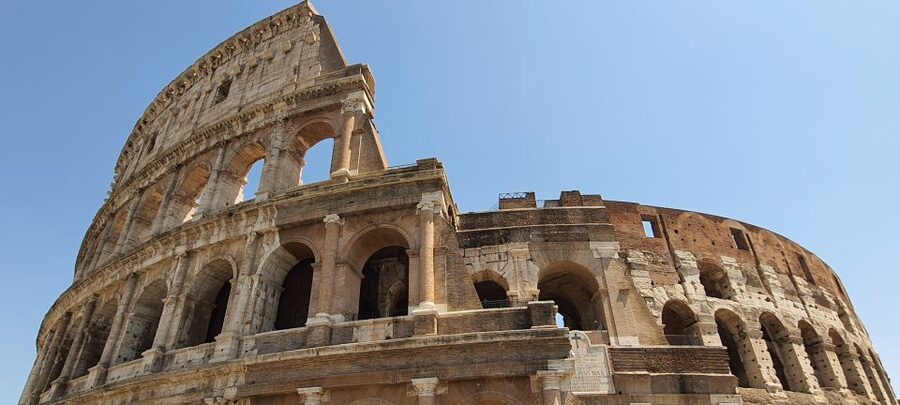
The final major stop is the Colosseum. You see the world-famous amphitheater from outside, with your guide explaining its role in Roman public life and its place within the wider ancient center.
This is the point where some people may feel disappointed. The Colosseum is not entered, and no admission ticket is included. If seeing the interior is a main reason for visiting Rome, book a separate Colosseum entry or a tour that includes access.
On the other hand, an exterior stop can work well if you already have a ticket for another time or if you want a short introduction before returning independently. The guide gives you useful background without turning this two-hour walk into a full-day archaeological visit.
The guides make the difference
The guide is the main reason to choose this experience over walking the same route with a map. Bruno receives especially strong praise for his warm, humorous way of explaining the past and for making complicated history easy to follow.
Gabriel is also described as an excellent guide, while Francesco is praised for answering numerous questions with ease. Sam is noted for being personable and well informed. Since the specific guide may depend on the date, you should not assume you will receive a particular person, but these names show the level of guide-led interaction the tour aims for.
This matters because the route contains many sites in a short time. A guide who can explain clearly and respond to questions helps you connect the stops instead of collecting a list of names.
The tour is in English. If you enjoy asking questions, the experience may feel more rewarding than a recorded audio walk. If you prefer a slow pace with long periods for photography, the fixed two-hour route may feel rushed.
Price, pace, and overall value
The listed price is $243.56 per person. That is a steep amount for a two-hour outdoor walking tour, especially since entrance fees and the Colosseum visit are not included.
The price can make sense if you place a high value on a live guide who connects lesser-known sites with the major monuments. You are paying for a guided route through several important parts of central Rome, not for admission to a single attraction.
Still, compare the cost carefully. The walk is short, the group size is not provided, and the tour does not include the interior of the Colosseum or the Forums. If you mainly want to enter the Colosseum, put more of your budget toward an admission-based tour.
The strongest value comes for a first-time visitor who wants a clear introduction to Ancient Rome and enjoys learning as they walk. The route covers enough ground to help you plan later visits, while the guides add the stories and connections that signs often leave out.
Free cancellation up to 24 hours before the start gives you some flexibility, and you can reserve now and pay later. The activity operates in rain or sun, so check the forecast and dress for the conditions.
Who should book this Rome walking tour
I would consider this tour for someone visiting Rome for the first time, especially if the city’s ancient center feels confusing. It gives you a useful route from the Jewish Ghetto to the Colosseum and includes places many short sightseeing walks skip.
It also suits anyone who likes public history explained in plain language. Bruno, Gabriel, Francesco, and Sam are all associated with the strongest parts of the guide experience: clear explanations, friendly conversation, humor, and confident answers.
I would not choose it as my only Colosseum experience. The interior is not included, and the price is high for a short exterior-only walk. You should also think twice if stairs, slopes, or sustained outdoor walking are difficult for you.
The overall rating is 4.3 out of 5 from 32 reviews, which fits the experience as described: a well-liked guided introduction with a strong route, but a price and ticket policy that require careful consideration.
Should you book it?
Book this tour if you want a compact, guide-led introduction to Ancient Rome that includes the Jewish Ghetto, Ponte Fabricius, Theatre of Marcellus, Capitoline Hill, the Forums, Circus Maximus, and an outside look at the Colosseum.
Skip it if entering the Colosseum is your top priority or if $243.56 feels too high for two hours without admission. For the right visitor, the guide’s storytelling and the route’s range make the cost easier to justify. Just treat it as an orientation walk, not a complete Colosseum visit.
FAQ
How long does the Ancient Rome walking tour last?
The tour lasts two hours.
Is the Colosseum included inside the tour?
No. The Colosseum is seen from outside, and visiting the interior is not included.
Are entrance tickets included?
No. Entrance tickets and fees are not included in the price.
What language is the tour in?
The live guided tour is in English.
Where does the tour start?
The stated meeting point is in front of the Basilica of Sant’Anastasia al Palatino.
Where does the tour end?
The activity ends back at the meeting point.
What should I bring?
Bring comfortable shoes because this is an outdoor walking tour.
Is the tour suitable for wheelchair users?
No. The activity is not suitable for wheelchair users or people with mobility impairments.
More Colosseum tours in Rome
- Rome: Colosseum, Palatine Hill and Roman Forum Guided Tour
★ 4.8 · 32,814 reviews - Rome: Guided Tour of Colosseum, Roman Forum & Palatine Hill
★ 4.7 · 27,897 reviews - Rome: Colosseum & Forum with Audio Guide App -Optional Arena
★ 4.2 · 24,770 reviews - Rome: Colosseum, Roman Forum and Palatine Hill Guided Tour
★ 4.5 · 23,903 reviews
Newest Rome tours we have reviewed
- Private TikTok Video Making in Rome★ 5.0 · 7 reviews
- Assisi, Orvieto and Civita di Bagnoregio Full Day Tour from Rome★ 4.5 · 45 reviews
- Assisi & Saint Francis Path Tour from Rome★ 5.0 · 45 reviews
- Art & Craft: Beer Tour with Street Art in Rome★ 4.5 · 6 reviews
- Assisi and Cascia Private Day Tour from Rome with Lunch★ 5.0 · 10 reviews
- Art Class in the center of Rome!★ 4.0 · 4 reviews
- Arrival in Rome: Airport Transfer & Exclusive City Introduction★ 5.0 · 3 reviews
- From Rome: Private Day-Tour of Tuscany★ 5.0 · 16 reviews
Rome Colosseum Tours, compared.
Colosseum, Palatine Hill and Roman Forum Guided Tour
Read our review →
Guided Tour of Colosseum, Roman Forum & Palatine Hill
Read our review →
Colosseum & Forum with Audio Guide App -Optional Arena
Read our review →
Colosseum, Roman Forum and Palatine Hill Guided Tour
Read our review →
Colosseum, Forum & Palatine Hill Tour & Optional Arena
Read our review →
Colosseum, Palatine Hill & Roman Forum Guided Tour
Read our review →
Colosseum: Underground and Ancient Rome Tour
Read our review →
Colosseum Arena, Palatine Hill & Forum Guided Tour
Read our review →Browse the lists this tour appears in