
Reviewed · BORGHESE GALLERY TOURS
Rome: Galleria Borghese Museum Entry Ticket and Guided Tour
The real star here is Bernini’s Apollo and Daphne, where marble seems to turn into hair, leaves, and skin before your eyes. I like that the two-hour tour also puts Caravaggio’s sharp, moody paintings beside Bernini’s dramatic sculpture, and that headsets help you follow the guide in busy galleries. The Borghese rooms themselves are part of the show, especially the grand ceiling frescoes.
The main caution is the price, $94 per person. That can be fair if you want the collection explained and need a timed museum visit, but it is a lot for a short tour. One recent booking was reported as lasting only 45 minutes, so confirm the meeting point and tour length at the start.
Key points to know before you book
- Bernini takes center stage: See Apollo and Daphne, Rape of Proserpine, David, and earlier works such as Aeneas, Anchises and Ascanius.
- Caravaggio is well represented: The collection includes Boy with Basket of Fruit, Saint Jerome Writing, Sick Bacchus, and Saint John the Baptist.
- The building deserves your attention: Mariano Rossi’s ceiling fresco in the Salone uses such strong perspective that the scene appears almost three-dimensional.
- The format is compact: You get two hours with entry, a live guide, and headsets, rather than an open-ended museum visit.
- The tour works for several language groups: Live tours and audio support are offered in English, French, and Italian.
- Look for the red flag: Meet at Piazzale Scipione Borghese 5, where the guide carries the Saints Tour logo.
Why Galleria Borghese feels different from a standard museum
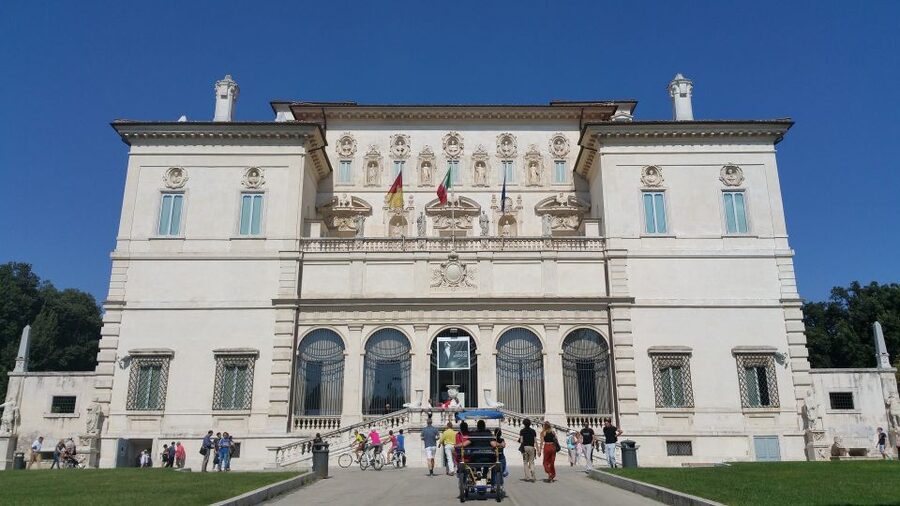
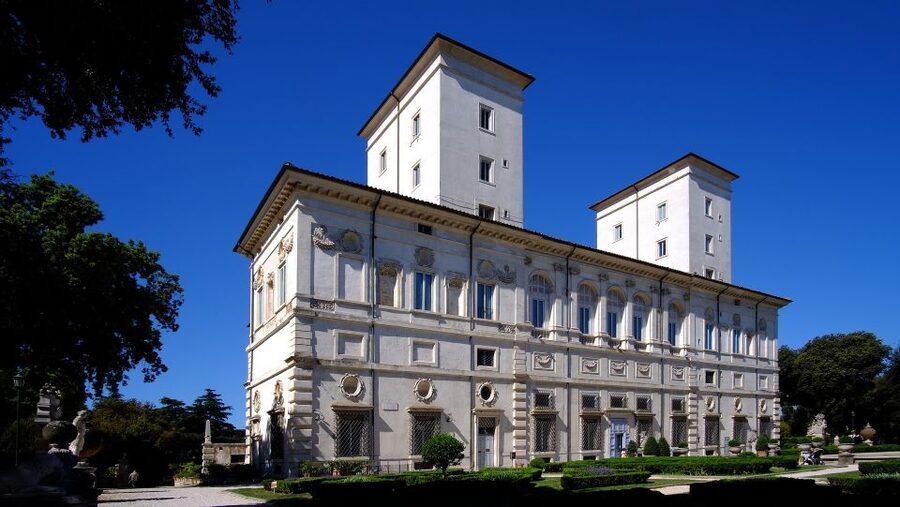
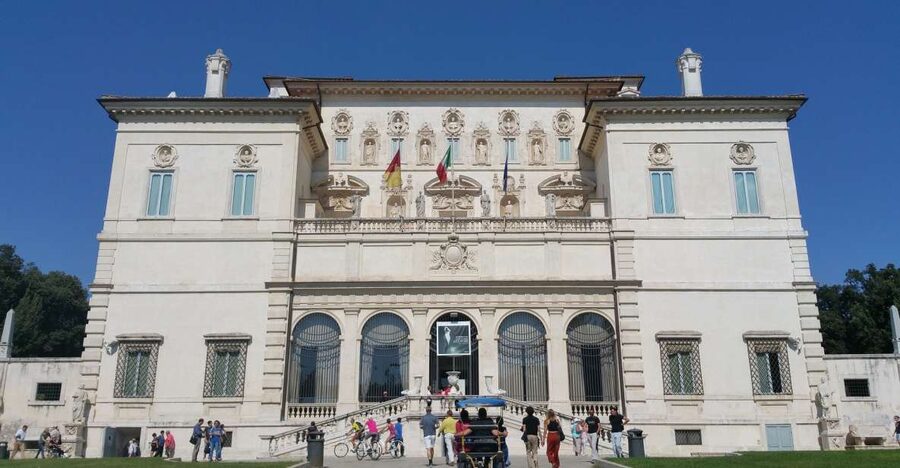
Galleria Borghese is not simply a room full of famous pictures. It is the former setting of Cardinal Scipione Borghese’s collection, assembled with a sharp eye for works by Caravaggio, Bernini, and other major artists.
That matters because the art is shown in rooms with their own decorative punch. You are not walking through plain white galleries. Marble floors, painted ceilings, sculpture, and paintings compete for your attention from the moment you enter.
Cardinal Scipione Borghese, nephew of Pope Paul V, collected with particular enthusiasm. Caravaggio is strongly represented, while Bernini’s secular sculpture fills much of the ground floor with movement and theatrical force.
I find this pairing useful for first-time art visitors. You can compare two very different forms of drama. Caravaggio uses light, shadow, and ordinary human faces. Bernini uses marble to suggest motion, touch, fear, and desire.
A guide can help you see why these works matter without turning the visit into a lecture. The best explanations point out what your eye might miss: a change in texture, a hidden line of movement, or a small facial expression that changes the whole scene.
More Borghese Gallery tours:
- Rome: Borghese Gallery Guided Tour with Skip-the-Line Entry
★ 4.8 · 2,649 reviews - Rome: Borghese Gallery Skip-the-Line Tickets with Audioguide
★ 4.6 · 2,562 reviews - Rome: Borghese Gallery Entry Ticket & Optional Guided Tour
★ 4.5 · 2,237 reviews
Meeting at Piazzale Scipione Borghese 5
The meeting point is Piazzale Scipione Borghese 5, with two listed starting options at the same address. Look for the red flag marked with the Saints Tour logo.
This is a practical detail worth taking seriously. The museum sits in a large complex, and a famous museum name does not tell you exactly where to meet. Give yourself enough time to reach the piazzale and find the red flag before the scheduled start.
The guide provides headsets, which is helpful in rooms where several groups may be listening at once. You can look at the art while still hearing the explanation instead of crowding around the guide.
The tour is offered with live guides in English, French, and Italian. Audio support is also available in those three languages. If language is important to your choice, check the exact option at booking.
The Salone and its ceiling frescoes
The first major visual surprise is the Salone, or great hall. Many people arrive focused on Bernini and Caravaggio, then look up and realize the ceiling is a major work in its own right.
Mariano Rossi painted the large ceiling fresco in the first room. It depicts Marcus Furius Camillus relieving the siege of the Capitol by the Gauls.
The clever part is the perspective. Rossi uses foreshortening so well that the painted scene can appear almost three-dimensional. The figures seem to push out from the ceiling rather than sit flat against it.
This is where a guide earns the admission price more easily than a simple audio file. A short explanation about how the perspective works can change the way you see the entire room. Before moving on, take a moment to look up and test the illusion yourself.
The Salone also introduces you to the building’s taste for mixing ancient subjects, Christian references, mythology, and grand decorative painting. It is a setting designed to impress, not a neutral box for displaying objects.
From Ceres to Phaeton
The first room of the Salone is known as the Chamber of Ceres. A marble vase depicting Oedipus and the Sphinx adds an ancient mythological note to the room.
The next room has a ceiling fresco by Francesco Caccianiga showing the Fall of Phaeton. These rooms give you a quick lesson in the visual language of the period: gods, heroes, catastrophe, and dramatic movement above you, with sculpture and paintings below.
You may find that the ceilings compete with the works on the walls. That is part of the pleasure, but it can also make the visit feel visually crowded. A guide helps by choosing what deserves your attention first.
Do not rush through these connecting rooms just to reach the famous Bernini sculptures. The architecture and frescoes explain the world in which the collection was meant to be seen. The gallery was built to make art feel powerful from every direction.
More museums and galleries in Rome:
- Vatican Museums & Sistine Chapel Tour with Optional Basilica
★ 4.3 · 67,413 reviews - Vatican Museums, Sistine Chapel & St Peter’s Basilica Guided Tour
★ 4.5 · 39,149 reviews - Rome: Vatican Museums, Sistine Chapel & Basilica Tour
★ 4.3 · 13,872 reviews - Vatican Museums & Sistine Chapel Skip-the-Line Entry Ticket
★ 4.4 · 13,838 reviews
Bernini’s Apollo and Daphne
Apollo and Daphne is one of the essential stops. The story comes from classical mythology: Apollo pursues Daphne, and she changes into a laurel tree to escape him.
Bernini captures the instant of transformation. Daphne’s fingers become leaves, her hair streams upward, and roots appear around her feet. Apollo reaches toward her, still not fully grasping what is happening.
The work is famous because marble appears to change substance. You can see hard stone suggest soft skin, fine hair, bark, and delicate leaves. The sculpture rewards a slow look from more than one angle, though the guide will manage the pace within the two-hour visit.
A useful detail is Daphne’s expression and gesture. She is not merely a decorative figure fleeing through space. Her body twists with alarm, while Apollo’s forward movement collides with the sudden change.
This is also a good example of why a guided visit can help. If you only take a quick photograph, you may miss the connection between the myth, the motion, and the technical challenge of carving such fragile forms.
Bernini’s Rape of Proserpine
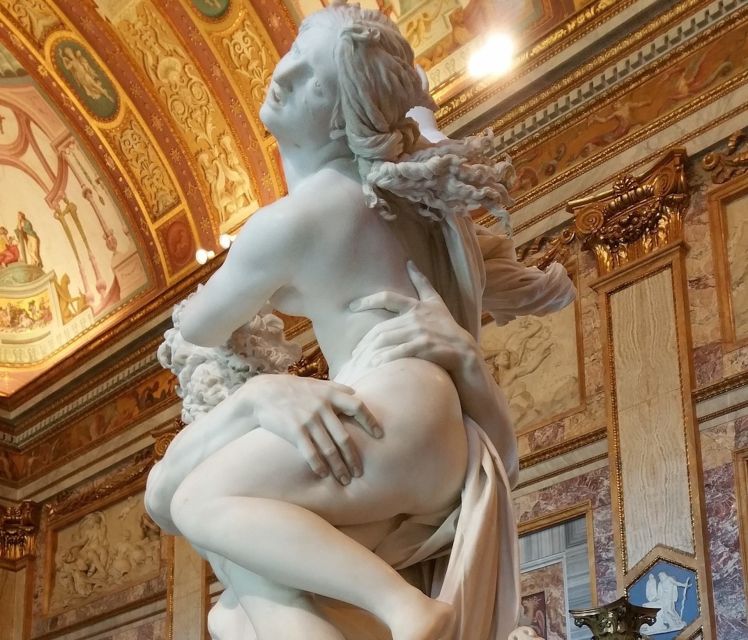
Bernini’s Rape of Proserpine is another major work on the ground floor. The subject is violent: Pluto carries Proserpine away to the underworld.
The sculpture is famous for the way Pluto’s fingers appear to press into Proserpine’s flesh. That illusion is one of the clearest demonstrations of Bernini’s skill. Marble suggests the softness of a body and the force of a grip at the same time.
This work may be uncomfortable, and it should be. The title uses the older meaning of abduction, but the scene shows force and terror. A good guide should give you the myth and the artistic context without brushing aside the subject’s violence.
Look closely at the contrast between Pluto’s powerful body and Proserpine’s twisting resistance. Bernini creates a spiral of movement, so the sculpture changes as you walk around it.
Along with Apollo and Daphne, this is the work most likely to make you understand why Bernini changed sculpture. His figures do not seem arranged for a single flat view. They act in space.
David, early works, and portrait busts
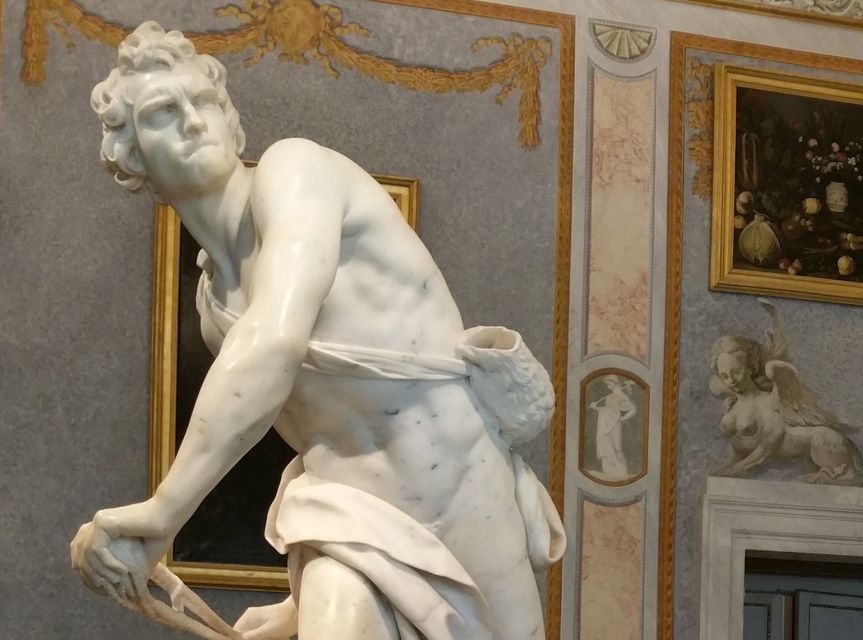
The ground-floor sculpture route also includes David, one of Bernini’s seminal works. Instead of showing the hero resting after the battle, Bernini presents him at the moment of action.
David’s body twists as he prepares to strike. His concentration gives the sculpture a physical charge, and the pose asks you to imagine the unseen target in front of him.
Earlier pieces show how Bernini’s work developed. Goat Amalthea with Child Jupiter and Faun, and Aeneas, Anchises and Ascanius, reveal an artist working with groups of figures, movement, and family relationships before reaching the full force of his later masterpieces.
The gallery also contains portrait busts, including Pope Paul V and two portraits of Cardinal Scipione Borghese. These portraits give you a human link to the people behind the collection.
Scipione Borghese is not an abstract name on a wall label. His taste and ambition shaped what you see. The portrait busts let you look at the collector himself, the patron who brought so much of this art together.
Caravaggio’s paintings: light, faces, and tension
Caravaggio’s works make a strong contrast with Bernini’s marble. His paintings use hard light and dark shadows to focus your eye on faces, hands, and gestures.
The collection includes Boy with Basket of Fruit, Saint Jerome Writing, Sick Bacchus, and Saint John the Baptist. The supplied highlights specifically call attention to Saint John the Baptist, but the other paintings help show the range of Caravaggio’s approach.
Boy with Basket of Fruit turns an ordinary subject into something intense. Fruit, skin, and fabric become studies in texture, while the figure’s direct presence keeps the painting from feeling like a simple still life.
Saint Jerome Writing is quieter and more concentrated. The subject is shown at work, with age and thought written into the body. Sick Bacchus has a different mood, with a physical vulnerability that feels far removed from polished ideal beauty.
Saint John the Baptist adds another powerful religious image. Caravaggio often brought sacred subjects close to everyday human experience, giving them weight and imperfect bodies rather than distant, decorative holiness.
A guide is especially useful with Caravaggio because the lighting can seem obvious at first. After a short explanation, you may begin to notice how the dark areas control the whole scene and how the brightest patches direct your eye.
What two hours really gives you
Two hours is enough for a focused introduction, not a leisurely study of every room. The route centers on the Borghese Gallery and the ground-floor sculptures, with the guide selecting the major works and explaining the building.
That compact format suits you if Bernini and Caravaggio are your priorities. You can see the essential pieces without spending half a day wondering which rooms matter most.
The trade-off is pace. A group may pause longer at Apollo and Daphne, then move quickly through portraits or secondary works. If you want to study every painting, this tour may feel too short.
One recorded booking described a 45-minute visit rather than the expected two hours. That does not establish the normal duration, but it is a sensible reason to confirm the start time and expected finish with the guide when you meet.
The group size is not specified. One recent family booking happened to be private because no other participants joined. You should not count on a private tour, but a small group could make it easier to hear questions and keep close to the guide.
Is $94 a fair price?
At $94 per person, this is not the cheapest way to see a museum. The price includes the entry ticket, a live guide, and headsets, but not food, drinks, or hotel pickup and drop-off.
I would consider it fair for someone who wants the collection explained and values a planned visit. The museum’s major works are easy to recognize, but their meaning, technique, and links to the building are much clearer with a well-paced guide.
The value drops if you already know the collection well or prefer to read labels at your own speed. You are paying for interpretation and structure, not just the right to enter.
Book early if your dates are fixed. The available places can become more expensive closer to the visit, and the museum’s best-known works make this a popular choice.
The reserve-now, pay-later option keeps you from paying at once. Cancellation is free up to 24 hours before the activity for a full refund, which gives you some useful flexibility.
Who should choose this tour?
I would point first-time visitors toward this tour, especially if Bernini and Caravaggio are high on your Rome list. The guide can connect the art to the rooms, the collector, and the stories behind the sculptures.
Families may also find the format useful. Silvia, one guide associated with the experience, has been praised for keeping teenagers involved and for adjusting the pace to a family group.
Art students and repeat visitors may prefer more time alone. The two-hour schedule gives you a clear route, but it does not promise long, quiet periods in front of each work.
The tour is wheelchair accessible. Large bags and luggage are not allowed, so arrive with only what you need and bring a passport or ID card.
The visit runs rain or shine. That matters less once you are inside, but you still need to reach the meeting point outdoors in the weather.
My booking advice
Book this if you want the major Bernini sculptures, Caravaggio paintings, and ceiling frescoes explained in one efficient visit. The combination of entry, guide, and headsets makes sense for a first look, provided you are comfortable with the $94 price.
Skip it if you want a slow museum morning or already know exactly what you want to study. In that case, a guided two-hour route may feel rushed.
Before paying, check the language, starting time, and cancellation deadline. At the meeting point, find the red Saints Tour flag and confirm that the planned visit is the full two hours. If the guide is Silvia, you may find a particularly family-friendly approach, but no guide can be guaranteed.
FAQ
Where does the tour meet?
Meet at Piazzale Scipione Borghese 5 in Rome. The guide carries a red flag with the Saints Tour logo.
How long does the tour last?
The scheduled duration is two hours.
What does the price include?
The price includes the entry ticket, a guide, and headsets so you can hear the guide clearly.
Is hotel pickup included?
No. Hotel pickup and drop-off are not included.
Are food and drinks included?
No. Food and drinks are not included.
Which languages are available?
Live tours and audio support are available in English, French, and Italian.
Is the tour wheelchair accessible?
Yes, the activity is wheelchair accessible.
What identification should I bring?
Bring a passport or ID card.
Can I bring luggage or a large bag?
No. Luggage and large bags are not allowed.
What happens if it rains?
The tour takes place rain or shine. You can cancel up to 24 hours in advance for a full refund, and the reserve-now, pay-later option is available.
Newest Rome tours we have reviewed
- Private TikTok Video Making in Rome★ 5.0 · 7 reviews
- Assisi, Orvieto and Civita di Bagnoregio Full Day Tour from Rome★ 4.5 · 45 reviews
- Assisi & Saint Francis Path Tour from Rome★ 5.0 · 45 reviews
- Art & Craft: Beer Tour with Street Art in Rome★ 4.5 · 6 reviews
- Assisi and Cascia Private Day Tour from Rome with Lunch★ 5.0 · 10 reviews
- Art Class in the center of Rome!★ 4.0 · 4 reviews
- Arrival in Rome: Airport Transfer & Exclusive City Introduction★ 5.0 · 3 reviews
- From Rome: Private Day-Tour of Tuscany★ 5.0 · 16 reviews
Borghese Gallery Tours, compared.
Borghese Gallery Guided Tour with Skip-the-Line Entry
Read our review →
Borghese Gallery Skip-the-Line Tickets with Audioguide
Read our review →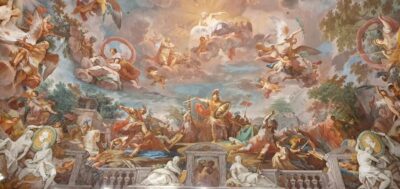
Borghese Gallery Entry Ticket & Optional Guided Tour
Read our review →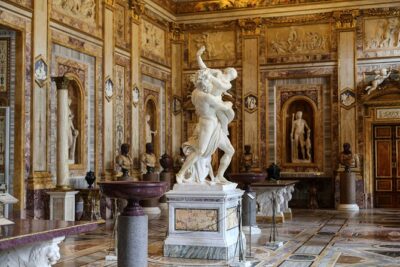
Borghese Gallery & Gardens Small Group Guided Tour
Read our review →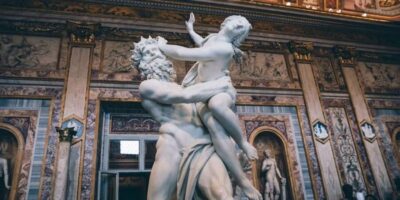
Borghese Gallery, Canova’s Masterpieces Skip-the-Line Guided Tour
Read our review →
Borghese Gallery Guided Tour with Skip-the-Line Entry
Read our review →Browse the lists this tour appears in