
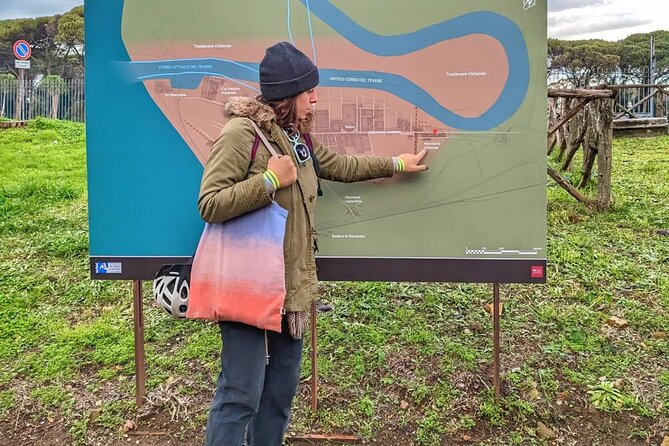
Reviewed · OSTIA ANTICA TOURS
Ostia Antica Semi Private Tour from Rome
Ostia Antica gives you something Rome itself often cannot: room to see how an ancient city actually worked. You walk through old streets past baths, bakeries, shops, homes, temples, toilets, mosaics, and public buildings, rather than viewing one famous monument at a time. The train ride is simple, and the small group keeps the tour personal.
I especially like the included entrance ticket and the guides’ strong academic background. Sonia is studying Ostia Antica at master’s level, Camille works as a marine archaeologist, and Rebecca has been praised for using graphics and clear stories to make the ruins easier to picture. The main drawback is the walking: the site is large, the ground can be uneven, and it may not suit anyone with serious mobility limits.
Key points to know before you book
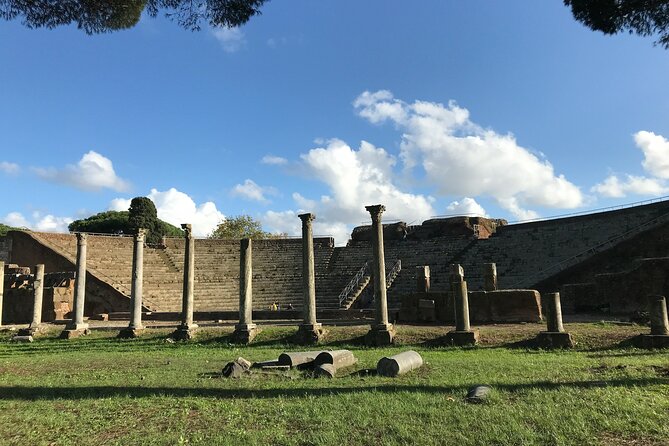
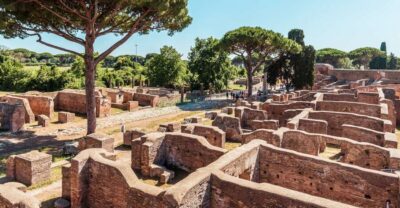
- A real ancient city, not just a single monument: See baths, markets, apartments, temples, a theater, bakeries, mosaics, and public facilities spread across a large archaeological area.
- Easy transport from Rome: Meet near Piramide Metro Station and take the train with your guide, avoiding much of the road traffic.
- Small group of 12 or fewer: You get more chances to ask questions and hear the guide clearly.
- Strong archaeological guides: Sonia, Rebecca, Camille, Ali, Fabio, and other guides are praised for combining site knowledge with friendly storytelling.
- About four hours on site: A restroom and snack break comes halfway through, but you should still expect plenty of walking.
- Budget for the train: Entry is included, but the round-trip train ticket costs €3 per person and is paid separately.
Why Ostia Antica deserves a place beside Rome’s big sights
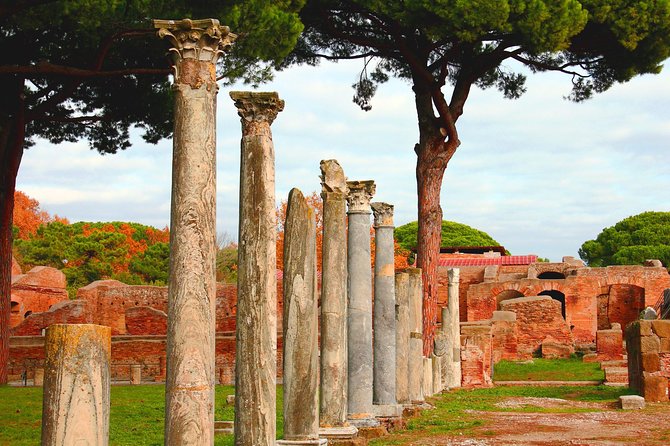
Many first-time visitors plan Rome around the Colosseum, the Forum, and the Pantheon. Those places are essential, but they can leave you with a narrow view of Roman life: emperors, temples, triumphs, and monumental ruins.
Ostia Antica fills in the everyday picture. This was Rome’s ancient port city, and its remains let you follow ordinary streets through a functioning urban center. You can see where people bathed, shopped, worshipped, worked, ate, and handled the less glamorous business of city life.
That makes the site a particularly good match for you if you enjoy archaeology and want context beyond grand monuments. The ruins are not presented as a collection of isolated stones. The streets and buildings help you understand how the city was laid out and how people moved through it.
The site is also a calmer change of pace from central Rome. You leave the traffic and dense crowds behind, then spend the morning outdoors among broad archaeological remains. The tour is still active and informative, but it has a quieter rhythm than many city-center visits.
More Ostia Antica tours:
- Ancient Ostia Antica Semi-Private Day Trip from Rome by Train with Guide
★ 4.5 · 579 reviews - From Rome: Ostia Antica Guided Half-Day Trip by Train
★ 4.8 · 486 reviews - Horse Sanctuary & Trail Ride in Ostia Antica
★ 4.5 · 276 reviews
Meeting at Piramide and taking the train
The tour begins at 8:30 a.m. near P.za Ostiense, 9, by Piramide Metro Station. Your guide meets you there and helps you buy the train tickets before the group sets off.
The return train fare is €3 per person, round trip, and is not included in the tour price. This is a small extra cost, but it matters when you compare the advertised tour price with your final spend. You do not need to arrange private transport, and the train avoids the uncertainty of local road traffic.
The ride is described as short and easy to manage, with one account putting it at about 25 minutes. For you, the main benefit is not luxury. It is simplicity. You meet at a central transport point, follow the guide, and do not have to work out the route to the archaeological park alone.
The early start also works in your favor. Ostia Antica has little shelter in many open areas, so a morning visit is generally more comfortable than arriving at the hottest part of the day. Wear comfortable shoes and light, practical clothing. Bring water and a snack, since food and drinks are not supplied.
Four hours among baths, markets, and Roman homes
Once inside Parco Archeologico di Ostia Antica, you spend roughly four hours exploring with the guide. The entrance ticket and skip-the-line admission are included, so you do not have to queue separately or pay again at the gate.
The most valuable part of the visit is the guide’s explanation of what you are seeing. Ancient walls can look confusing when you walk through them alone. A guide can point out the difference between public buildings, homes, commercial spaces, religious sites, and civic facilities, then explain how they fit together.
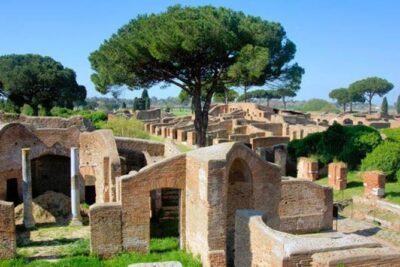
The remains include bathhouses with mosaics, markets, bakeries, homes, temples, a theater, heating features, and ancient public toilets. These details bring the site down to human scale. You are not simply looking at a surviving column. You are seeing evidence of where people gathered, worked, washed, bought food, and managed daily routines.
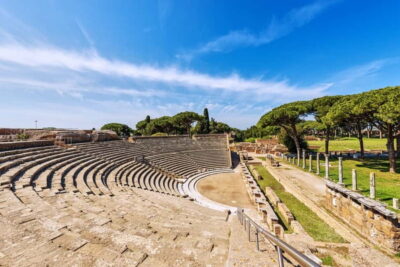
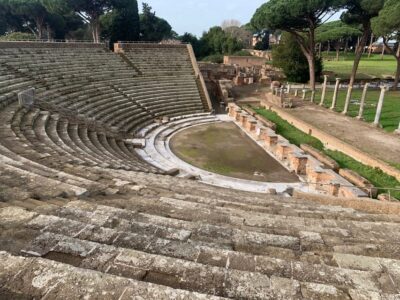
The theater is one of the more recognizable features, while the mosaics reward a slower look. Some buildings and paths are not well marked, so a guide is especially helpful if you want to understand what you are passing rather than simply wander through the ruins.
You may also hear about features that are easy to miss, including the synagogue. One visitor who tried to find it alone after the guided portion had trouble locating it, which is a useful warning: the archaeological area is broad, and not every point of interest is obvious from the path.
Guides who turn stones into a city
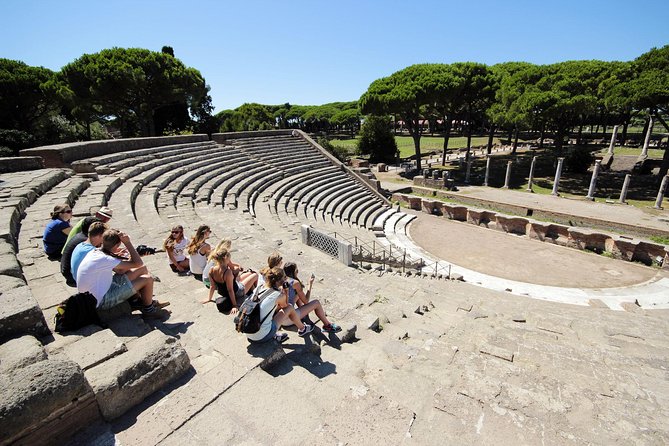
The quality of this tour depends heavily on the individual guide, and the guide lineup has several strong names attached to it.
Sonia is repeatedly praised for her enthusiasm and academic work on Ostia Antica. She is described as writing a thesis or working toward a master’s degree focused on the site. That kind of focused study can make a difference when you want more than a standard overview. She has also helped groups with practical suggestions, including restaurant ideas and the option of continuing toward the coast after the tour.
Rebecca is another frequently praised guide. Her approach combines site knowledge with clear presentation, and she has used visual graphics to help visitors picture the ancient city. That is useful at Ostia because many structures are partial, and a drawing or reconstruction can make the original purpose much easier to understand.
Camille brings a background in marine archaeology and architecture. Her strength appears to be connecting history, art, and buildings while pointing out small details you might otherwise pass. Ali and Allie are also described as archaeologists with a strong command of the ancient port.
Of course, you cannot guarantee a particular guide unless the operator specifically confirms one. Still, the range of guide backgrounds is encouraging. The common thread is enthusiasm for the site, not simply the ability to recite dates.
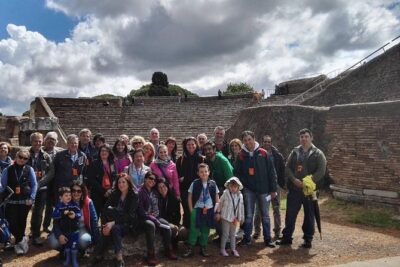
The group limit of 12 is another real advantage. A large archaeological park is hard to handle with a crowd. In a small group, you can ask questions, stay close enough to hear, and sometimes request an additional stop when timing allows. Several visits had only a handful of people, which created an especially personal feel.
More private tours in Rome:
- Rome by Golf Cart Private Tour: Beyond the Landmarks
★ 5.0 · 4,361 reviews - Early Morning Vatican, Sistine, St. Peter’s Semi or Private Tour
★ 5.0 · 3,779 reviews - Rome on a Golf Cart Semi-Private Tour Max 6 with Private Option
★ 5.0 · 2,502 reviews - Rome Private Arrival Transfer: Fiumicino Airport to Hotel in Rome
★ 4.5 · 2,492 reviews
The break that keeps the morning manageable
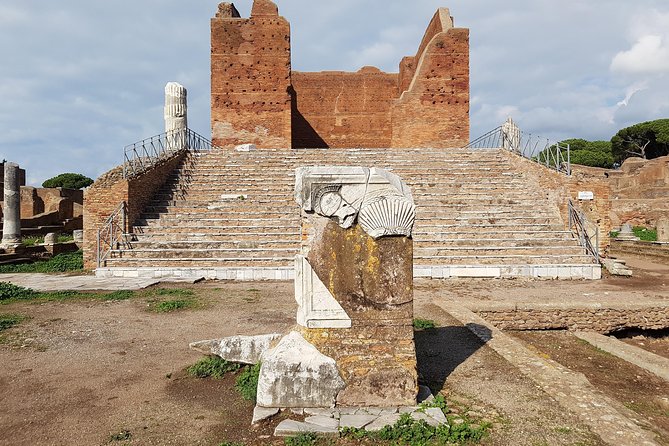
Ostia Antica is larger than you might first expect. You are outside for much of the visit, walking from one section to another across ancient streets and open ground.
The tour includes a restroom break halfway through, with time to rest and eat a snack. This is a modest detail, but it helps. Four hours of ruins can become tiring if you are trying to keep up without a pause, especially in warm weather.
You should still plan for an active morning. The tour does not provide food or drinks, so carry your own water and a small snack. Large backpacks and suitcases are not allowed inside, which means you should arrive with only what you can comfortably carry in a smaller bag.
Comfortable shoes are not optional here. The site includes old paving and uneven surfaces, and you will be on your feet for a long stretch. If walking is difficult for you, think carefully before booking. A direct review raised concerns for people with mobility disabilities, and the tour description does not promise a fully adapted route.
Service animals are allowed, and the site is near public transportation. Those facts help, but they do not remove the practical challenge of a large outdoor archaeological area.
What the $95.58 price really covers
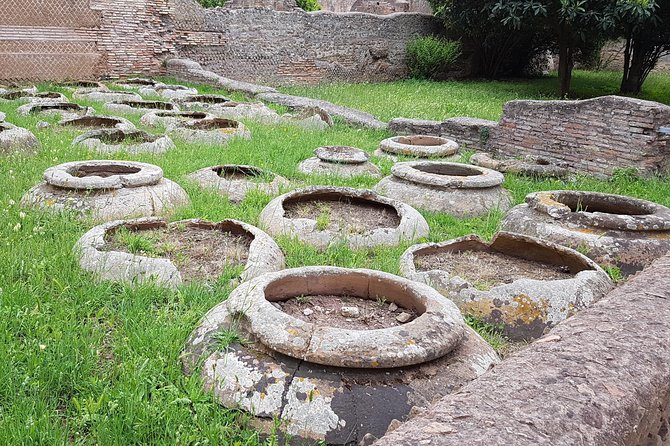
At $95.58 per person, this is not the cheapest way to see Ostia Antica. The price becomes easier to judge when you separate the included services from the extras.
You receive an English-speaking guide, a group capped at 12, the archaeological site admission, and skip-the-line entry. You also get help with the train and a guide for the return trip if you choose to go back to Rome with the group.
The train is the one required extra, at €3 round trip per person. Food and drinks are also your responsibility. There is no private car or private transfer, but that is not a serious weakness here because the train is the practical way to reach the site.
For me, the value rests on the guide. If you already know Roman archaeology well and are happy to read signs and explore alone, you may prefer to pay only for entry and transport. If you want the ruins explained, the small group and expert-led walk make the higher price more defensible.
The tour also saves you planning time. You do not need to compare train routes, work out where to get off, or find your way through a large archaeological park without context. That convenience matters most during a short Rome visit.
Staying at Ostia or returning to Rome
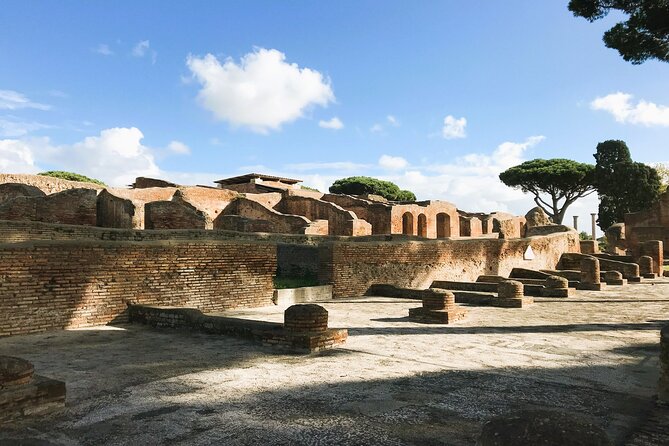
At the end of the guided visit, you have a choice. You can remain at the site and continue looking around on your own, or return to Rome with the guide.
This flexibility is useful because four hours may feel either just right or too short, depending on your interest. If you have a serious interest in archaeology, staying longer lets you revisit areas that moved quickly during the guided walk. If you are ready for lunch and a rest, returning with the guide keeps the logistics easy.
You can also use the time to continue toward the coast. Several people were advised to take the train a few more stops for lunch near the Mediterranean, and that plan worked well for a seafood meal overlooking the water. This is not part of the tour and should be treated as an optional extension, but it can turn a focused archaeological morning into a fuller day outside central Rome.
The official end point is back at the original meeting point. If you choose to stay on your own or continue toward the coast, you are handling that part independently.
Who will get the most from this tour
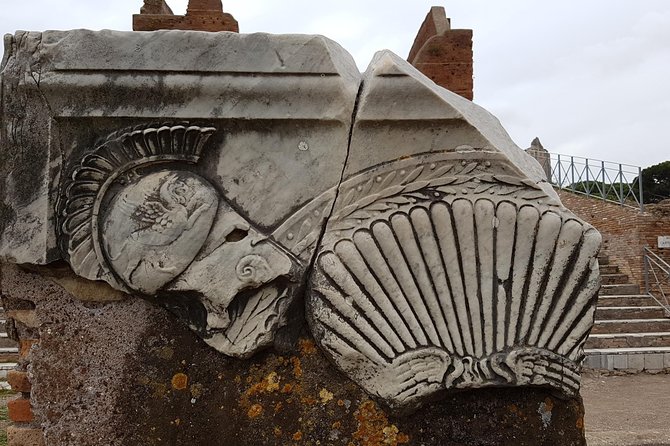
I would recommend this tour most strongly to you if you:
- Like Roman history but want to see ordinary urban life, not only imperial monuments.
- Are deciding between Ostia Antica and a longer trip to Pompeii.
- Prefer a guide who can explain what you are looking at.
- Value a small group and the chance to ask questions.
- Want an easy half-day outing from Rome.
- Can comfortably walk outdoors for several hours.
Ostia Antica is a good alternative when Pompeii does not fit your schedule. It is much closer to Rome and more manageable as a half-day visit. You will not need to give up most of a day to long-distance rail travel.
Families with older children may also find the site more engaging than a museum because you move through streets and buildings instead of standing in front of display cases. The exact suitability depends on how well your group handles heat, walking, and a four-hour guided visit.
I would hesitate if you have limited mobility, dislike outdoor walking, or want a quick photo stop. This is not a short orientation. The site is broad, and the best parts come from paying attention to the layout and the guide’s explanations.
Booking, cancellation, and practical details
Confirmation is provided when you book, and the tour is offered in English. It is commonly booked well ahead of time, with an average booking point of about 36 days before the visit, so leaving it until the last minute may not be wise during a busy Rome trip.
The tour requires a minimum number of participants. If that minimum is not met and the activity is canceled, you are offered another date or experience, or a full refund.
You can cancel for a full refund up to 24 hours before the start time. Changes or cancellations made inside that 24-hour window are not accepted for a refund, and the cut-off follows local time.
Bring a mobile ticket, comfortable shoes, water, and a small snack. Keep bags compact because large backpacks and suitcases are not permitted. The early meeting time also means you should allow enough time to reach Piramide without rushing.
Should you book the Ostia Antica tour?
Yes, if you want to understand how Roman cities functioned and prefer a less crowded setting than central Rome. The included entry, train guidance, and small group make the logistics clean, while guides such as Sonia, Rebecca, Camille, and Ali add serious archaeological skill.
I would choose it over a generic ruins walk because Ostia offers a full city experience: streets, homes, baths, shops, religious buildings, public facilities, and a theater. I would also choose it if Pompeii is too far for your schedule.
Skip it if you cannot manage several hours of walking or if your Rome plans leave no room for an early half-day trip. For most history-minded visitors who want more than the standard Rome checklist, this is a strong use of a morning and a very worthwhile addition to the city’s famous ancient sights.
FAQ
Where does the Ostia Antica tour begin?
The tour begins at P.za Ostiense, 9, near Piramide Metro Station in Rome. The start time is 8:30 a.m.
How do I get to Ostia Antica?
You meet the guide and take the train together from the Rome area near Piramide. The guide helps you purchase the round-trip tickets.
Are train tickets included in the tour price?
No. Train tickets cost €3 per person for the round trip and are paid separately at the meeting point.
Is admission to Ostia Antica included?
Yes. The Ostia Antica entrance ticket and skip-the-line admission are included.
How large is the tour group?
The group has a maximum of 12 travelers. The small size is intended to allow a more personal visit and easier questions.
How long does the tour last?
The full experience lasts about four and a half hours, with roughly four hours at Parco Archeologico di Ostia Antica. A restroom and snack break is provided halfway through the site visit.
Can I cancel for a refund?
Yes. You can cancel at least 24 hours before the start time for a full refund. Cancellations or changes made less than 24 hours before the start time are not refunded or accepted.
Newest Rome tours we have reviewed
- Private TikTok Video Making in Rome★ 5.0 · 7 reviews
- Assisi, Orvieto and Civita di Bagnoregio Full Day Tour from Rome★ 4.5 · 45 reviews
- Assisi & Saint Francis Path Tour from Rome★ 5.0 · 45 reviews
- Assisi and Cascia Private Day Tour from Rome with Lunch★ 5.0 · 10 reviews
- Art Class in the center of Rome!★ 4.0 · 4 reviews
- Art & Craft: Beer Tour with Street Art in Rome★ 4.5 · 6 reviews
- Arrival in Rome: Airport Transfer & Exclusive City Introduction★ 5.0 · 3 reviews
- From Rome: Private Day-Tour of Tuscany★ 5.0 · 16 reviews
Ostia Antica Tours, compared.
Ancient Ostia Antica Semi-Private Day Trip from Rome by Train with Guide
Read our review →

Ostia Antica Archaeological Park Ticket & Audio App
Read our review →
Browse the lists this tour appears in