
Reviewed · ROME SQUARES AND FOUNTAINS TOURS
Rome: Fountains and Squares Small-Group Walking Tour
Rome’s Baroque center is best understood on foot, one fountain and piazza at a time. This 2.5-hour walk links the Spanish Steps, Piazza Navona, the Pantheon, Sant’Ignazio, and the Trevi Fountain, while showing how ancient Rome was reshaped by Renaissance and Baroque artists.
I like the route’s strong first-day value: you see many essential sights without spending the price of several separate tickets. I also like that the Pantheon is visited inside, while Bernini’s fountains and Sant’Ignazio’s remarkable painted dome add plenty of visual variety.
The main catch is pace and weather. The tour is almost entirely outdoors, so rain or cold can make the walk tiring, and the group may reach the Trevi Fountain feeling rushed. Church dress rules are strict, and the route is not suitable for wheelchairs, strollers, or children under 10.
Key points to know before booking
- Spanish Steps to Trevi Fountain: The route crosses Rome’s historic center from the Keats Shelley Museum to the city’s most famous fountain.
- Ancient and Baroque Rome together: You see the Pantheon and Stadium of Domitian alongside Bernini and Borromini’s grand work.
- Small group, up to 20 people: Most departures are smaller, and some have operated with only a few participants.
- English-speaking guides with personality: Stefano, Bruno, Matteo, Paolo, and Andrea are among the guides associated with departures.
- Churches require proper clothing: Bring something to cover your shoulders and knees, even in warm weather.
- Useful Rome orientation: The walk gives you a practical sense of the center and ideas for what to visit next.
Why this route works so well in central Rome
Rome can feel like a giant open-air museum with no clear order. This walk gives you a sensible thread through the historic center, starting at the Spanish Steps and generally moving toward the Trevi Fountain.
The route is especially useful early in your stay. You learn where the major squares sit in relation to each other, and you get historical context before returning to the same places on your own. One visitor who spent six days in Rome described the walk as the high point of the trip, even after visiting the Colosseum, Forum, and Trevi Fountain independently.
At $45.55 per person, this is not a bargain-basement outing, but it offers good value if you want a live guide, an organized route, and entry to the Pantheon. The tour lasts about 2.5 hours, though several experiences describe it as closer to two hours in practice. That makes it easy to fit around another booking, but you should leave breathing room if you have a Vatican or Colosseum tour afterward.
The group limit is 20 people. That is not a private tour, yet it is small enough for a guide to keep the group together and answer a few questions. Some departures have had only two people or a handful of participants, giving the walk a much more personal feel.
More squares and fountains walks in Rome:
- Rome: Pantheon, Trevi Fountain & Roman Squares Guided Tour
★ 4.7 · 386 reviews - Tour Squares of Rome and Vatican
★ 4.5 · 133 reviews - Rome: Immersive Underground and Piazzas Tour
★ 4.7 · 133 reviews
Starting beneath the Spanish Steps
You meet by the entrance to the Keats Shelley Museum at the bottom of the Spanish Steps, in front of the Acqua di Parma store. Look for a guide wearing a GetYourGuide badge or holding a matching sign, and arrive 10 minutes early.
The location is easy to identify once you are in the right part of Piazza di Spagna, but the Spanish Steps can be crowded. Do not wait until the last minute to search for the meeting point. The guide cannot always hold the group for late arrivals, and one especially practical warning from a past departure was simple: arrive on time.
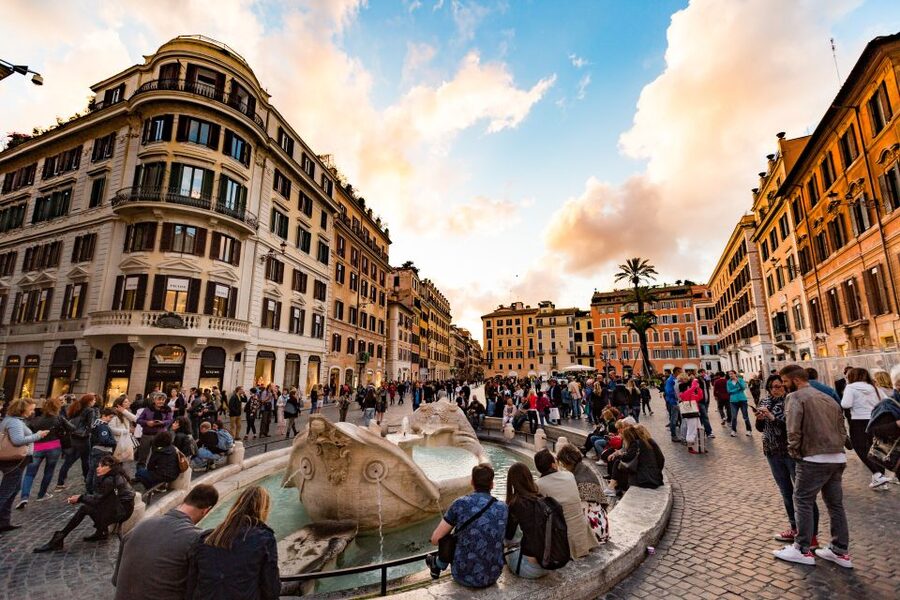
The steps lead up toward Trinità dei Monti, the late Renaissance church at the top. Even before the main walking begins, this opening gives you one of Rome’s classic urban views, with the long staircase, the church above, and the busy piazza below.
Near the bottom, you see Bernini’s Fountain of the Barcaccia, the half-sunken boat in the center of the square. Its low shape is easy to miss when crowds gather around it, so a guide helps you notice its design and place it within Rome’s Baroque story.
The steps themselves are a public gathering place rather than a quiet monument. Expect people sitting, taking photos, and moving through the piazza. This is one reason the guide’s voice and group position matter. Stay close enough to hear, especially when the group moves through crowded streets.
Piazza Navona and the Stadium of Domitian
From the Spanish Steps, the walk heads toward Piazza Navona. This is one of the most satisfying parts of the route because the square combines ancient foundations, Baroque design, fountains, churches, cafes, and street life in one long oval space.
Piazza Navona follows the outline of the Stadium of Domitian, built in 85 A.D. for athletic contests. The ancient structure is not always obvious from the open square above, which makes the explanation valuable. You begin to see that Rome is not simply a collection of separate monuments. Modern streets and piazzas often sit directly over older buildings.
The Baroque square is tied to major names such as Gian Lorenzo Bernini and Francesco Borromini. Bernini’s Fountain of the Four Rivers anchors the center, with its large sculptural figures and tall obelisk. The scale is impressive, but the details reward a closer look, especially if your guide can point out the artistic rivalry and political messages built into the square.
Piazza Navona is also one of the tour’s busiest stops. It can be hard to stand in one place without blocking pedestrians, and you may need to shift position to see the fountain clearly. A group of 20 can spread out quickly, so listen for instructions about where to gather.
The square is a good example of why this experience is more than a checklist. You see famous works, but you also learn how Rome used grand public spaces to display power, faith, art, and civic pride.
Inside the Pantheon, Rome’s great ancient survivor
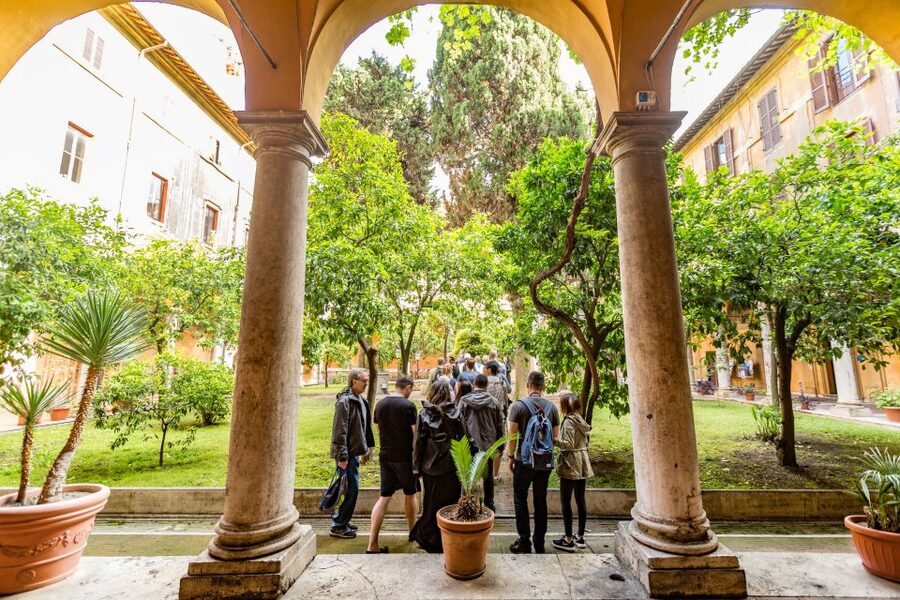
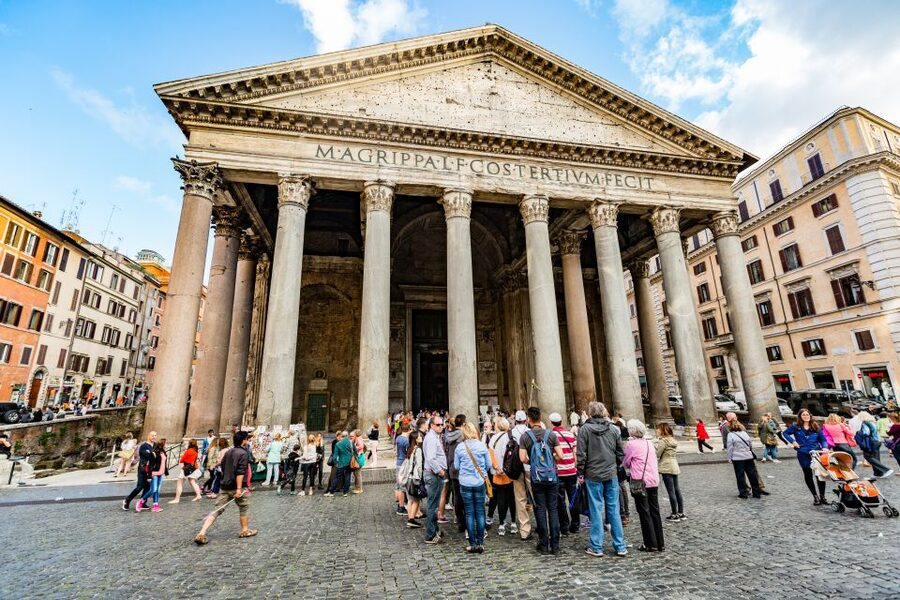
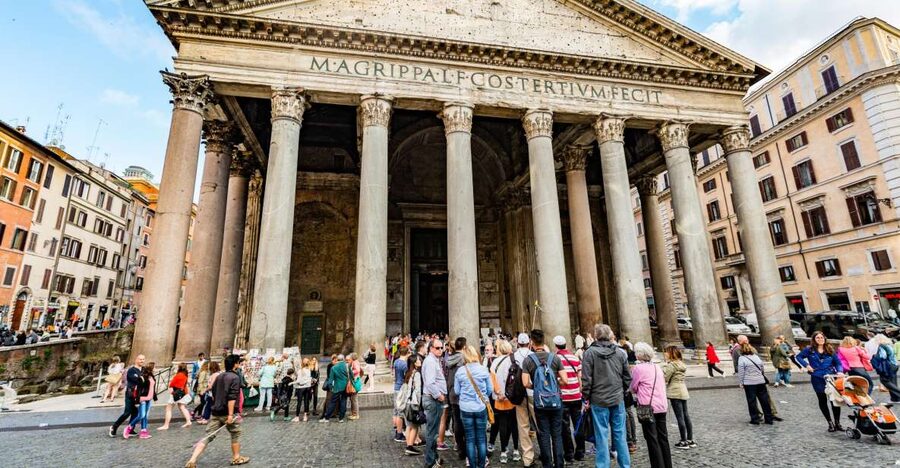
The Pantheon provides a change of scale and mood. After the open piazzas, you step into a building that has survived from ancient Rome in remarkably complete form.
The tour includes going inside, which matters. You can look up at the famous opening in the dome and see how daylight enters from above. You also get a feel for the building’s massive proportions from within, something a quick exterior stop cannot provide.
The Pantheon is one of the strongest parts of the walk because it connects the Roman Empire to the later history of the city. The building was first a Roman temple and later became a Christian church. You do not need an entire lecture to appreciate it, but a good guide can explain why its structure remains so striking.
Crowds inside can affect the experience. You may not have much time to linger, and the group must follow the rules of the church. Keep your voice low, dress appropriately, and avoid assuming that the guide can pause wherever you want.
The Pantheon is also close to several other central sights, so the stop helps you understand the compact nature of Rome’s old center. After seeing it, you can easily return later for a slower look if the group’s schedule feels too quick.
More walking tours in Rome:
- Rome: Trastevere & Campo de Fiori Street Food Walking Tour
★ 4.9 · 2,768 reviews - Rome: Paranormal Night Walking Tour & Secret Backstreets
★ 4.9 · 1,921 reviews - Rome by Night Walking Tour – Legends & Criminal Stories
★ 4.5 · 1,003 reviews - Rome: Guided City Center Evening Sightseeing Walking Tour
★ 4.4 · 953 reviews
Marcus Aurelius and a glimpse of Roman storytelling
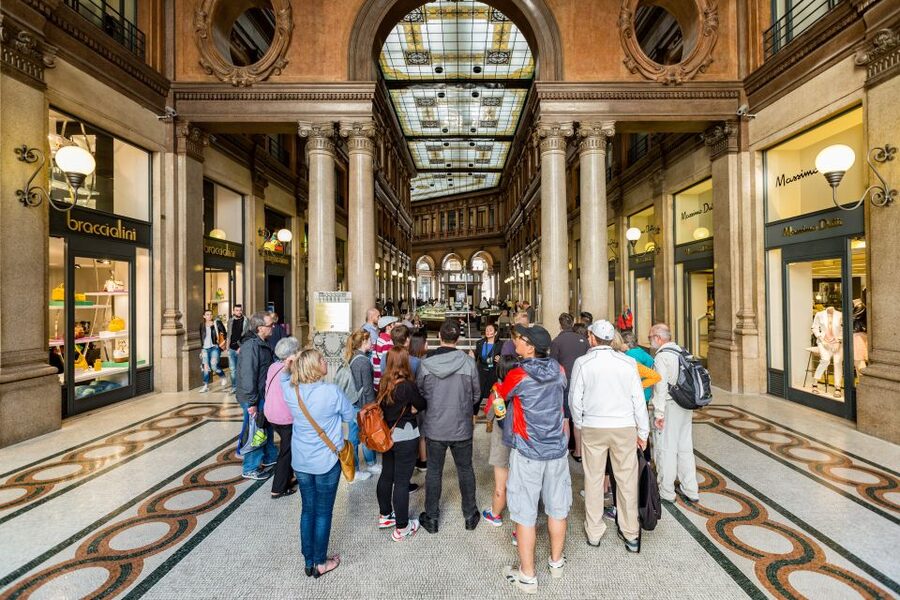
The route continues to the Column of Marcus Aurelius. The carved relief winds upward around the column, showing scenes from the emperor’s military campaigns.
The column is a useful reminder that ancient Rome told stories through public monuments. The carvings were placed high above street level, so you will not see every detail with the naked eye. The guide’s explanation gives the monument meaning even when the sculpture itself is difficult to study from below.
This stop also includes a reference to scenes associated with the film Gladiator. That can be a fun bridge for visitors who first met ancient Rome through cinema, but the real value is seeing how modern images of Rome connect, sometimes loosely, to actual monuments and places.
Do not expect a long, private viewing session here. The column sits in an active part of the city, and the stop is more about context than close inspection. It works well in the middle of the tour because it breaks up the fountains and church interiors with another piece of ancient public art.
Sant’Ignazio and the painted dome that fools your eye
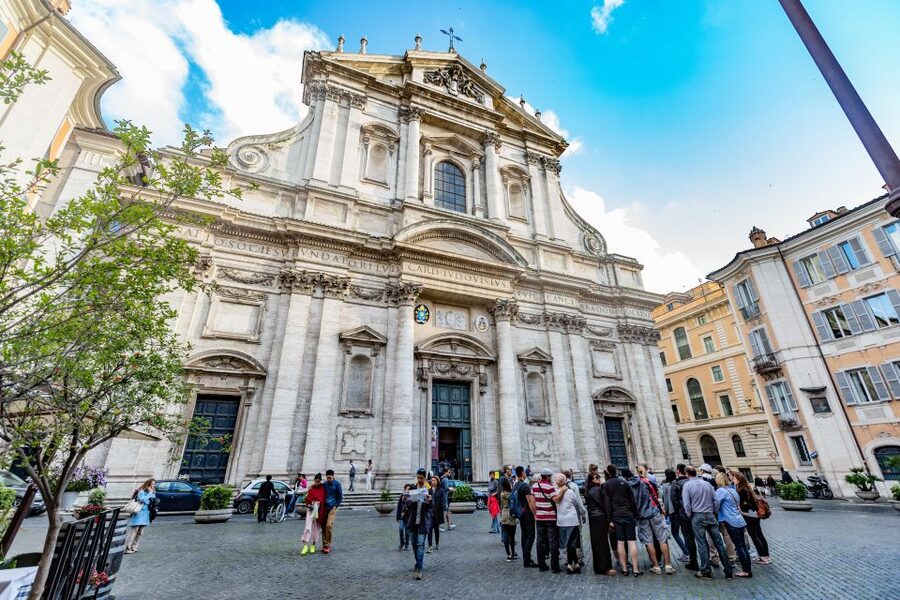
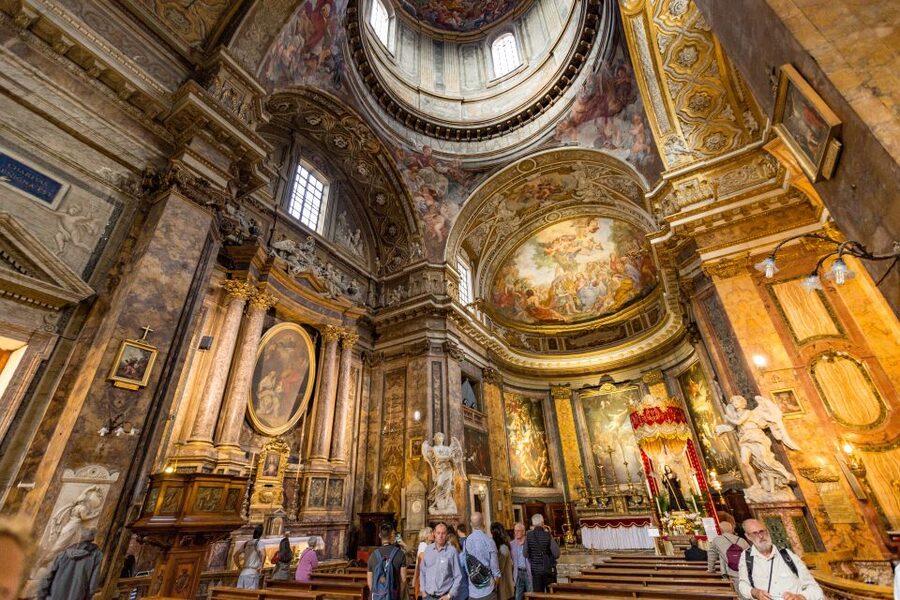
Sant’Ignazio Church is one of the tour’s most memorable surprises. From the floor, you look up at a painted ceiling designed to appear three-dimensional.
This is a fine example of trompe l’oeil, an artistic technique that makes a flat surface look architectural. Painted columns, figures, and depth create the illusion of a real dome, even though the church’s construction history made a full dome impractical.
The effect depends on where you stand. A guide can show you the best viewing point, and you will see how the illusion changes when you move around. This is the kind of detail you might miss when walking through Rome alone, particularly if you enter the church without knowing where to look.
Church visits require suitable clothing. Shorts, short skirts, and sleeveless shirts are not allowed, and you should carry something that covers your shoulders and knees. Food, drinks, smoking, and alcohol are not allowed during the tour.
Sant’Ignazio also gives you a quiet pause between the open squares. Still, it is not a guaranteed long rest. The group needs to stay on schedule, and the church may feel crowded or active during services.
Finishing at the Trevi Fountain
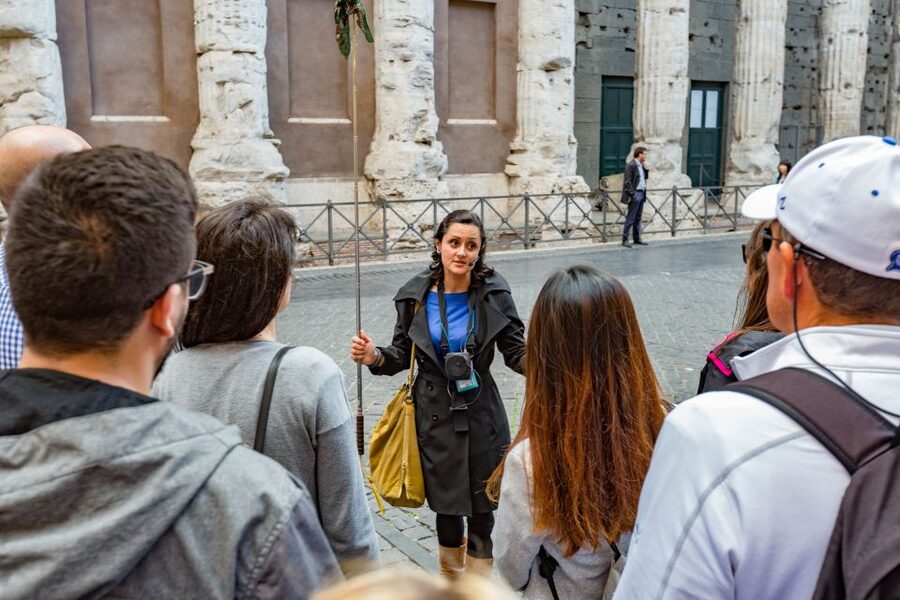
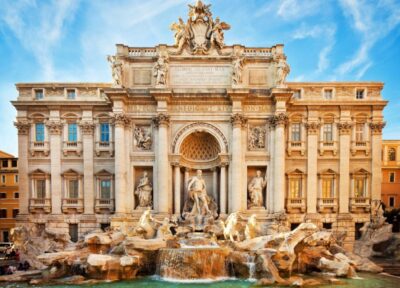
The advertised walking route finishes at the Trevi Fountain, where the guide explains the familiar coin tradition. Toss a coin over your shoulder and you are supposed to return to Rome.
The fountain is grand, noisy, and often packed. You may not get a peaceful moment beside the water, but the first sight of the sculpture squeezed into the narrow piazza is still memorable. The tour gives you a useful introduction, then you can return later at a quieter time if you want photographs or a longer look.
Some departures have felt rushed at this final stop, especially when rain began or the group had another appointment afterward. If Trevi is especially important to you, plan to revisit it on your own rather than relying on the final minutes of the walk.
There is a small logistical inconsistency in the supplied meeting details: the route description says it ends at the Trevi Fountain, while the end point is also described as returning to the meeting point. Confirm the final arrangement when you book, and do not assume you will finish exactly where you started.
The guide may also suggest a good gelato stop or other places to visit later. Food and drinks are not included, so any gelato or coffee is your own expense. That is usually preferable here because you can choose where and when to stop rather than being tied to a group meal.
The guides make a real difference
The strongest part of this experience is the guide’s delivery. Names associated with departures include Stefano, Bruno, Matteo, Paolo, and Andrea.
Stefano is repeatedly described as funny, enthusiastic, patient, and full of useful facts. He has led groups in cold rain while keeping the mood light, and he has been praised for making the information easy to follow. Bruno is described as warm, flexible, and personable, with one departure including a tiramisu treat. Matteo has been noted for his humor and respect for the group, while Paolo and Andrea have also been singled out for strong guiding.
You cannot choose a specific guide from the information provided, so treat these names as examples rather than a guarantee. The common thread is an informal, lively style rather than a dry lecture.
The guide also has a practical job: keeping the group together, making sure people can hear, and controlling the pace. One group of about 10 found the size particularly comfortable. If you are placed in a full group of 20, stand near the guide and avoid drifting behind at busy crossings.
No translating is allowed during the tour for the comfort of the group. You should be comfortable following an English-only explanation for the full walk.
Weather, clothing, and walking demands
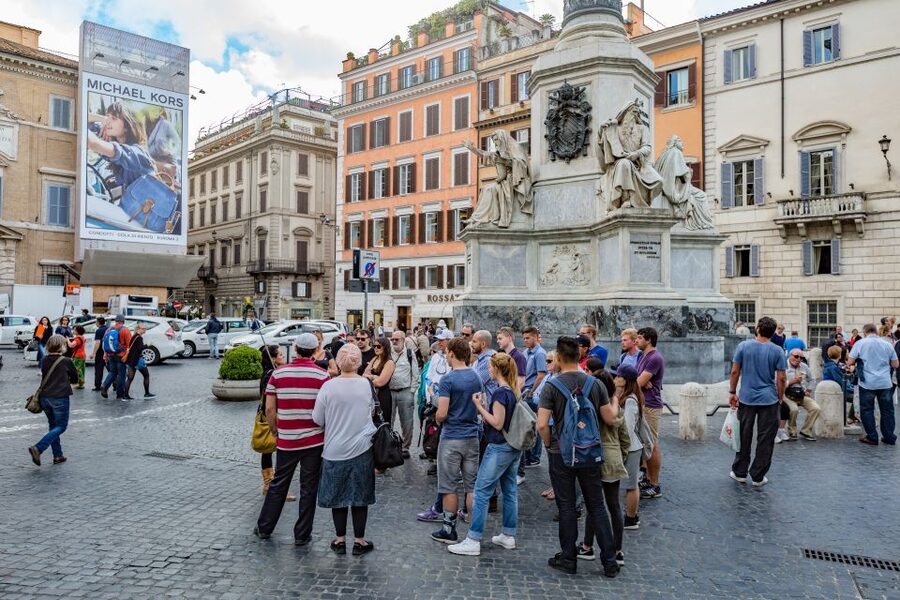
Wear comfortable shoes. The route covers uneven city streets, steps, and several stops where you stand rather than sit.
The tour continues in poor weather. One departure took place in cold, pouring rain, and the guide still delivered the full experience for most of the group. That shows useful determination, but it also tells you to check the forecast and dress properly. Rain can make the walk tiring, and wet church floors or crowded pavements require care.
Pack a compact rain layer, and bring a shoulder and knee covering for church visits. Large bags, oversize luggage, baby strollers, and food or drinks are not allowed. Pets are also not permitted.
The route is not suitable for wheelchair users, and it cannot accommodate strollers. Children under 10 are not eligible. Those limits make this a better fit for adults, older children, and anyone comfortable walking for two hours or more without frequent seated breaks.
Is $45.55 a fair price?
At $45.55, the price is reasonable if you want a structured introduction to central Rome with a licensed English-speaking guide.
You are paying for the route planning, the historical explanation, and the Pantheon visit. The fountains, squares, churches, and exterior monuments do not require a separate tour ticket, but seeing them in a sensible order saves you from wandering between disconnected stops.
The value is strongest if this is your first or second day in Rome. You get your bearings, identify places to revisit, and receive practical suggestions from the guide. It is less valuable if you already know the historic center well or prefer exploring at your own pace.
Food and drinks are not included, and tips for the guide are optional. If the guide keeps the group engaged and gives you useful context, budgeting a tip is a reasonable way to show appreciation, though it is not listed as mandatory.
Free cancellation up to 24 hours before the tour and reserve-now, pay-later booking add flexibility. That matters in Rome, where rain and changing sightseeing plans can affect a full day.
Should you book this Rome walking tour?
Book it if you want a lively introduction to Rome’s fountains, churches, ancient monuments, and main squares in one compact walk. It suits first-time visitors, couples, solo visitors, and families with children aged 10 and older who can manage the pace.
I would especially choose it for an early morning or first-day slot, then return to the Pantheon, Piazza Navona, or Trevi Fountain later for more time. The guide’s humor and strong command of Rome’s stories are a major part of the value.
Skip it if you need wheelchair or stroller access, dislike walking in poor weather, want long photo stops, or already know the center well. Also reconsider it if your church clothing will not meet the rules.
For most visitors, this is a sound way to meet Rome: a little ancient engineering, a lot of Baroque theater, and enough practical guidance to make the rest of your stay easier.
FAQ
How long does the tour last?
The stated duration is 2.5 hours, although some descriptions of the walk refer to about two hours. Check the available start times and allow extra time around the scheduled finish.
Where does the tour begin?
Meet by the entrance of the Keats Shelley Museum at the bottom of the Spanish Steps, in front of the Acqua di Parma store. The guide should wear a GetYourGuide badge or hold a sign with the same logos.
Where does the tour end?
The route description presents the walk as ending at the Trevi Fountain. The meeting information also says the activity ends back at the meeting point, so confirm the exact end arrangement before you go.
Is the Pantheon included?
Yes. The tour includes going inside the Pantheon, subject to the rules and conditions of the site.
Is the tour conducted in English?
Yes. It is led by a live English-speaking guide, and no translating is allowed during the walk.
Is the tour suitable for children?
It is not suitable for children under 10. Older children can join if they are comfortable with the walking pace and church clothing requirements.
Can I bring a stroller or wheelchair?
No. The route is not suitable for wheelchair users, and strollers are not permitted. Oversize luggage and large bags are also not allowed.
Newest Rome tours we have reviewed
- Private TikTok Video Making in Rome★ 5.0 · 7 reviews
- Assisi, Orvieto and Civita di Bagnoregio Full Day Tour from Rome★ 4.5 · 45 reviews
- Assisi & Saint Francis Path Tour from Rome★ 5.0 · 45 reviews
- Assisi and Cascia Private Day Tour from Rome with Lunch★ 5.0 · 10 reviews
- Art Class in the center of Rome!★ 4.0 · 4 reviews
- Art & Craft: Beer Tour with Street Art in Rome★ 4.5 · 6 reviews
- Arrival in Rome: Airport Transfer & Exclusive City Introduction★ 5.0 · 3 reviews
- From Rome: Private Day-Tour of Tuscany★ 5.0 · 16 reviews
Rome Squares and Fountains Tours, compared.
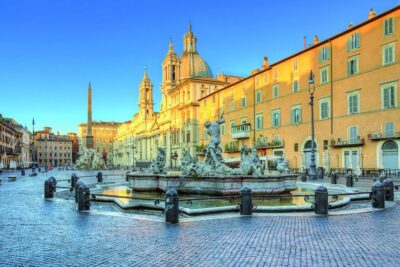
Pantheon, Trevi Fountain & Roman Squares Guided Tour
Read our review →
Fountains and Squares of Rome 2-Hour Walking Tour
Read our review →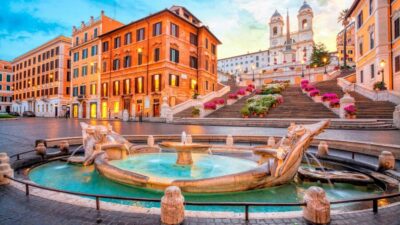


Early Morning Sightseeing and Piazzas with Breakfast
Read our review →Browse the lists this tour appears in